Stroke is a killer. Worse, it can make a victim of anyone at any time. Knowing how to identify a stroke is crucial.
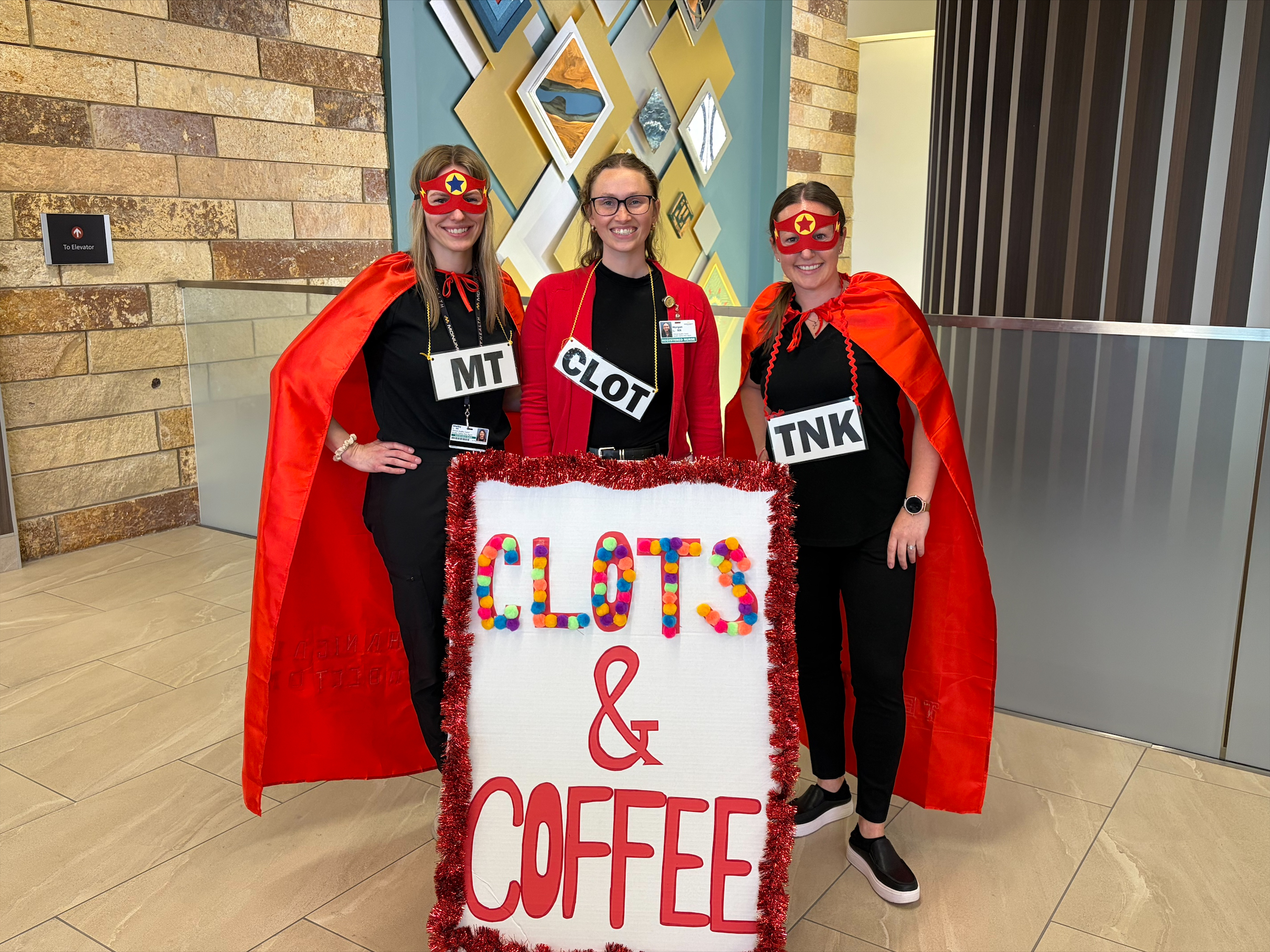
In recognition of National Stroke Awareness Month, Morgan Lantis, BSN, RN, Stroke Coordinator, Rapid City Hospital and a few Caregiver volunteers bring donut holes and coffee around to RCH staff and quiz them on their stroke knowledge and readiness. Correct answers are rewarded with a free specialty coffee at one of our hospital coffee shops.
The program is called Clots and Coffee. The purpose is to ensure that Caregivers are aware of the signs of stroke and what to do when those signs are identified in a patient.
“It is something that I heard during a Penn State stroke webinar. They found that if they made it silly and goofy, stroke education could be fun and people would listen and interact,” says Morgan. “We go to every floor in the hospital for both day and night shift, just trying to hit as many people as we can for stroke education.”
The questions Morgan asks are called stroke tracers and they’re based on questions that the Joint Commission might ask when they conduct a stroke survey on one of their visits to our hospital floors. For non-stroke certified floors, the questions are basic: “How do you identify a stroke?” “What do you do if you do identify a stroke?” For stroke certified floors, the questions are more in-depth, such as how frequent our assessments are needed and what interventions we have.
The Caregiver response to Clots and Coffee is universally enthusiastic, especially the coffee and donuts part.
The important thing Morgan wants Caregivers to remember is that strokes can happen to anyone at any age, including babies and kids. Further, we don’t necessarily know when they’ll hit. There are common symptoms of stroke (see the BE FAST acronym spelled out below.). However, not every stroke presents the same. “There are also a few risk factors that can increase your chances for stroke but that doesn’t necessarily determine whether you’ll have a stroke. You can also have a stroke without any of those, so it can literally happen to anybody,” she says.
Critical for patient education is establishing the last known well of a suspected stroke, which the Joint Commission describes as “the date and time prior to hospital arrival at which it was witnessed or reported that the patient was last known to be without the signs and symptoms of the current stroke or at his or her baseline state of health.”
“Last known well is our basis for stroke intervention,” says Morgan. “We can offer Tenecteplase to the patients who qualify up to 4. 5 after their last known well, and mechanical thrombectomy up to 24 hours after the last known well. That is why it is so important for people who are concerned they are having a stroke to come to the hospital as soon as possible because stroke interventions are only beneficial up to 24 hours after last known well.”
Know the signs of stroke, BE FAST:
B – Balance: sudden trouble with balance or coordination.
E – Eyes: sudden blurred or double-vision, or loss of vision in one or both eyes.
F – Face: face drooping or feeling numb on one side
A – Arms: arm or leg weakness
S – Speech: slurring or trouble speaking
T – Time: is crucial; call 911 immediately.
Keep any eye out for Morgan and her team of volunteers. They’ll be bringing coffee, donuts and stroke awareness to an RCH floor near you.
Story by Kory Lanphear