
 Patient Stories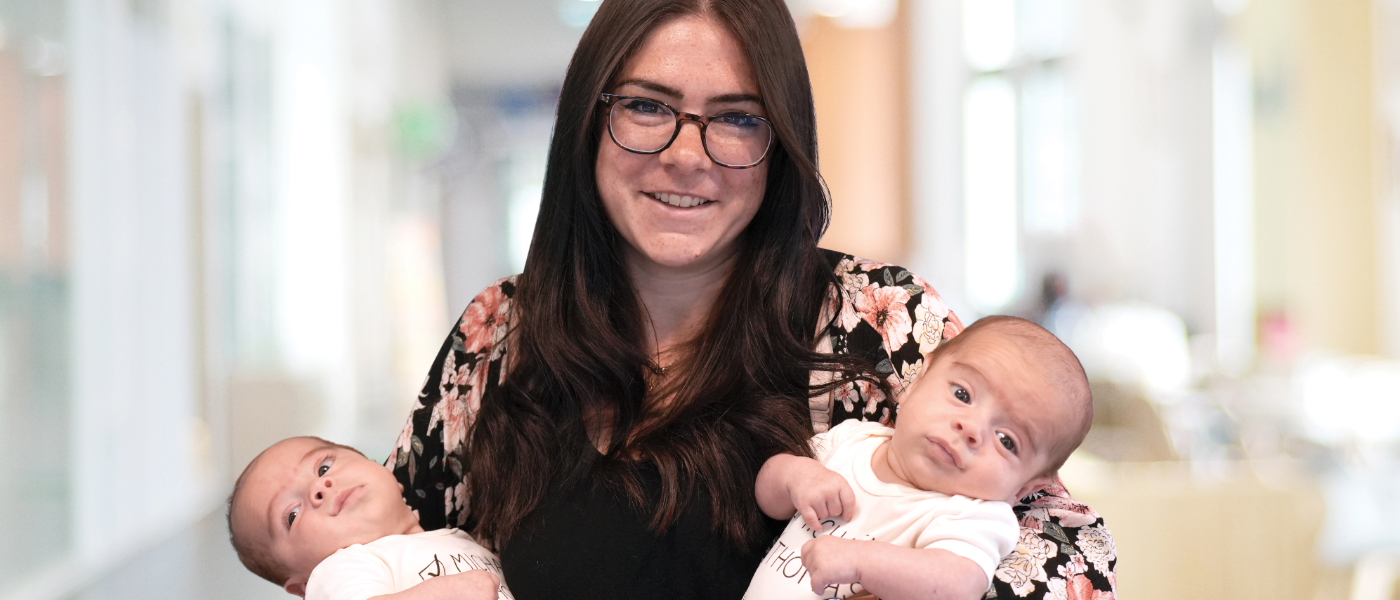
Michael and Thomas DeBarrows are pretty typical 8-month-old boys. The twins have just started learning to crawl, they get cranky about teething and are in overall good health. But when they were born at 36 weeks, about a month early, at Monument Health Spearfish Hospital, they both had underdeveloped lungs — a common challenge faced by premature babies.
“I went in to get induced knowing that it was four weeks early,” said Katelynn DeBarrows, the boys’ mother. “When I had preterm labor a few times, they got steroid shots for their lungs and I was optimistic that everything was going to be fine.”
The twins were delivered four minutes apart, and immediately after birth, both boys required help to breathe. Physicians and caregivers focused on stabilizing Michael and Thomas as they were moved to the nursery. “By the time they wheeled me into the nursery, they were already talking about the possibility of transferring the boys to the NICU in Rapid City,” Katelynn said.
Rapid City Hospital is home to the only Neonatal Intensive Care Unit (NICU) within 325 miles, and Katelynn knew — just as the doctors and caregivers helping her boys did — that it was the best place for Michael and Thomas to get the care they desperately needed. The only obstacle was getting them there. That’s where the Monument Health Transport Team stepped in.
“The Transport Team is made up of a neonatal nurse practitioner, a registered nurse and often a respiratory therapist,” said Neonatal Nurse Practitioner, Megan Hammerbeck. “Since 1981, this team has served the western side of South Dakota, northwest Nebraska, eastern Wyoming and occasionally Montana and North Dakota.” The team assists with the stabilization and transfer of Monument Health’s most vulnerable patients — premature and ill newborns, as well as sick infants up to 28 days of age.
To facilitate the transfer, the Transport Team used a new NxtGen Neonatal Transport Incubator, purchased by Monument Health through a grant from the Helmsley Charitable Trust, less than six months before the twins were born. The new transport equipment boasts a state-of-the-art ventilator that can provide both invasive and non-invasive respiratory support, a second high flow nasal cannula delivery system, which allows two babies to simultaneously receive respiratory support, ambient heat for temperature control, a thermal mattress for additional temperature control, multiple ways to monitor temperature and vital signs and much more.
Once the boys were transferred to Rapid City, they were admitted to the NICU, where they received specialized care and monitoring. “It was really hard on us,” Katelynn explained about the experience. “I knew they were in good hands, but we also needed to care for our other children at home. I’m so grateful for how much the caregivers in the NICU talked to us, kept us updated about the boys’ daily care and made me part of the decision-making.”
Monument Health’s Children’s Miracle Network (CMN) program was also a big help, providing assistance with gas to help alleviate the burden of Katelynn’s daily drive to Rapid City and back to Spearfish again to be with Michael and Thomas, but also care for the other kids in the family while her husband completed training at the South Dakota Highway Patrol Academy in Pierre.
After two long weeks in the NICU, Michael and Thomas were able to join their family in Spearfish in good health, hitting expected milestones under the watchful eye of Pediatrician Paula Marsland, M.D. “The boys have done so well, and Dr. Marsland has just been the best,” said Katelynn. “When they were in the NICU she was checking in on them, making sure they were okay. And when they were released she kept checking in. She’s been a pivotal part of this experience for me.”
The Transport Team
Across the Black Hills area, families trust that when they need lifesaving care for their newborns, they can count on Monument Health; no matter where they are. For more than four decades, Monument Health has invested in the transport team, and they have earned that trust, responding when premature or critically ill infants need urgent care and safe transport. On average, they complete around 60 transports each year, bringing advanced neonatal medicine directly to small, critical access hospitals across a five-state area that cannot support fragile newborns long-term.
The two new NxtGen transport incubators ensure those babies receive the highest level of care from the moment the team reaches them. These mobile NICUs give the transport team the ability to stabilize and manage almost any condition while transporting the most vulnerable patients, including the DeBarrow twins’ journey in February 2025.
This lifesaving technology is available thanks to Monument Health donors, whose ongoing support ensures that babies born in small, rural communities have access to the same high-quality care, expertise
and leading-edge technology found in the country’s most advanced NICUs. The generosity of donors helps Monument Health reach families where they are; providing hope, comfort and a fighting start in life.
“I’m so grateful for how much the caregivers in the NICU talked to us, kept us updated about the boys’ daily care and made me part of the decision-making.” — Katelyn DeBarrows