
 Patient Stories
A Long Ride Back
Published August 2026 in Summer 2026
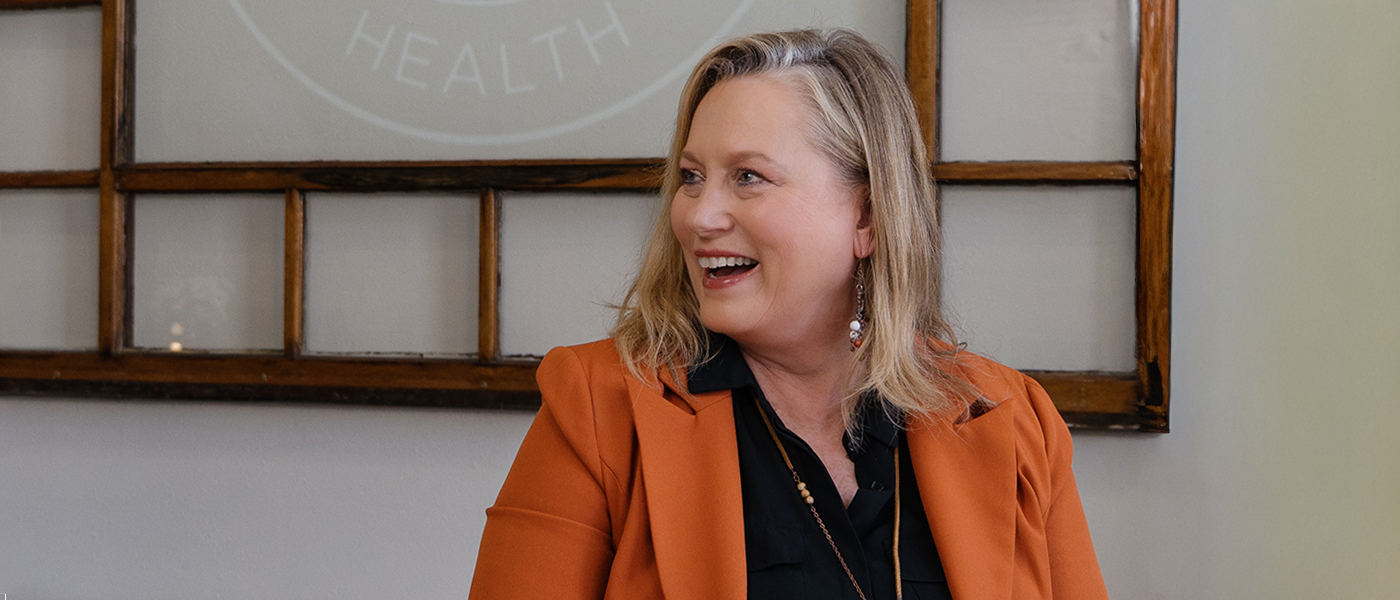
For more than 30 years, Kim Lantis has occupied nearly the same corner of Monument Health Rapid City Hospital.
Technically, she has moved. Just not very far.
“I’ve never left the suite,” she said with a laugh. “I’ve moved about 10 feet in all those years.”
As Executive Assistant to John Pierce, President of Rapid City Hospital, Kim is a steady hand behind the scenes. She manages calendars, coordinates meetings, supports the Rapid City Hospital Board and supervises fellow executive assistants. She’s often the first voice caregivers, community members and
board members hear, and frequently she’s the last person to check on hundreds of moving pieces that have to fit together.
“You never know exactly what your day is going to be like,” Kim said. “Sometimes you’re serving fellow caregivers. Sometimes it’s physicians, patients, families, vendors, board members or community members.”
No two days are alike; far from finding that overwhelming, she embraces it. “I love it,” she said. “You never know what each day is going to bring.”
Life beyond the hospital
Outside of her job, Kim’s life is filled with a different kind of work.
She and her husband ranch, like many families in the area. Much of their life revolves around horses and cattle. Their children grew up helping with ranch work, and gathering cattle remains a familiar part of the rhythm of life.
In autumn, 2023, Kim was helping move cattle from a government grazing lease west of Crazy Horse Memorial. It was a familiar task, one that she’s done countless times, and she was comfortable in the saddle.
After several hours on horseback, she dismounted to take a short break. Unfortunately, a quick burst of hail and sleet had made the ground slicker than she realized. One foot slipped, while the other remained caught in the stirrup.
She was grateful that her horse remained calm, yet she knew it was a dangerous situation. Trying to free herself, she twisted and fell against the rocks below. “I heard a crack and knew something bad had happened,” she explained.
Moving cattle isn’t always neat and orderly, and riders were spread across the valley gathering and herding the livestock. Few people even realized what had happened, and even once she was able to alert her husband, he had to ride to higher ground, searching for cell service, so he could call for help.
“This was not an easy place to get to and I knew I couldn’t ride out,” Kim said. “So, we were making a plan when we heard a noise. It was a helicopter, and I said, ‘I bet that’s coming for me.’”
The helicopter was, in fact, there for Kim. After circling several times to let her fellow riders herd the cattle away, they landed and loaded her for transport. From there, they took her to the Rapid City Hospital Emergency Department.
“It wouldn’t have been my choice to come that way,” she said. “But it was probably the right decision.”
Experiencing care firsthand
For decades, Kim had known Monument Health from the administrative side. She understood meetings, processes and the scheduling work required to keep things running smoothly. She supported physicians, nurses and other caregivers from behind the scenes.
Now, she was seeing the organization from a very different perspective. “I totally had my faculties,” she said. “I knew exactly what was going on.”
She recognized the security officer who greeted her. She knew physicians involved in her care and encountered colleagues she had worked alongside for years. The hospital she had spent decades supporting had suddenly become the place caring for her.
Tests revealed a complicated injury. Kim had a severe fracture involving her tibia near the knee joint. Megan A. Brady, M.D., Orthopedic Surgeon with Surgical Affiliates Medical Group, Inc. (SAMGI), led Kim’s care and understood immediately that recovery would not be simple.
“The fracture was highly comminuted, meaning it was in many pieces,” Dr. Brady said. “That made it more difficult to treat and to recover from.”
Kim was evaluated for internal bleeding and then underwent emergency surgery to stabilize the injury while swelling subsided.
This was only the beginning of her journey to recovery.
Collaborative medicine
Kim’s recovery didn’t follow a straight path. Over the next two years, she underwent eight surgeries. There were stretches of improvement followed by unexpected setbacks.
Because the injury sat just below Kim’s knee, in an area with very little soft tissue, the surgical site repeatedly failed to close. The wound at the top of her tibia simply wouldn’t heal properly. Recognizing that this was no longer just an orthopedic problem, Dr. Brady brought in Plastic Surgeon, Hunter Moyer, M.D., for
additional expertise.
Eventually, Dr. Moyer recommended a complex intervention: a flap surgery. “He said, ‘We’re going to have to do this procedure where they pull part of your muscle from the side of your leg,’” Kim explained. “They pull that up into this area where there’s problems healing, and it stimulates blood flow and adds additional circulation, which promotes healing and closure.”
The flap surgery was a success, and Kim’s wound finally began to close properly. With one problem resolved, though, another challenge reared its head.
A new threat
After multiple surgeries to repair her shattered tibia and fibula, as well as close the wound on her leg, recovery took a frightening turn when Kim developed an infection in the injured limb. Clinically, the stakes were high, and Kim knew it. “My injury was serious, of course, the infection … I knew that meant I could lose my leg.”
To treat the infection, Kim underwent interventional radiology procedures that placed IV ports that allowed her to receive continuous IV antibiotics. She had a constant IV drip of antibiotics for 60 days, a prolonged and intense phase of her recovery. And even when the antibiotic course was finished, there wasn’t an easy confirmation that the infection was truly gone.
“The only way to know the infection is gone without opening up the leg was to wait and see,” she said. “This was honestly the scariest part, because any changes could have meant that the infection returned. That would mean a real conversation about the possibility of losing my leg.”
Throughout this stretch, her care became highly coordinated across multiple teams. Lab technicians were constantly running tests, infectious disease specialists were checking on her, and her care expanded to include hospitalists, wound care and imaging on a regular basis.
In the end, the strategy worked, Kim beat the infection and continued to heal. A complex combination of surgery, interventional procedures and prolonged antibiotics had finally gotten her on the right track.
“Kim is one of the kindest, most positive and stoic patients that I have treated,” Dr. Brady said. “She is such a kind and patient person, and despite the injury she was a pleasure to treat.”
“Her attitude and patience with the healing process was inspiring, and I think it played an important role in her recovery,” she added.
Relearning and rebuilding
Eventually, the focus shifted from surgeries to rehabilitation. Kim arrived at her first physical therapy session in a wheelchair. Over time, she progressed to a walker, then crutches and eventually a cane. Progress was often measured in small victories that others might overlook.
Physical therapy seldom offers quick fixes. Instead, it rewards commitment and consistency.
Initially, Kim’s therapy focused on pain, swelling and restoring movement. “We were then faced with the new challenges of relearning how to walk with good mechanics and control,” said Bryan Olson, PT, DPT. Later, the emphasis shifted toward rebuilding strength, improving balance and helping Kim return to the activities that she enjoys.
“Kim is one of the most motivated and hard-working patients that I have had in my career,” Bryan said.
From her first visit with Bryan, she put in the work, starting with learning to stand again. By the end of Kim’s sessions, she could walk again, and they had progressed to jumping exercises.
“It was amazing to see her progress from significant limitations and immobilization to being able to start moving toward her activities on the ranch,” Bryan said.
Moving forward
Today, Kim continues the work of recovery. She’s still doing the exercises she learned in physical therapy and makes a point of moving throughout the day. Although stiffness can be a challenge, she’s returned to many of the activities she enjoys.
One goal remains firmly in her sights.
“I hope to get back on a horse,” she said.
Despite her accident happening on horseback, she isn’t afraid to get back in the saddle. In fact, she’s eager for the moment she’s ready. “The horse wasn’t to blame. He didn’t move at all,” she said. “He could have stepped on me or ran off, dragging me. But he didn’t.”
All that’s holding her back right now is the physical demands of mounting and dismounting. “You’ve got to be able to stand and balance on one leg. I don’t think I can do that yet. But I’ll get there.”
A new perspective
After spending so much time helping to keep the hospital running, Kim found herself relying on that same place during the most difficult experience of her life. She knew how the hospital worked, how the caregivers and physicians moved through the day and how the patients received the care they needed. It
was a whole new experience however, to be on the receiving end of that care.
For Kim, the experience reinforced what she had always valued most about Monument Health.
The people
The patient access specialists that answer the phones and schedule appointments, the nurses that check in on rounds, the technicians who draw blood and the physicians that provide treatment. The people who spend their days helping others, celebrating small victories and showing up when people need them.
For more than 30 years, Kim has been one of those people. When she needed them most, they were there for her, too.
“I’ve always known this was a great place to work,” Kim said. “But the silver lining to this experience is that I’ve never been prouder to be part of this hospital.”
Story by Wade EllettPhotos by Mason Stevens