Junior CNA Starts With Heart

“It was a stressful time and meeting this caregiver was a BREATH of fresh air when we were holding ours. They came into our room to check my family member’s pressure and take a temperature. They were very pleasant, very proficient and proceeded with confidence and professionalism. How did this young person gain so much poise and ambition?” – From Kaia Carlson’s anonymous TULIP award nomination.

It was already a great start to her health care career when Kaia Carlson, 17, was hired as Junior Nurse Aide Certified in the Heart and Vascular Unit (HVU) while still a junior at Stevens High School. However, it quickly became downright auspicious when, just a month or so into the job, she was recognized by a patient with a nomination for Monument Health’s TULIP award.

TULIP is an acronym for Thoughtful, Upbeat, Loving, Individuals caring for Patients. The monthly award recognizes outstanding members of our nursing support teams. Kaia, who trained via Monument Health’s community CNA course, is the first Junior Nurse Aide to receive the award.

“The best part about TULIP is that all of it is anonymous. We don’t know who the caregiver is, or the patient,” says Sadie Colbeck, Supervisor Nursing Support, for HVU. “I never knew Kaia was nominated until I was told that she had won the award, and I’m a part of the nursing support council made up of nurses, nurse aides and CNAs, that votes on them.”

Kaia’s grandpa was a doctor, and her mom (Tara Carlson, PA-C) is a provider at Monument Health’s Rapid City Urgency Cares. “I grew up around medicine, and I’ve always really been interested in the body and how it works,” Kaia says. “After I started caring for people, that made me want to do it more, just because I like the hands-on patient work, and to care for people who are vulnerable and show them kindness and try to brighten their days. And this setting really has allowed me to do that, because there’s so many people that need that.”

A philosophy of care certainly made its way down the generations to Kaia. She has an informed, purposeful approach to interacting with patients, one that is wise beyond her years. So, it’s fitting that Kaia ended up in HVU because her method starts with heart.

“First thing I do when I go into a patient’s room is ask how their day went and then based off of that decide how to specifically care for them,” she says. “I try to be extra kind and just calm and ask them basic comfort questions and see if there’s any little details that I can do to just improve their day. Sometimes taking a little extra time to just give direct, specific care to that person can help a lot. I usually walk around with them on walks, and that’s a really good way to get to know them more personally, and it feels like they’re getting more personalized care, too.” 

After she graduates from Stevens, Kaia plans on attending either Grand Canyon University in Arizona, or USD here in South Dakota. She’ll first pursue nursing and after that decide if she want to go on to pre-med or pre-PA from there, though she sheepishly admits that she hasn’t even thought about adding her TULIP award to her application yet. 

“I have so much love for the TULIP award, because Monument Health is the only organization who has it,” Sadie says. “It’s great that Kaia’s the first junior nurse aid to win it, because the role is still so new and it comes from her peers. That’s a really cool aspect to the award in general­ — it’s the people you work with that are voting on who deserves the award.”

Each TULIP award winner receives a handmade, glass vase from a local craftsperson. “They’re all just a little bit different, a little bit unique, because all of our TULIP winners are just a little bit unique,” says Sadie.

Patients can be reminded to go to monument.health/TULIP to nominate a Nursing Support Caregiver.

Story by Kory Lanphear

Photo by Erika Cianca
First Spearfish Hospital Expansion Phase Complete

Phase One construction of the Spearfish Hospital Expansion is complete and we began caring for patients in our newly opened facility this month. This milestone has long been in the works, requiring the coordination and cooperation of internal and external stakeholders, construction companies, city officials and, especially, Spearfish Caregivers and community members. Seeing it come to life has been incredibly exciting for our entire organization.

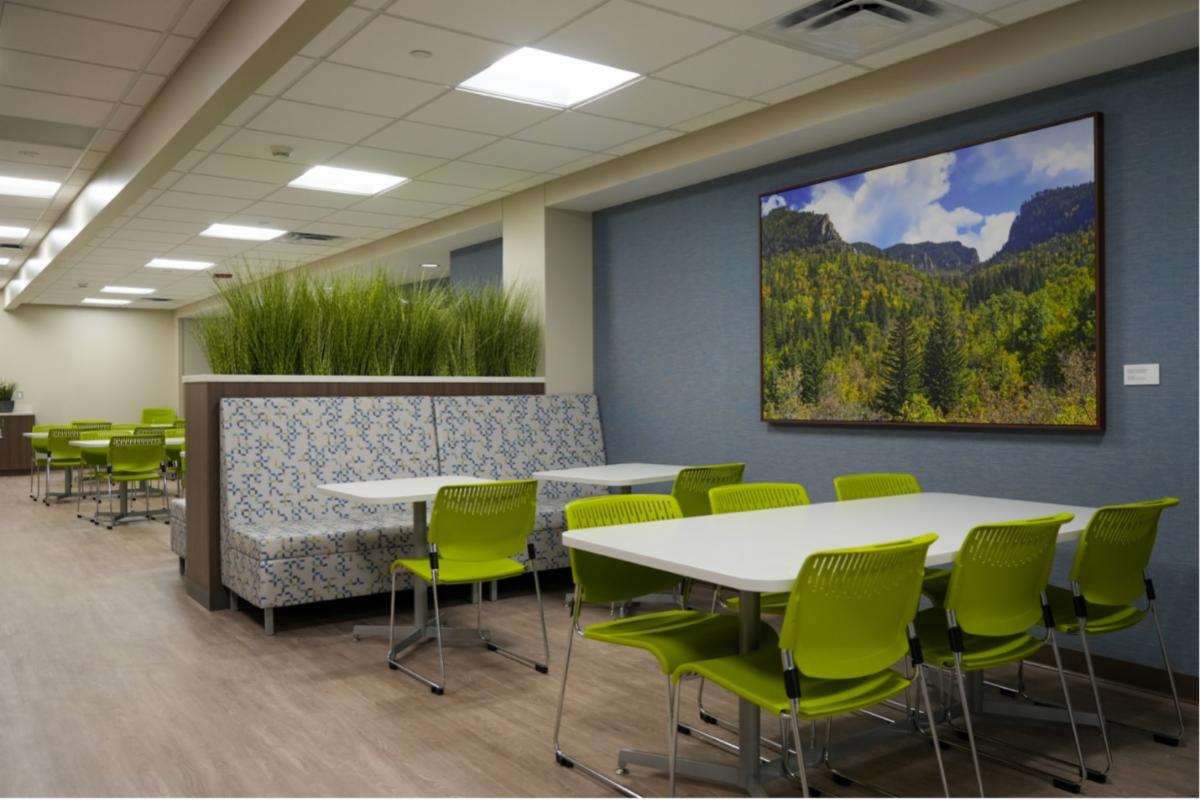
The addition to Spearfish Hospital includes 19 inpatient rooms, 15 of which are designated for medical surgical care and four for the ICU. The space is lighter, brighter and more modern than what we had before. Rich blue walls and seafoam green accents create a calm, healing atmosphere with artwork to match. Centrally located nurse stations allow Caregivers to keep a close eye on the patient rooms. Private rooms with individual bathrooms are a meaningful upgrade, both for patient comfort and for safety.

On the main floor, 22 Surgery Pre/Post rooms offer flexible bed spaces for patients checking in for surgery, recovering immediately after a procedure, or awaiting discharge or transfer. These rooms are filled with natural light and furnished to feel as welcoming and comfortable as possible. The basement level is home to a brand-new, much larger cafeteria that will serve Caregivers, guests and patients. Caregivers will also enjoy a new Starbucks machine, a small but welcome addition.

Phase Two will bring a new surgical wing, with construction expected to take around 14 months. Once that is complete, the final phase will transform the existing surgical wing into a modernized Emergency Department, nearly doubling capacity from 7 to 13 beds. We are proud of the progress and grateful to the many people who helped bring Phase One across the finish line. There will be more updates as this $80 million project continues to transform health care in the Northern Hills communities and across our organization.

Story by Kory Lanphear

When It Comes to Fighting Colon Cancer, We Really Blue It

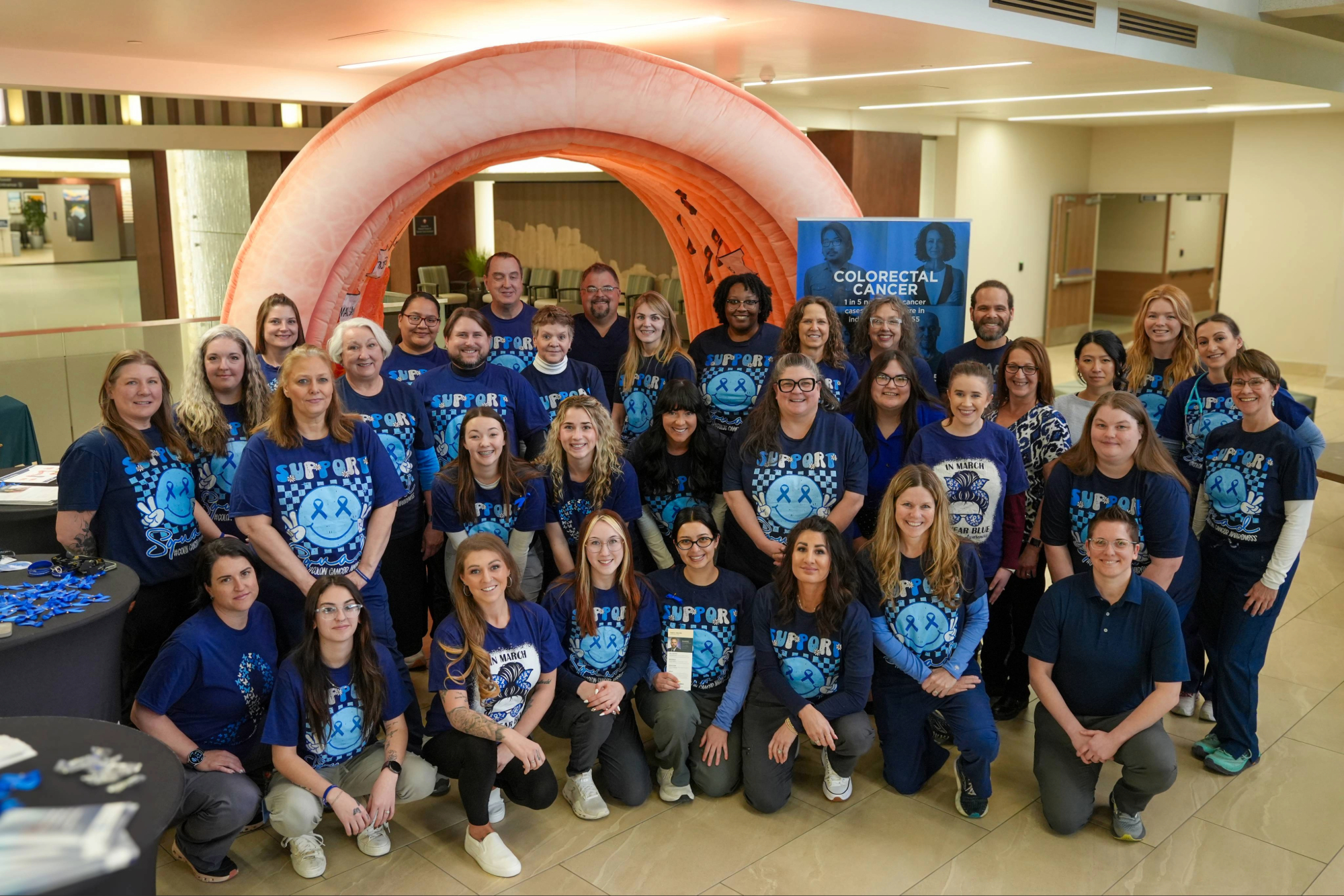
Friday March 6 was Blue Day, an annual, national event honoring Colorectal Cancer Awareness Month. At Rapid City Hospital’s main entrance, Providers and Caregivers from Gastroenterology donned blue shirts and gathered around a large, inflatable demonstration colon to hand out helpful information, pins and other goodies to raise colon cancer awareness in the Black Hills.

Colon cancer rates are high in the United States and raising every year, especially for people under 50 years old. Locally, though, screening rates are low. However, colon cancer is preventable and detectable in its early stages. It’s also treatable and curable, even in advanced states, according to Emuejevoke Okoh, M.D., a fellowship-trained Interventional Gastroenterologist, who was on hand to talk to reporters from KNBN and KOTA Territory for the occasion. He stressed, though, that individuals need to know that screening starts at 45 years old, and possibly earlier for those with a family history or predisposing conditions such as irritable bowel syndrome.

Although there are a few options for getting screened, which have improved in accuracy and reliability the past few years, the gold standard remains a colonoscopy.

Chantel Holz, CNP, in Gastroenterology detailed the minimal risks of getting a colonoscopy which are vastly outweighed by the benefits. There are low chances of peroration because the procedure is performed with a tube attached to a small camera.

“High-processed foods, processed red meats, and especially diets that are lower in fiber ­— those are the things that increase the risk of colorectal cancer,” Chantel says. “If you’re having any symptoms: change in bowel habits, blood in the stools, weight loss, you want to be aware of it and bring it to your provider because you really want to go forward with a colonoscopy.”

If colon cancer is caught in the early stages, survivability percentages are high. However, in the later stages, the percentages fall off quickly, so it’s crucial that people get their screenings early and often.

For more information on Blue Day, Colorectal Cancer Awareness Month and colon cancer, check out the Colorectal Cancer Alliance website.

Story by Kory Lanphear

Photo by Erika Cianca
Heart and Vascular Institute Rallies Afib Patient

For 35 years straight, Spring Valley, Minnesota resident Tony Larimer, 58, has been coming to the Sturgis Motorcycle Rally. However, he almost missed the 85th Annual Rally last month due to a serious health matter he experienced this past May while attending a separate motorcycle-related event in these very same Black Hills.

Over Memorial Day weekend, Tony and his wife, Kelli, were staying at a friend’s house in the Nemo area when Tony, a diabetic, began experiencing food-poisoning-like symptoms. Tony didn’t know it at the time, but his insulin pump fusion set was either malfunctioning or not properly connected. His blood sugar kept rising, so Tony kept dosing more insulin. 

“I started throwing up all night. It was pretty brutal,” says Tony. “The next day, my breathing was extremely labored. Our friends know a nurse practitioner that lives in Nemo. She came up to the house and said, ‘You’re in full ketoacidosis. You need to go to the emergency room.’”

Diabetic ketoacidosis (DKA) is a condition in which diabetics cannot produce enough insulin. It can get serious, fast. If they don’t get it treated, patients can slip into a coma state.

Kelli drove Tony to Rapid City Hospital’s Emergency Department. By the time they arrived, Tony was in a bad state. “My blood sugars had gotten so high that my kidneys were shutting down, my vision disappeared. Everything just looked white,” he recalls. 

Emergency Physicians performed an ECG, which revealed that, in addition to the DKA, Tony had a blockage in his heart.

“My lungs were struggling to breathe and so I ended up intubated and on a ventilator for a few days. And during that time, I was continually going into Afib.”

“Tony had a blockage of his left anterior descending artery and went into cardiogenic shock,” says Luis Hernandez, M.D., FACC, Medical Director of the Advanced Heart Failure Program at the Heart and Vascular Institute. Such conditions can lead to a so-called “widowmaker” heart attack because the heart is blocked from receiving half of the blood it needs to work.

Dr. Hernandez and Moinuddin Syed, M.D., Interventional Cardiologist, decided that Tony required stents and a temporary Impella pump to help his heart beat stay constant. For three days, the Impella pump assisted Tony’s heart. The decision turned things around and saved Tony’s life, something for which he’s very grateful.

Once back home, Tony went under the care of his cardiologist. Whether or not he will need additional surgery or a pacemaker remains to be seen. For now, he’s being monitored, undergoing rehabilitation and taking medications. He finds out this month if this plan is paying dividends. 

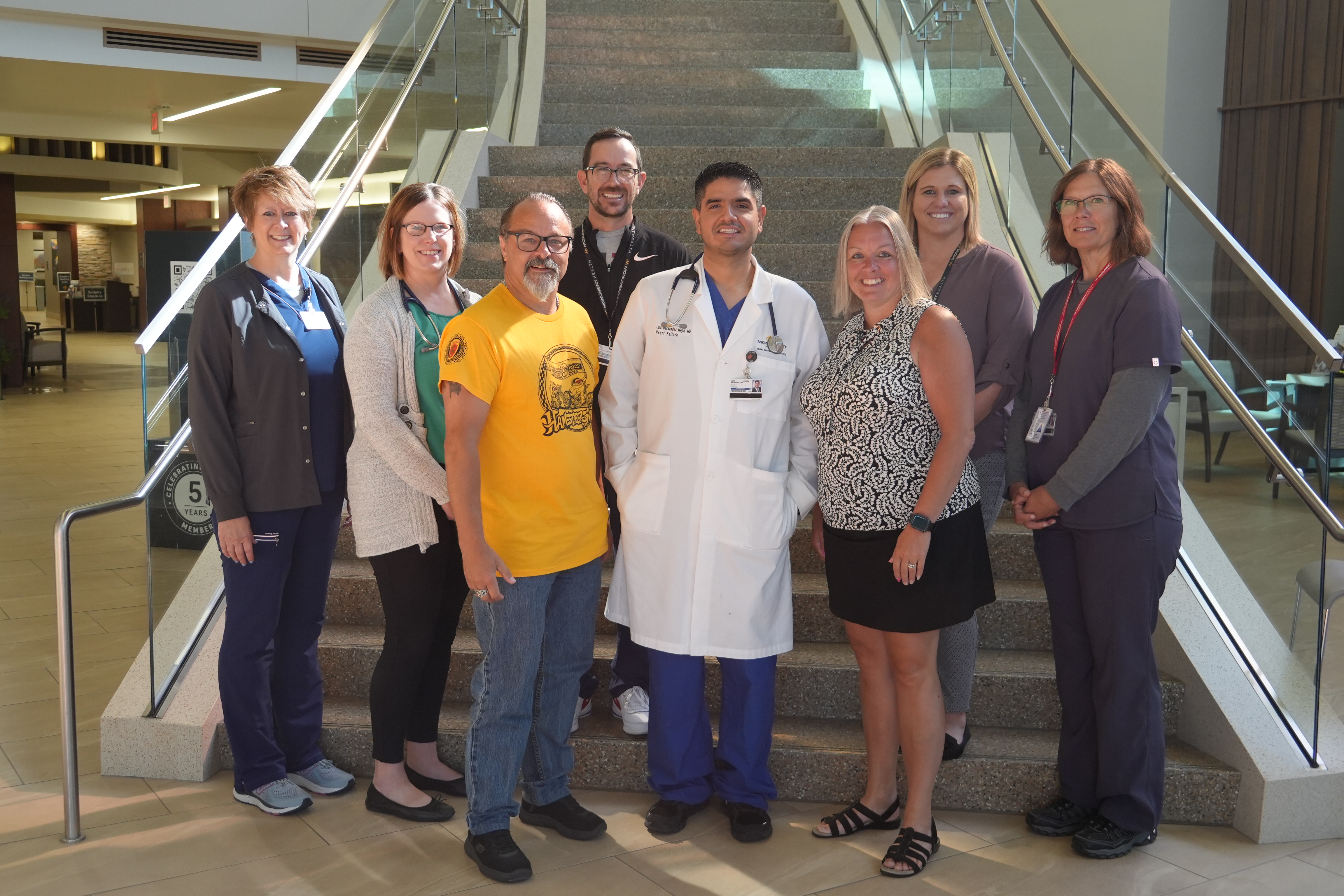
Left to Right: Patient Care Coordinator Leah McCormick, APP Jessica Tvedt, Tony Larimer, Transition Coordinator Ron Gallet, Luis Hernandez, M.D., FACC, Kelli Larimer, APP Megan Hullinger, APP Audrey Bickerdyke

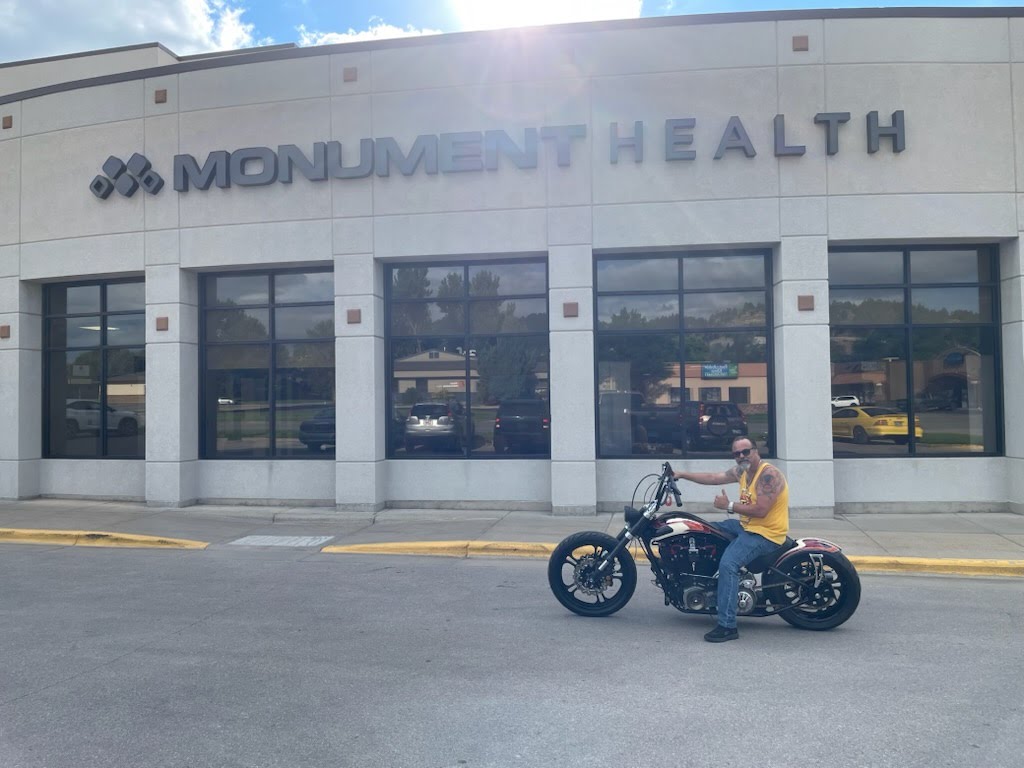
Last month, Tony was back in the Hills for the 85th Sturgis Rally. He made it a point to stop by Rapid City Hospital, where he reunited with Dr. Hernandez and his care team. Tony and Dr. Hernandez shared a teary-eyed hug. Dr. Hernandez also introduced Tony to Dr. Syed, whom Dr. Hernandez called the “man of the hour” for his role in Tony’s care. Tony was so incapacitated that he wasn’t even aware that Dr. Syed performed the placement of the Impella pump and stents that facilitated his recovery.

“I’m fortunate to be here,” Tony told Dr. Hernandez during their reunion. “My doctors at home said that there’s very few skilled hands that could do what they did here so well. The fast work of your team saved me. I can only say, ‘Thank you.’” 

The HVI team’s work benefited more than just Tony’s personal Rally enjoyment. As a member of the Hamsters USA motorcycle club, Tony is heavily involved in charity projects around the Hills during the Rally. During the 85th Rally alone, the Hamsters raised $333,000 for Lifescape in the Black Hills. “We’ve given now over $5 million. We do that across the country,” Tony says. “For Spearfish, we give Meals on Wheels up to 20 grand every year to help with that. We just donated $100,000 to the museum in Sturgis, because we have to keep this heritage. We’re really involved in the short time we’re here.”

Story and Photo by Kory Lanphear

Submitted photo courtesy of Kelli Larimer