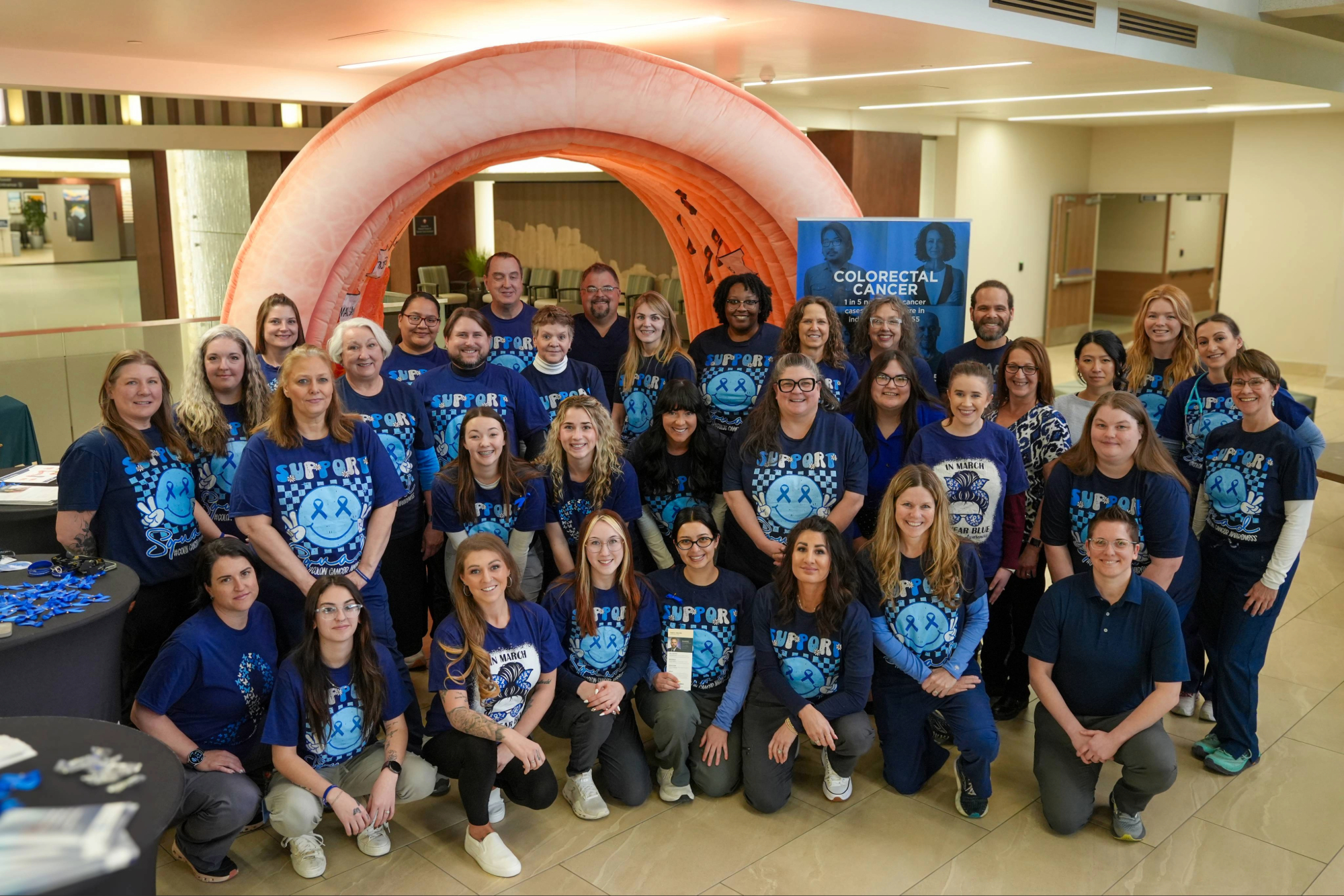
Friday March 6 was Blue Day, an annual, national event honoring Colorectal Cancer Awareness Month. At Rapid City Hospital’s main entrance, Providers and Caregivers from Gastroenterology donned blue shirts and gathered around a large, inflatable demonstration colon to hand out helpful information, pins and other goodies to raise colon cancer awareness in the Black Hills.
Colon cancer rates are high in the United States and raising every year, especially for people under 50 years old. Locally, though, screening rates are low. However, colon cancer is preventable and detectable in its early stages. It’s also treatable and curable, even in advanced states, according to Emuejevoke Okoh, M.D., a fellowship-trained Interventional Gastroenterologist, who was on hand to talk to reporters from KNBN and KOTA Territory for the occasion. He stressed, though, that individuals need to know that screening starts at 45 years old, and possibly earlier for those with a family history or predisposing conditions such as irritable bowel syndrome.
Although there are a few options for getting screened, which have improved in accuracy and reliability the past few years, the gold standard remains a colonoscopy.
Chantel Holz, CNP, in Gastroenterology detailed the minimal risks of getting a colonoscopy which are vastly outweighed by the benefits. There are low chances of peroration because the procedure is performed with a tube attached to a small camera.
“High-processed foods, processed red meats, and especially diets that are lower in fiber — those are the things that increase the risk of colorectal cancer,” Chantel says. “If you’re having any symptoms: change in bowel habits, blood in the stools, weight loss, you want to be aware of it and bring it to your provider because you really want to go forward with a colonoscopy.”
If colon cancer is caught in the early stages, survivability percentages are high. However, in the later stages, the percentages fall off quickly, so it’s crucial that people get their screenings early and often.
For more information on Blue Day, Colorectal Cancer Awareness Month and colon cancer, check out the Colorectal Cancer Alliance website.
Story by Kory Lanphear
Photo by Erika Cianca