
For 35 years straight, Spring Valley, Minnesota resident Tony Larimer, 58, has been coming to the Sturgis Motorcycle Rally. However, he almost missed the 85th Annual Rally last month due to a serious health matter he experienced this past May while attending a separate motorcycle-related event in these very same Black Hills.
Over Memorial Day weekend, Tony and his wife, Kelli, were staying at a friend’s house in the Nemo area when Tony, a diabetic, began experiencing food-poisoning-like symptoms. Tony didn’t know it at the time, but his insulin pump fusion set was either malfunctioning or not properly connected. His blood sugar kept rising, so Tony kept dosing more insulin.
“I started throwing up all night. It was pretty brutal,” says Tony. “The next day, my breathing was extremely labored. Our friends know a nurse practitioner that lives in Nemo. She came up to the house and said, ‘You’re in full ketoacidosis. You need to go to the emergency room.’”
Diabetic ketoacidosis (DKA) is a condition in which diabetics cannot produce enough insulin. It can get serious, fast. If they don’t get it treated, patients can slip into a coma state.
Kelli drove Tony to Rapid City Hospital’s Emergency Department. By the time they arrived, Tony was in a bad state. “My blood sugars had gotten so high that my kidneys were shutting down, my vision disappeared. Everything just looked white,” he recalls.
Emergency Physicians performed an ECG, which revealed that, in addition to the DKA, Tony had a blockage in his heart.
“My lungs were struggling to breathe and so I ended up intubated and on a ventilator for a few days. And during that time, I was continually going into Afib.”
“Tony had a blockage of his left anterior descending artery and went into cardiogenic shock,” says Luis Hernandez, M.D., FACC, Medical Director of the Advanced Heart Failure Program at the Heart and Vascular Institute. Such conditions can lead to a so-called “widowmaker” heart attack because the heart is blocked from receiving half of the blood it needs to work.
Dr. Hernandez and Moinuddin Syed, M.D., Interventional Cardiologist, decided that Tony required stents and a temporary Impella pump to help his heart beat stay constant. For three days, the Impella pump assisted Tony’s heart. The decision turned things around and saved Tony’s life, something for which he’s very grateful.
Once back home, Tony went under the care of his cardiologist. Whether or not he will need additional surgery or a pacemaker remains to be seen. For now, he’s being monitored, undergoing rehabilitation and taking medications. He finds out this month if this plan is paying dividends.
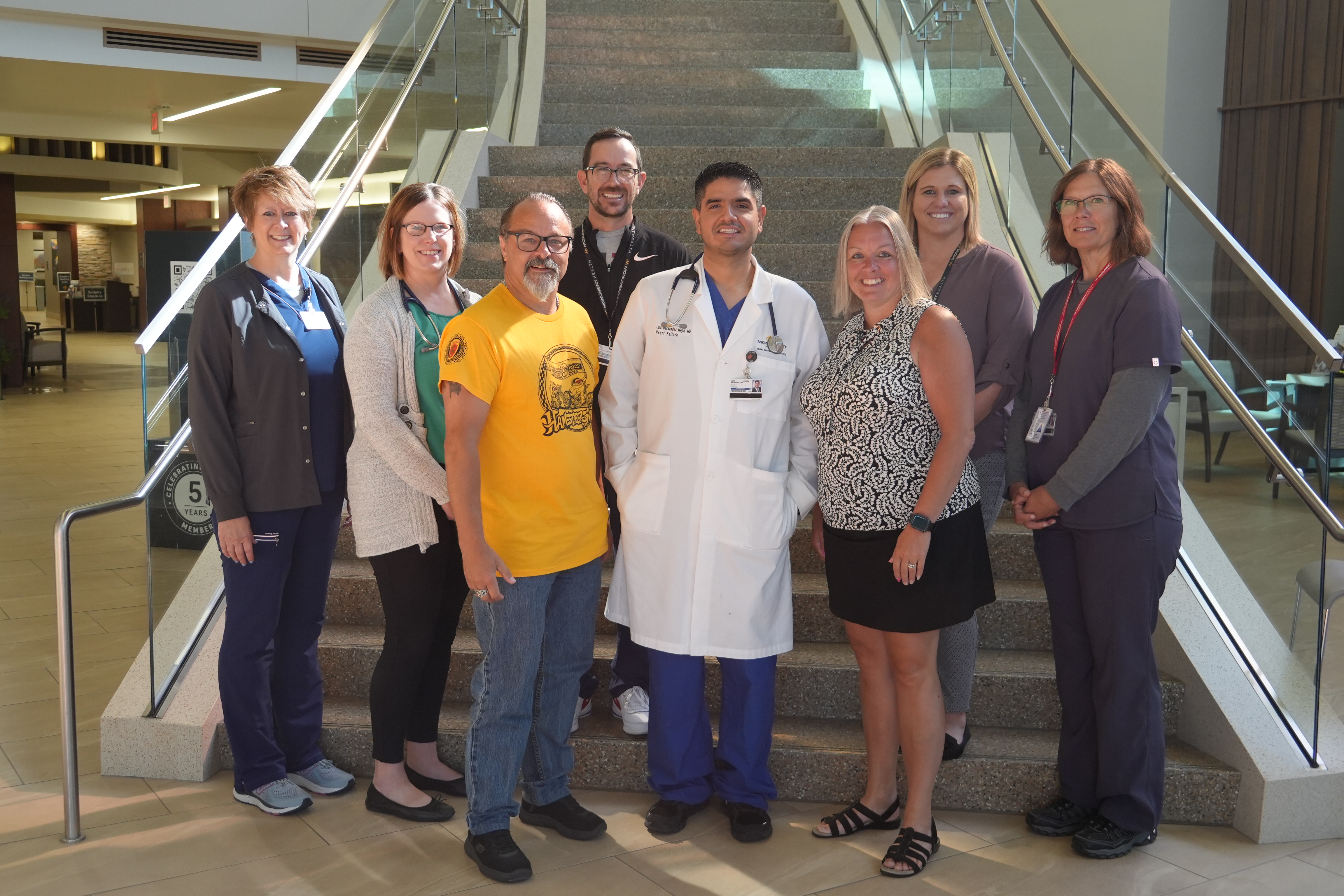
Last month, Tony was back in the Hills for the 85th Sturgis Rally. He made it a point to stop by Rapid City Hospital, where he reunited with Dr. Hernandez and his care team. Tony and Dr. Hernandez shared a teary-eyed hug. Dr. Hernandez also introduced Tony to Dr. Syed, whom Dr. Hernandez called the “man of the hour” for his role in Tony’s care. Tony was so incapacitated that he wasn’t even aware that Dr. Syed performed the placement of the Impella pump and stents that facilitated his recovery.
“I’m fortunate to be here,” Tony told Dr. Hernandez during their reunion. “My doctors at home said that there’s very few skilled hands that could do what they did here so well. The fast work of your team saved me. I can only say, ‘Thank you.’”
The HVI team’s work benefited more than just Tony’s personal Rally enjoyment. As a member of the Hamsters USA motorcycle club, Tony is heavily involved in charity projects around the Hills during the Rally. During the 85th Rally alone, the Hamsters raised $333,000 for Lifescape in the Black Hills. “We’ve given now over $5 million. We do that across the country,” Tony says. “For Spearfish, we give Meals on Wheels up to 20 grand every year to help with that. We just donated $100,000 to the museum in Sturgis, because we have to keep this heritage. We’re really involved in the short time we’re here.”
Story and Photo by Kory Lanphear
Submitted photo courtesy of Kelli Larimer