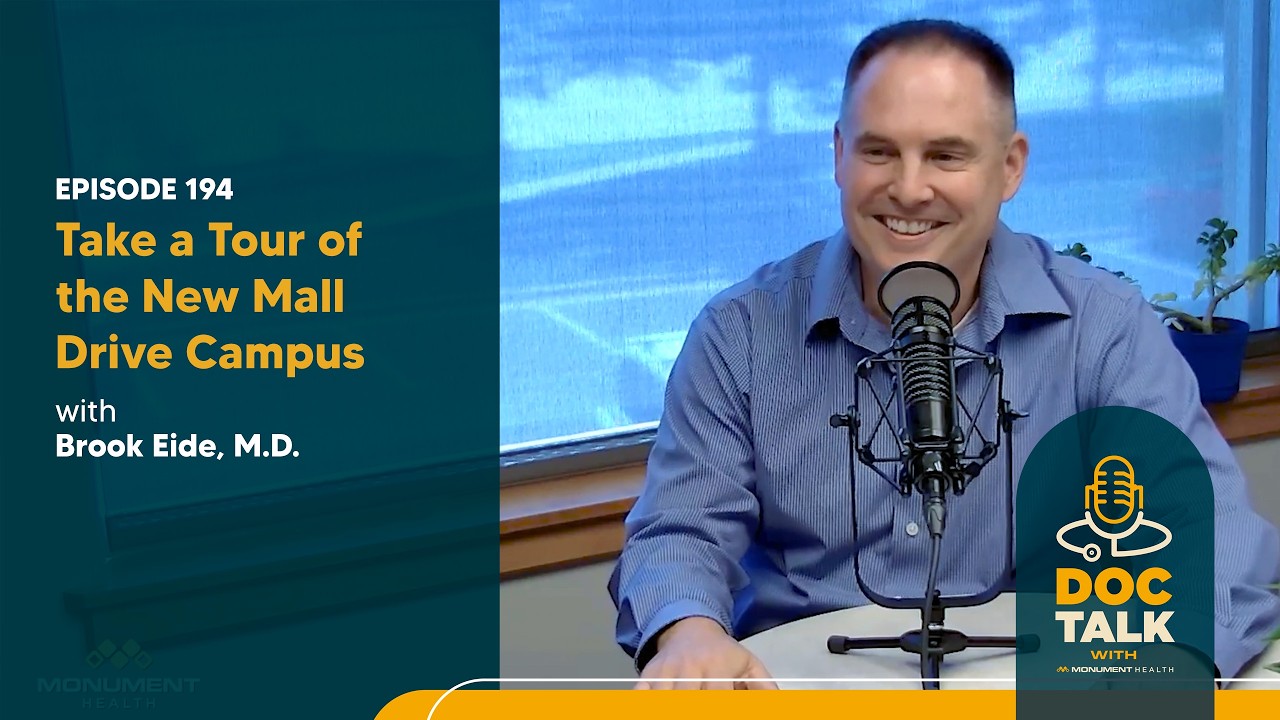

Listen or watch this episode on your preferred platform:


MARK HOUSTON: Hi everyone. I'm Mark Houston, and welcome back to Doc Talk with Monument Health. Today we're on East Mall Drive with the brand new Monument Health emergency room. Dr. Brook Eide is back and he is giving us a behind the scenes tour before the doors officially open.
We'll walk through the Saint Barbara Chapel, the ambulance bay, the trauma room, the CT scanner, the lab; and the central hub where the team will keep an eye on every patient. Brook will explain what this new ER could do, what still has to happen at the main hostpital, and why having a facility like this on the east side matters as Rapid City keeps growing. So come along with us. Let's take a look. Hello again, Doctor. It's good to see you. Thanks for coming out here. All this new car smell out here right now. Isn't that great?
DR. BROOK EIDE: I agree. You just walk in and it feels fresh and new and ready to go.
MARK HOUSTON: Well, we're here because this is going to be the brand new emergency room for Monument Health. This is the one that's been in the works. If you drove down the interstate, you saw the sign coming soon. This was going to be big and exciting. And I can't imagine for you how this feels to have something like this open now in this part of Rapid City.
DR. BROOK EIDE: It's exciting. As you can see, we're still bringing stuff in. We're still getting ready for the first big day here, but we'll be ready to go soon. And we're excited. I'm excited to share with you today.
MARK HOUSTON: I would love to go have a look. Let's go walk around, Doctor.
DR. BROOK EIDE: Let's go this way and I'll show you where we come in. We come in this way as a front door, and I'll show you the ambulance bay, and we'll just kind of walk through it.
MARK HOUSTON: Excellent.
DR. BROOK EIDE: Come on in. So we've got that beautiful waiting room we saw, but we also have this room, and this is our Saint Barbara Chapel that we call it. And this is a room just to come. If your family is getting tested on, if you need a moment to kind of sit and relax and have just a nice area, families could gather here. And so it's just a beautiful space. And we have this space because the Lien family sold us this land. And they were very generous. Part of that was that we would build this chapel to honor Barbara Lien. And so this is our Saint Barbara Chapel. And it's going to be a great place for patients and staff, really just to come and get a quiet moment and relax.
MARK HOUSTON: Again, it's a beautiful room, a beautiful space. Yeah. And I think it's needed in an emergency room and in situations where people are stressed and panicked, anxiety, where they can just sit down a second and kind of collect themselves.
DR. BROOK EIDE: Also, sometimes we get bad news in the emergency department. It's nice to have a nice quiet space, you know, just to let families kind of soak that in and to talk with them and not have that chaos.
MARK HOUSTON: All right, Doctor, well, now we are heading to the brand new ambulance bay here at this new emergency room. And I remember from last time we talked at the emergency room that's downtown in Rapid City, that one is huge. You said we can get how many ambulances in and out of there?
DR. BROOK EIDE: We can get eight to ten ambulances in there. So yeah, that one's made for busy, full-service ambulance. You'll see a little different thing here where we're looking more at not a lot of ambulances coming in, probably more going out if we need to go back to our main job, but a much lower ambulance volume.
MARK HOUSTON: All right, well, let's go take a look and see what it's like. Well, Doctor, here we are in the brand new ambulance area here at the emergency room on East Mall Drive. And this is considerably smaller than the one you will find downtown at Monument Health, right? So this will be, you mentioned a little bit earlier, that this might be more for coming than going in this path.
DR. BROOK EIDE: So this site, a lot of our ambulances come in. Ambulance will bring very sick patients often. So a lot of those are going to go to our main hospital where we have all the resources like we talked about last night. But there'll be times that people are going to come here and we're going to find something on them. That's a true emergency that needs maybe a surgeon, maybe our heart doctors. And so they'll be coming out of here a lot, and then maybe some coming in as well, but a lot coming out. And so that's kind of what we see here. So it's going to not have near the traffic of the other place. And so the same nice service was built this way, where you come in one door and out the other. They're not backing in, they're not backing out. And it's a very nice ambulance bay. It's nicer than when we had the old hospital, to be honest with you. But it's nothing like we have at the main hospital, and it won't have near the service and level of ambulances coming through it.
MARK HOUSTON: Well, what I noticed, and what I really think is obviously well planned, is that if you are coming in here and you're getting off the ambulance, the room that they're going to take you to is steps away, which I think can make a big difference for somebody coming off that ambulance.
DR. BROOK EIDE: Absolutely. Even though we're a smaller scale here, we're set up where we have to deliver that same high quality of care. Our ambulance bay here is across the hall to our trauma room, which is set up to do all the magical things that we do in a trauma room in Rapid City only. From there, we'll have to package and get over to the other specialists, but we're set up here. If you come in, if you're close to the interstate here with a car accident, you're going to come in here and you're going to be in our resuscitation bay quickly and ready for us to work on you. Let's go check it out. Let's have a look. I've still got my clothes and stuff here. It's just like when you move into a house, everything's still boxed up. My flip flops are in one of those, I don't know which one. So this will be the area that they come into.
MARK HOUSTON: Like I said, that step, that walk across there didn't even take us six seconds, I bet. And you know, when paramedics are moving somebody from that ambulance into here, I think quickness is the key in a lot of instances too, right?
DR. BROOK EIDE: Absolutely. So time is a big thing. And that's one of the things that in emergency medicine we talk about. Time. Time is tissue. Time is brain. Time is whatever it is. And so we're set up that if we have a sick patient come in here, they're out of the ambulance, they're across the hall here and into this large room. You can see we're set up to have that big work area where we can do procedures and resuscitation and all the magical things that we do in emergency department. You know, right here in a modeled version, like we have multiple of in the main city and whatnot.
MARK HOUSTON: Yeah. And what's nice is this is all top of the line. Everything in here is brand new. I mean, state of the art.
DR. BROOK EIDE: Yeah. So lots of time and hours went into figuring out what we need in these rooms, to kind of model it after our main ED to say, these are the things that we need to do, we need to have, even if we don't use them a lot. We have them here and we're ready for that patient.
MARK HOUSTON: All right, let's go take a look at some of the rest of the stuff that's in this brand new emergency facility here on East Mall Drive. So one thing I noticed, Doctor, in this new facility, and I'm sure these happen in most emergency rooms or hospitals, is, let's say we're in Rapid City, we're in South Dakota. There's going to be a blizzard at some point, right? You guys have a place that you can kind of quickly regroup and recoup. But you're here, you're ready to go. But there's rooms here for you guys to kind of go in, sit down for a minute, and just wait for what's about to roll in again. Correct?
DR. BROOK EIDE: Absolutely. This is a place that's been great for patients, but great for our staff. You can see we have a nice little staff break room where you can have a break and get some food. We have a room here that's a sleep room. You know, I'll tell you, during Atlas, I'm old enough that I worked during Atlas, and I spent four days at the hospital stuck there. And so it's nice to have a place you can slip off and get a little sleep. And so we have a little sleep room here. It's not the Grand Hyatt, but it's a place to catch a few Z's.
MARK HOUSTON: One thing I want is my ER doctor's rested. Okay. So that's good to know. All right, Doctor, we have just been in the ambulance bay. We've been on that side of the facility. And you said as we came in, that people and patients will end up going kind of in both directions when they come into the facility. But I think this will be the main hall where a lot of people will end up generally.
DR. BROOK EIDE: Yeah. So we kind of modeled this after our emergency department, as you remember, downtown in the city, where we have this outer hub. And this is where patients will be. And then we'll come later into the inner hub, which is where our care workers will be at. And so we can do two rooms each door, so we can keep kind of the medical stuff on that side and the patients out here. And so this is kind of the other hallway. We have a lot more stuff here. We have our staff break room, and then we'll have lab and imaging. We'll see as we go down further. And so those will be some nice things that we can bring people out of a room in this hallway to get those things done where we maintain that kind of privacy of the center area.
MARK HOUSTON: Now, what are some of the things that this place specifically can't do, like downtown, the main hospital can?
DR. BROOK EIDE: Yeah, there's going to be some limitations on some of the imaging that we do. We're going to have CT scan, the main imaging with X-rays, ultrasound sometimes, sometimes not, because that's kind of a lesser used modality of imaging. And then as far as the physicians, again, the same doc here, I might be here today and at the main shop tomorrow. So we're going to have that same high quality. Always have a board certified ER doctor here. So that will be there. We'll have nurses in here that share with the main hospital. So same expertise will be here. Just some of those resources will be a little bit different. And then probably the biggest thing will be that we won't have MRI here, and we won't have a lot of specialists here. And so if you do come in, you're having that heart attack, we're going to do the first part of it, but now we need to get you to that heart doctor, and that's going to be in the ambulance over to the main hospital.
MARK HOUSTON: Well, I wanted to go into the X-ray radiation room here because I believe this is the room that does have your CT scan machine in here, correct?
DR. BROOK EIDE: Yeah, absolutely.
MARK HOUSTON: All right, let's go take a look. I've never seen one brand new before. Boy, that still has the plastic on it. It still has the floor mats that say detail. So what is the difference between a CT scan and an MRI?
DR. BROOK EIDE: Yeah. So a CT scan, as you saw the big sign there, uses nuclear medicine. It uses radiation. And there's multiple thin cuts, like an X-ray almost, just multiple of them that put together into one big image, where an MRI uses magnets to develop their images, takes longer to do, and it's better for different things. MRIs are great for seeing ligaments or seeing joints or those kind of things, where CTs work for us when we're seeing, you know, the spleen or the pancreas or the brain. So they kind of do different things and have different strengths and weaknesses. But MRI is something used more as a scheduled thing, and CT scan, we do a lot of our emergency stuff.
MARK HOUSTON: Excellent. Well, I don't want to ever be the first one to use a machine like this, but glad it's here.
DR. BROOK EIDE: Yeah, ready to go. It's a great machine, and we're going to be able to do maybe some outpatient stuff here too, to kind of just help the community. And so it'll be well used. This continues to give us great images, just high, high quality, and going to help us give great medicine to Rapid City.
MARK HOUSTON: The urge to touch those screens right now is almost irresistible. So we should probably go.
DR. BROOK EIDE: All right, let's get you out of here. This is very expensive if you break them.
MARK HOUSTON: So what would be in a room like this then, Doctor? Explain this one a little bit. This was right next to the room with the CT machine.
DR. BROOK EIDE: Yeah, so this is our X-ray. This will be X-rays. And that's just kind of a big X-ray arm there that you can lay down and get X-rays of different things. And so that's done here. And then in the center that we walked through is kind of the command hub, if you notice that. And so much of this now is computer run. And to get that perfect image, the computers help us do that. And our technicians are super skilled, but they use these computers. And it's kind of one of those things, like most jobs, where it used to be more of a physical thing and now you've got to know your computers to run any of this stuff. So it's all very high tech, but gives us great images that really helps us take care of people.
MARK HOUSTON: So, Doctor, you mentioned that labs can be done here too. Obviously, if somebody comes in and needs emergency treatment, that's one of the things you want to be able to do. And so the room here with labs still getting set up, with lots of people that are way smarter.
DR. BROOK EIDE: So this is the lab. You can see it's super high tech.
MARK HOUSTON: It is.
DR. BROOK EIDE: And one of the things that has to be done before we can open is lots of quality assurance on all these new machines, right? To make sure that we're getting accurate lab tests to make our decisions on them. So we're getting set up, we're showing them all. And this is going to be a great lab. We do a lot of things out of this lab, a lot of our emergency tests. But they'll also do some outpatient lab here. So that will help the community being able to come here to get their cholesterol drawn.
MARK HOUSTON: Right. So if somebody needs blood work done before they see their doctor, they could make an appointment to come here to do that.
DR. BROOK EIDE: Exactly, exactly. So that'll be a nice use of it. And then like I said, when we need it, the lab will be the number one thing that gets our patients done. You know, so we can quickly get people their lab tests to determine what we need to do to help them.
MARK HOUSTON: Oh, it's so exciting to see all of this getting set up and ready to go.
DR. BROOK EIDE: It is exciting. It's coming quick.
MARK HOUSTON: Yes, it is. Let's take, again, another quick tour here just into the entrance area.
DR. BROOK EIDE: Yeah. So again, this is where most people will be coming in if they're not coming in by ambulance. So it's all set up.
MARK HOUSTON: And again, what I like about this, what I noticed from the renovation at the first hospital, the hospital downtown, there still is, I mean, there's a lot of building and construction, right? But you still manage to bring in that sense of calm that's in here too. I think aesthetically the way it's made, even the sound as well. Again, when you were here before, it was super busy on the inside, that quietness was still here, right? It's kind of still maintaining that.
DR. BROOK EIDE: But this hallway will be patients and that stuff. We'll get to the inside. You'll see that there won't be patients there, but we maintain that same sense of these outer hallways to guide our patients through, with our inner core area. And then this great waiting room here that, you know, will be used to get our patients in and out. We're really hoping for emergency patients that we're going to get them right back. And we're going to do what's called direct bedding, where you come in, you tell us your complaint, and we're going to get you to a room right away and get things going. So we're excited about that.
MARK HOUSTON: Well, let's go see now where a lot of the magic and monitoring happens too, which is right here in the middle.
DR. BROOK EIDE: Yeah.
MARK HOUSTON: What's on the peak? All right, Doctor, let's go see where everything will be monitored extremely close.
DR. BROOK EIDE: So this, there we go. That's why magic hands. This is why he's a doctor. So this little room here is a triage room. So if we need to, if we're full, we can bring you in here and kind of figure out what's going on and figure out how to get you back. This was similar to the big triage I had to make small, because our plan is mainly to be able to bring people right back to a room. But if we have to, then we'll be able to do that. Or maybe you can see that's a phlebotomy. They can draw blood there to get things started. And so this is just kind of a small area to use if we need to sort through what we're going to do in here.
MARK HOUSTON: What specifically makes this a phlebotomy chair? Why is it a specific thing?
DR. BROOK EIDE: Well, it's the arms. And so you got to get your arm up there and then we can strap you down so you can't move. No, just kidding. It's mostly the arms, like getting the access to draw that blood. So it goes up and down. And it's similar to, we have IV chairs and those chairs that do this kind of same thing, where you give them that right position to work on them. And so if you've got your phlebotomist here, you want to build them up to where they're comfortable, where they're not bent over, and get that arm in a good place so they can get that vein and get that blood started.
MARK HOUSTON: Yeah. Get it out quick.
DR. BROOK EIDE: Get it out. That's right. You don't want to put it in there for a long time.
MARK HOUSTON: All right. We're going to go through this one.
DR. BROOK EIDE: All right. Oh, you go first.
MARK HOUSTON: Okay. So now again, we're in the, I guess this would be the hub.
DR. BROOK EIDE: Yeah, the center core, we call it.
MARK HOUSTON: Okay, excellent.
DR. BROOK EIDE: So this is kind of, we have those outside halls, and we came down on both sides of us, and they had doors that went out to the halls. And now there's doors into this area too. And this is where our staff will be working, our doctors and nurses working in this area, being able to see all these people and come back quickly and put stuff in computers and do those things. So this will be a place where we'll have the monitors up. Again, this is all patient protected. And so we don't have patients here, and that lets us do that.
MARK HOUSTON: Well, I noticed in the main hospital downtown, there were television screens everywhere on the walls, I feel like, right? Is that as needed here in a place like this, because the space is smaller?
DR. BROOK EIDE: Yeah, less needed, and also just a lot less rooms. So we had those walls of monitors where we had, you know, twenty people maybe on telemetry at a time, or thirty. Here we have nine rooms. And so we need a lot less of that, obviously, but we'll still be able to have that same thing where we can have those up. So if you are out here, we always have an eye on patients even though they're close. Yeah, we have an extra eye on them. If we're doing some paperwork here, you can watch them as we're waiting for their evaluation.
MARK HOUSTON: Well, thanks again, Doctor, for giving us a tour here of the brand new emergency room on East Mall Drive. When you come to a place like this after all of your years of being an ER doctor, and all of the emergency rooms you've seen, what does it mean to you to get a facility like this? It's brand new, state of the art. I mean, it's got to be exciting. I mean, what you do is already exciting, or it's why you do it. But what does this mean?
DR. BROOK EIDE: Yeah, it's super exciting. This is the first time I've ever helped set up a design. And so that was really a fun thing, and really had that input to say, hey, this is what works best, this is how we want to do it. So that's been really fun. And then just to have it done now is exciting, because you always worry, you build the house, you always worry how it's going to end up. It's turned out beautiful. I'm super excited about how everything came together, how everything's going to work, and excited to see the first patient here. So it's coming up soon. And that's what we're really, that's what we're there. But we're close, and it's been a great experience. This is a great facility, and just really great for Rapid City.
MARK HOUSTON: Yeah, I think the location, and as Rapid City continues to grow, obviously this is going to be needed. I mean, this is a place where it should help people that feel anxiety or stress about either coming to a place like this, or having to be in an ambulance and come to a place like this. Having this kind of behind the scenes tour, and you explaining what's been going on, that really should give a lot of positivity to this community specifically and how this is going to work. So again, thank you for having me.
DR. BROOK EIDE: Absolutely. Yes.
MARK HOUSTON: I don't ever want to see you in this building.
DR. BROOK EIDE: That's fair. Outside, absolutely.
MARK HOUSTON: Okay. That sounds fair.
DR. BROOK EIDE: All right, we'll do it that way.
MARK HOUSTON: All right. Thanks a lot.