
Listen or watch this episode on your preferred platform:


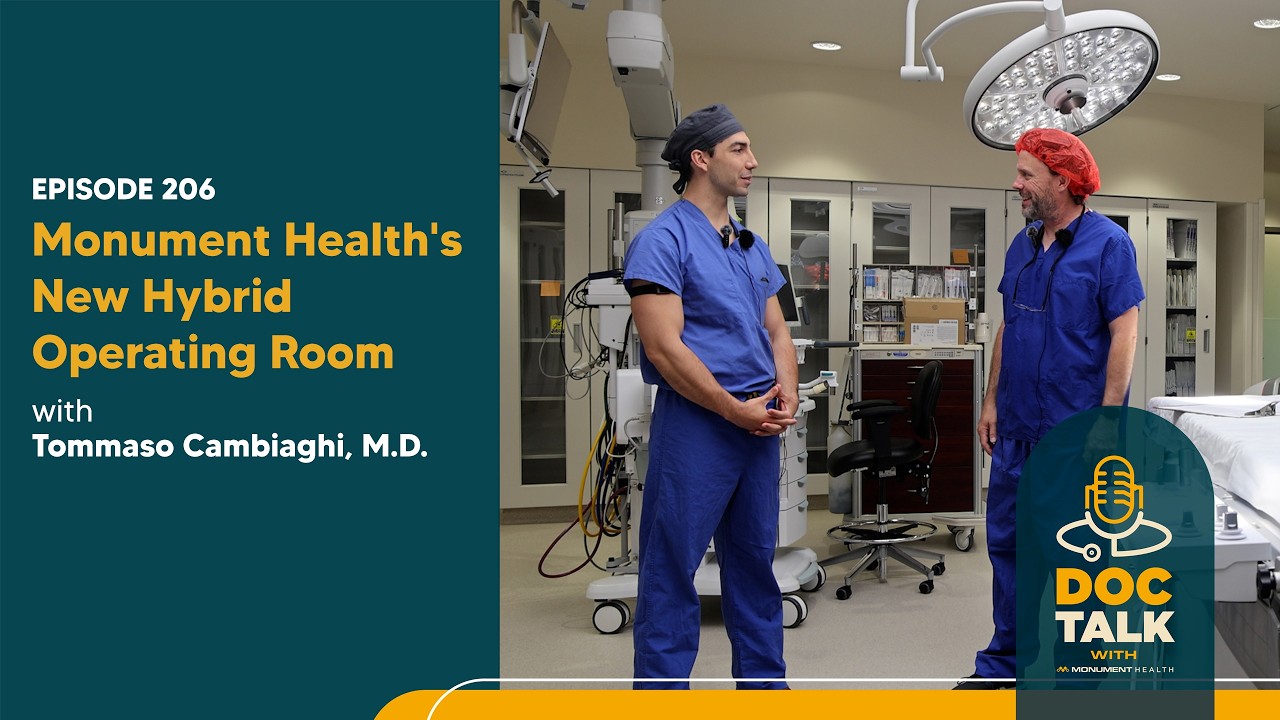
MARK HOUSTON: Hello again everybody, and welcome to another edition of Doc Talk with Monument Health. My name is Mark Houston, and Monument just opened the doors to something brand new that we're standing in here today, a new state of the art operating space built for the most complex heart and vascular cases in the region. Uh, today we're walking through it with Doctor Cambiaghi, a cardiothoracic and vascular surgeon who trained in Milan and Texas, before landing here in Rapid City. I'm really interested to get to why you ended up here in Rapid City on this journey, doctor.
DR. CAMBIAGHI: Yeah, that's a that's a great question. It's, uh you know, the Black Hills are a little different from the Alps.
MARK HOUSTON: Yeah.
DR. CAMBIAGHI: But, uh, the, the little, the opportunity of, uh, building something new in a place that somewhat resembles home. I was from a small town. I grew up close to hills, and I've been through all this training, and I wanted to find a place where this training was really needed. And, uh, Rapid City in the area that Monument serves, uh, really needed advanced cardiothoracic surgery and advanced vascular surgery. And so I'm happy to be here to provide that.
MARK HOUSTON: So how does this look in, uh, like in a country where in Italy where you're from, is it you guys have similar spaces like this there? I mean, could you not find something there that you were looking for? And that's kind of why you wanted to come over here to the United States.
DR. CAMBIAGHI: Yeah. So the Italian healthcare system is extremely different from the American one. It's a nationalized healthcare system. It's great for, uh, for patients that don't have, uh, you know, the means to afford insurance or cover their own costs. But on the other side, as extremely limited resources because costs have to be contained. And so, uh, it's rare to find a facility, even in smaller areas that has the ability to provide such advanced technology to the patient.
MARK HOUSTON: Well, like I said, this is a brand new space that we're in here today. So kind of walk us through really quick about what we're seeing in a space like this. I mean, starting obviously where the patient will be correct.
DR. CAMBIAGHI: Yes. So this is what we call a hybrid room, hybrid because it combines the open operating room abilities. So I can do any type of open surgery. We have anesthesia standing there. We have a heart and lung machine in the back. And we can do any type of surgical procedure. But on top of that, it also has endovascular capabilities, meaning we can do minimally invasive approaches by looking at devices through an X-ray machine and seeing them on a screen, so that I can do complex interventions inside of a patient without having to have big incisions, I can just go into their vessels from the groin or the wrist and insert these devices without having to open them up and put them through the stress of an open operation.
MARK HOUSTON: So you, you, you, what you're bringing to this is aortic and like endovascular expertise, right? That's that's your whole background on this. Kind of explain a little bit what that is for somebody that might not know.
DR. CAMBIAGHI: Yeah. So, you know, there's a, there's a lot of pathology that can be treated with endovascular means. My main interest and focus is aortic pathology. That has been covered extensively recently in the news. Um, thanks to or because of, uh, Senator Graham's demise from aortic dissection. That's just a little part of what aortic pathology looks like. The aorta is a big blood vessel that comes out of the heart and gives blood flow to everything in the body. It gives branches to the arms, the legs, the intestines, the kidneys. And unfortunately, because of different, uh, disease processes, it can dilate and form aneurysms, which are bulging of the aorta that can eventually rupture and cause to bleeding out. Or they can cause dissections. And there's multiple ways to approach this. And endovascular surgery, has been pushing the envelope in trying to fix all these pathologies without big operations, but with a lot of stress on the patient.
MARK HOUSTON: Well, let's talk a little bit about a procedure that you are super familiar with that you actually kind of helped create, which is the TAMBE. Can you walk us through that a little bit, what that means and how you kind of were at the, at the, at the forefront of this?
DR. CAMBIAGHI: Yeah. So TAMBE is actually, um, the specific device, uh, that can be used for something called endovascular repair of thoracoabdominal aortic aneurysms. So aortic aneurysms are dilations of the aorta in both the chest portion and the belly portion. And they are quite challenging to manage. Open surgery requires extensive, uh, operations that last up to twelve hours. Uh, that put the patient at extremely high risk. And, uh, they have to go through tough recovery. So endovascular surgery has been trying to fill that need for a less invasive operation. The way it works is we insert these devices through the groin, put them inside of the aorta, and then we have to connect multiple pieces from the aorta to the arteries to the liver, to the intestines, to the kidneys. And while in the past we would have to modify a stent to be able to do that, now this device comes pre-made with the four branches that allows us to treat all these vessels.
MARK HOUSTON: So the device is what's actually going. Is it is it going inside? Is it, is it or is it is it permanent?
DR. CAMBIAGHI: It is permanent. It's kind of like a line, a disease pipe.
MARK HOUSTON: Okay.
DR. CAMBIAGHI: Think about the aorta as a big pipe and it's leaking. And instead of replacing, uh, the pipe like, uh, you would do in the old days by opening the chest and belly, we just reline it from the inside to prevent any leakage.
MARK HOUSTON: So there, it just seems to me like it's a really glorified stent in a way, just a much better way to do this whole thing.
DR. CAMBIAGHI: It is a glorified stent. It's a big stent with multiple components that takes a lot more work and expertise to complete. But it is a glorified
MARK HOUSTON: Well, how did you then how did you start with this? I mean, how did you how did you become involved with, with in, in essence, helping create this a little bit? Did you.
DR. CAMBIAGHI: Yeah. So I wasn't involved in the creation process per se, as much in the evaluation of its applicability to people. Uh, this was before I even finished medical school. I was, uh, in a big center in Milan, and we were doing a lot of the early work with complex endovascular therapies and, uh, the Gore TAMBE device, which is what you brought up wasn't even on the market. It was like barely on trial. And we still didn't know how effective or how helpful it would be to the population. So I spent many nights, uh, studying, uh, CT scans. So information of different patients were previously treated with the big open operation. I mentioned to see how many of those patients could have been treated with the device and we. We saw that more and more patients could get treated. We made some adjustments to the design of the stent to even expand its applicability to even more patients, because the only limitation of this device is it comes in only two configurations. So unless you meet that configuration as a patient, that wouldn't really be an option. It would have to look at other more complex endovascular.
MARK HOUSTON: Right.
DR. CAMBIAGHI: So that's what some of the early work in my research was focused on, seeing how many patients we could actually help with this device. And then more recently, I kind of pushed the envelope in trying to expand the applicability of this device by delivering it through a vein instead of an artery. Arteries are the vessels that go from the heart towards the outside and veins flowing the opposite direction. Now, arteries in older patients can be very small and calcified, and sometimes not big enough to allow the delivery of this device. The veins, on the other hand, very rarely calcify and are normally bigger than arteries. So in a patient that needed it, we use the vein to get into the body, then went from the vein into the artery and deployed the device. And we were able to treat this patient that would have otherwise not have had a solution for a problem.
MARK HOUSTON: That's, uh, that had to be very rewarding.
DR. CAMBIAGHI: Yes it is. You know, it's years and years of training, it's like six years of medical school, two years of masters, five years of vascular surgery training, two more of cardiothoracic. And then we're here in Rapid City. And even in a place that, you know, you think is small towns, smaller hospital, we were able to deliver such a complex procedure. And this just builds on years and years of studying, training, practicing, but also relies on a much bigger team. Uh, you know, this is not a one man show. Surgery is a team effort. You know, we have anesthesiologists that keep our patients safe and asleep during the procedure. We have scrub techs handling the instruments that need for the procedure. Circulating nurses that provide all the devices that are needed. Uh, radiology techs that help optimize the imaging during these endovascular procedures. And everybody outside of the operating room that helps take care of the patients before and after surgery.
MARK HOUSTON: Well, if somebody is on this table here, um, how many people approximately are in the room at any given time?
DR. CAMBIAGHI: It really depends on the complexity of the case. Usually it's the most complex one you're doing. The most complex would have one to two anesthesia providers at the head monitoring the patient vitals and respiration. We'd have one surgeon or even two surgeons, depending on the extent of the procedure and one or two dedicated assistants. Then there would be a scrub tech, which is the person that hands you the instruments and a radiology tech that hands you all the endovascular material, and sometimes they handle also the movement and the fine tuning of the image. And these are the people that are right next to the base. And then there's at least a couple of nurses in the room that can help gather supplies that are needed.
MARK HOUSTON: So a room this size is needed. I mean, just for this sheer amount of people that are coming in and out while you're doing this, and it's not only the people, it's also the devices, right?
DR. CAMBIAGHI: A lot of devices have their own, uh, machinery that they plug into, and those sit around the table. There's a heart lung machine for the more complex ones. There's a other ancillary endovascular devices that have to find room in, in the operating room as well.
MARK HOUSTON: So in here, what I'm noticing too is this the procedures you're doing in here are hands on. There's there's not robotic really surgery that happens in here at all.
DR. CAMBIAGHI: All right, all right. We do do robotic, uh, cardiothoracic surgery that has a different set of specialized equipment. You probably have heard of the Da Vinci robot. And we do some of that, just not in this setting. Now there's the room of potentially bringing in, uh, Da Vinci robot if we wanted to do hybrid robotic and endovascular surgery. That is a very limited niche. So the robot doesn't sit in this room permanently. Um, but that is a possibility.
MARK HOUSTON: So kind of quickly, if you can doctor, kind of walk us through what you would be doing at this table. Are you basically on this side of the table as you're doing it? Do you have a do you have a preferred side? If you're on the other, you'd feel uncomfortable.
DR. CAMBIAGHI: Most procedures that happen in the belly and chest, I would sit. I would stand on the right side of the patient just because I'm right handed. Everything was, uh, smoother. When I work with, uh, from this side, I just have it. But if I'm working, for example, on a left leg. I may stand on the opposite side.
MARK HOUSTON: Okay.
DR. CAMBIAGHI: So the majority of the cases, I would be here. This way I have access to the controls that can be moved on the opposite. Opposite side. If I am standing there and from here I can control different movements. I can have the table move up to adjust to my height. I can move it up and down or to the sides to get better exposure to different portions. And then there's the key portion of the endovascular equipment, which is, which is that C-arm, the C-arm has an X-ray emitter and then a detector on the opposite side. And all the pictures I take with that come up on that machine over there. And with this controls, I can turn the C-arm to get better angles. I can move it up and down so that I can get the best angle of view of the diseased vessel or aorta or whatever other brands.
MARK HOUSTON: So that's so these are kind of I mean, obviously you're, you're seeing what's happening as they're laying here, but this has kind of become a more high tech version of your eyes as well as you're doing this.
DR. CAMBIAGHI: Exactly, exactly. Unfortunately, I'm still working on my X-ray vision. So in the meantime, I have to settle for this machine.
MARK HOUSTON: Uh, well, maybe that'll bring it all down to be much smaller. This giant equipment. If you as soon as you get that X-ray vision. Um, this, um. Is this how long does a piece of equipment like this been around?
DR. CAMBIAGHI: So there's been, uh, different iterations throughout the years. I would say the, the most primary ones were, you know, portable C-arms that were no different from the X-ray machines. We, we do to do chest X-rays. And the image quality was extremely poor. The X-ray dose that we would, uh, emit in the, in the air would be much higher. And then those have been getting smaller and smaller and with higher resolution, there's been portable machines on wheels. And then we evolved to this, uh, more fixed systems. Uh, these have better imaging capability that lower radiation dose, which is important to protect the patient from any negative effects from X-rays. And also the team that operates with this machinery every day. And as the imaging system advances, uh, they not only show us what's inside the patient as we take X-rays, but they can also allow us to see what's inside the patient before we even take an X-ray. They do that by overlaying images from existing CT scans on the screen, so that we know where we're working on, uh, without even doing X-rays sometimes.
MARK HOUSTON: Well, I mean, all of this stuff is, is exactly what, you know, you see on television sometimes too, in movies they show you. But this to me seems even more involved. And it has to be exciting for you. Like you mentioned earlier, at the top of the podcast is that, you know, for a small town like Rapid City, we're, we're kind of in the middle of nowhere in a lot of instances between Minneapolis and Denver and Billings, uh, up in Montana, you know, uh, it's people, I think, worry when they have these issues that you've described. Well, that's where I'm going to have to go. That's where I'm going to have to end up. And that's going to cost more money. And time and family can't be around. Right? So in a room like this and with procedures that you do, um, I mean, this has to, this has to make you feel pretty good in the sense that you get to help these people without sending them
DR. CAMBIAGHI: Yes.
MARK HOUSTON: All over the world.
DR. CAMBIAGHI: That's the most rewarding thing about this job is we get to help people that would have otherwise no option but traveling five, six hours. You know, the nearest aortic center with this capability would be, uh, Denver going south, maybe Sioux Falls, but more likely Minneapolis, uh, and, uh, Mayo Clinic and all these patients have been treating in the past year and in the past had to go there, take a plane and, uh, the cost of air travel, not having the family support to the Canada was have over here. And also not only for the procedure itself, but also for all the follow ups.
MARK HOUSTON: Yeah.
DR. CAMBIAGHI: You know, every time you need to go and get this procedure checked, which is something that is very important to do periodically, they would have to take a plane to Minnesota or Colorado. And so being able to provide this service for the for this patient has been extremely rewarding. I've ran into some of my patients in the grocery store. You know, I've been taking care of patients that had previously been treated in some of these bigger hospitals that, you know, don't have either the means, the time, or the capability of going back to get their follow up. And, you know, any fine tuning that they need in the future.
MARK HOUSTON: I mean, to me, this just feels, you know, this feels like science fiction when you're walking around in a room like this and all of the training you've done. And when you started in this, this technology has had to move incredibly fast, even for you. Is it hard to keep up with that? I mean, is the the training is ongoing for you for forever, as long as you're going to do this, right.
DR. CAMBIAGHI: Training never stops. The fascinating thing in cardiovascular surgery is the constant evolution. If you think about it, seventy years ago we didn't even have the heart and lung machine. Cardiac surgery was something that was thought to be impossible. Anybody who would try to operate in the heart or blood vessels was being the fool. And now we can do these super complex procedures without even making incisions on the patient. And, and the pace hasn't been slowing down. Every every month there's a new device, a new technique and new technology. And it's extremely stimulating to keep up and have a new tool to offer to these patients every year. There's patients out there that maybe two years ago didn't have a solution to their problem, and now they can be easily managed well.
MARK HOUSTON: And you must love the tech side of this. The technology, I mean, that has to, like you said, uh, the next evolution has to get you excited to be like, what is going to be next? And what am I going to get my hands on and start moving around? Right.
DR. CAMBIAGHI: Um, that's, uh, it's exciting. You know, we keep going to conferences to stay up to date. There's courses about new devices, so we can never get outdated. But the pace is incredible. It's extremely exciting. The big thing is going to be moving away from X-rays and relying more on navigational systems that don't rely on harmful radiation. Moving away from contrast media that can affect the kidneys or cause allergic reactions, make these procedures even less invasive with smaller and smaller devices. And now AI is finding a role in cardiovascular medicine. And it's not only, you know, to get ChatGPT to to plan your vacation trip, it's also to find a way to, uh, find these patients earlier, before it's too late, before aortic aneurysm or dissection takes their lives unnecessarily. It's to monitor them, uh, more carefully to find what patient is at higher risk or lower risk so we can train how aggressive we need to be with our treatment.
MARK HOUSTON: Okay. It's all about, you know, prevention rather than trying to take care of a problem when it's too late. Hopefully they don't have to get here, right? Eventually. Right.
DR. CAMBIAGHI: That was the goal. That's the goal. Yeah. I finally have some time off when, uh, when we can, uh, prevent every single vascular problem. Uh, but yes, it's a lot easier, uh, both on me and on the patient. Yeah. To treat a problem, uh, when we find it early, then, uh, when they show up in the emergency department and may be too late. Right.
MARK HOUSTON: Well, this is like I say in this room is we're doing as we're doing this podcast today. Uh, this room doesn't officially opening until, we're on a Friday and it doesn't open until Monday. So there hasn't, there, a patient hasn't been seen in here. All of this equipment is, uh, you know, uh, fresh off the trucks and ready to go. And I mean, you have to be, Monday's got to be like your Super Bowl here coming up, or your World Cup maybe.
DR. CAMBIAGHI: I would say World Cup would be better. That's right, that's right. The team is ready. The team is excited. We're at the top of our peak. Yeah. And, uh, on Monday at seven a.m., we'll start our first procedure here.
MARK HOUSTON: Excellent.
DR. CAMBIAGHI: We'll do. All the preparations have been done. The supplies are here. The machine is working. So it's just a matter of, uh, playing the final.
MARK HOUSTON: Yeah. That's right. Well, who do you. Who do you? Who do you? Who are you taking, Argentina or Spain then?
DR. CAMBIAGHI: Uh, that's a good question. Yeah, I would say Argentina deserves a win. I think Messi should end, you know, at a high.
MARK HOUSTON: That was my thought too, was, I mean, if he's gonna go out he truly is going to be done then, yeah. I guess you gotta pull for him a little bit. Yeah. Yeah. Well doctor, thank you very much for taking time to do this. I know it was kind of on a timetable here, so we gotta get out of here. But I appreciate it, man. And I hope to talk to you again and do this, uh, after this has all been broken in a little bit.
DR. CAMBIAGHI: Absolutely. All right. Thank you, sir. Appreciate it.
MARK HOUSTON: Yeah, that'd be great. Thank you so much.