
Listen or watch this episode on your preferred platform:


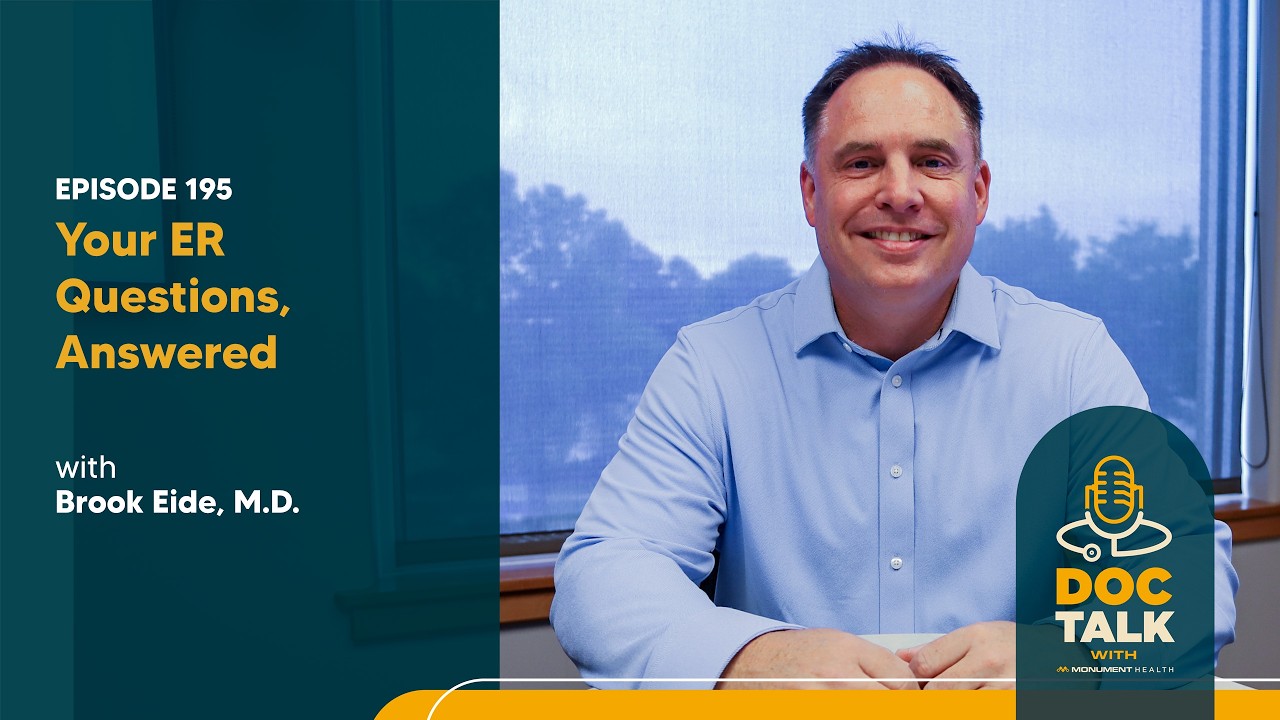
MARK HOUSTON: Welcome to Doc Talk, a weekly podcast featuring Monument Health physicians addressing medical topics. Tune in to your health with Monument Health. Hello again, everybody, and welcome to another edition of Doc Talk with Monument Health. My name is Mark Houston, and if you've been following along with us this year, you've already taken a couple of pretty big walks, more walking than I've done all spring and summer, actually. The first was through the main emergency department downtown at Rapid City Hospital. The busy one, the one that serves a five-state region. The second was a first look inside the brand new ER on East Mall Drive. We were still getting the plastic peeled off the machines when we were there. And our guide on both of those tours so far has been Dr. Brook Eide, an ER physician who has been doing this work in Rapid City for well over sixteen years now.
DR. BROOK EIDE: Yeah. Eighteen. Eighteen, oh yeah.
MARK HOUSTON: Well, after those episodes aired, we got a lot of people in the inbox asking questions about this, which was great. So today, Dr. Eide, I'm glad you're back, because I want to do something a little different. We're going to recap what we saw at both locations, and then we're going to spend most of our time on the people that sent in these questions. So, Doctor, welcome back. Thanks for coming in and doing this again. We get to sit down this time. We can be comfortable. We don't have to look awkward on camera.
DR. BROOK EIDE: It is nice to sit down. I was going to bring it up off air, but I was a little bit worried about how short of breath you were there, you know?
MARK HOUSTON: Well, like I said, I'm with an ER doctor. I wasn't too worried.
DR. BROOK EIDE: We've got some wonderful cardiologists and emergency physicians, and we'll get you plugged in here, ready to help.
MARK HOUSTON: Well, we've had you on twice now for tours. You can go back and watch the tours on YouTube on the channel, or you can just listen to it as well. I think we explained things pretty well as we were walking around. We toured the main ER downtown and the new East-side location on East Mall Drive. So before we get into the listener questions, just give us a quick refresher on what each of those facilities is built to do, Doctor.
DR. BROOK EIDE: Yeah. So it's nice. Now we have these two facilities, and so there's a little differentiation between the two. Our main facility, the first place we toured, the main Monument hospital in Rapid City, is a large tertiary emergency department that sees traumas and strokes and has multiple helicopters coming in. It's like the TV shows. And so that's what we do there. This new facility is going to be a really nice alternative, to have another location to go. It's going to be not as busy. It's going to be easier to park at, off the main campus. But we're going to do the same emergency care there. We're going to have the same physicians that work one day in the main emergency department, seeing the craziness, the next day being there to offer that same great care, just at a different location. So it's really exciting for Rapid City to have an alternative here, and then have it within the same system, so we can really plug you in easily to the main hospital. So it's going to be great for the people of Rapid City and the surrounding areas.
MARK HOUSTON: So you kind of mentioned it. This is still one big system. Is that what this is?
DR. BROOK EIDE: This is correct. There are two separate entities, of course, but that relationship between the two is going to feel very familiar.
MARK HOUSTON: I'm assuming, for people that have had to be there more than once, you're still going to understand and get that care, right?
DR. BROOK EIDE: Absolutely. So we talk about it a lot as a long hallway, really. We're here in Rapid City, and it's just a long hallway to this other facility on the other side of town, giving access to more people in a quick fashion. When you come in, we're going to have the same computer system. We're going to have all the same things, the same access to your doctor's information. It's all going to be right there. And if we have to send you somewhere else, it's all plugged in. So it's really nice that it's part of that system. It's really just a different location. Once you're in that room, you might close your eyes and not know which place you're at. You get that same care.
MARK HOUSTON: And there are just some small differences between the two, really. If it's a big, major-deal traumatic thing that has happened to you, the main emergency room is where you want to be, right? But if it's something a little bit smaller, something that they can deal with quicker on that side of town, that's where you'll go, right? That's kind of the connection between the two. If you go to one, you still may end up at the other.
DR. BROOK EIDE: Yes, absolutely. So it's going to be that thing, in some ways, to think of it as a place to go where, if you're not sure, you're like, well, I'm not sure what I need, maybe urgent care, but this seems more than urgent care, then that's a great place to go.
MARK HOUSTON: It's a great way to think of it.
DR. BROOK EIDE: If you're coming by ambulance, lights and sirens, something really bad has happened, then you're going to go to that main hospital where all those resources are. And that's really the main difference, a lot of the resources there. As far as other specialists, as far as some of the other specialized imaging, some of that stuff will only be available at that main campus. But for the bread-and-butter emergency care, we'll be able to do that really well at this new facility, in a really timely fashion. So it's going to be great for those kinds of things. You know, if you've had a kidney stone before and all of a sudden in the middle of the night you have this terrible pain and say, I can't take this, this feels like my kidney stone and I'm never going to sleep, then that's a great place to go, because we can manage that pain. We can get that imaging, we can figure out how big that stone is and where to go with it. If you have had six heart attacks and you wake up clutching your chest, this feels exactly like the last time I went to the cath lab and got stents, then you might be better off going to the main hospital, where we can really timely get you plugged into cardiology and get that intervention quickly.
MARK HOUSTON: Well, and what's nice is, by the time this podcast airs, we will be just a day away from the brand new facility opening out there on Mall Drive, right?
DR. BROOK EIDE: Yeah.
MARK HOUSTON: And that's got to be, even for somebody that's been doing this for over eighteen years, how many new emergency rooms have you been in? Like brand new, just peeled the sticker off and you're walking in.
DR. BROOK EIDE: Yeah. Well, the one we're in currently. It was kind of an exciting time. We moved over that emergency room in the middle of the night, because at our main shop, we were never dead. We always have patients. And so we tried to plan that to do it on a Tuesday night at four a.m. when we're statistically the slowest. And the problem with emergency medicine is you can never plan. And so I remember that night, we ended up having fifteen or sixteen people in the emergency department. So we had a caravan of people that we rolled over, and peeled the sticker off, and put them in the new place. This will be a little different, where when we open up on June tenth, that first person that walks in will truly walk in. There'll be nobody there. And so they'll be our first patient.
MARK HOUSTON: We should have balloons and streamers. I mean, depending on how serious it is, maybe there needs to be a little fanfare.
DR. BROOK EIDE: Yeah, right. I should go to Walmart and get some of those little popper things and confetti.
MARK HOUSTON: No, it was my heart. Don't make it pop.
DR. BROOK EIDE: Exactly, exactly. Like, is this, I'm at the zoo, or I'm at the emergency department? But so yeah, this will be a unique thing, in that this is the very first time that the first patient will walk into this new facility. So that's really exciting. And you're right, there's not a lot of opportunities you have to work in a brand new place and take the tape off the door and open it up and go in. So it's exciting for us. It's exciting for the community, really, because for a lot of years we've had regional and Monument, and it's been kind of the one place to go. And I guess if you go back far enough, there was Saint Mary's and the other hospitals, but that's before my time. So this is exciting for the community to have this alternative here. An alternative within our system, that really has the same benefits that you'd have in the main place, but is just a different place to choose.
MARK HOUSTON: Well, and I think, speaking of the community, which is obviously going to be the ones that are best served with this, for sure, it was fun to get some questions that actually came in about the new medical campus. And I want to walk through some of them with you. I removed all last names and everything, but these are real questions from people in the community that came in. So let's start with Allison, who wants to know: what level trauma center will the new ER be? Because the current ER is a level two, correct?
DR. BROOK EIDE: Yes. So this will be, it will not be, all emergency departments get a trauma designation. But this will be a low-level trauma designation. In order to get your trauma designation higher, you have to have resources. And we kind of talked about that before, that we're level two, and the only reason is that we don't have residents, surgical residents, in our hospital. Otherwise, we would definitely meet the criteria for a level one. So we do everything we do to level one except for some of the teaching stuff. And that's because we have access to trauma surgeons and orthopedic surgeons and vascular surgeons, and all those are right there for that trauma care. This will be a lower-level trauma center, because it'll have just the emergency doctor there. That said, if a trauma comes there, we're going to quickly get them to our main trauma center, and we're set up to have that plug-and-play and be there in minutes. We won't bring things like ambulances directly there, because they may need more of those trauma resources, and we want to bring that to the trauma center where time is very important to us and we can have them get those resources. So as far as a trauma center, it's not going to be a level one or level two or level three. It's part of our system, and so it's going to be kind of tagged off to the old ER, but it won't serve as a trauma center, necessarily.
MARK HOUSTON: Okay. And this question from Katie that came in, which it seems like it would be a common-sense question, but I'm glad she asked it, because there might be a fair number of people that just aren't aware. Will this emergency department be twenty-four-seven, three hundred sixty-five?
DR. BROOK EIDE: Yeah, that's a great question. And that's one of the things that will define this from an urgent care especially, or things like that, is that we will be twenty-four-seven, three hundred sixty-five. So we will have a board-certified emergency physician there to meet you on Christmas Eve at eleven o'clock at night. So it will always be open. We will always have it staffed, just like a real emergency department. This is a freestanding emergency department, but it's truly an emergency department. So it will offer all the emergency care of an emergency department, just without the main hospital hooked to it.
MARK HOUSTON: It's not common for emergency departments to not be open like that, is it? Are there places that do that?
DR. BROOK EIDE: Yeah, they have a few carve-outs in some states where they let them do it. But for the most part, what designates an emergency department is that twenty-four-hour service. And with that, there's certain rules you follow. The emergency department, we follow the government's rules and some other government guidelines that help us make sure that we're meeting the community's needs really there and meeting everyone's needs. And we'll do that there, too. We'll see whoever needs to be seen, whoever's emergency, just like at our main hospital. You know, we're there to serve our community. And by our community, the nice thing about this is, I don't just mean Rapid City. I'm a, I grew up in the northern hills, right? So we'll serve all of the surrounding area at this facility, just like at the main one. So we're happy to see whoever needs emergency care. We'll be able to take care of them there.
MARK HOUSTON: Mary, I'll quote her directly, actually. She says, quote, I hope it's faster to get in and out than the other ER. Now talk to me about that. Like, with the direct-bedding setup you showed me on the tour, what should people actually expect when they walk in?
DR. BROOK EIDE: Yeah. I mean, our hope is that this allows us to give more emergency care. And so, you know, right now we have times at the main ER where there are some waits, honestly. South Dakota has the second-fastest ER throughput times in the country.
MARK HOUSTON: And that was surprising to learn. You told me that when we were walking through the new one.
DR. BROOK EIDE: Yeah. So we're actually very fast. It's just, when you have an emergency, nothing's fast enough. And I get that. When you're having that, you don't want to wait fifteen minutes. You don't want to wait half an hour, because it's an emergency. With this facility, our goal is to bring people directly back to a room when they come in, if we have rooms, and start that care immediately, and be able to quickly get them the tests they need, the laboratory tests they need, the imaging they need, to determine what their emergency is and then how we best treat that.
MARK HOUSTON: Cass asked, if a patient arrived needing emergency surgery, would the surgery be performed at that facility?
DR. BROOK EIDE: Yeah. So again, kind of going back to those resources, there won't be any surgeries done there, or some advanced testing. So this is going to be a place where we do the emergency room care, the stuff that you would typically get in the emergency room in the main hospital. If you need surgery, if you need to go to some other ancillary service, then those will all be at the main hospital still. And so you'll be taken over to the main hospital for those kinds of procedures.
MARK HOUSTON: Now, would that all be direct, ambulance-driven? I mean, if you have to get over there, you're in an ambulance then, and you're taken over to the main hospital. Would that be right?
DR. BROOK EIDE: So we'll coordinate all of that. Monument will coordinate that. So if we determine that, you know, you're in our system and you need care that needs to be done at a different campus, then we will get you to that campus and we will get you to the right place, and we will get that all plugged in for you and take care of everything. So if you show up in this ER, it's just like being in another ER, except instead of going on a cot to the next place, you may get an ambulance to go there first.
MARK HOUSTON: Okay. Paulina wants to know: will there be a pediatric specialist on site?
DR. BROOK EIDE: There won't be a pediatrician in the hospital. All of our emergency physicians that are there will be board-certified emergency physicians. So they're certified in pediatric emergencies as well as adult emergencies. So there will be the ability to do the same. It'll be the same physicians in the emergency department doing the pediatric care. If you need to be seen by a pediatric specialist, then you will need to come to the main hospital.
MARK HOUSTON: So that question, to me, just kind of seems like a worried parent right there, right? Asking, you know, if something comes in with my son or my daughter and something is wrong, will they know how to take care of that? But yeah, you've answered that question.
DR. BROOK EIDE: Yeah, absolutely. So they come in, we'll still do that initial figuring out what's going on, figuring out a treatment, figuring out if we can get that child good enough to go home and see their pediatrician, or if they need to be in the hospital, determining that. And if they do need to be in the hospital, we'll get them to that pediatric area in the hospital and make sure that's all taken care of.
MARK HOUSTON: Okay. Sue and Judy kind of sent in similar questions, so I'm going to combine them both together here. If somebody comes into the new ER and ends up needing to be admitted, where do they wait until a bed is available at the main hospital? They get transferred over by ambulance, but where will they wait while they're there at this new ER?
DR. BROOK EIDE: Well, once we determine they need to be admitted, just like in our emergency room currently, there's a little bit of lag time as we make sure that room is clean and ready for them, making sure they get onto the right floor. And so they'll wait in our freestanding ER for a short period of time, until we have a room ready for them, and then go by that ambulance directly to that room.
MARK HOUSTON: Okay. Now, we're already nine questions in here, and this is the first one we got where somebody is now asking about the cost. So Felicia says, if transport to the main facility is needed, is that a cost charged to the patient? Especially if it's because of a limitation in the smaller facility that they wouldn't have known about going in.
DR. BROOK EIDE: Right. That's a great question. So those transport costs will be part of the Monument cost. So they will not be, you won't get another ambulance bill. And so, yeah, I can see that big concern, saying, well, now you're calling an ambulance. I didn't come in the first time because I didn't want to get the ambulance bill, and now you're calling an ambulance and took me to the main hospital. That'll be the same as when we transfer people from Sturgis or Custer or Deadwood, or when you get transferred into the main hospital. It's the same thing, where we use an ambulance for transport, but it's really transport. It's not an ambulance.
MARK HOUSTON: Oh, okay. Well, that's really good to know, honestly. I think that's a question a lot of people, and I, when I read it the first time when it came in, yeah, I wouldn't have thought twice about it. I would have thought the same thing. Oh, great, now I'm going to be charged even though I didn't come in that way.
DR. BROOK EIDE: Yeah. So that's kind of a Monument thing. We use ambulances to help us transfer people from different facilities all the time. And this will just be a similar thing, that if you went to Sturgis and needed to come down, then we use an ambulance service, but otherwise they're really transport more than they're ambulance services at that point.
MARK HOUSTON: Excellent. Now, Alicia, last question here. She says, I'm going to read this one the way she sent it in: are you guys actively hiring for that location, asking for a friend?
DR. BROOK EIDE: Yes. We can get you penicillin. Yeah. So I think we are, we are hiring. We're always hiring. I mean, Monument is a large healthcare facility, and we're always looking for qualified people for lots of different positions. So we're always looking for more. If you're an emergency physician, give me a call, we'll figure something out. But we're looking for nursing. We're looking for other things. We have lab there, we have radiology there. And so yeah, we're always looking to find good people that treat our patients the way we would treat our family. And if she has a friend that meets that, we'd love to hear from her.
MARK HOUSTON: Now, you may not know this, but do you know about how many people generally will be working there at any given time?
DR. BROOK EIDE: Yeah. So we'll have one emergency physician there, twenty-four-seven, three sixty-five. And then we'll have two nurses, two emergency nurses, there at all times. And then we'll have a plethora of other staff, from front-office staff and registration staff and those kinds of people, to kind of make the wheels turn. And then we'll have multiple people in our lab at all times there. The lab will be open twenty-four-seven as well. And then we also have an imaging department that will have a few people there as well, to do your X-rays and CT scans, and at times we'll have some ultrasound ability there, and that'll grow. There's going to be some outpatient lab and imaging there. So it'll be nice that there'll be several people there to do those outpatient things, but also to prioritize our emergency tests when they're done.
MARK HOUSTON: And that, I know we talked a little bit about this on the last podcast as well, for that outpatient service, is that going to turn on immediately when the ER opens, or is that coming down the road later? For people that don't need an emergency service, but just need blood work, they want to come in and do that, is that ready to go from day one, or is that later?
DR. BROOK EIDE: Yeah. So some of the stuff we're going to roll out over the first few weeks, but I believe they're going to have some outpatient lab and imaging starting really, really right away.
MARK HOUSTON: Okay. Well, last thing, Doctor. For people in this region who've only ever known the main hospital downtown, what is the one thing you want them to walk away understanding about why this new facility matters for the region?
DR. BROOK EIDE: Yeah, that's a great question. I think this new facility really helps us grow in delivering health care. Our communities have grown, and we've seen growth in Rapid City and growth in our surrounding communities. And we're trying to meet that and match that and say, how do we continue to best serve all the people of Western South Dakota and Nebraska and Montana and North Dakota? How do we do that? And our goal is to continue to do that and continue to give world-class health care right here in Rapid City. And we do that by timely seeing patients, treating their emergencies with the best specialists for their care. And this lets us keep doing that. And that lets us kind of grow and expand and serve our patients, but not make them all come into the main place and try to find a parking place and all that, but help them, bring health care to where they are. And that's kind of our goal, and that's kind of where health care is going, is to bring health care to where people are. And this is Monument kind of taking that forward, progressive step to say, let's serve this community. Let's take health care out to where people are living and moving, how they can access it, and really give them great care to make sure that we're a healthy community.
MARK HOUSTON: Well, I can tell you're excited for this new facility to open, since we've been talking about it. What's your first shift out there, do you know?
DR. BROOK EIDE: I will be there day one.
MARK HOUSTON: Will you? June tenth?
DR. BROOK EIDE: I will be there with my stethoscope on my neck, ready to see everyone who comes in.
MARK HOUSTON: That's right, that's right. All right. Dr. Brook Eide, who is an ER physician, will be at both ERs. You'll work downtown here, and you'll also be working out at the new one, on whatever rotation, however they set that up. We'll be surprised to see you at some point, I'm sure. Thank you for coming in and recapping all of this, too, Doctor. And, you know, we hope to talk to you again, maybe next year, when it's been kind of a year under the belt, to see how it's all going. That'd be fun to follow up on.
DR. BROOK EIDE: Absolutely. Yeah. There's a lot of unknowns with any new project, mostly exciting and good. And yeah, I'd love to come back, and I'll tell you what surprised me and what didn't, and what went well, and where we're going moving forward.
MARK HOUSTON: All right. Awesome. Thank you, Doctor. It's always good to talk to you, man.
DR. BROOK EIDE: Great. Thank you, I appreciate it.