
Listen or watch this episode on your preferred platform:


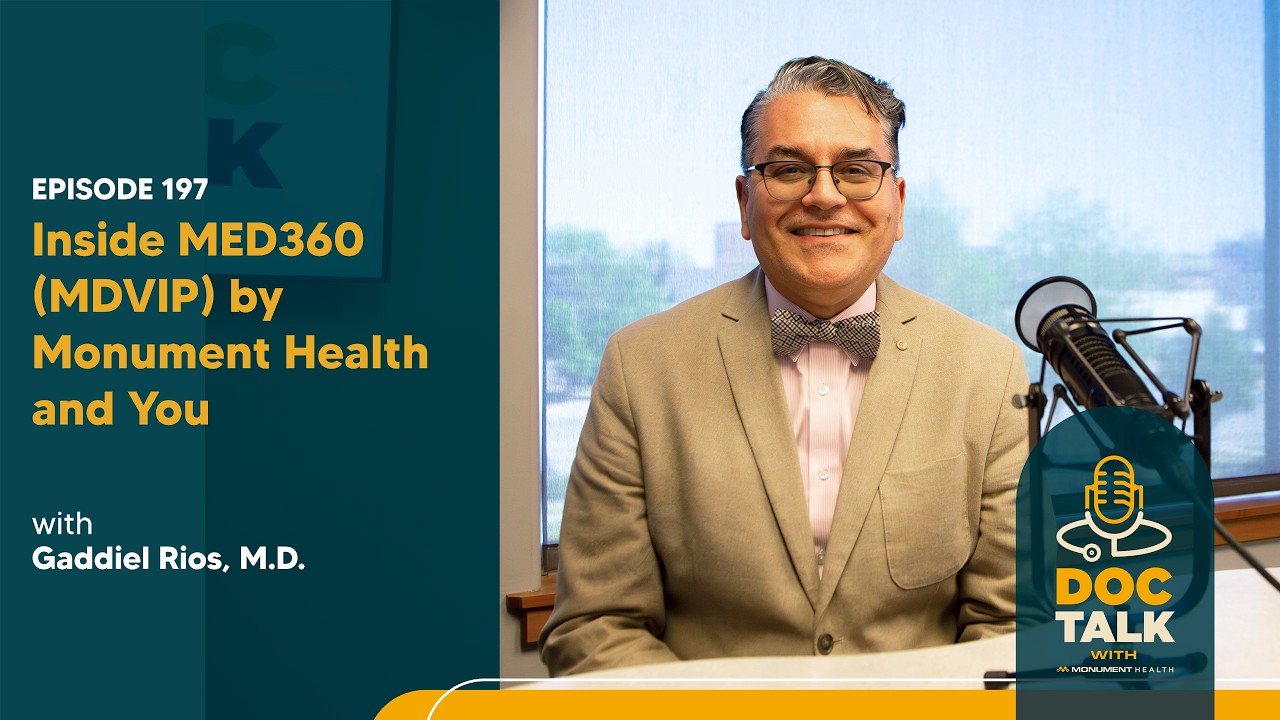
MARK HOUSTON: Hello again, everyone, and welcome to another edition of Doc Talk with Monument Health. My name is Mark Houston. Today I am sitting down with Dr. Gaddiel Rios, a primary care physician in Rapid City who is part of a national network called MDVIP. It's a different way of practicing medicine. Smaller patient loads, longer appointments, and a real focus on catching problems before they become problems. Dr. Rios is going to walk us through what this kind of care is and what it looks like, who's a good fit for it, and why preventive medicine matters more than most of us realize. Welcome, Dr. Rios. Thank you for coming in.
DR. GADDIEL RIOS: Well, thank you. Thank you for having me here.
MARK HOUSTON: Now, how long have you been here in Rapid City?
DR. GADDIEL RIOS: So in Rapid City, we opened the clinic last summer. Actually, today is the one-year mark.
MARK HOUSTON: Oh, congratulations.
DR. GADDIEL RIOS: So yeah, before that I was in South Dakota as the associate chief of primary care for the Black Hills VA. Total, a little over two years in South Dakota, and about two and a half years in Wyoming before that.
MARK HOUSTON: Well, where do you come from before you ended up out here in the middle of nowhere?
DR. GADDIEL RIOS: So I have a very nomadic trajectory. Originally, my folks are from Puerto Rico, and we moved to Massachusetts when I was seven, where I went through school and high school. I did my undergrad in Michigan at Andrews University and then medical school at Tufts University in Boston. I took the military health scholarship at that point to help pay the bills, so I traveled with the U.S. Army from Walter Reed to Belgium, Fort Hood, Texas, Fort Polk, Louisiana. I got a year's vacation in Iraq, in '03 and '04. I like to say, you know, sun, sand, palm trees.
MARK HOUSTON: I mean, if that's how you've got to rationalize that.
DR. GADDIEL RIOS: Absolutely. And then in '05, I opened a private practice in Houston, Texas.
MARK HOUSTON: So you were enlisted?
DR. GADDIEL RIOS: I was an officer. A medical officer. One of the nice things about the health scholarship the U.S. military offers is that you can be in any branch, Army, Navy, Air Force, and so forth, and you come in as a medical officer. So while you're in school, you're a second lieutenant, and then once you graduate, you jump from second lieutenant to captain and full active duty. My time in the military was always as a medical officer, from 1994 to December of '05.
MARK HOUSTON: Did you always know that this is what you wanted? Is there medicine in your family background?
DR. GADDIEL RIOS: So my youngest uncle on my mom's side of the family, he's about nine years ahead of me. He was the first one to go to college in the family, and he went through medical school the same way, with the health professional scholarship. He was in the military, and when I was in high school, that would have been when he was graduating from medical school. So he served as a role model for me. Now, with that said, through high school my intentions were not medicine. I actually spent three summers at IBM camps in the '80s learning computers. In the early '80s, that was science fiction. It was exciting to be part of the summer programs with the IBM group learning about cutting-edge technology, which back then was refrigerator-size systems. We're talking the 1983 to 1985 time frame. But then in 1986, one of my teachers, I think it was my biology teacher, recommended me for a summer program at UMass Medical School for high school kids interested in science. I spent six weeks at UMass rotating with medical students and residents and seeing the hospital, and that's when I fell in love with it. Because even though I loved computers and I loved science and math, the difference was the interaction, being able to talk to someone and be there and help them out. So when I went off to college, instead of following engineering, which I had been offered a scholarship at Boston University for, I did a bachelor's in medical technology. That took me right into the hospital system, and that led me to a couple of years at the Cleveland Clinic in Ohio, where I ran a research department under Dr. Eric Topol. That was my stepping stone to medical school.
MARK HOUSTON: Boy, that is a long road to get to where you are right now. But it sounds like you had a genuine interest in this, and it seems like so many of the doctors I talk to on here, it's not immediately known, but something about getting into this profession clicks for them.
DR. GADDIEL RIOS: Yeah. That's how it was for me. That summer I spent at UMass was like, wow, this is really what I want to do.
MARK HOUSTON: Well, let's talk a little bit about what specifically brought you here, Doctor. A doctor I spoke with a year or two ago on the podcast had brought up MDVIP, and I didn't really look much into it after the fact until I got the topic you wanted to talk about. It's a name a lot of folks I don't think are familiar with at all. So give us just a quick overview of what it is and how your practice fits into that network.
DR. GADDIEL RIOS: The company has become a national company. They've been around since 2000, started off in Florida. Basically, a group of primary care doctors in the year 2000 looking ahead and saying, where is healthcare going? A lot of doctors, especially those of us who are a little bit older and saw what medicine was like, could see what medicine was becoming. So they predicted that back in 2000. They got together and said, how can we provide a system that still allows direct care, direct patient access to your doctor, and quality? They went to Washington and started doing all the homework, looking at where legislation was going. And the reality for them was, well, not pure concierge medicine where you pay for everything along the way, but a membership-based model to offset the cost of volume. When I was in Houston, for example, my patient panel in my private practice was four thousand patients, because you have to see patients, you have to have the flow to pay the bills. That's just the reality of modern medicine. With the MDVIP model, can you keep the patient load between four hundred and six hundred patients? That way you have the time. I can sit down for an hour, hour and fifteen minutes with a patient if I need to. I can walk in patients every day if they need to be seen, or at least see them tomorrow. The other really important aspect is that every one of my members gets my cell phone number, so they know they have access to me. They can call me if something happens. It's not leave a message somewhere or put in a computer message and see when it gets responded to. So it's accessibility. You have access to your provider. It's availability. It's not, oh yeah, we can see you in two weeks or three weeks. It's we can see you today or tomorrow. Those are two big aspects of it.
MARK HOUSTON: What just stands out to me, you said at one point four thousand patients. Now you're down to four hundred to six hundred. That alone not only gives the patient you're seeing peace of mind, but boy, for you it also has to feel fantastic.
DR. GADDIEL RIOS: Sure. My average day in Houston was thirty-two, thirty-three patients in a day. When you convert that to now eight to ten patients in a day, and that's a busy day, you have time. And that makes a big difference.
MARK HOUSTON: Well, and you were talking too about the screenings you're able to do with MDVIP. The wellness program includes what you guys consider advanced screenings that kind of go beyond what insurance will even cover, correct? What does that mean?
DR. GADDIEL RIOS: So when we look at a regular annual wellness visit, it includes a cholesterol panel, cholesterol, triglycerides, HDL, LDL. What we can do is look beyond that and say, well, the sub-markers like apolipoprotein B, lipoprotein A, myeloperoxidase, LP-PLA2 activity, these are cardiac markers that can give us a better insight and a better predictor of what your actual risk is beyond just looking at your cholesterol. Most insurances won't pay for that, and so that's paid for with the membership fee. It's all inclusive. Beyond that, we do a screening EKG, pulmonary function test, grip strength, blood pressure comparisons of arms and legs, that's called an ABI. We do a body composition analysis, hearing, visual. We really bundle up a lot of screening tools that normally don't happen in a regular visit, and that allows us to take a deeper dive.
MARK HOUSTON: One of the stats I saw too, in looking into this, that kind of stood out to me: seventy-two percent lower hospitalization rate. Is that accurate?
DR. GADDIEL RIOS: It is, and here's why. Anyone in healthcare will tell you, especially the ER will tell you, if someone doesn't have access to their doctor, they're going to go to the ER. Or they weren't able to see their doctor, something worsened, and now they have to go to the ER. When you're accessible and when people can see their doctor, you can catch those things early, treat them and manage them in the clinic and at home, as opposed to waiting for complications to evolve. And now we also have a nationally documented twelve percent lower risk of a heart attack for MDVIP members. When you look at the impact of twelve percent across a population, that's a huge impact. By allowing us to do extra tests that normally don't get paid for with regular insurance, incorporated into the membership fee, we can take a deeper dive and look at coronary artery prevention. The extension of that is wellness and living better, healthier, longer. It's a combination of lifestyle, dietary changes, and knowing your numbers. What can we measure and help fix?
MARK HOUSTON: The security aspect of it too. I can't tell you how often in different areas, especially here in Rapid City, if you ask people how easy it is to talk to your primary care doctor, they'll say they have to leave a message, send a computer message, eventually someone replies, and it's not the doctor. That creates frustration and uncertainty, right? Am I getting the right answer?
DR. GADDIEL RIOS: Exactly. And I don't mean to be critical of the system. It is the way it is, and those measures are put in place to help communicate with patients. But the old-fashioned way of having accessibility to your doctor, I think that goes a long way. People's go-to is the ER for whatever. An earache, a sprained ankle on the path, I've had people that slipped and fell and needed suturing. Let's do it in the office. You don't necessarily have to go to the hospital for those things. It really evolves into a situation where you don't have to worry about the hours you're going to spend at the hospital, and the hospital doesn't have to carry the burden of things that could be done in the family practice office.
MARK HOUSTON: But you say you give your cell phone number to these patients. That's a twenty-four-seven commitment right there. How do you handle something like that?
DR. GADDIEL RIOS: Let me frame it this way: I did the same thing in Houston with four thousand patients. And the reality is that when patients know you're accessible and know you're available, when they do call, it's significant. I want to talk to those patients. Even with the volume of patients I had, I had very few phone calls at night or on weekends. And when I did have those phone calls, they were important. Same thing here. We just hit the one-year mark, and yes, when my patients text me, message me, call me, it's important. And when patients know you're accessible and you're there for them, it doesn't get abused in general.
MARK HOUSTON: And I wonder too, if just knowing that you're there gives someone peace of mind to where maybe they don't even have to call. I know he's there, I know he's available, maybe I can wait until tomorrow morning.
DR. GADDIEL RIOS: It does. It gives them peace of mind. They don't have to overstress about this. And nowadays, of course, a simple text message goes a long way. I can reply and say, oh yeah, let's talk about it, or, oh no, you're fine, come in in the morning and I'll see you. Having that level of communication goes a long way.
MARK HOUSTON: Well, talking about relationships, that must make it hard to leave certain places when you've built those connections.
DR. GADDIEL RIOS: Part of it was automatic because of my military time. You just had to pick up and go. I spent a long time in Houston. Really the bulk from early 2006 to 2021, and it was tough to make that decision. Now, part of it was not my choice. We had a huge freeze in 2021 overnight that destroyed my building and my practice. You wake up the next morning and realize you've lost everything. So what do we do next? You go to a place where we can handle freezes pretty well. That's part of how I ended up here. I came with a specific goal, which was to build a rural clinic in Wyoming near Devils Tower. And then I took the role of associate chief of primary care for the Black Hills VA, because of my time as a physician, I was heading down more of an administrative road toward eventual chief medical officer and things like that. But very quickly I realized I really missed my patient interactions, which is what got me into medicine to begin with. When I had a conversation with our CEO, Ms. Davidson, and she presented this plan they'd been thinking about, that really lit the light bulb. I thought, I would love to participate in that, be able to give care one-on-one with time and give the quality. That's how this particular journey started.
MARK HOUSTON: Early on in your career in Houston, I imagine you got to know people quite well over the years.
DR. GADDIEL RIOS: Oh, absolutely. I got invited to birthday parties, to weddings. I actually had a few patients who left in their will that I had to speak at their funeral. Three come to mind that are very memorable, that I went and did their eulogies. Not that that's something I wanted to do, but it shows the amount of relationship you're able to develop with these folks. They hit their eighties, and they want you to be part of their lives. They want you there at the end as well. It goes to show the relationship you can establish.
MARK HOUSTON: Now, this is a membership-based service. Some folks will hear that and assume it's only for one type of person. Who tends to benefit from something like this?
DR. GADDIEL RIOS: It's interesting. My current age distribution goes from the mid-twenties to eighties, so it's a pretty wide range. Every age group is looking for something different. The younger group is looking for how do I live better, healthier, longer, and how do I plan ahead based on family history or other motivations. The forty to sixty year-olds are getting to that phase of life where they're looking at how am I going to enjoy my retirement and stay healthier. Then the over-sixty population, who had the old-fashioned way of medicine, they're saying, how do I get that doctor I can really talk to and see when I need to be seen, because now I have more health issues and concerns. Beyond that, the executive exam is something people really value, because we can dedicate a deeper dive. The first visit is about an hour and a half. The follow-up visit, where I sit down and customize a health journey for them with all the data we've collected, is about an hour. That's really important for a lot of people. Corporations also see the benefit. Keeping their employees healthier translates into less missed work, better quality of work, and lower healthcare costs. When they renew their insurance plans, it's a lot better. Nationally, MDVIP has told me that a huge portion of their membership is people like nurses and truck drivers, because of accessibility.
MARK HOUSTON: The other thing is, because it's a national network, someone traveling can still get care.
DR. GADDIEL RIOS: Exactly. Let's say I have a patient traveling to Arizona and they need to be seen. Instead of going to an ER or urgent care, they call me. I call one of our affiliate clinics down there and say, hey, can you see our member? And they can walk in because they're a member. Along with that, we have a network of fifteen major medical centers we're affiliated with. So if we need to refer to a subspecialist or something we don't have here locally, Monument Health already has a great relationship with Mayo, but now we have an extended relationship with places like Harvard, Johns Hopkins, MD Anderson, Miami, UCLA, and a few others. How many doctors are part of this? Right now it's about thirteen hundred doctors nationwide in forty-seven states, and over four hundred twenty thousand members in MDVIP nationwide.
MARK HOUSTON: Is there anyone you'd say this might not be a fit for?
DR. GADDIEL RIOS: Well, as a physician, I think everybody should have a good doctor and take care of their health. Now, there are folks, let's be honest, who don't want to know. They don't want to engage with it. For someone who's not really going to take advantage of it, why spend the money? But in general, because we are primary care based, there isn't really a reason to say this doesn't apply. I see my members' children as well, from toddlers through teenagers, up to age twenty-six as a dependent. The only thing I don't do anymore is deliver babies. But from the toddler phase up through the geriatric phase, I see them. And if we need any subspecialist or specialist for anything, we do those referrals as needed. That's how it all ties in with Monument Health as well.
MARK HOUSTON: Fortune magazine ranked MDVIP highly in their executive exam list, didn't they?
DR. GADDIEL RIOS: They did. The current Fortune ranking for best executive-style exams has Mayo, and then MDVIP right below it. But we're the only one in the top ten that is actually primary care based. The places that are strictly executive-style exams are built just for executives, for the high-end CEOs and so forth. Because we're primary care based, it really is wide open.
MARK HOUSTON: For someone hearing this podcast right now who's interested but hesitant, what do you want them to know before they reach out to you?
DR. GADDIEL RIOS: First, what are they looking for? Are they looking for managing their current medical problems? Are they looking for prevention and wellness? Do they want to talk about weight loss, preventing cancer, preventing heart attacks and strokes? I always like patients to come with their history, to know themselves and their family history. Say, here's my history, what are the things you think I should watch out for, what are the things we can work on? I always like my patients to be informed first. And then, where are we going with this? Is it to just manage your medicines and not worry about anything else, or is it how do we improve our outcomes? One of the things I do is I use an AI algorithm for cardiovascular risk. I can plug in a patient's data, and I can say, look, here's where you are today, and your risk of having a cardiac event down the road is X. But if we make these changes, that risk is going to drop. I'm already able to show that with patients. It's empowering to say, wow, I just dropped my risk of a heart attack by twenty percent. I want patients who want to be engaged, involved, and want to improve their health. If you just want to come in once a year, this is probably not the right fit. The right fit is patients who want to reduce their risk down the road.
MARK HOUSTON: You mentioned an AI algorithm in there, and going back to your interest in technology from the eighties, are you amazed at how it's changed from when you started to right now?
DR. GADDIEL RIOS: You have to look back and say, oh my goodness. When I was a medical student, we had lab coats with pockets built inside and out, and you carried tons of weight with all the reference books you had to have. The PDR, the Physicians' Desk Reference, which has all the available medications to prescribe, used to fit in a shirt pocket. You can't do that today with a drug book. The technology has shifted from, I have to look that up, I have to go find it, and keep up with the journal articles, to, the accessibility is on your phone. Now, the one thing I caution students with, and in the mentoring I've done over the years, is that we have to be careful not to be dependent on our tools, especially AI. AI is a great tool to condense the data, process the data, and give us a summary. But AI is not intelligent in the way our brain is. It does not make moral decisions or logical decisions the way we do. Recently, I had a little interaction with AI with a patient. We asked AI on Google a question, and then we asked AI on a medical app that only uses scientific journals to answer the question, and the answers were very different. People also don't realize that AI answers online are dependent on the region. If you ask a question in South Dakota compared to Florida or California, you're going to get slightly different information. AI is not some human back there making decisions. It's a collection of data. Whatever data gets put in the system, it's going to crunch it out.
MARK HOUSTON: Well, having both of those interests, you're kind of in the best of both worlds. The technology where it's come now, getting to practice and be with people, what a trajectory.
DR. GADDIEL RIOS: Yeah. It's great. I love tools, I love technology, we just have to understand how to use them and what their limitations are.
MARK HOUSTON: Well, Dr. Rios, this has been great talking to you. I'm so glad you came in and did this. He's a primary care physician in Rapid City who's part of a national network called MDVIP. You can find them at mdvip.com, and you can get all the details, find his practice here, and look it over to see if it's right for you. Thank you very much for coming in, Doctor. I really appreciate it.
DR. GADDIEL RIOS: My pleasure. Thank you for having me.