
Listen or watch this episode on your preferred platform:


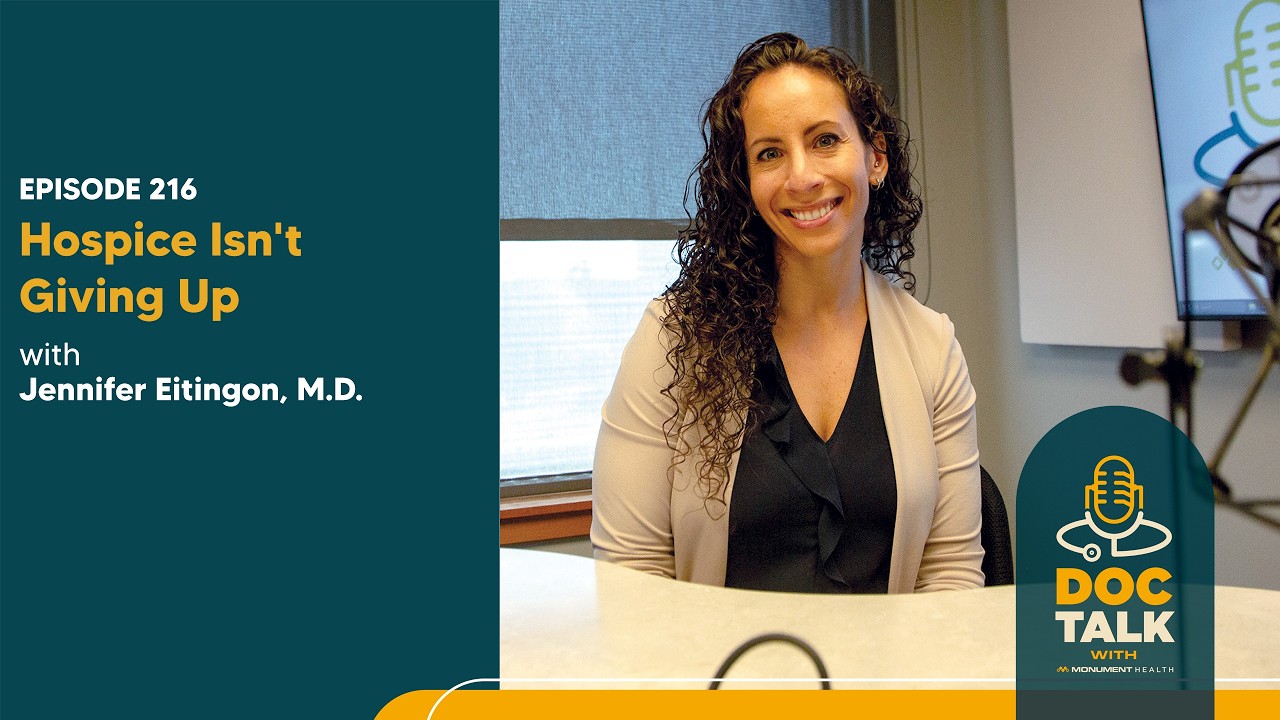
MARK HOUSTON: Hello again, everyone, and welcome to another edition of Doc Talk with Monument Health. My name is Mark Houston. And back in episode one eighty-six, Doctor Jennifer Eitingon told me hospice isn't a time stamp on somebody's life. Today we're going to pick up right where we left off there, because I've been thinking about that quite a bit. Hospice might be the most misunderstood word in healthcare. People think it means giving up. They think it's only for the last few days, and a lot of families end up saying the same thing afterward: we wish we'd known sooner. So, Doctor, I'm so glad you're back to help us kind of sort out what's myth and what's real on the podcast today. Thanks for coming back. I'm glad you had a good enough time last time that you came back.
DR. JENNIFER EITINGON: Thanks for having me. Yeah. Thrilled to be here.
MARK HOUSTON: Well, and you were so new last time, too. So now you've had time to be here a while. And, um, everything, uh, everything going well? I'm assuming.
DR. JENNIFER EITINGON: It's going very well.
MARK HOUSTON: Awesome. Excellent. Yeah. I'm glad you like it out here, for sure.
DR. JENNIFER EITINGON: [South Dakota] has been very kind to me.
MARK HOUSTON: Good. Excellent. Um, well, let's. We'll get into it, Doctor. Um, you know, last time, like I said in the intro, you mentioned that hospice isn't a time stamp. Okay. Um, and I bet you still have to say that quite a lot to people. So why do you think the giving up idea sticks around so stubbornly when we talk about this?
DR. JENNIFER EITINGON: Oh, gosh. That is, I think, more of a philosophical question than perhaps you mean for it to be. Um, I think, I think over the past, you know, two centuries, medicine has, has come at us with this fix for everything. Um, we've really painted it that way, that, that you have a problem, you go to a doctor, the doctor can fix it. And part of that, I mean, there's, there are all these conversations right now, whether or not aging is a disease, whether or not aging is something that we can fix. If you ask me personally, I think aging is a feature of biology. It's something that is going to happen, right? Um, but it's because of that kind of tension between whether it's a, it's a disease or not, it's seen as something we could fix. And when we can't fix it, it, people feel like it's, it's a failure. When we can't fix death, it feels like a failure. And I tell patients and their families all the time, if we consider dying a failure, then we're all failures. And that's, that's not a good way to frame the end of life.
MARK HOUSTON: Well, what a great answer to that question, though, because I think that's, that's exactly it. You do, you know, but at the same time, nobody wants to admit that we're going to fail at that point, but we're all going to. Right.
DR. JENNIFER EITINGON: Well, again, I will, I will challenge the use of the word failure.
MARK HOUSTON: Right. You're right.
DR. JENNIFER EITINGON: But no. Yeah. One of the gifts of my job is I get to reframe what a successful life is. Yeah. And dying is not failure. Dying is, or, you know, the experience of approaching the end of your life is an opportunity to reflect on your life, to reflect on your relationships, to tell the people who you love that you love them, tell them the things that matter most. And unless we have those really honest conversations about where we are in our lives and our disease, and that we might not have as much time as we thought we did, you know, we don't get those opportunities to reframe things and to, to talk openly about the things that matter most. Tell the people we love that we love them.
MARK HOUSTON: Right. Well, you, you started out in surgery, where the job is to fix things, right? So now your job, like you said, is to make people comfortable. Was, was it hard for you to stop thinking of comfort as, like, the consolation prize when you made, when you made the change?
DR. JENNIFER EITINGON: What an interesting way to think about it. The comfort as the consolation prize. Sometimes I tell people, it's funny, sometimes I'll tell people, you know, there are no awards in life for suffering. You don't have to suffer. Like, it's okay, we have. Because often you'll run, not often, but you'll run into patients that are, you know, apprehensive to use opioid medications and things like that. But, um, sorry, I'm running all over the place. You asked me about surgery and the transition from surgery. Um, I found that even as a surgical resident, I found that I was always drawn to having these open conversations about where we are. Um, I think surgeons, and I love surgeons, I think they do a great job, I think they are trained, and rightly so, to see, uh, the body as its organs, to see each, each part of us as, you know, the piece. Sometimes I think of it as thinking, thinking like a car. We are all of our separate parts. And I found myself kind of struggling with that mindset. And I always looked at people more holistically, like, you know, what is most important to them should be the first question we ask. And then what? How do our treatments that we're providing kind of fall in line with those, with those values? Right. Um, you know, less fixing things, more addressing values as, as the first conversation.
MARK HOUSTON: Okay. So it was always kind of in you, then, to, you...
DR. JENNIFER EITINGON: Yeah. I wouldn't have...
MARK HOUSTON: ...might have found you.
DR. JENNIFER EITINGON: Yes, absolutely.
MARK HOUSTON: Wow. That's, I mean, that's interesting, because, yeah, I mean, you know, surgery, I think a lot of people look at it as, you know, that's, that's the pinnacle of, of, of being a doctor, right? When you can go in there and cut away the problem. But then your path led you to, you know, this whole other approach. Yeah. Um, if I turn the, turn this a little bit to, to, to hope, which is kind of what, you know, I think a lot of people want to have in hospice, for sure. If hope doesn't go away in hospice, what, what does it turn into? Right. What, what are people hoping for once that focus shifts?
DR. JENNIFER EITINGON: Yeah. Uh, the thing that I hear most often from my patients is that their goal is to have a safe place to be at the end of their lives and to be free of pain. Um, those are the things that we can hope for, and to reframe. Again, it's all about to, to look differently about the end of life being a failure. And instead, you know, there are, there are such things as successes. There are things like a beautiful death. I've heard this quote before and it really sticks with me: when we can't prolong life, our job is to help choreograph a beautiful death. And in my mind, and in the minds of my patients, very often that's having a safe place to live and having, having comfort. Um, there's also, you know, the, the existential journey, you know, feeling at peace with, with one's spirituality. And that means different things for different people, but that can also be defined as success.
MARK HOUSTON: Oh, for sure. Um, what? Well, what does living well look like, then, in that, in that instance, for someone in hospice? You know, I'm thinking, like, the regular stuff, like you're just, you're sitting on the porch, or you're having something good to eat, right? I mean, is that, is that what you would consider living well? Sleeping in your own bed, that sort of thing?
DR. JENNIFER EITINGON: Everyone's different. People have different goals, different priorities, which is kind of one of the reasons I love this field. I get to meet them where they are and help explore and extrapolate what it is that living well looks like to them. I think the same things that we really, I think it's a disservice that we delineate the end of life from life, because the truth is, it's a continuum. The same things that make us happy when we're, when we're living make us happy when we're approaching the end of our lives. So being surrounded by our animals, being surrounded by the people we love, tasting our favorite things. Chocolate cake makes me happy now. It's, you know, going to make me happy on my deathbed. Yeah, exactly. For sure. Yeah.
MARK HOUSTON: Uh, well, people, and I think people worry when, when they get into hospice that they're handing over control at that point, too. Right. Um, how does it help someone stay independent and keep calling their own shots when they're in hospice?
DR. JENNIFER EITINGON: Well, we do lose control at the end of our lives, but it's not because we're handing it over to hospice. Very often we're handing it over to a disease. The disease is taking the control. It's not hospice. The, the goal of hospice and the job of hospice, the way I describe it, is try to keep you as the captain of the ship for as long as possible. Keep the autonomy, make sure you can continue to do the things that you want to do, understanding that the disease is making it harder. Right.
MARK HOUSTON: And I think a lot of people, when they hear the word hospice as well, think, oh, it's just, you go in for the last few days and then it's done. But that's not, I wouldn't say that's, not mostly the timeline, is it, for hospice?
DR. JENNIFER EITINGON: I think that's one of our biggest cultural failures. Um, our unwillingness and our fear of talking openly about the end of life leaves us in this place where we're not accessing this insurance benefit, this Medicare benefit, that we should be accessing much earlier. Very often, patients aren't enrolled in hospice until the final days of life, when it is a crisis, because they're so afraid of that word. And that's such a shame, because in a perfect world, right, the, or the way hospice, the hospice benefit is designed, is that it is meant, you're meant to be introduced to hospice months before the end of your life, where you get to know your nurses, where you walk on this journey, where, you know, you, you create these relationships where you feel like you can be vulnerable with your caregivers. And that is something that kind of blossoms over time to, to help alleviate some of that fear of dying.
MARK HOUSTON: Well, that seems like that's what people must be missing out on, then. If just those last few days, you know, if they just come in at that time and think, well, you know, that's, that's, that's what hospice means, then they are missing things, right?
DR. JENNIFER EITINGON: Absolutely, absolutely. Yeah.
MARK HOUSTON: Um, all right. Well, you, you, you told us, um, focusing on comfort can actually help someone live longer. We talked about that the last time you were here. And to me, that sounds very backwards. Right. So walk us through why that happens.
DR. JENNIFER EITINGON: Yeah. Well, I think, again, this is a little bit more of a philosophical answer, but I think it's, it's in line with what we were speaking about before, this, this paradigm, or this, this zeitgeist, that medicine fixes everything. Um, and every intervention that we have in medicine is, is a gift, and it can come with a cost. You know, every time we, we bring a scalpel into the picture, another antibiotic, we risk antibiotic resistances. We risk, you know, with surgeries, bleeding, infection, damage to surrounding areas. Chemotherapy comes with a, a, you know, laundry list of toxins. Um, you know, and again, I'm not undermining the value of these interventions, but they do come with costs. When we're not having conversations openly about what the end of life, when the end of life is foreseeable, when it is potentially coming, um, I think people are probably being subjected to interventions that could even hasten death because they're no longer beneficial at that point. Is there evidence that says this? You know, there aren't a lot of randomized controlled studies, but, I mean, there's a whole, you know, you talk about primary prevention, secondary prevention, tertiary prevention. There's a new, um, newish prevention. There's something called quaternary prevention, which is that idea that we shouldn't be intervening, um, or we shouldn't be providing unnecessary testing because of the risk that it has of causing harm. That if we're looking too deeply for problems, we're going to find those problems and potentially cause harm. So there's, there is this field of, of, I don't want to call it a field of medicine. There's a thought process that's kind of evolving, um, about iatrogenicity, or this idea that, that medical intervention is, can be causing harm.
MARK HOUSTON: But at least the thought is there, and at least you're thinking about that, right? I mean, I think, which is important, too.
DR. JENNIFER EITINGON: Mhm.
MARK HOUSTON: Um, because... No, go ahead.
DR. JENNIFER EITINGON: I was just going to make one, you know, I really want to underline that. I think, um, medicine is spectacular. Medicine is a gift and does so much good. Uh, and we need to speak openly about when we're in a place when, you know, we might not have a fix for something.
MARK HOUSTON: Well, and that's, that brings me kind of to my next question, too, about doctors. Um, sometimes, again, we love our doctors. All right. That's not, that's not called into question at all, obviously, but they, sometimes they can bring up hospice too late. Um, and, and not just the families bring it up, but the doctors can, too. Um, why is it hard for the medical side to start that conversation? And you kind of mentioned how it's changing a little bit, but why do you think it's hard for them? To me, I look at a doctor and I think they also don't want to give up. They also don't want to be, you know, they're like, no, we're going to get through this somehow. Does that come into it a little bit, too?
DR. JENNIFER EITINGON: Absolutely. I think, I think part of it is that it's, you know, it feels like a personal failure, and it shouldn't, it shouldn't. Right. We haven't, we haven't beat death. We don't know how to stop that. Um, but our job, our medical training, is all about extending life. Um, so if we can't do that, I could certainly understand why it would seem like a failure. Yeah. Um, and very often I have those conversations with, with other doctors, with colleagues. And so, this is, this is not a failure. This is you providing the best care that you can at this time. Um, hospice is a scary word culturally. We're very, very apprehensive to talk about the end of life. Um, and doctors are people, too. So the cultural, again, that, that influence affects, affects us all. Um, why else are we afraid of, so many, gosh, so many reasons. And the truth is, the way that the, the hospice benefit, I will be very transparent about this, the way that the hospice benefit is structured, very often it means that patients are going to be home at the end of their lives. They're not going to be coming back and forth to the clinic as often. And you create these relationships with your patients over, over years, and it's hard to say goodbye. I'm not going to be seeing you as much anymore. Where, I mean, on the hospice benefit, you can still choose your provider, so you can continue to have your PCP on hospice as well, but you do see them a little less. It's a little bit of a different relationship. So I imagine that might be contributing to...
MARK HOUSTON: Out of all of the people that I've talked to about this, because what we're going to have, we're going to run this for, for the, the entire month, we're going to have, like, a hospice month with these podcasts. Um, you know, it, it is, the conversation is what you guys seem to be stressing so much, is that, you know, you, the plan is laid out. You guys know what you're doing, you know the steps, you know what's going to happen. But it's getting that first conversation to happen, for people to understand that this is where we have to go. This is the path we got to be on, right? And it's amazing that you guys are so adamant and so ready to have that conversation. Yeah. When it seems like so many people don't want to.
DR. JENNIFER EITINGON: I know. It's, it's interesting that you say that it's the conversation that we have to have, this is the path that we have to be on. Because I really want to stress that autonomy is a huge part of this. Right. Some people say that they would be willing to tolerate any intervention for another breath of life. Yeah. That's the rarity. That is not typically what people want. People typically don't want to be on a machine at the very end of their life. They want to be home, surrounded by their loved ones. The conversation, to me, having that conversation is just about being very clear about what the end of life could look like, and how we reach those goals means different things to different people. The pathway, again, one of the reasons I like this work is the pathway is not set. You need to have a conversation about what the pathway, what pathway you want, you want it to be. And then we can, without having that conversation about what you want, how can we get there? Yeah, that's how people end up on machines. And, you know, we leave the decision to family members to, quote unquote, pull the plug, which is a terrible situation to be in. So, yeah.
MARK HOUSTON: Well, you, uh, you come from the East Coast. You're in New York. Um, right.
DR. JENNIFER EITINGON: Am I giving myself away?
MARK HOUSTON: No, you're not. Not at all. But I wanted to, I just wanted, I wanted to, to set up this question with that. I needed to tell everybody that that's where you're from. Um, do you notice that hospice is different here in western South Dakota? Do, do, you know, ranchers and small-town families, do they think about the end of life differently than they do in the East?
DR. JENNIFER EITINGON: I think they do a little. Do they? I think they do a little bit. People, um, people here see death in their animals, in their livestock. Um, I think, I mean, I don't think you're wrong.
MARK HOUSTON: I, and I never thought about that, but the second you say it, of course.
DR. JENNIFER EITINGON: Right.
MARK HOUSTON: Because you see it so much more around here. Yeah. Just because of the ranching and the farming. Not that New York doesn't have a fair amount of that, too, but, you know, not like here, obviously. Yeah. Boy, that's a good point.
DR. JENNIFER EITINGON: Yeah. I think in some ways people are a little bit more grounded with the, with the reality of, of what birth, what life is, what, you know. Right. The, um, the bookends that exist on a life, um, where perhaps you don't see that as much with, uh...
MARK HOUSTON: Well, in bigger cities, where people, and where people just don't see that happen. You know, you don't, you don't see that, the, the circle of life in a lot of instances in major, if you, if you've never left a major city, you know, most times you won't see that. Um, I mean, out here, even if, you know, I'm not a rancher or farmer, I mean, I've grown up around it, though. Uh, you know, so I'm familiar enough to where, I mean, that's just a great point. I wouldn't even have thought of it that way. Yeah, possibly.
DR. JENNIFER EITINGON: Yeah. I work with a veterinarian and an ethicist, and we have these conversations and gave presentations on the differences between end-of-life care between animals and humans. Yeah. Um, and yeah, certainly one of the, it's, it's, yeah, I think one of the biggest differences in care is that, you know, you can have a veterinarian throughout an animal's entire life. And granted, veterinarian medicine for, for pets is different than, of course, agricultural medicine for, for livestock. But it's, it is interesting to think about.
MARK HOUSTON: Yeah. Well, so say someone is listening to this right now and wants to know more, but isn't ready to, obviously, commit to anything. In your opinion, what's the easiest, lowest-pressure step that they can take, and who do they call?
DR. JENNIFER EITINGON: Yeah. Ask someone. Am I allowed to plug for Monument?
MARK HOUSTON: Absolutely. I mean, they pay for this podcast, so you bet you can.
DR. JENNIFER EITINGON: Call, call Monument, call. The palliative care is a nice kind of first step to having those conversations, where you're not changing your insurance benefit, you're not changing any of your, your physicians, and you can talk to somebody who's specialized in having these conversations. Yeah. Um, specialized in symptom management. Palliative care is often, you know, I don't, I think palliative care gets a bad rap, too. So I don't want to say palliative care is the first step to hospice, but palliative care is kind of a, a safe way to have the conversation, to prioritize your autonomy, and to make sure you're having the conversation, open conversations, about what you want your life with, you know, chronic disease to look like.
MARK HOUSTON: Right. I just, you know, it's the words. It seems like every few years we should just change what hospice and palliative...
DR. JENNIFER EITINGON: Palliative care is... supportive care is this...
MARK HOUSTON: Oh, there we go. Yeah.
DR. JENNIFER EITINGON: They go through the iterations.
MARK HOUSTON: Oh, that's great. Uh, Doctor Jennifer, uh, thank you very much for coming in and doing this again. I really appreciate it. And, you know, you're welcome back anytime. Uh, especially since, well, you, you didn't really go through a winter here yet, though, either. But I mean, New York's got winters, too. You've, you've experienced it.
DR. JENNIFER EITINGON: If I make it through the winter, I can come back.
MARK HOUSTON: Yes, one hundred percent. Well, if you haven't moved away at that point, for sure. Yeah. Thank you again, though, Doctor, for coming in. I appreciate it.
DR. JENNIFER EITINGON: Thanks.