
Listen or watch this episode on your preferred platform:


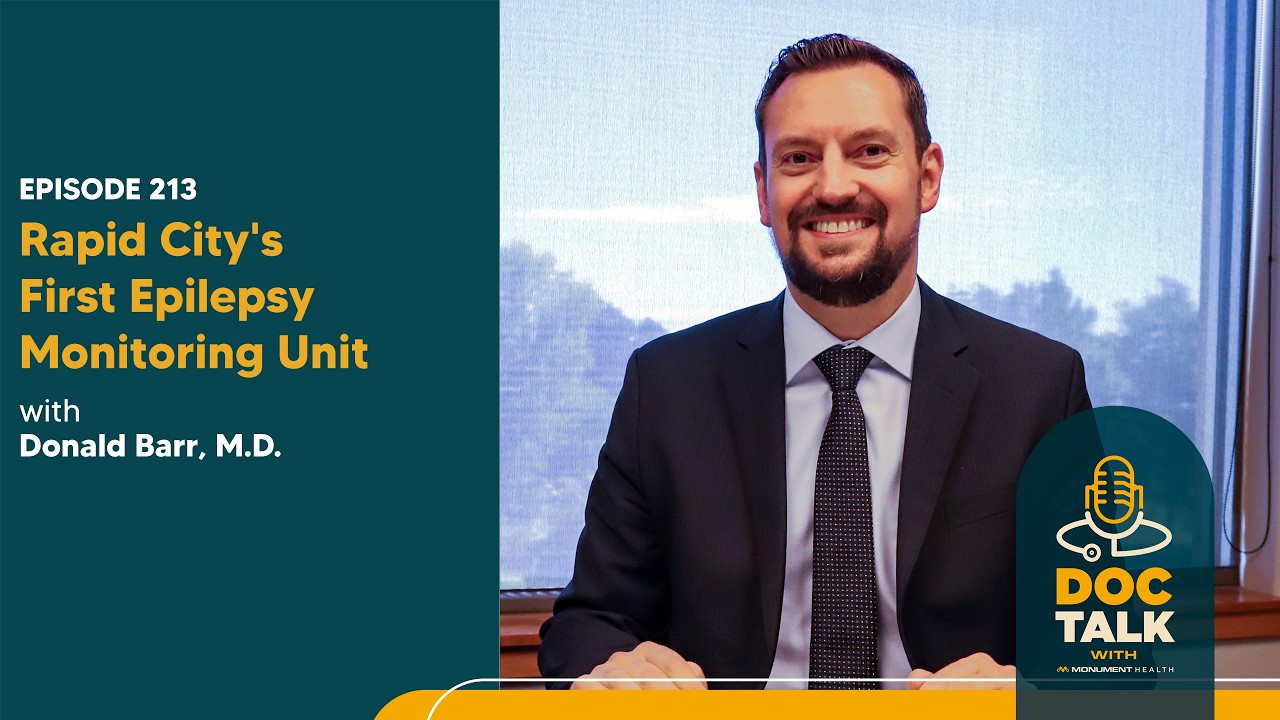
MARK HOUSTON: Welcome to Doc Talk, a weekly podcast featuring Monument Health physicians addressing medical topics. Tune in to your health with Monument Health. Hello again, everybody, and welcome to another edition of Doc Talk with Monument Health. My name is Mark Houston and I want you to picture this. Okay. Your kid starts blacking out for a few seconds at a time. Nobody can tell you why. So the doctor here says we need you hooked up to monitors for five days so we can actually catch one of these episodes on camera and on the EEG. Fine. Except until this year, that meant driving to Minnesota or Colorado, renting a hotel room, taking time off work, being away from your own bed and your own kitchen while you wait for your brain to misbehave on schedule. That's not the case anymore. Monument Health just opened a two-bed epilepsy monitoring unit right here in Rapid City. First one of its kind in our region. It's already helped patients who used to have nowhere to go but out of state. And I've heard at least one story that I want to talk about with the guest I'm interviewing today. Coming up. I want to welcome today Doctor Donald Barr, who is an epileptologist and neurology section chief at Monument Health. I'm just going to take a minute to revel in the fact I said it right, correctly.
DR. DONALD BARR: Yeah, that was excellent pronunciation.
MARK HOUSTON: Thank you very much.
DR. DONALD BARR: Very proud.
MARK HOUSTON: Uh, very good. Well, thank you for coming in and doing this, obviously. Um, I mean, I'm glad you're here. And this is super exciting news for Rapid City, and I want to get to it coming up. Um, where, where are you from? What led you all the way out here to this island in Rapid City, Doctor?
DR. DONALD BARR: Yeah. So it's, uh, it's been a long journey to finally find my place, to the right spot. So I actually, I grew up in California. I did my residency in central Texas, and then I did a two-year epilepsy fellowship at the University of Miami. Loved it. Uh, it was a wonderful experience. Was at a level four epilepsy center and it was burning the, the candle kind of from both, from both ends for a time. So I decided to step back and do something called locums. So you have like your traveling nurses, physicians do the same thing. I had actually never even heard of Rapid City until they presented it to me, to the locums. And they added, oh yeah, Mount Rushmore is nearby. So I say, hey, I'll go check it out for a week and move on with my career. Uh, the people out here are absolutely lovely. Uh, the clinic was so well run and it's beautiful. So my stints started, coming out for one week, then two, then four, then six. I got a little tired of flying back and forth to Miami every other weekend to see my then-fiancée. And I would send her pictures and say, hey, you know, this is a beautiful place. And she laughs and says, you go out more in Rapid City than you do in Miami. What's, what's, what's the deal? I said, okay, you just come check it out. It's a hard sell for me.
MARK HOUSTON: And you sold her out here? You sold her on this place?
DR. DONALD BARR: Well, no. So she had to come here.
MARK HOUSTON: Okay.
DR. DONALD BARR: Right. That was, I, come see it for yourself. So she, uh, she took the rental car, and she explored around the Badlands, Deadwood, while I was working, and she said, I think this could work. She's from Buenos Aires, lived in Milan and was living in Miami. So I've never been into any...
MARK HOUSTON: Wow.
DR. DONALD BARR: ...any spot here, like, like Rapid City. But she met the people as well. And that was the biggest, the biggest selling point for both of us. And so I said, all right, well, let's, uh, let's get married, have a baby and move to Rapid City. And so we decided to do all three.
MARK HOUSTON: That is, that, that is a great origin story actually, for how you got out here. Um, has, has medicine, is it in your family? Um, I mean, do you, how did you end up here?
DR. DONALD BARR: Yeah. You know, it's, it's a good question. Um, you know, the, the easy answer would be my father had epilepsy and he was a very, you know, the epitome of strength and courage, was a jet fighter pilot, Princeton graduate. And then I would see him in this very fragile state, and he would ask me to hold his hand. And then he would stare off, smack his lips, or rub his fingers together. And for the next few minutes, I was the rock for him. And then he would be really tired afterward. And so, you know, that's a pretty scary thing for a little kid to experience. And I think that planted the seeds of epilepsy. Um, I actually got interested in neurology from the traumatic brain injury component. I grew up boxing. And so that was what initially kind of got me into it. Um, and then I went into my residency training in neurology, again, kind of leaning more toward doing something more in the traumatic, chronic traumatic brain injury. And I had a wonderful, uh, epilepsy, um, mentor. And so I kind of just gleaned onto it. And then the pieces kind of fell into place as far as my experiences. I could kind of understand people from both sides of the curtain, on one side as a physician, but also as a family member who's, who's experiencing it.
MARK HOUSTON: Well, let's, before we get into any of this, I mean, obviously we have to start with the question of what epilepsy actually is, because I think if you're not familiar with it, if you're not around it, which personally myself, I've never dealt with it. So I've, the only time I ever see it is if I sit down to play a video game, the screen that pops up that says flashing lights. They use the word epilepsy in there.
DR. DONALD BARR: Yeah.
MARK HOUSTON: What is it?
DR. DONALD BARR: So, so epilepsy means we're at an increased risk of having seizures without being on medications. Let's back up. What is a seizure? So a seizure is from abnormal electrical activity in the brain. It kind of comes in two flavors. Think of it like a circuit board. There's one which is called focal epilepsy. And that's where there's one spark on the circuit board that gets ramped up and then spreads across the entire circuit board. And that's when people can have the staring spells, the convulsions, and then the system reboots and we start to come back around. Then there's also something called a generalized epilepsy, and that's where the whole circuit board fires off altogether at once. The, the difference between the two is some medications you can use with one and then not the other. But again, if we have this abnormal electrical activity in the brain, we're at a higher risk of having these seizures begin to recur. And so that's where you develop the, the diagnosis of epilepsy. Sometimes people will say, well, I don't have epilepsy, I have seizures. It really kind of becomes a case of the semantics, but it's, if you're at a higher risk of having seizures in the next two years without being on medications, that fits the diagnosis of epilepsy.
MARK HOUSTON: And it's, do you, do you know, I mean, can, in like, in, is, is it, is it hereditary?
DR. DONALD BARR: Yeah. So there are, there are hereditary. There are what we call idiopathic. My, my old pathology professor at medical school said idiopathic, because we're idiots, we don't know why. You know, often it's something more on the level of the cell that we're not able to clearly identify, even with neuroimaging that we have. So you can have genetic components, you can have what we call a non-lesional, so there's not a clear origin of injury. Or if someone has a stroke or a tumor, that can disrupt the, you know, the electrical activity and precipitate seizures.
MARK HOUSTON: Now, I know the brain is a very challenging organ to work with, obviously. Um, how challenging is it then to, to, to figure out what's going on in there? How do, how do we, is there any way we'll ever be able to fully know and stop and prevent what's happening in there? Or is it just so complicated that all we can do is what we're about to talk about here?
DR. DONALD BARR: So, well, the things we're going to talk about are, are interventions that we can actually, we can, there are treatments that can cure epilepsy. We'll talk about that as...
MARK HOUSTON: You can use the word cure for it?
DR. DONALD BARR: We can use the word cure.
MARK HOUSTON: Okay.
DR. DONALD BARR: It's very, it's a very select group and it's not a one hundred percent guarantee. But we'll, we'll, we'll dive into that a little bit. Um, what we have with people and what we're about to get into is that about forty percent of people with epilepsy have what we call medically refractory epilepsy. That means despite being on two seizure medications, either together or independently, the person still has, has seizures. And so in that case, we need to start thinking about things outside the box, from beyond medications. And in that case, we lean toward things like epilepsy surgeries, which require most times an additional evaluation, which is what I'm very excited to start nerding out with you guys on.
MARK HOUSTON: All right, well, let's get into that then, because, um, I'm sure almost nobody outside of people that maybe experienced epilepsy or have families that do know what an epilepsy monitoring unit is, right? So if I check myself in, what is, what's physically happening to me for those five days while I'm being monitored?
DR. DONALD BARR: Yeah, that's a great question. What am I getting into?
MARK HOUSTON: Yeah.
DR. DONALD BARR: What are you signing up for? So we have you come in. It's an elective admission. We put on the little sticky electrodes, and then we wrap your head up in a little turban, and then we, we monitor your brainwaves. You just, just chill out in the hospital during those five days. And sometimes we will, depending on the case, we may actually end up reducing the medications in order to precipitate seizures, because we're trying to identify where are the seizures coming from so that we can make sure we're having the appropriate intervention. Thinking about things again outside of medications, like epilepsy surgeries. We can also, someone may stay on their medications, but they're having the episodes like the example you gave. You've got a family member who's having these, you know, these staring episodes. We're not sure what they are. You know, sometimes as someone describes an episode, it sounds very much like a seizure. And I can kind of identify where it's coming from, what we're looking at. But seeing it on the brainwave can help give some additional information. Sometimes we see, hey, this, these episodes are not related to the abnormal electrical activity in the brain. And it's a totally different treatment avenue we would be going down.
MARK HOUSTON: What could be different? I mean, what, the second one. Yeah. Expand on that a little bit.
DR. DONALD BARR: So if someone has something called psychogenic nonepileptic seizures, or I call them psychogenic nonepileptic events, so we don't get them confused with epileptic seizures. Those can often be related to kind of a stress response to a distant trauma. So it's coming out in a physical way. On the outside, it can look very much like your epileptic seizure, the shaking, the stiffness. But it's not from the abnormal electrical activity in the brain. It's the body's manifestation of that. The treatments are different, and you don't use medications to calm electrical activity because that's not the issue. The treatment is something called cognitive behavioral therapy. It's a specific type of therapy to kind of unpack things. So the person is now staying more in the moment and not having what's called a dissociation. They're kind of unplugging. And that was a response they probably had in the past to, to survive whatever terrible experience they had. But now it's becoming problematic. And we need to kind of reprogram our, our approach with things. So that can be very helpful, because sometimes people are on a number of medications and you realize, hey, these are not related to the abnormal electrical activity. You don't need to chase this whole gamut of side effects and other effects down, downstream. And they get in with the, the right treatment, they can start doing better.
MARK HOUSTON: So where did, where did, where did people have to go before this unit opened? Kind of paint me that picture of what it looked like for a family, and like here in Rapid City or eastern Wyoming. What did that look like for them?
DR. DONALD BARR: Yeah, absolutely. So if they wanted to, you know, if they saw a neurologist, wanted to get them into an epilepsy monitoring unit, it would require a referral typically either to Mayo or to University of Colorado. Then they have to go through University of Colorado's process. Sometimes that required an additional individual consultation as opposed to just a direct, you know, setup for the admission. And so it can be a pretty cumbersome trip back and forth. You got to take off, you know, quite a bit of time in order to, to go out there. And it's a lot of, uh, a lot of extra heavy lifting. Um, and so that, and there's also kind of a little bit of a delay. I think things are just a little bit harder to get in when you're coming out of state.
MARK HOUSTON: So yeah, again, having a unit like this here, obviously, I mean, it's just night and day for somebody that suffers from stuff like this, for sure.
DR. DONALD BARR: Yeah.
MARK HOUSTON: Um, what I, what I've been thinking about is, you're talking about this thing when you were explaining what happens in the unit. Um, you're waiting for somebody to have a seizure on purpose, right? Which seems just totally backwards from the way any medicine goes.
DR. DONALD BARR: Yeah. Correct.
MARK HOUSTON: Um, so walk me through that logic a little bit.
DR. DONALD BARR: Yeah. Let me clarify a few things. Right. So yeah. So again, we come in, we wrap your head up in the, in the turban, and then you're continuously monitored by, there's a technician who's always watching the brainwave test. There are the nurses. So you're, it's a very controlled environment. So there's always a plan in place if someone is having a seizure. How do we, how do we approach it? You know, we have the abortive medications. We have the backup medications on top of that, if we need to, you know, re-initiate the ones that we had held or do an additional loading dose. So it's a very, it's a very structured and, and planned-out process. The nurses are all trained in the, you know, the emergency management of seizures. And so it's a, it's a very controlled environment. So that, exactly, when you're thinking that backwards way of, wait, we're, we're, we're trying to make, have someone have a seizure. In that sense, like we were saying, if we're looking actually, you know, for the option of different types of epilepsy surgeries, or also knowing what someone's triggers are, so that we can capture those events and make sure that we're, again, going down the right avenue, whether it's the treatment with anti-seizure drugs or epilepsy surgeries versus something like the cognitive behavioral therapy.
MARK HOUSTON: So what, what's, what's a day look like? I mean, how much, how, it has to be kind of hard to be there for five days and just live your normal life while you're there, right?
DR. DONALD BARR: Yeah.
MARK HOUSTON: I mean, is it, is it a lot of just sitting around, or? I mean, how, what, what does the patient do while they're there?
DR. DONALD BARR: Yeah. So, you know, it really, it is a lot of sitting around. If someone has some specific triggers, you kind of say, hey, what are the triggers? You know, if, if heat is your trigger, well then we're going to dial up the thermostat. You know, if having your, your mom and dad with you, you might just hang out with them and get some of those provoking mechanisms behind it, right? Otherwise they're, are just, you know, we're looking at what are their triggers. And then otherwise we're just, just monitoring. They kind of do their, their thing and they'll, you know, they have their, their iPads, or watching movies or the TV, or texting on their phone. Um, we have some limitations. You don't want people to go out and walk around in the hallways, because if you had a seizure, you fall, you, you strike your head. We can have some of those issues. So it's a, it's a pretty closely monitored, but a, you're just, just kind of hanging out in the, in the room for what it is.
MARK HOUSTON: Um, kind of the most, what's the most dangerous part of epilepsy or seizures? You know, I, I mean, I think some of the obvious, like you said, would be falling down, um, hitting your head in a lot of instances, but are there, are there internal things that are as dangerous with a seizure? Or is it mostly external because of what's happening to you when you're in it?
DR. DONALD BARR: So it's a combination of things. So we can certainly have what we call autonomic dysfunction. So people can have, uh, have heart attacks. They can have strokes. Um, you know, we're having this abnormal electrical activity in the brain kicking off, and those, those brain cells are firing off and they become very refractory. So someone goes into something called status epilepticus. And so that's a prolonged, sustained seizure that we're using, typically they have to be intubated, and using, uh, anesthetics to, to break those. And the long term, people can die from seizures. And that's one thing that I try to kind of reiterate, as some people can say, hey, well, I only have one a couple times a year. The fact is, these are dangerous from the standpoint of, again, we can have higher risk of stroke, cardiac issues. You can have long-term brain damage from them, or we can die from them because of the, the ongoing process.
MARK HOUSTON: You mentioned too a little bit earlier about optimizing medication, which is kind of a big piece of this. So what does, like, like, and you just, you kind of touched on this too, like having too many seizures, like what does that actually cost someone day to day? Is it kind of what you just listed there? Um, you know, the people who would have, who never had one wouldn't think about, right?
DR. DONALD BARR: So yeah. So I mean, in terms of the, the cost, when people have uncontrolled seizures, you know, there is going to be a, a cognitive burden that's going to, that's going to accompany that. Um, you know, and then also on top of that, just the, the quality of life, the ability to, to work and have meaningful time and income, you know, the driving restrictions. So it has, it has some pretty far-reaching aspects of that as well.
MARK HOUSTON: You, um, you also told your team, and I was excited to get to this question specifically, um, about a patient who, a guy having seizures. Um, he's been seizure free since that, that, that he came in to you, and he said that it was life changing. I mean, I think he used words similar to that.
DR. DONALD BARR: Yeah.
MARK HOUSTON: Um, what was that visit like when you saw him and realized that all of this worked?
DR. DONALD BARR: Yeah, it was, it was euphoric is probably the, the best word I could give you. I mean, it's, it's the, it's neat to see the, the accumulation of the work and what's the purpose? You know, it's, it's, this is stuff that I find interesting and exciting. But the bottom line is the patient and their family. What's, what's their experience with it? And to see him, to identify what's going on, to treat it appropriately, and have him come in with his mother, who is just ecstatic that her boy hasn't had a seizure, you know, in the, in the weeks and months following his epilepsy monitoring unit evaluation. It's a, it's the most rewarding experience. You really, because again, it's so many downstream effects. It's not just the individual patient, but their families. It's, I know what it's like to be on the other side of the curtain. And when that gets controlled, uh, life, life does change.
MARK HOUSTON: Well, and it's, and epilepsy seems like a condition that's so, because you don't know when it's going to happen, right? So there's always that stress and tension of, is it going to happen now? Is it going to happen now?
DR. DONALD BARR: Absolutely.
MARK HOUSTON: Is it going to happen now? And so are you going to go a couple months to a year of that not happening?
DR. DONALD BARR: Yeah.
MARK HOUSTON: I mean, that's the relief. I can't imagine the relief that comes with that.
DR. DONALD BARR: Yeah. It's, it's, it's regaining a little bit of life's predictability. Life's pretty unpredictable. But that's the, the, exactly the scary part, is waiting for the other shoe to drop. That's a conversation I have with eighty percent of the patients that I see, is, is the anxiety of, yeah, I've been doing well, but when's it going to happen again? I saw a gentleman recently with a, had a brain tumor resected sixteen years ago, has been seizure free, but his, we didn't really get into it until recently, he said, so I know these seizures are going to come back. It's like, wait, no, no, they're not. You know, you're, you're doing good.
MARK HOUSTON: You were able to say that, to say those words.
DR. DONALD BARR: Yeah. So you're, we have the background, the backstory to, to say, hey, we haven't had any. It's, the medicine's doing its job. You're protected. We can put that down, of waiting for the other shoe to drop. Worry about the other things.
MARK HOUSTON: Wow. Um, when, when, when somebody is having a seizure, do you know it? Do you know that it's happening? Or is it, because they'll often mention blacking out, right?
DR. DONALD BARR: Right.
MARK HOUSTON: And so do you know?
DR. DONALD BARR: So they can, they can come in a number of forms. So sometimes people can have the, the staring spells where it looks like they're just kind of zoning out. So it's not always a clear, big, you know, wild shaking event that we see in the movies. Um, you know, and, and when someone's describing an event, you know, they say, okay, I was blacking out, but I think, uh, you know, a two-cent history is worth more than a million-dollar workup. So you get a little bit more of what was going on before then. Oh, I got this weird, you know, burning rubber smell that usually happens before these blackouts. And it's always, his wife says, yeah, he just kind of stare and kind of smack his lips, or he just picks at his fingers. And so getting a little bit more of the, the, the picture of what's going on with some cases. You mentioned the scary seizures, like that status epilepticus. Sometimes people can have what's called non-convulsive status epilepticus, where they're just a little out of it and their brain is firing off, but they're still somewhat able to attend. Those are the scary cases, you know, and that's where they need the brainwave test to identify that and then to treat it. Other times, someone can have a, a, a seizure with the physical manifestations, you know, shaking, eyes deviated to one side. And we can see that a little bit more clearly. But they come in a lot of flavors. And that's where the epilepsy monitoring unit is, is tremendous in terms of identifying, okay, which, which is which, and where is this coming from? And it can give us some, some direction, again, as far as the correct treatment.
MARK HOUSTON: Well, you're, I think you guys are expecting something like two to three dozen patients a year through this unit. Um, is that, is that number driven by demand you already knew was out there? Or are you expecting people, once they kind of discovered this existed, to reach out?
DR. DONALD BARR: Yeah. So, you know, just coming out of the gates, very few people that have the medically refractory epilepsy get referred to an EMU already. So there's already a, a low, a low number. And so now that we have this, this opportunity available, um, our waitlist, so we're kind of doing things one month at a time right now, and we've got about thirty people already built up on our list, as we're kind of trying to triage people to get the more urgent cases in for epilepsy surgeries and so forth. Um, we're planning to fully, you know, continue expanding that, but word is already getting out. We've already had a number of outside referrals for our EMU, which is, is exciting. But just even internally, you know, the word is getting out and we're growing and growing.
MARK HOUSTON: I was going to say, so it could possibly go from two beds. I mean, you, it, hopefully eventually, yeah, it'll grow enough to where you'll be able to do even more. Um, it's, where does, where do people start? You know, like I said when I kind of started this, um, talking about, you know, you have a kid that blacks out, you're not quite sure what happens. You take them to a doctor. Obviously, I'm assuming your, your primary care physician is the first place to start with something like this.
DR. DONALD BARR: Yeah. And so, yeah, exactly. And, and asking, asking the questions with your, with your primary doctor, giving them, giving them the clear history. And again, I give my little soapbox for my patients to remember. At the end of the day, you know, I work for them. All the other physicians work for them. So if they feel like they're not being heard, you know, you can always, you know, speak up and push a little more. But it typically will start with the, the primary care doctor, they'll get referred to us. Or if they were seen in the hospital, for example, they get referred to us for additional evaluation. We talk about things, we gather the history, and then we think about what the next steps would be.
MARK HOUSTON: Are there still instances where you have to send people maybe to Rochester or Denver?
DR. DONALD BARR: Yeah, there, currently there are a couple of cases. You know, we, we just hired a functional neurosurgeon who did his epilepsy fellowship for epilepsy surgeries, kind of getting the ball rolling and starting that with him. But there are some cases right now that we'll still refer out to, um, to, to Mayo or, or Colorado. Again, as we develop our program and get things more, you know, established, then certainly these people will be, be staying in house. But a lot of the time we'll even kind of get the initial phase, what's called a phase one. That's where they come into the epilepsy monitoring unit, we hold, or capture the seizures with the medications. And then the next step would be to follow through with, with, with Mayo or UCHealth.
MARK HOUSTON: At what point do the medications, not stop working, I guess, is kind of the question I'm looking for, and then you have to consider the surgery? Um, um, that, that's got to be kind of a...
DR. DONALD BARR: So it's, it's, it's hit and miss sometimes. Again, some, you know, someone can be seizure free and they're on the same dose for an indefinite period of time. And for some reason that little spark just wants to wake up, and it doesn't respond to, you know, different, you know, mechanism of action in terms of trying to calm that electrical activity. So there isn't a set time frame, um, for things to kind of wear off. People can be on the same dose forever and have no further seizures, and we're all set and good from there. But when they do have seizures and we try a second one and they're still having seizures, as an epileptologist, my, my next thought is, hey, we need to have the conversations about the epilepsy surgeries. And I can kind of dive into that with you if you want.
MARK HOUSTON: Well, I would like to a little bit. Yeah. Because now I'm super interested in, because I said the brain to me seems just like the most baffling organ in the body, you know.
DR. DONALD BARR: Oh, it is. It would have to be. Yeah.
MARK HOUSTON: For us. How do you even, how do you look at it? So there's, there's obviously parts of the brain that have, where the seizures originate from, right? And you can narrow that down, you know, enough of where that is.
DR. DONALD BARR: Yeah. So, so that's where, so someone, that begins with someone describing a seizure to me, and as someone's describing what happens before, during and after, it gives me an idea of maybe what part of the brain could it be coming from, what side of the brain could it be coming...
MARK HOUSTON: Can it be in any part of the brain?
DR. DONALD BARR: It can come from anywhere in the brain. Yeah. So it's a, you know, it's a, it's a very complex entity. And the, the manifestations are not always like what we see on TV where someone has the full shaking. So you kind of gather that, and I get kind of, I put up my hypothesis. This sounds like this is probably coming from the left temporal lobe, because they have right upper extremity shaking, and afterward they can't get their words out. And then we do the brainwave test and the imaging, and the, the brainwave test is just a short, like a one-hour brainwave test called an EEG. And maybe we see some of that abnormal electrical activity there. And then we say, okay, well, before I'm going to say I want to place an electrode in this location, or say I'm going to remove this part of the brain in this location, we probably need a little bit more information. And so they would come into the epilepsy monitoring unit. We would stop the medications to provoke the seizures, to make sure they're all coming from the same place. One of the, the nightmares and things that we, we worry is, you know, if, if I say all the seizures are coming from the left side and there's a couple from the right, and we do a lobectomy, now, now, now, now, now where are we? Because the seizures are coming from the other side as well. And so part of that evaluation is to capture the, the events. And then we have something called stereo EEG. And they place electrodes in the areas that we say, hey, this is hypothesized, the most likely locations. We also know sometimes one seizure can masquerade as another type from a different area. So we want to make sure we cover those bases. But it's a very thought-out process. And then in, in doing that monitoring, we say, okay, this is where the seizure is coming from. We can pinpoint, this is, this is the location. What are our options? If it's in an area what's called the eloquent cortex, that's the areas of the brain that control our motor movements, our sensory, you know, our vision, our language. If it's in a location there, it may be a little hard to remove that area without creating some devastating impairment. So in those cases, we can't remove it. We can sometimes place an electrode in that location. It almost acts like noise-canceling headphones. You see the sound wave, the noise-canceling headphones sends a sound wave in the opposite direction and it kind of nullifies it. And so you can place an electrode that then sends a signal that can either shorten or reduce the, the spread, or even abort the seizures altogether. So that's one, that's called a palliative treatment, with something called RNS.
MARK HOUSTON: Sometimes it's a device that's worn all the time, then?
DR. DONALD BARR: Yeah. So it's actually implanted. It's, it's, it's located in the, in the brain. And then there's a little device that kind of goes into this, in, into the, below the scalp. And that's, that's one of the, the, what we call a palliative treatment. It's not a cure, but our goal is to, can reduce the frequency. Sometimes, let's say that location is not in the eloquent cortex. We can actually remove that part of the brain. And that can be curative. At this point, that's the only cure that we have. It's not one hundred percent, uh, but it is the, the only treatment they have in terms of, that can be a cure for the epilepsy. Other times it's, hey, we're, we're maybe still having seizures, but we can reduce the dose and the number of medications that we're on, and all the constellation of things that go along with that. So it's not always just seizure number. There's also the downstream effect of, are we tolerating medications? You know, people can feel sedated, trouble thinking, memory issues, and all kind of. So sometimes the treatment feels like it's worse than the disease.
MARK HOUSTON: Yeah. Well, it seems like, uh, how do you feel about the future of this then? How do you feel about where we're going to go once we understand the brain better, which it obviously seems like we're still probably, for you guys, seems still light-years away to understand what's happening, even though you've come so far?
DR. DONALD BARR: You know, it's, it's been exciting. Uh, we were talking, about talking earlier about the different types of seizures. For a generalized epilepsy, epilepsy, again, it's kind of where the whole circuit board fires off. There's an area in the thalamus that has really been identified, and placing electrodes in those locations has shown to be very effective in terms of treating a generalized epilepsy. In the past, we just said, hey, we can implant an electrode here or there for the focal, for the single spark. But this, you know, just a recent development, and a great trial that's going on called the NAUTILUS study, looking at treating the generalized epilepsies with the electrodes. Whereas before, we were pretty, pretty darn limited. So we are making more and more ground and making more and more progress. Um, there's a medication called Xcopri, or cenobamate, that has actually shown some effectiveness in people with medically refractory epilepsy. So for the other medications in the last fifty years, it's really been a change in the side effect profile and drug interactions. But the effectiveness in seizure reduction, they're all about the same across the board. But we do, are making a little bit of progress here. So I think as we, we begin to kind of identify more options and locations, and kind of looking outside the box for things that we had previously used. Again, for example, that, that the RNS, the reactive neurostimulation, was previously used just for the focal epilepsies. And now saying, hey, this can have a big effect on people with the primary generalized. It's just exciting, you know, as we're continuing to find, find things, find locations, and start to understand things a little bit better as far as just the underlying process.
MARK HOUSTON: Well, and even, you know, for the time you've been doing this, you've had to have seen almost leaps in this kind of stuff, haven't you? The way the technology is so fast.
DR. DONALD BARR: Yeah, it's been, it's been fantastic. And, and things that a year ago I wouldn't have been able to do. Again, you mentioned, you know, I sent someone to, to Colorado for the implantation, um, looking at the primary generalized epilepsy. And this was the first person in South Dakota to have any procedure like that with primary generalized epilepsy. So we're, we're breaking new ground. And it's, it's just, it's so encouraging and so exciting that we actually have the tools here, because in general, people with refractory epilepsy are still underserved. And then we're in a location that magnifies that by tenfold. And now we have a hub that we can have people locally getting treated, and have, and have someone that's, that they're intimately familiar with. It would be hard to go through a brain surgery and this process with a stranger and then come back to someone else. And you're really not sure, who do I belong to?
MARK HOUSTON: Yeah.
DR. DONALD BARR: And so...
MARK HOUSTON: Well, that's a good point. I never thought of that either. That does, that connection alone can make such a big difference in, in not only the procedure but just the aftercare.
DR. DONALD BARR: Yeah.
MARK HOUSTON: You know, because you feel like, well, first of all, I'm not having seizures anymore, this is fantastic. Second of all, I know the guy, you know, and it seemed like he genuinely wanted me to get better and cared about it. And here we are.
DR. DONALD BARR: Right. I kind of, for sure, is essential. And it's great, you know, just, it's great for me to see the evolution and how my people have begun to improve. And you just know you're on the right track, and it's, you know, it's, it's, it's a win for, for everyone.
MARK HOUSTON: Well, it is. And going back to what we talked about earlier, that, that relief that people feel, the weight, uh, which is unimaginable for a lot of people that don't understand what epilepsy is, either having it or having it in your family. I mean, there's no words. There's just no words that describe how that feels when it can be fixed.
DR. DONALD BARR: Yeah, absolutely. It's, that's the most rewarding moment, when I see someone and they said, I'm so glad that, I'm so glad that we met, you know?
MARK HOUSTON: Well, I'm glad you came in too, Doctor. I appreciate it. Uh, Doctor Donald Barr, who's an epileptologist and neurology section chief at Monument Health. Thank you for coming in and talking about this, man. I really appreciate it.
DR. DONALD BARR: It's my pleasure, you guys. Thank you so much.