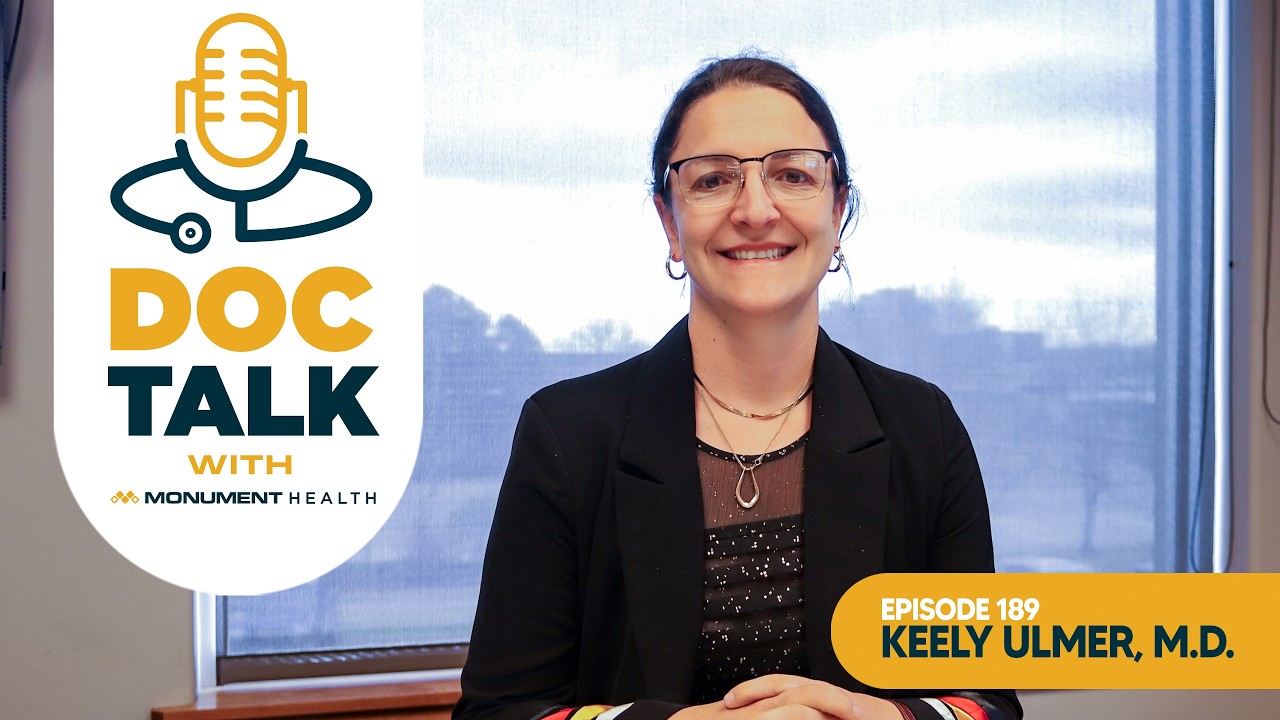

Listen or watch this episode on your preferred platform:


MARK HOUSTON: Hello again, everybody. And welcome to another edition of Doc Talk with Monument Health. My name is Mark Houston. And when it comes to our health, knowledge really is power. And today on Doc Talk, we've got someone in the studio who has made it her life's work to make sure women have exactly that. Dr. Keely Ulmer is a gynecological oncologist at the Cancer Care Institute at Monument Health. She's fellowship trained, a former chief resident at the University of Iowa, and she's a proud member of the Oglala Lakota Sioux Nation, raised right here on the Pine Ridge Reservation. She came back home with world class training and a real passion for making sure the women in this region get the very best care possible. There's, I don't think, honestly, any better person to talk about women's health right now, what to watch for and how far treatment has come. Dr. Ulmer, thank you very much for coming back. Your second time on the podcast. First time in person. Do you remember where you were when you zoomed in that time?
DR. KEELY ULMER: Yeah, I was at my house in Iowa City, Iowa.
MARK HOUSTON: Oh, is that before you came here?
DR. KEELY ULMER: Yep. It was my last year of fellowship.
MARK HOUSTON: Excellent. Well, how did this all begin for you to get you back here, then?
DR. KEELY ULMER: Yeah. So, kind of a very interesting story. I went to college to play basketball at Black Hills State University. I was pretty sure that I was going to be a pharmacist. That's what I thought I was going to be. So I was a chemistry major. And then my last year of college, I actually had a little bit of time outside of sports to spend some more time in a pharmacy. And I realized that that wasn't my calling after all. So then I floundered around for a year or so. Some of my professors were like, you should go to medical school. And, you know, I was like, oh, I don't know if I'm smart enough for that. Like, oh, we think you are. So then I worked some odd jobs. I was waiting tables, working at a sale barn loading out cattle. I applied for nursing school, was actually accepted to go to nursing school, but applied for Indian Health Service scholarship to fund that. One day, before I went to the sale barn for work, I got a call from Maryland, which is where the IHS scholarship program headquarters is. And it was the person in charge, it was a captain, Dr. Kelly, and she just said, I can't really sign off on this. I think you should go to medical school. And if you get in, we'll fund you. So I said, yeah, all right, I'll give it a shot. Took my MCAT, got some interviews. Now I look back, it's kind of crazy. I got some interviews at some medical schools, and then kind of just told myself that if I don't get into the University of South Dakota, I'm not going. Got in. I thought I was going to do rural family medicine, fell in love with general OB-GYN on my frontier and rural medicine rotation in Winner, South Dakota, which is where my husband is from. And then pursued general OB-GYN, matched the University of Iowa Hospitals and Clinics for general OB-GYN. I didn't have any exposure to gynecologic oncology as a medical student because the gyn onc that was here at that time was in a transition phase, so I never did a rotation. When I got to residency, I realized pretty quickly that I really liked gyn onc, specifically. But my husband's a rancher. The plan was four years there, come home. I was going to be a rural OB-GYN, actually, in Winner, South Dakota was the plan. So, a lot of heart to hearts about having to stay for another three years. I was a little bit late to the fellowship application. I went into the fellowship director at the University of Iowa one day, I'll never forget it. I was super nervous, but they, so when you go to fellowship, you have to go through a match process. So you have to apply and then you have to interview. And then a computer algorithm matches you. University of Iowa very rarely takes anybody outside of the match. And so I pitched to him like, you know what you're getting with me. I know what I'm getting with you. I want to be very well surgically trained. This is a great program. Why don't you keep me? So they agreed to keep me outside of the match. But I needed to spend one more year because I was late to the application. So I worked for a year as a general OB-GYN at the University of Iowa, and then continued my fellowship at the University of Iowa for three years. So we were there for a total of eight.
MARK HOUSTON: You just, you sound like this was all, it just feels like this was in the cards for you. This was going to happen no matter what.
DR. KEELY ULMER: Yeah. Wherever this path in life was going to take you, this is where it brought you. When I saw open doors, I took them. Because I figured, you know, if this door swings open for me, it's probably the right choice.
MARK HOUSTON: Boy, that's great advice right there. We could just end the podcast right there. Look, if that door opens, walk through it.
DR. KEELY ULMER: Yep. Walk through it.
MARK HOUSTON: Well, most people will hear the term gynecological oncologist and I think in a lot of people's minds, they just think cancer doctor. But I want you to help us understand what that actually means day to day. Like, what does your job look like?
DR. KEELY ULMER: Yep. So my job as a gynecologic oncologist is essentially, you know, I take care of female cancers, not breast. Breast really isn't gyn. That's more breast surgeons. But so uterine cancer or endometrial cancer, vulvar, vaginal, cervical cancer, ovarian cancer, the surgeries and then the chemotherapy that follows them. I also do complex pelvic surgeries. So people with very large uterine fibroids that a general gynecologic provider maybe isn't comfortable with, or suspicious ovarian masses that aren't confirmed to be any sort of cancer, or very large ovarian masses. So just more complex gynecologic procedures that can be benign. But mostly it's those types of cancers, the surgery and then the chemo.
MARK HOUSTON: Well, there's obviously, like you said, several different types of these kinds of cancers. Can you kind of walk us through the main ones, to help us understand how each tends to show up and who it affects the most?
DR. KEELY ULMER: Yes. So ovarian cancer, I'll just start with the top three. Well, there's actually four. So ovarian cancer, the typical age of presentation is later age, so sixties to seventies. Unfortunately, with ovarian cancer, unless you have a genetic defect, there are certain patients that are more genetically susceptible to ovarian cancer, like people with a BRCA mutation, for example. So those patients tend to have a stronger family history of breast cancer especially. They have about a seventy to eighty percent chance of developing breast cancer in their lifetime, which is up to age eighty. And then depending on BRCA1 or BRCA2, let's say from fifteen to forty percent chance of developing ovarian cancer, and they tend to develop them earlier. There are prophylactic surgeries to be done in those patient populations, but the vast majority of patients, it's just bad luck. You know, as they have advanced age, with many cancers, you're just more likely to get a cancer. Unfortunately for ovarian cancer, there isn't a good screening modality. We've tried. There's not a good blood test, ultrasound doesn't work, CT scans don't work. And so the unfortunate truth with ovarian cancer, thankfully it's only about one to two percent of the population, but when you're that one to two percent, it's one hundred percent for you. So the vast majority of my patients will present at stage three or stage four, because it's hard to screen for. It's a lot of vague or no symptoms until it gets bad. And then those patients, my job is to decide whether they get surgery upfront. Surgery remains a very large, well, you have to do surgery at some point. It's just whether you're doing surgery upfront followed by chemo, or if you're doing a little bit of chemo, surgery in the middle, and then finishing out with chemo. They tend to be a little bit more advanced age, but less frequent. However, ovarian cancer used to carry the highest mortality of gynecologic cancers, just because of the nature of the disease. In recent years, that has shifted more to endometrial cancer. So endometrial cancer incidence is higher, as well as mortality. So endometrial cancer, the thing I will say about it, again, there's not good screening. It also tends to affect postmenopausal patients more. There are a few rare patients with a few random genetic syndromes that put you more likely to get an endometrial cancer, but they tend to be postmenopausal. The biggest thing to watch for for uterine cancer, endometrial cancer is the more technical term, is postmenopausal bleeding. So you go through menopause, you haven't had a period for over five years, or let's say even you're kind of at the age of menopause, but you're still having heavy, irregular uterine bleeding. You really need to get that worked up. So you go through menopause or you're around menopausal age and you're just still bleeding like crazy, or you develop new onset bleeding. Kind of our saying for that is that's endometrial cancer until proven otherwise. And so you need to be evaluated by a general gynecologist. It requires a biopsy, so an endometrial or uterine biopsy that's done in the office. And then once you get diagnosed, it depends, there's different types. Some are lower grade or less aggressive types, and then there's more aggressive types. And surgery also remains a mainstay. So usually a total hysterectomy, we sample some lymph nodes, and then a lot of your lower, less aggressive types, surgery will be all you need, or maybe just a little bit of radiation. But more aggressive types can sometimes need some chemotherapy, or if there's lymph node metastasis. Another common cancer type is vulvar cancer. So on the skin of your privates, that also tends to affect older age. There are some autoimmune conditions that make you more susceptible to that. The thing to watch for is unrelenting itching. So a lot of itching or pain, or a lesion that wasn't there that's starting to hurt, or you're just itching constantly. That's just something that can really make you more susceptible to having a vulvar cancer. That also involves some surgery, some lymph node sampling. Oftentimes you need nothing more than that, but in rare instances, maybe some radiation. And then cervical cancer is something near and dear to my heart, especially in our population here in the northern Midwest, especially among the American Indian population. They have two times the incidence and four times the mortality of cervical cancer. They tend to present at younger ages and later stages. Cervical cancer is actually one of our best screenable cancers with Pap smears. And now with self-swab HPV testing, that can triage you into further workup with directed cervical biopsies or excisional procedures of the cervix. And the big thing with cervical cancer is the earlier you catch it, the better off you are. There are some symptoms with cervical cancer, you know, postcoital bleeding, or bleeding after intimacy, intermenstrual spotting. So usually these patients are having regular periods, but they start spotting between their periods. And the vast majority of advanced cervical cancer patients are people that are under screened or never screened. And then my last talking point with cervical cancer is it's really the one cancer that we have opportunity to vaccinate against. HPV vaccine. I know that there's a lot of vaccine hesitancy right now. There's the common myths, you know, this will make my kids more sexually promiscuous, or there's a million and one reasons why people don't get an HPV vaccine. And really, HPV vaccine works best when you give it to your kids. So between the ages of nine and twelve, it uses your natural immune system. The immune system at that point is more robust and is more likely to give you long-standing, lifelong immunity to HPV. Not that you won't get HPV, but that your body will recognize it as foreign and be able to clear it. It is one of our almost best vaccines against a cancer. And it's cervical cancer, it's vulvar cancer, it's head and neck cancers, which among men is one of the fastest-growing cancer sites in young men. And so all of these, head and neck, cervical, vulvar, vaginal, are usually largely HPV driven. And I think the thing is, oh well, this will make my kid more sexually promiscuous. But what they don't realize is HPV is ubiquitous. It's like a cold sore. So how many people do you know that get a cold sore? Well, almost everybody. So almost everybody's also going to have HPV. And this is the one cancer type that we actually have the opportunity to just vaccinate your kids and then they get to avoid these very awful, harsh diseases later in life. And we just don't have that opportunity in literally any other cancer. So it's amazing to me that that exists, and it gives you hope for other cancers somewhere down the road. And with widespread HPV vaccine uptake, if we could just get behind it as a nation, Australia had a very good vaccine program and they're on track within the next few years to eradicate cervical cancer among their population.
MARK HOUSTON: That's almost unbelievable.
DR. KEELY ULMER: Yeah, I know. It's great.
MARK HOUSTON: Well, and you kind of covered a little bit of my next question here, which is that women's health symptoms can be easy to dismiss. And I think a lot of people are guilty of putting things off. You listed some of the signs of something that needs more than a wait and see approach. Is there anything more generic that kind of elicits a, if that's there, don't wait?
DR. KEELY ULMER: That's a broad question because everything's a little bit different. With endometrial and cervical cancer, pain, or for cervical cancer, postcoital bleeding, intermenstrual bleeding. Or if you've just never got screened or are under screened. A very common patient presentation for cervical cancer is, well, when was your last pap smear? Well, with the birth of my last child, fifteen years ago. Because most people get pretty standard screening and care during pregnancies, and then they get busy with life and kids, and then they never get screened. Uterine cancer again, the postmenopausal bleeding. Anytime you have postmenopausal bleeding, or really heavy menopausal transition bleeding or something like that, that deserves a workup. Don't sit on that. You have postmenopausal bleeding, go get a workup, get to a general gynecologist, get to a family medicine doctor. You need a transvaginal ultrasound and an endometrial biopsy. That one's actually kind of easy. That one's straightforward. Ovarian cancer is vague. It's just very vague. I would say there's some pain in older women. One of the common things is they'll have this bloating or GI dysfunction that's long standing. Not the occasional bloat. We're talking about bloating that just is there and persistent. And then there's some pain, or they notice their belly is getting bigger out of nowhere. Unintentional weight gain or weight loss. Those things really need to prompt you to get a workup, to not sit on that forever. If those things are going on, you need to have a workup, an ultrasound, and maybe a CT scan. But if you're truly gaining abdominal girth out of nowhere, you might have a mass, you might have a cancer, and that deserves some workup.
MARK HOUSTON: Well, let's talk a little bit about something you mentioned during your introduction, something you're passionate about. People know, I think they understand that healthcare access on the Pine Ridge Reservation has historically been underfunded. And as someone who was raised there, what do you see as the biggest gaps when it comes to women's cancer care in that community?
DR. KEELY ULMER: Lack of access, number one. And underfunding of the healthcare systems that do exist there. And that's not just a Pine Ridge problem. It's really all the reservations here, and really nationwide. It's a systems problem. Because that money that's allocated for healthcare is woefully low. For example, if you take a Medicare patient and put their healthcare spending as one dollar, they get one dollar of healthcare spending. The VA gets about 0.7 of that one dollar that Medicare does, and IHS gets about zero point four. So it's grossly underfunded, which leads to so many systemic problems. Staffing, high staff turnover. The problem of what time of year referrals happen, just because it's allocated as a lump sum. There's just so many systemic problems, lack of specialty care. I'm hoping, in the works here soon, I'll have an outreach clinic close to where I grew up. I'm hoping to decrease a little bit of that disparity, especially for patients. And then there's travel and there's socioeconomic, I mean, there's just so many long-standing issues that really came from years of forced colonization and so many systemic governmental issues that I think really, truly affect patients. And so I'm hoping to be able to at least decrease some of that burden and help with some access to care, both through my own clinic in partnership with IHS, and then the Walking Forward program, which I know that you guys have talked about before.
MARK HOUSTON: Give me, explain that a little bit again. Because this was a podcast a while ago, so bring it back up again.
DR. KEELY ULMER: So the Walking Forward program is a long-standing, over twenty years, NIH, National Institutes of Health funded program. That Dr. Peter Wright, who's also been a guest on this show, a radiation oncologist here in Rapid City, started about over twenty years ago. And the major goal of Walking Forward is screenable cancer. So he's done a lot of work in the prostate, colon, and lung cancer screening space. I was hooked up with him when they were interviewing me for the job here. So part of the reason I came back is I was always going to come back. I feel very passionately about increasing the access to care among my people and among American Indians throughout South Dakota. Just everybody. It's not even just that it's rural, you know what I mean? Like, just rural patients who all experience a lot of the same levels of disparity compared to non-rural or more affluent patients. And so I was put in touch with Dr. Peter Wright when I was interviewing, about three years ago. And ultimately, he viewed me as a good person to bring into the fold and eventually take over the program when he nears the age of retirement. So right now, what I'm trying to do is expand that screenable cancer cohort into cervical cancer, which is a huge problem as we've talked about. He has the Walking Forward program, and we now have a very robust patient navigation system, which has been proven time and time again to be invaluable to patients getting the next level of care. It's not just about the screen. It's about the follow-up to the screen and helping patients navigate that process. I mean, the big city is scary. Getting to the big city, getting to the hospital. Where do I go? And the patient navigation helps a lot with that. So that's what I'm trying to do, again, increase access for cervical cancer care, follow up with patient navigators, and then hopefully be able to get my own subspecialty clinic going on the reservation, with the hopes of expanding that to many other rural communities, not just on the reservation, but in different places that need that access. I need to get a partner to do that, but I'm working on it.
MARK HOUSTON: Well, if anybody out there wants to help, here we go.
DR. KEELY ULMER: Yeah.
MARK HOUSTON: And I think that also will go a long way for the people that are still living on the reservations. That's their life. But all of a sudden that kind of little ray of sunshine pops up, they're like, hey, wait a minute, I can get help here. I don't have to go all the way to Rapid City.
DR. KEELY ULMER: Right. And I think it would help even the providers that are providing access to care. That takes a level of complexity off of getting the referral out, getting people there, when they know, okay, well, there is this specific subspecialist that's coming out once a month. So much easier to send them to me there than it is to coordinate. So I think it would help, that ray of sunshine, and also just ease, you know, to meet patients where they're at instead of the other way around.
MARK HOUSTON: And that alone makes such a huge difference. Well, if you could say one thing, Doctor, to a woman who is kind of scared right now, maybe sitting with a diagnosis, or waiting on results, what would you want them to hear?
DR. KEELY ULMER: I would want them to hear that we've come so far in our treatment of gynecologic cancer. This is not hopeless, even with advanced stage ovarian cancer. They're very responsive to chemo. Around eighty to ninety percent will respond to chemo. It's not a death sentence anymore. May it shorten your life, yes, but we're not talking about, you know, we're talking about adding five, ten plus years to your life with treatment. So even with some of the worst diagnoses, we've come so far in our treatment algorithms. Surgical technique, targeted therapies, things like that. After the upfront treatment, there's still many, many options if you are to recur, to target your specific tumor profile, your genetic profile, things like that. We've come so far in the science that it's not really hopeless. And endometrial cancer, vulvar, the big thing is get on it early. And you know, there's a good chance that you're going to die of old age with one of those other things. So it's not hopeless. It's not a death sentence. It's a new chapter. It's not the end of the book.
MARK HOUSTON: Well, that's a great way to put it. And, you know, obviously anytime you hear the word cancer, no matter what it is, it's always scary every single time.
DR. KEELY ULMER: Yes.
MARK HOUSTON: Well, Dr. Keely Ulmer, thank you very much for coming in and doing this. This was great. And anytime you want to come back and talk about anything else that you feel really passionate about, I would love to have you back on the podcast.
DR. KEELY ULMER: All right. Thank you.
MARK HOUSTON: Dr. Keely Ulmer is a gynecological oncologist at the Cancer Care Institute at Monument Health here in Rapid City. Thanks for talking with me, Doctor.
DR. KEELY ULMER: Of course. Thanks for having me.