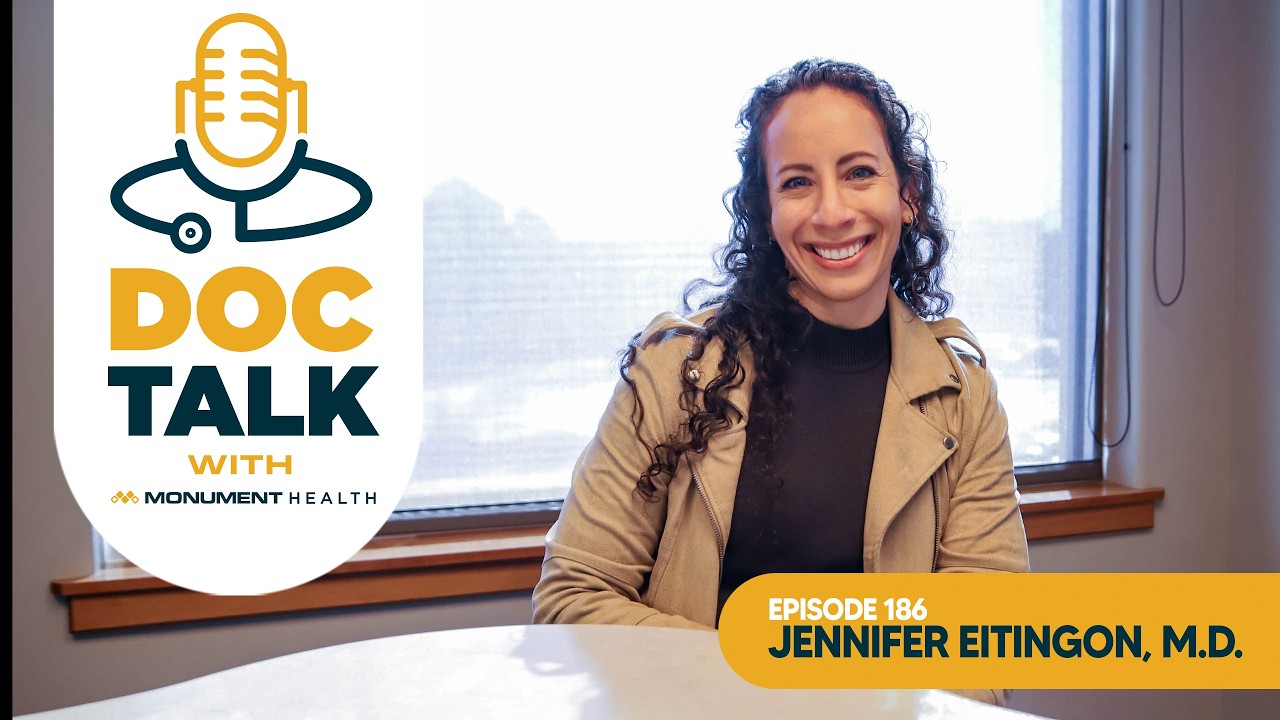

Listen or watch this episode on your preferred platform:


Doc Talk with Monument Health
Episode 186
Host: Mark Houston | Guest: Dr. Jennifer Eitingon
HOST (MARK HOUSTON): Welcome to Doc Talk, a weekly podcast featuring Monument Health physicians addressing medical topics. Tune in to your health with Monument Health.
MARK HOUSTON: Okay, hello again, everybody, and welcome to another edition of Doc Talk with Monument Health. My name is Mark Houston. Most of us don't think about end-of-life care until we absolutely have to. And by then, it can feel overwhelming. It can be confusing, and honestly, it can be a little bit scary too. But what if the conversation didn't have to start there? What if there was a whole field of medicine dedicated to helping people feel better, not just at the end, but all along the way? So today, I'm excited to sit down with Dr. Jennifer Eitingon, a palliative care physician right here in Rapid City. Trained at Johns Hopkins, worked in one of the country's top hospice centers in Maryland, and then you came here to the Black Hills. So welcome, Doctor. I'm glad to have you on the podcast today. I'm glad you decided to do this, because I think this is a great conversation to have, even though it's kind of a hard conversation to have. So let's start with the basics, because honestly, I think a lot of people mix these up. What exactly is palliative care? Like, if you had to explain it to somebody at a backyard barbecue, how would you do it?
DR. JENNIFER EITINGON: Yeah, the conversation I have at a backyard barbecue is a little different than in the hospital. But, um, yeah, thank you for having me.
MARK HOUSTON: Absolutely. Not just here, but the Black Hills. It's been a very warm welcome. How long have you been here?
DR. JENNIFER EITINGON: About three months.
MARK HOUSTON: Oh, that's it. You're very new, then. Okay. Well, where are you from originally?
DR. JENNIFER EITINGON: I'm from New York originally. I ended up doing my residency... well, I had a little bit of a convoluted path. I started off as a surgical resident. I was sure I wanted to do surgery. And then I started surgery and saw some really hard things. The way that we were taking care of patients who were approaching the end of their life, it felt like we were always offering them more interventions, more surgeries, and what we really needed to do was sit down and have those hard conversations. So that was my first kind of exposure to palliative care. I said, "Oh, wow, this is really what we need more of in American medicine." It didn't feel like we needed another surgeon. Not that I don't have unbelievable respect for my surgical colleagues, of course. It just wasn't my path. So I did a 180. I moved to Montana. I did my residency at Billings Clinic, and then, knowing I was going to go into palliative care at that point, I did my fellowship at Johns Hopkins, worked at Johns Hopkins for a few years, and now I'm here. To answer your question, how do I describe palliative care? I describe it as a specialty, like anything else. I had to go to fellowship, like cardiology, like gastroenterology. It's a specialty that focuses on symptom management. Things like pain, shortness of breath, nausea, vomiting, constipation, all of the things that make us feel crummy. That's my expertise. Under that umbrella exists hospice, and hospice is an insurance benefit for the right patient at the right time in their life. I can go into that a little bit more. If I were sitting with a patient, I describe what we do in three buckets. The first is the symptom management bucket. We focus on making people feel as good as possible. A lot of our patients have chronic illnesses or are dealing with chronic pain, and we work to come up with a game plan to manage that. Sometimes it's medications, sometimes it's psychosocial, sometimes it's meditation, whatever is right for that person. The next bucket is getting to know each other, which helps to manage symptoms, but also to make sure that we're on the right care plan. At a certain point in our lives, it doesn't make sense to go back and forth to the hospital. It makes sense to stay in our home and receive care there. That might be when it's appropriate to start thinking about hospice. And then the last bucket is the paperwork bucket. Things like advanced directives, five wishes, care planning, things like that.
MARK HOUSTON: I guess you kind of answered the next question, which is great, because people will hear the term "palliative care" and automatically assume the worst. And how it differs from hospice. The buckets you described were a pretty good way to go about it, because it's all before you get to hospice care. Correct?
DR. JENNIFER EITINGON: That's how I would describe it. Palliative care is more of an umbrella, and hospice sits under that umbrella. Palliative care is the kind of care given in hospice, but you don't have to be in hospice to get palliative care.
MARK HOUSTON: Oh, okay. That's interesting. Can you explain that a little more?
DR. JENNIFER EITINGON: Absolutely. We offer outpatient palliative care as well. For folks who are not in the hospital, we have palliative care physicians outside of the hospital, and you can see a palliative care provider at an outpatient appointment to work on adjusting your medications and making sure symptoms are managed. Those patients aren't yet enrolled in hospice. That might not be where they are in their disease trajectory. It just might not make sense for them at that time. So palliative care, again symptom-focused treatment, can still be offered even if somebody's not enrolled in hospice.
MARK HOUSTON: I see. Okay, that's a much better way for me personally to understand that. Well, what is the biggest misconception families have when they first come to you? And can that sometimes get in the way of the care they're about to receive?
DR. JENNIFER EITINGON: Absolutely. You know, for better or for worse, we don't like to talk about hard things. We don't like to talk about the end of our lives and what that might look like. So a lot of people do correlate palliative care with hospice. And then when a hospitalist or an intensivist says, "Hey, I'm going to get the palliative care doctor involved," everyone assumes that means time is short. I really try to emphasize that hospice is not a time stamp on somebody's life. Palliative care certainly isn't a time stamp on somebody's life, but hospice isn't either. It does change the care plan. But very often for patients who have a life-limiting disease, focusing on symptoms rather than recurrent interventions and traveling back and forth to the hospital can actually prolong life. So it's the right thing for the right person at the right time.
MARK HOUSTON: That makes perfect sense. As you're saying this, I'm thinking about someone sitting at home right now who may have parents or a spouse dealing with this. What is the one thing you wish they knew that most people don't find out until it's too late?
DR. JENNIFER EITINGON: I try to think about reframing the conversation. All of us want to live as well as possible, for as long as possible. "As long as possible" is an objective measure, but "as well as possible" is different for different people. And I try to explore that when I'm getting to know someone. What is the most important thing to you? Is it continuing your relationships with your doctors, going back and forth to the hospital, getting those treatments? Or is the most important thing spending as much quality time as possible with your family and spending the time that you have at home? Hospice does involve sending a nurse to the home, or a social worker, or making sure people have the support they need at home. So I try to reframe the way we're thinking about our healthcare in terms of focusing on our values first. What's the most important thing for our life? And then how do we integrate medicine to help promote those values and get the quality of life that we want?
MARK HOUSTON: You mentioned that when you first started, you thought maybe being a surgical doctor was the way to go. Was there a moment where you realized this is what you truly wanted to do? Because this is an incredibly compassionate field. You wanted to go beyond the surgery, beyond constantly sending people back for appointments. I'm so interested in that moment where it clicked for you.
DR. JENNIFER EITINGON: I could name so many patients. There was one in particular during my surgical residency who had been in the hospital for months. She had wounds on her stomach and her back. Every day we were changing her dressings, and she had to turn over onto her side and then onto her back again. It was incredibly painful. She was becoming more and more withdrawn. Eventually she lost capacity, which unfortunately happens when someone has been in the hospital for a long time, for a lot of reasons. And I just stopped and said, "What are we doing? When did she lose her autonomy?" The other hat I wear is in ethics. I have a master's in bioethics as well. So I asked myself, are we doing things that are improving her life? Is the medicine we're providing still helping? Or should we be reevaluating our care plan? That was the patient who really stuck with me. There were a lot of circumstances like that. For some patients, I'm published in end-of-life care for Orthodox Jewish patients. They're really interesting to me because very often they accept what's considered a vitalist ethic, which means do everything you can for another breath of life. That's considered the appropriate care plan under their religious law. They would pursue any procedure that could potentially lengthen their life. But for most of us, that's not what we want. So navigating that, seeing where somebody's values lie, is a really important path to explore when making sure we're treating them in the right way.
MARK HOUSTON: I suppose you also have to take into account all of the different spiritual beliefs people have. That has to be a maze to walk through in a lot of instances. You trained at Johns Hopkins, worked in Baltimore, were in Israel for a while, I believe. You've had this whole career on the East Coast, and then you came out here. Does the care change? Is it different here in the Midwest than on the East Coast?
DR. JENNIFER EITINGON: I like to approach things very modestly. I've only been here a few months. I don't pretend to have an in-depth understanding of what people believe here, but I'm really looking forward to learning about it. Especially with the Lakota tribes. I want to learn more about the spiritual beliefs and cultural beliefs that people have here, because again, I want to make sure we're taking care of people the right way. Medicine can do a million things, but are those million things right for everyone? Probably not. I will say, folks are tough as nails here. You'll have somebody who's been a rancher their whole life, comes to a doctor for the first time, and they're already missing two fingers. They just shrug it off and say, "I'm fine." Maybe that makes these conversations even harder. Or maybe not. Maybe because folks here are on farms, they see the death of cattle, and this is just more a part of life.
MARK HOUSTON: Exactly. And that's really interesting. In all different parts of the world, of course it's different. How, just in our country as big as it is, how people feel about this when nearing that stage is something you have to navigate and understand. And that means learning from all the ways people deal with this. You have to really love this work, which is a weird thing to say.
DR. JENNIFER EITINGON: Yeah, I love exploring people and their different paths. None of us make our decisions in a bubble. We're all very relational. One person's relationship with their third cousin might be the most important thing to them. Somebody else's relationship with their son or their God might be the most important thing. Everyone has their own priorities and path. I really love people. I love having those conversations and learning. So have me back in about a year, and maybe I'll have more to say.
MARK HOUSTON: I absolutely want to do that, once you get to know the people here. You've touched a little bit on this already, but how do you navigate having that conversation with a family who isn't ready to hear it?
DR. JENNIFER EITINGON: I consider emotion a success. If we're reaching a place where there are some emotions, that means there's understanding. Yes, there are going to be sad emotions. Death is sad. Disease is sad. But I think it comes with a lot of meaning and a lot of purpose and a lot of opportunity to have really hard conversations. So yes, a lot of what I do elicits some really difficult feelings, but sometimes that opens the door for really positive ones that needed to come out.
MARK HOUSTON: Do you get people who get mad? Who get upset?
DR. JENNIFER EITINGON: I remind myself and the folks I work with that it's not about us. The anger is not directed at us. We're angry at the situation. When we're sick, we're angry at our bodies, but we project that anger onto everyone else. Just reminding ourselves of that, and staying humble in the understanding that everything is so much bigger than us, it's not anger directed at us. I know that. I've had patients and families apologize to me the next day and say, "I'm really sorry I yelled at you. It wasn't anything you said." And I tell them, I know. You don't have to apologize. I get it. This is tough, and it's not about me.
MARK HOUSTON: Well, now that you're here in Rapid City, if somebody is hearing this and needs to begin this process, where do they start?
DR. JENNIFER EITINGON: Again, palliative care is always available, and I emphasize that it's a specialty like cardiology or endocrinology. If you feel like you're having symptoms, if you have a chronic illness and your symptoms are not adequately controlled, ask to see a palliative care provider. We have an outpatient palliative care clinic, and we can help explore with you whether or not it makes sense to consider transitioning care to hospice. But again, that's for a small part of the population. What we do is help get to know folks, explore their values, and make sure we're treating them in the right way.
MARK HOUSTON: I don't think a lot of people knew this was even an option. Are you the whole team, or are there others as well?
DR. JENNIFER EITINGON: We have three doctors and two nurse practitioners that make up our palliative care department. We have an outpatient service and an inpatient service in the hospital as well.
MARK HOUSTON: Do you recommend people make an appointment directly with you, or should they go through their primary care doctor first? Is there a process?
DR. JENNIFER EITINGON: Great question. Very often we get our consultations from the hospital. When somebody is having recurrent hospitalizations, perhaps for symptom management, we'll say, "Hey, do you want to see someone outpatient?" But there's no reason you can't reach out to the palliative care department directly and get an appointment.
MARK HOUSTON: All right, very good. Well, Dr. Jennifer, thank you very much for coming in and talking with me today. These podcasts, the emotion behind them, they're kind of hard to listen to sometimes. I think people will see the topic and say, "I'm not ready for that conversation. I don't want to hear this yet." But I think everybody should hear this. I'm a firm advocate of having the conversations. You're going to have to have them at some point, and if you're prepared for it, it's never going to get easier, but maybe a little less stressful in certain situations. And I'm just happy to know that we have this here. So thank you very much for coming in. We'll have you back in a year to see how you've gotten to know everybody around here, and whether you still think we're as tough as you might think. Anyway, thank you, Doctor. I appreciate it.
DR. JENNIFER EITINGON: Thanks for having me.
MARK HOUSTON: You bet.