
Listen or watch this episode on your preferred platform:


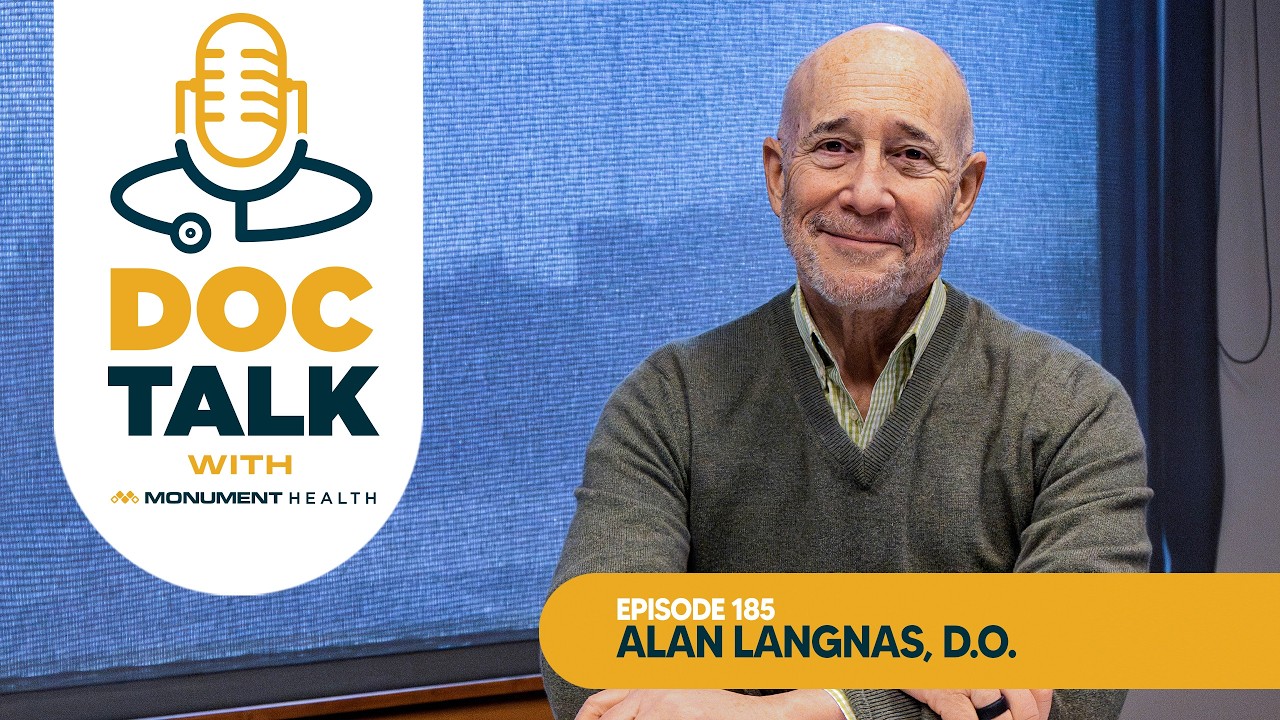
Doc Talk – Episode 185
Transplant Medicine: Partnership, Innovation, and Patient Care
Host: Mark Houston | Guest: Dr. Alan Langnas, Professor of Surgery & Director, Nebraska Center for Transplantation – University of Nebraska Medical Center
Welcome to Doc Talk, a weekly podcast featuring Monument Health physicians addressing medical topics. Tune in to your health with Monument Health.
Mark Houston: Hello again everyone, and welcome to another edition of Doc Talk with Monument Health. My name is Mark Houston, and most of us don't think about transplant medicine until it becomes personal. And when it does, that's when everything changes. Suddenly you're learning new words, new risks, new timelines. It can feel like stepping into a completely different world. So today we're going to talk with someone who has been leading in that world for decades. Dr. Alan Langnas is a professor of surgery, director of the Nebraska Center for Transplantation, and chief of transplantation surgery. He also serves as the clinical director of the liver transplant and intestinal programs. He's been on faculty at the University of Nebraska Medical Center since nineteen eighty-nine and has led the transplant program since nineteen ninety-seven. So this is someone who's seen the field evolve. He's seen families at their most vulnerable, and now there's a partnership that directly impacts patients right here in the Black Hills. That's what I want to dig into and what that really means. So welcome, doctor, to the podcast. Thanks for doing this.
Dr. Alan Langnas: Thanks, Mark. Great to be here.
Mark Houston: Well, now when you hear that read back to you, do you hear nineteen eighty-nine and think, oh boy, it's been a minute?
Dr. Alan Langnas: You know, it's a funny thing about life. The old saying goes, the days get longer, but the years get shorter. And for sure that applies here. I mean, I vividly remember coming to Omaha from Detroit, which is where I came from. And now I look back on it and I cannot believe how many years it's been. I had three children grow up in Omaha, and now they're on their way doing their own things. So yeah, time goes quickly. The world moves on. But it's all wonderful.
Mark Houston: What led you into this, doctor? When you were growing up, you were in high school, did you ever dream that this is where it was going to be? Is this what you wanted to do?
Dr. Alan Langnas: So I appreciate that. I'm not sure I appreciate that question, but I get asked that question a lot. And you know, I'm not that person, right? I was an okay student in college. I went to the University of Michigan as an undergraduate, you know, go blue. But I went to school as sort of an environmental studies major. I was outdoorsy. I was a backpacking and canoeing guide, that kind of deal. Tree hugger, however you want to characterize it, maybe old school hippie back in the day. And I don't know, I just sort of wandered my way, ended up in medicine, but I really got there maybe a little later. And then became a surgeon because that really resonated with me. Being a surgeon, I don't necessarily know that I wanted to be a doctor. But I thought I really wanted to be a surgeon. And then that just took me this way and that way and ended up in transplantation. So I wasn't one of these kids who knew it from the beginning. I was a late bloomer, so to speak. But I think that's okay.
Mark Houston: Well, I mean, you should tell your kids that. With my son, he's nineteen years old, and I'm like, you'll find your way. It doesn't matter, you don't have to follow the path that everybody else follows. And obviously it worked for you very successfully. Well, let's get into a little bit about why you're here, doctor. You oversee a wide range of transplant services, liver and kidney and pancreas, small bowel, intestinal rehabilitation. For listeners who may not realize how complex this field is, can you help us understand the full scope of what your team actually does on a daily basis?
Dr. Alan Langnas: Oh, can you even break that into a soundbite here? I think one of the things we do culturally as a team, and what we try to achieve, is that we get sent patients from all over this region and actually all over the United States. As a program, we believe we have a responsibility to the region. I think we have a social contract, not just with Metro Omaha and Lincoln, but the entire state of Nebraska, virtually all of South Dakota, western Iowa, Kansas, Missouri, at a minimum. And so I think as a consequence, we try to provide a certain type of experience for patients and their families, because the way it typically goes is somebody goes to see their doctor and they're given bad news. There's just no way around it. They get told, hey, you got dealt a bad hand. The stakes are high. Your health is in jeopardy. Your life is in jeopardy. Or your family member's in jeopardy. Your child is in jeopardy. Your baby's in jeopardy. So it's a really impactful moment for all these families. So what we make sure of is that when they come to Omaha, to the University of Nebraska Medical Center, to get sort of that front row seat to this experience, we talk to them about creating a partnership. We're going to be in this together. This is not your doctor, this is the diagnosis, this is the plan, see you later. We're going to invest in your lives to help you on this really challenging journey. And so because of that approach, when people come to us at the University of Nebraska, we put sort of that warm blanket on you to help you navigate a really, really stressful, really difficult, really high-stakes situation for you or your family member.
Mark Houston: You've been part of this program since the late eighties. You've been leading it, like we said, since about the nineties. From your perspective, what's changed the most? That's one of the questions I love asking people who have been in these fields for a long time. And I guess kind of a follow-up to that would be, what are you most proud of in the changes you've seen over all these years?
Dr. Alan Langnas: Yeah. So in so many ways, nothing's changed. Sure. I think the operations are kind of the same. Some of the medications are mostly the same. But I would say the things that have changed the most are the types of patients we're seeing, some of the diseases that we see are different. So for example, early in my career, hepatitis C did not exist. Somebody discovered it. It didn't exist, really. Nobody knew what it was. It was called non-A, non-B hepatitis. Nobody knew what it was due to. Then somebody in the late eighties, early nineties discovered this virus. And we said, oh my goodness, all these people have hepatitis C. And then we would transplant people and we didn't really have a good treatment for the virus, and people could get recurrent disease. And then new drugs came out. And now we've literally cured so many people either before transplant or after transplant. So a disease was discovered, treatments were applied, and then revolutionary curative treatment was invented. So this is all in my lifetime. And I joke around with people. I say, in my medical career, HIV came out in like eighty-two and nobody knew what it was. Then it was discovered and everybody was dying. And then suddenly we have treatment, not a cure, but now there's good treatment and people just live their lives. Just look at Magic Johnson, right? And then hepatitis C, another sort of epidemic. Didn't know what it was, discovered it, didn't know how to treat it, got treatment. Now it's just not really a big issue. And then COVID, so in one person's lifetime, sort of three things kind of came in, right? So that just gets to your question about what's changed. The operations haven't really changed. If you come and watch me do a liver transplant, that operation is fundamentally the same as what I used to do, from what I did in eighty-eight to what I did last week. It's the same operation, some little tweaks here and there, but at its core it's the same. I think the exciting new things for us now are new technologies. The biggest barrier to people getting the treatment they need, whether you have kidney failure and need a kidney transplant or you have bad liver disease and need a liver transplant, the biggest barrier is the donor organs, right? We can't just, like heart surgery or brain surgery, get stuff off the shelf and fix you up. You need to have a donor organ. And whether it's a deceased donor or a living donor, that still represents the rate-limiting step for the whole thing.
Mark Houston: So we still always talk about organ donation. Has that gotten better in your time in practice, as far as people signing up more to be organ donors? Or is it still a pretty big struggle to get the ones you need?
Dr. Alan Langnas: So I would say yes to both. I think we're still not where we need to be. People still die on the waiting list. They're waiting for an organ transplant, waiting for that phone call. It's as dramatic as maybe we think about it or see on television or read about. So that drama still exists. But when I speak about new technology, two things have happened that I think have been the most dramatic. The first is something called first-person legislation. And I must confess, I'm not sure about South Dakota, but I know Nebraska. In Nebraska, when you go into the DMV to get your driver's license, they say, do you want to be an organ donor? And you can check that box. What first-person legislation means is that if you check that box on your driver's license, saying I want to be an organ donor, that's legally binding. So if something catastrophic happens to you, even if your family doesn't want to do it, it's going to happen because your wishes have been put down on paper in a legally binding way. And that's really helped improve organ donation and our ability to get more organs for transplantation. Then the other thing that's happened is that we now have new technology. We can take these organs, and it used to be just like you would imagine on TV, people get a kidney or liver, they take it out and put it in the cooler ice box and immediately it's got to hit the plane and off they go. That still happens. But now we also have these machines, what we call machine perfusion. We can hook the organ up to a machine that will pump human blood at the right temperature, at the right flow rates through these organs, and we can measure things. Now some of these logistical issues get eliminated. And sometimes we're not sure if an organ is going to be safe to use because we're not sure it's going to work well, and the stakes are high. If I put a liver in you, Mark, and that liver was a dud, your life is in immediate jeopardy. I'm talking about days. So our ability to put these organs on machines to test them, give them a test drive, we can get lab tests, we can see how much bile it makes, do a biopsy. It allows us to say, you know what, Mark? Not only do we think it's good, we've done even more. We know we've given it a test drive. We're even more confident it's going to be okay. And it allows us to use more organs that maybe we otherwise wouldn't have, to help more people.
Mark Houston: That's super reassuring to hear, because I don't think most people have any idea that you guys can do that. A lot of people thought, well, when will they ever just have artificial organs that we can use? I mean, you can never say no, but that is pretty close to, hey, before it goes into your body, this works.
Dr. Alan Langnas: Yeah, right. We give these organs a test drive. We kick the tires, give it a test drive, make sure it's okay, make sure it's safe. And there's still some risk, but we've really reduced it. We're now able to use organs that we were skittish about before because we didn't want to jeopardize the person we're putting it in. Now we have more confidence and we can help more people. And it's really wonderful.
Mark Houston: What is the most common transplant that's done in people?
Dr. Alan Langnas: A kidney transplant. It is the kidney for sure. And yeah, there are so many people on dialysis today and there is sort of an epidemic of kidney failure. I'm a boomer, so there's a big bulge of people in a certain age group that are getting older and going on dialysis to keep them alive. And the reality is, in terms of quality of life and even costs, kidney transplantation is always the way to go. And I think everybody who knows somebody, or is on the verge of getting on dialysis or is on dialysis, should talk very seriously with their doctors. Is transplant an option for me? Can I go visit with a transplant team and see what I can do?
Mark Houston: Oh, that's great advice. Now let's get into a little bit about the partnership with Monument Health. Nebraska Medicine started building this formal partnership. What stood out to you? What made you feel confident that this is something that's going to work?
Dr. Alan Langnas: So it is a real partnership because it's a friendship. Paulette Davidson, who is the CEO of Monument Health, was sort of my quote-unquote partner. At the University of Nebraska, I was the surgical or medical person running it, but she was my hospital administrator partner. She was the executive director of transplant. She came from Indiana, I think it was, and got a new job in Omaha in senior leadership for the hospital. They said, okay, you need a hospital partner, you need a dyad kind of deal. I want you to meet Paulette Davidson. And we just became thick as thieves. We proceeded to not only do great things together in terms of the health system, but we became friends. And then she was very talented and that was just a starting point for her. Obviously then she came up to Rapid City and worked her way up to the leadership position she's in today. So this really is, I mean, this goes back to a friendship that's blossomed into this great partnership for transplants, one hundred percent. And I give credit to Paulette. She said, listen, we can use transplant up here. What do you think? There's a lot of other people who want to date us, kind of deal. But I think it would be better if it was your team from Nebraska, Alan. And I said, yeah, it makes sense. And when you look at Rapid City, Omaha, Nebraska, South Dakota, culturally, nothing's the same. But man, we are really close.
Mark Houston: Oh, it's super similar. This whole region is very tight, honestly.
Dr. Alan Langnas: Yeah. And we all think the same. We have the same issues. A few people live in the Rapid City metro area, a lot of people live in the Omaha metro area, but most of our patients come from other places and everybody's got to go a long distance. Everybody's farmers and ranchers, and we have people who are Native American. So we deal with, culturally, I think we are a good fit and we quote-unquote get it. And I think it's just a really good partnership because of that.
Mark Houston: Well, let's say someone in the Black Hills has been told that they may need a transplant. Obviously, like you've talked about a little bit, that's a life-altering moment. I can't think of a bigger one, honestly. How does this partnership kind of change their path compared to trying to coordinate care across states on their own?
Dr. Alan Langnas: Right. Anybody who's had serious health issues knows that navigating the medical system today is really challenging. Even for somebody who is in medicine and connected, it's hard. I can't even imagine the uncertainties and the frightened nature of the whole experience for everybody. So what we do is we work very closely with all the ambulatory care people, the outpatient stuff, the inpatient physicians, the hospitalists, all the people who are here and live here. We have a very nice relationship with them. And somebody will say, we want you to see Mrs. Jones. We say great, and we have a clinic up here so we can come up. We come up here twice a month, we come up in the Nebraska Medicine jet, which I came up in this morning. And barring any horrible weather, because we don't like to fly in bad weather, we have a clinic up here at Monument Health and we'll see people in the clinic. We'll talk to them about the transplant. We'll tell them, yeah, we think you're a candidate. We'll get as much testing as we can done here locally and eventually say, I think in the end you're going to have to have a road trip down to Omaha and spend a couple of days with us down there. But we do screening and education here locally, get to know these people, answer important questions, give them resources, and kind of try to smooth out the anxiety that they're going to have. Because they get bad news and they're scared. And knowledge is power. The more we can help them out, really, it helps things out.
Mark Houston: Is it just to be clear, the transplants, the surgeries, don't happen here in Rapid City? You have to go to Omaha for that.
Dr. Alan Langnas: That's correct.
Mark Houston: Is that the closest one? I mean, I suppose you could go to Denver or Minneapolis, Rochester obviously.
Dr. Alan Langnas: Yeah. I don't have a map in front of me for sure, but it's got to be pretty equidistant. Everything's about an eight-hour drive, right? And you know, Rapid City is a wonderful place. But we kind of are in the middle of the region, right? And that's kind of a good thing in so many ways sometimes. You fly in here, you look out the window of the plane, it's just absolutely gorgeous. It is just beautiful. And so people have to go a distance, but as a health system we get it. We have the resources, there's housing close to the hospital. We have things for people who need gas money because a lot of people don't have a lot of money. So we have things set up to help people lessen the blow of the whole thing. And a lot of it's financial. So we try to do our best to help with that. And I would also say that South Dakota Medicaid has been a really great partner. I mean, they really have. I've worked with them, I've talked to them. They really do look out for the people of the state. And we have a really good relationship with Indian Health Services as well. So we deal with them a lot as payers. We work very closely with them to help make it as smooth a process as possible under challenging circumstances.
Mark Houston: Well, that kind of leads into my next question that you touched on briefly. Because you're sharing this care between two systems, it's the University of Nebraska and Monument Health here. Communication has to be seamless for something like this. So how do you guys make sure that patients don't feel like they're being bounced around and that they feel supported?
Dr. Alan Langnas: Yeah. I think once we kind of get people plugged into our system, we are friends for life. We have wonderful nurse coordinators who are sort of our frontline health providers. And so they are constantly talking to these patients directly, saying, listen, you need to repeat your labs, how are you feeling? You're not feeling well? Go to the ER. We have relationships like with Matt Murphy, who's I think still the head of all the hospitalists here. We have great relationships at so many different levels. Everybody knows each other, everybody's got each other's phone number, everybody's texting each other. So in the end, that really improves the coordination of care for people who have complex medical problems.
Mark Houston: So for people that are listening to this podcast right now, this is such a challenging moment for them when they realize that a transplant is going to be necessary. They're going to be scared, overwhelmed, which is an understatement when you talk about something like this. What would you personally want them to know about your team and this partnership?
Dr. Alan Langnas: So I appreciate you asking that, Mark. What I can assure people is that you are going to get the highest level of medical and surgical care anywhere in the world. There are equals, of course. But you're not going to go anywhere to get better, or to get more state-of-the-art, cutting-edge, most thoughtful care than we're going to give. That's for sure. But people ask me what makes us different or better. And I do believe it's just that warm Nebraska blanket we put on people. We get it. People are coming from the ranch. They're coming from other places, coming from long ways away. They don't have a lot of resources. We get it. And we are going to make this process as inviting as possible for you to go on this journey, and we're going to do it with you. Like I said, it's just this partnership we make with our patients. We have a social contract with them, and that's our culture. I tell people, our nurses are the first people that meet our patients when they show up in our clinics. I remind them, I say, this is our job. We do it same thing every day. And there's routines to it. But I say, when that person shows up in our clinic, you have to understand this is arguably the most dramatic moment in their life. Every minute of this experience is going to be seared in their brain and they're never going to forget it. And so whether it's like the birth of a child, everybody remembers every little detail. We remind ourselves of that all the time so that when people do show up, we're trying to always put our best foot forward and help people, in whatever their unique circumstances are, navigate whatever's going on.
Mark Houston: I love that analogy, and it kind of reminded me of another doctor I interviewed at Monument Health who said, you know, I could go into a night of being on call and do five or six epidurals. He said, I've done thousands of these. So to me, I'm like, oh, it's another epidural, here I go. But to that person getting it, it could be their very first. And he said, so I have to walk into that room with that same mindset of, hey, we're going to be okay. We're going to get this done. You're going to be fine. I'm very good at this. You're scared, I understand that, but as a team we're going to make this work.
Dr. Alan Langnas: Yeah. I appreciate you saying that. I think we want to provide reassurance, but not false expectations. We're honest with people. Most people do okay, but not everybody does. It's still a high-stakes game. But we're upfront with people. We believe in transparency. I tell patients, there's no such thing as a dumb question. Unless you've done this ten times before, which I know you haven't, anything you want to ask is fine. Write down your questions, give us a call. We don't want you laying in bed at night worrying about stuff. Talk to us, ask us. This is, again, a partnership.
Mark Houston: This might be a kind of a weird question to ask, but as you've done this as long as you have and obviously thoroughly enjoy the work, are there transplants that you enjoy doing more than others? Do you have ones that you feel like, yeah, this is the one I know is going to help, I know it's going to make the most difference?
Dr. Alan Langnas: You know, I think, so I was just giving a talk somewhere out of the country. I wanted to count up how many transplants they wanted me to give a talk on liver transplantation and stuff like that. So we've done about four thousand five hundred liver transplants, which is a lot. But of those, a thousand of them have been in children, and most of those, the majority, are in babies because that's just how it goes. You can go that low. You can have babies get a transplant. Getting to all that, I guess, you know, if it's another kind of, you know, another dude like me who's a little long in the tooth, it's just like, okay, that's fine. But when you see these young families who are dealt a really, really difficult situation with a sick child, oftentimes a baby less than a year of age, those things just take on a higher level of intensity and maybe emotional investment. Typically the transplants we're doing in those age groups are technically a little bit different. We're doing living donations, so a family member is donating a piece of liver, or we're taking a deceased donor and cutting off a small piece of that. So the technical challenges are elevated, and the stakes are high. Children are children. How could it not be more special? And that's a privilege to be able to do that.
Mark Houston: Oh, that's a great answer. Well, Dr. Langnas, I'm really glad that you found time to come up and do this. I really appreciate talking with you. Down the road, if you're ever back and want another cup of coffee and just want to chat for twenty-five minutes, there's lots of obviously transplant surgeries and a ton of stuff we could talk about on this. You can get super specific on everything. And if you're ever up for it again, I'd like to get more specific into some of these, because it's obviously just an unbelievably interesting field that has to be done. The fact that it can be done, the fact that it saves lives is something I think needs to be discussed even more. So I really appreciate you coming in. Dr. Alan Langnas, professor of surgery, director of the Nebraska Center for Transplantation, chief of transplantation surgery. You've got a lot of stuff on this list, doctor. Thank you for coming in and doing this, I appreciate it.
Dr. Alan Langnas: Oh, thanks, Mark. I really, really appreciate the opportunity.