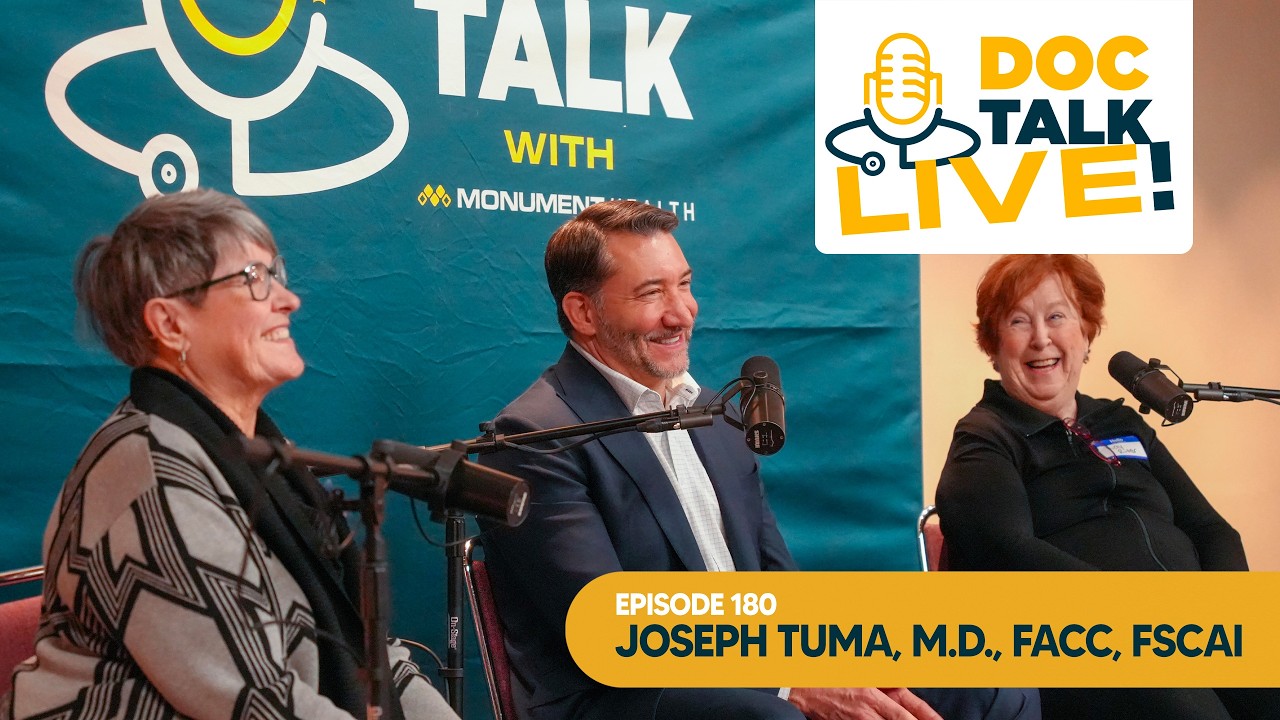

Listen or watch this episode on your preferred platform:


HOST: Welcome to Doc Talk, featuring Monument Health physicians addressing medical topics.
This week, interventional cardiologist Joseph Tuma, MD, hosts a special Valve Disease Awareness Day roundtable live in front of an audience at The Monument in Rapid City.
Listen in as patients share their experiences undergoing transcatheter aortic valve replacement (TAVR) procedures performed at the Heart and Vascular Institute.
DR. JOSEPH TUMA, MD, FACC, FSCAI: Well, welcome everybody to Heart Valve Awareness Day. I’d like to thank everyone for coming.
This is always a very gratifying day for me. I get to reconnect with patients—from that first clinic visit, through discussions about the procedure, getting to know you and your families, and then seeing you here today on the other side of it, back to your normal lives.
It’s really fun for me to see people doing well after the procedure.
Today, we have a couple of patients who have undergone the TAVR procedure, Darcy Olman to my right, and Kay Ryder, to my left.
They’ve had different experiences, so I thought it would be helpful to hear their perspectives. I’d also love for the audience to ask questions.
We’re approaching our 1,000th TAVR procedure, which is a huge milestone. This has been a very successful program, and that’s thanks to the incredible team—Jaci, Becky, Megan, Darlene, and many others.
I just show up and put the valve in—they do all the hard work.
DR. TUMA: Darcy, what stands out most to you about the procedure or the process?
PATIENT (Darcy Olman): I remember not realizing how bad I felt until after it was over.
Right after the procedure, I said to someone—I’m not sure who—that I already felt better. And the next day, when I got to go home, I thought, “I’ll take the dog for a walk.”
That was a little too soon.
(Laughter)
But I also remember how many people were involved in getting me ready. Everything went very smoothly, and the care was excellent. I really appreciated everyone involved.
DR. TUMA: Kay had a different experience.
Her initial procedure went very well. But about a year later, she started having symptoms again—similar to what she had before.
What we found, which is very rare, was that the valve had migrated. It had shifted into the heart’s pumping chamber, causing leakage around the valve.
We had a lot of discussions about treatment options. Ultimately, I referred her to one of the leading experts in valve treatment, Dr. Paul Sorajja at Abbott Northwestern, who successfully corrected it.
Kay, can you share your experience?
PATIENT (Kay Ryder): I’ll start from the beginning.
I was at a routine physical with my primary care doctor and mentioned, “Sometimes I feel like I get a sharp pain in the middle of my chest—like I’ve been shot with an arrow.”
He said, “We’re going to need an echocardiogram.”
I had no idea what that was. I didn’t even realize I had heart issues, but I did notice I couldn’t walk like I used to. I would get tired very quickly.
When I found out I needed a valve replacement, I was nervous—but the care here was incredible. The team explained everything clearly.
After the procedure, I felt better right away. I even thought about going for a walk immediately, but that was a bit ambitious.
Then about a year later, I had issues again and went to Abbott Northwestern. They did a great job there, but I have to say—the care here was absolutely exceptional. I can’t say enough about how well I was treated.
The Process: Diagnosis to Procedure
DR. TUMA: One question people often ask is about the process—from diagnosis to treatment.
Can you talk about that timeline?
PATIENT (Kay Ryder): It started in June with the echocardiogram, and by mid-October, I had the procedure.
There were a lot of tests in between, but that actually made me feel more comfortable because I knew everything was being carefully evaluated.
It felt like a long time at first—you just want to get it over with—but I understand now why each step was necessary. It’s probably why everything went so well.
Life After TAVR
DR. TUMA: How are you both doing now?
PATIENT (Darcy): It’s been a little over a year. I had never gone to a gym before, but now I go four days a week.
Cardiac rehab really helped me get started. Before the procedure, my daughter had to slow down for me when we traveled. Now I can keep up with her.
PATIENT (Kay): I’d like to be stronger, but overall, I’m doing well.
We went through a move, sold our house, and I felt strong through all of that. I’m grateful to be alive and enjoying life.
And I’ll say again—they walk you through every step of the process.
I also had RSV during recovery, so I spent a lot of time at the hospital, but even through that, the care was excellent.
Surgical Valve Patients & Team Approach
DR. TUMA: We also have some surgical valve patients here. Would you mind raising your hands?
We work closely with our cardiothoracic surgeons, including Dr. Mongara and Dr. Cambiagi. They are an essential part of our structural heart team.
Every patient is evaluated by structural heart advanced practice providers, a cardiologist, a cardiothoracic surgeon.
We review imaging—CT scans, echocardiograms, angiograms—and determine the best treatment approach for each patient.
Audience Q&A
AUDIENCE MEMBER: I want to talk about family involvement.
When I had open-heart surgery, my daughter and sister came from out of state. The care team included them in discussions about my condition and treatment.
My sister is a retired operating room nurse, and she was amazed. She had never seen that level of collaboration before.
After everything I went through, my daughter got her own cardiologist and started tracking her heart health. That’s important—family members should be proactive too.
AUDIENCE MEMBER (Jim): I think I was the exception.
My TAVR procedure didn’t go as planned—my heart stopped during the procedure.
But these guys are my heroes. They had minutes to figure it out and save my life, and they did.
I woke up in the ICU instead of going home, but today I walk dogs at the Humane Society four or five days a week. I get 8,000 to 10,000 steps a day.
If you need exercise, come volunteer. Nothing like walking a 100-pound pit bull.
AUDIENCE MEMBER: Cardiac rehab was incredibly helpful for me.
I also realized something important—sometimes you think symptoms are just aging. I couldn’t walk as far, couldn’t push a cart, and assumed it was normal.
But it wasn’t.
DR. TUMA: That’s very common.
Symptoms develop gradually, and people adapt over time. Many say, “I thought I was just getting older.”
But symptoms like shortness of breath, fatigue, and reduced activity tolerance should be evaluated.
Aortic stenosis, which we treat with TAVR, produces a very distinct heart murmur. It’s easy to detect with a stethoscope and usually leads to an echocardiogram.
DR. TUMA: Thank you all for coming. There’s food available—please help yourselves. I’ll be around if anyone wants to talk or ask more questions.
Thanks again, everyone.