
Listen or watch this episode on your preferred platform:


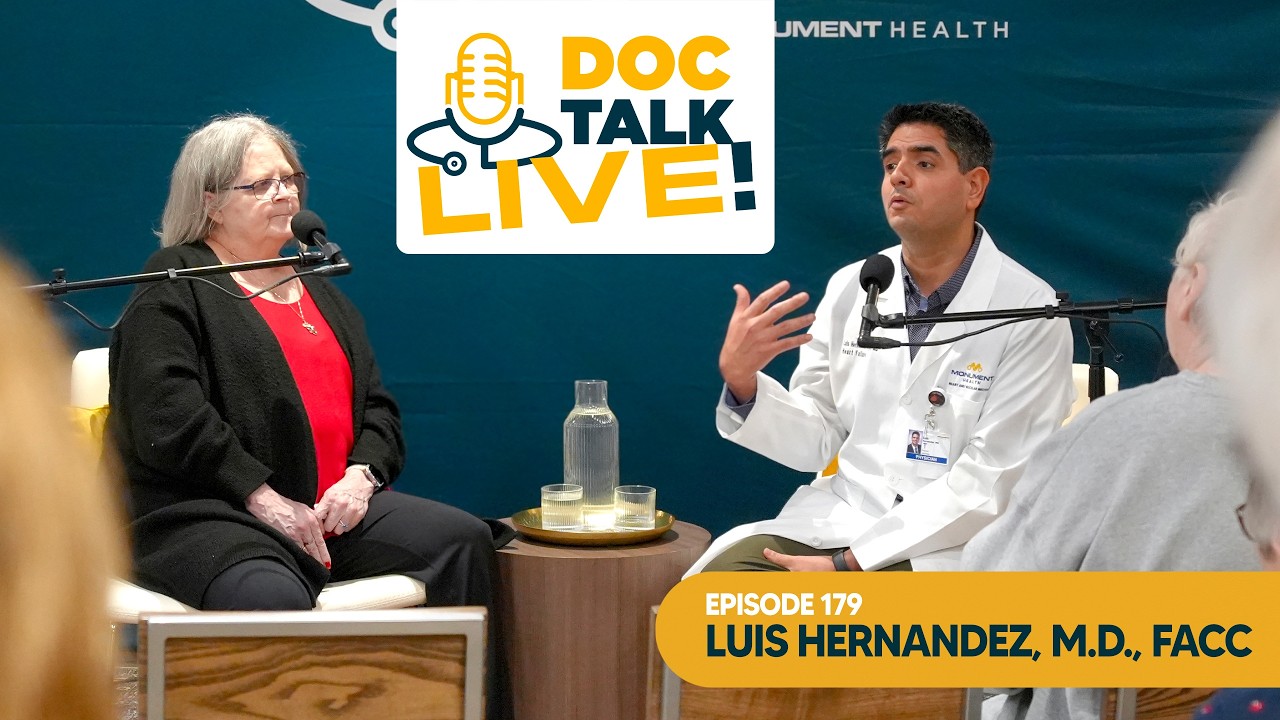
Welcome to Doc Talk. I'm Mark Houston. What you're about to hear comes from a Heart Awareness Week conversation in Rapid City. It's a real, unscripted discussion led by Dr. Luis Hernandez, a cardiologist at the Monument Health Heart and Vascular Institute and the Medical Director of the Advanced Heart Failure Program. In this conversation, Dr. Hernandez sits down with a patient to talk openly about end-stage heart failure, transplant decisions, and the practical realities involved. You'll hear how age and timing factor into how treatment plans are shaped, and what the process looks like from a patient's perspective. This conversation reflects the kind of meaningful educational discussion at the heart of Doc Talk.
Hello everyone. Good afternoon, and thank you for being here celebrating Heart Awareness Week. As I always tell everyone, everything that we have done is thanks to my team here on this side. My team, raise your hand. Let's give them a round of applause, because we couldn't have accomplished what we accomplished without them. I have a couple of patients with me today, and I just want to introduce what's new here in Rapid City. We're going to talk a little bit about heart transplant and kidney transplant. Not too much about the kidneys, but we're going to focus more on other things we can do when the heart is failing. So what do we do when patients reach what we call end-stage heart failure? What options do we have to offer? What can we do here in Rapid City? Let me welcome Renee. She is, believe it or not, both a heart and kidney transplant recipient. Tell us a little bit about your experience, what things we were able to do here, and how you're doing now.
I started out in two thousand. I came in and had a defibrillator pacemaker put in. We did pretty well with that for quite a while. We worked on different medications and management. Then I came in in January of last year, and it was just at the point where Dr. Hernandez, the first time I met him, came into the room and said, I think we're going to have to do a heart transplant. And I looked at my kids and went, what? That kind of started the process. We went through different tests. I ended up having an ablation and that didn't really fix it. Then Dr. Hernandez did a heart catheterization and said we're going to have to do something fairly soon. They put me in the hospital at the end of April, and then in April they transferred me to Minneapolis. I ended up rupturing a blood vessel in my leg, so I had a lot of problems with that. My kids were there and we talked about it a lot. They talked to me about the transplant and everything involved. We were kind of going back and forth, also dealing with my leg. Then my kids said, mom, do you really want to do this here? It's a thirteen-hour drive up, thirteen hours back, every time you have to go in for an appointment. Or should we do it in Denver? My daughter lives in Colorado Springs, about sixty miles from Denver. So that made the decision. I came home and at the end of June I went to Denver and did my orientation. Then on the seventh of July I qualified for both a heart and a kidney, because by the first of July my kidneys were failing pretty badly. I went down to Denver on the first of July, they completed all the other tests, and I was approved on the seventh.
You forgot to tell people that you didn't want to go.
No, no. And then you called and said, Renee, you have to go.
Well, that's the tough part. You have to tell the whole story.
So we got down there and everything was going well. I went to my daughter's on the eleventh of July, and by the eighteenth my defibrillator was going off constantly. We went back to Denver on the eighteenth, and by the twenty-sixth of July I had my transplant. Things were looking pretty critical by the twenty-fifth, so I was very relieved. I still sometimes wake up and think, am I dreaming? Is this real life? It's one of those pinch-yourself moments. Dr. Hernandez and Dr. Heilemann, both of whom I had been seeing for several years, if it weren't for them I probably wouldn't be here. They didn't just give me an ultimatum. They sat down and said, you need to go. And I think that's what people sometimes don't realize.
People always think you have to be dying to get a transplant. Ideally, we want to send people before they're dying. We don't want to send you when you're too sick. You want to be as healthy as possible so you can have the option to get a transplant. If you're too sick, the options become very limited, whether that's a transplant or a heart pump. It's a difficult situation.
And one thing I heard a lot was, you're old, you're too old, I don't know if we should be doing this. I started to get a complex.
That's another misconception. People think that if you're sixty-five or seventy, you're too old. Most programs will go up to age seventy. Minneapolis does seventy-two, for example. Every program is different. There are a lot of things that need to be taken into account when evaluating someone for a transplant. Social support is a big one. Renee has an amazing family, which made a real difference. Part of our job as a heart failure team is to understand your life and your lifestyle so we can figure out how best to help you. We also talk about things like substance use. You cannot be using drugs and be eligible for a transplant or a heart pump. Those things are serious regardless.
I am so happy to be better. Like I said, every now and then you just get this feeling like, is this real? I've totally enjoyed the extra time and hope to have a lot more with my grandkids. My grandson, who's twelve, came to visit me in Denver. I was there from the first of July and got out the fifth of August, but had to stay in Denver for a while. They have a place called Brent's Place, kind of like a Ronald McDonald House, right across the street from the hospital. He came down and said, Nana, when are you coming home? I said, I'm not sure yet. He said, well, why did you get an apartment? I said, just because I have to stay for a while. Then when I went back for an appointment in October, he said, oh no, you're going back? I said, just overnight, a couple of days. Not forty-three days like the last time. It wasn't forty-three days, but I guess that's what it seemed like to a twelve-year-old.
Family support really is a huge part of this.
What kinds of medications did you have to change after the transplant?
I had a whole list of heart medications that all went out the door, and my defibrillator is gone too. But I went from a whole lot of heart meds to a whole lot of immunosuppression drugs. The quantity didn't really change. I just went from one kind to a different kind. Down in Denver they'd come in every other day and say, we need to talk to you about your medications. They'd go through them all and remind me I had to take them on time. I said, I've had a defibrillator since two thousand. Taking my meds on time is nothing new to me. But yes, it's a lot of different ones, and many of them I'll be on for life.
That's an important point regardless of the transplant. Yes, there are a lot of pills. I can't honestly say I fully understand what it's like because I don't take them myself. But we do know those medications work. The idea is that they all work together and they make the heart stronger. Most of my patients will say they don't want to take all those pills. And I always tell them, well, if you end up getting a transplant, the quantity probably won't change. It may actually increase, because some medications only come in a very small dose, so you need multiple pills to reach the right amount. So if we can strengthen the heart with medicine and avoid getting to that point, that's always the goal. Push to the highest tolerated dose, monitor kidney function, monitor everything. I know, I know, even though I always say the heart is the most important organ.
When you get a kidney transplant, they just put the new kidney in and you keep your original two. I was floored when the kidney surgeon explained that. I said, so I'll have three? He said yes, but he explained it like hamburger and French fries. He said, we're just the French fries. Your heart is the hamburger. And I said, can I have a large drink with that? He said, I guess so, since you'll have three kidneys to process it.
Any more questions from the group?
Can you tell us more about how long you have to stay at the transplant center?
That's something patients ask about a lot in our clinics. How long will I have to stay there?
When I went down on the first of July, I'd had blood tests done and that's when we found out my kidney function was pretty bad, around a creatinine of three point five. They said, we want you to come down right now. I had been there in early June to do paperwork to see if I would even qualify, and then it goes before a board. I was approved on the seventh of July. But once you're approved, if you start having complications, you have to go and you may wait. There were people down there who had been waiting six months already and still didn't have a transplant. That scared me. But how long you wait depends on how quickly they can find a match, what condition your heart or kidneys are in, and what you need. I didn't realize how serious things had gotten until my defibrillator started going off constantly. I went from that happening on a Friday to having surgery the following Saturday. I must have moved up the priority list. Once you have surgery, they usually keep you in the hospital twelve to fifteen days. I stayed nine days and got out. Then I stayed at Brent's Place, just across the street from the hospital, until the twenty-fourth of September, about two months. They wanted me to stay another month, but I had had all positive biopsies, nothing negative on any of the tests, and I didn't have any appointments left except therapy on my hand. I said I could do that at home. So I went home a month early. Most of the time it depends on how far away you live. I know one woman down there who was from New Mexico. They may ask those patients to stay longer.
It's usually around three months that we'd like to keep patients close by. The first month it's every two weeks, then every three weeks, then the visits start to space out to once a month. It makes sense to go home once things are stable.
It made complete sense to me. I had no complications. And now I go once a month. That schedule ends this month, and then I go back in two months, then again in two more months which will be June. Then they want me in July for my one-year appointment. They're also going to do a coronary angiogram at eleven months, and then after that it'll be every six months.
You have to keep in mind that the time you'll spend at the transplant center depends on a lot of factors. Whether you have complications. Whether it's a heart transplant versus a heart pump. Your transplant came very quickly, which was likely because of the change in your status when you were getting frequent shocks. But you can wait for a long time. It also depends on your size. If you're smaller, you're essentially competing with pediatric donors, and there are fewer of those. Blood type matters too. If you're type O, you can give to anyone, but you can only receive from type O donors, so the competition is higher. If you're type A or B, there are more options.
Be positive. That's my blood type. B positive.
Easy to remember. Be positive.
I was very lucky because they found a donor where I could get both the heart and the kidney from the same person. And I was told about three or four weeks after I was recovering, one of the doctors told me how close I came to not getting the kidney. He said that once they put the heart in on Saturday, the kidney was actually doing so well on its own that they debated not putting the donor kidney in the next day. I came that close to not getting it. Heart was Saturday morning, kidney was Sunday morning.
The kidney allocation rules have also just recently changed, which brings a lot of new considerations. We won't get into all the details today, but they're significant changes.
Any more questions?
I want to show the picture. I was trying to be on my best behavior today, so we decided to put it on the back of our team photo. Our nurse educator Ron's child drew a picture of how he thinks the heart looks. Two chambers on top, two chambers on the bottom. We decided to make that our team picture for this year. It's a good reminder of why we do what we do.