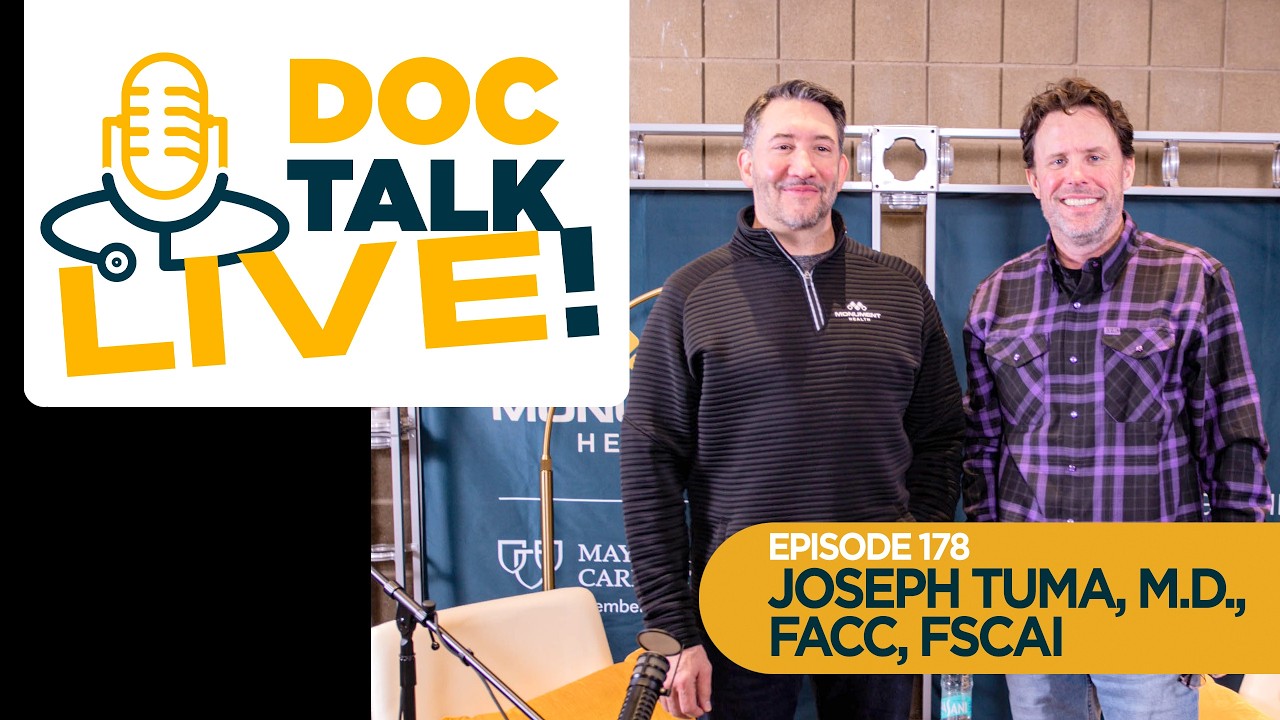

Listen or watch this episode on your preferred platform:


Welcome to Doc Talk, a weekly podcast featuring Monument Health physicians addressing medical topics. Tune in to your health with Monument Health. Well hello everybody, and welcome to this live edition of Doc Talk with Monument Health. My name is Mark Houston, and I'm happy to have Dr. Tuma with me today, who has been on a handful of episodes. You're a pro at this at this point, right?
It's pretty easy.
We're going to talk about a condition today that's more common than people realize, and it kind of flies under the radar until it ends up being a real problem. Our guest is Dr. Joseph Tuma, interventional cardiologist with deep expertise in coronary and structural interventions and peripheral vascular disease. So if you've ever had leg pain, wounds that don't heal, or have just been told you have poor circulation, this is going to be an episode you're going to want to listen to. And before we got started, Doctor, I asked, in this entire building we have thousands of people here at the stock show right now, and I was curious how many people do you think walking around here today might unknowingly have something like this?
Statistically, ten to twenty percent of people have some version of peripheral vascular disease. A lot of that, the majority of it, is actually asymptomatic and not causing symptoms. And probably seven to eight percent do have some symptoms related to the disease, and they may or may not even know what those symptoms are. Hopefully we can go through some of that.
Let's start simple. When people hear the term peripheral vascular disease, it really does sound intimidating. Those are a bunch of big words that sound scary all together. So what exactly is it, and how does it differ from heart disease?
They're very similar. The mechanism is the same. Basically, it's plaque buildup, cholesterol plaque buildup, in arteries other than the heart. That's the easy definition of peripheral vascular disease. The mechanism, the process, is the same where over time oxidized cholesterol called LDL gets deposited in the wall of the artery, which can start to calcify and limit blood flow to various parts of the body. The legs are probably the most common area we deal with, but it can affect the kidneys, the organs in the abdomen, the carotid arteries, and the arms. Really anything that's not the heart.
You mentioned LDL, and I think when a lot of people go in for their yearly physicals, that's always a big number they pay attention to when they get their blood work back. And obviously it's a number we should pay attention to when it comes to this, right?
Right. That's really the mediator of plaque buildup in blood vessels. LDL cholesterol, which stands for low density lipoprotein, is a small molecule that has a tendency to get deposited in the medial layer of the artery wall. Over time it starts to encroach on the lumen. It gets narrower and narrower. And then your body starts to heal that and calcify it, and that's the healing response. So five or ten years down the road, something that was not causing symptoms starts to limit blood flow, and then people start to have symptoms.
So LDL is what they also consider the bad cholesterol. Correct. You want the HDL to be higher. Who tends to be most at risk for peripheral vascular disease?
It's the same risk factors as coronary artery disease. People that have high blood pressure, people that have diabetes, people that have high cholesterol, whether a familial version or due to diet. Sedentary lifestyle, poor diet. Cigarette smokers.
I was going to say, you didn't mention smoking yet and I knew we'd get there.
Saving that one for last.
What about lifestyle factors and family history? Does that stuff move the needle on this too?
Big time. A lot of it really comes down to family history. It's about how your body processes cholesterol. Some people can have a super high LDL, but their body is very efficient at processing it so it doesn't get deposited in the wall of the arteries. We're learning more about that right now, looking at the various subtypes of LDL and trying to target exactly the ones that get deposited in the artery wall.
We have a lot of people walking around today who chalk up their leg pain to just getting older, or being on their feet all day. A lot of farmers and ranchers here, and it takes a lot to get them into a doctor. What should they really be paying attention to? What are the signs and symptoms that might actually point to this disease?
In peripheral vascular disease, it depends on the vessels that are involved. The legs are the most common. Typically it's going to be cramping pain in the muscle that occurs with walking, and it gets better when you stop moving. You go a certain distance, a muscle cramps up, you stop walking, the cramp goes away, and you can walk again. That's usually going to be a blocked artery. If you have to sit down and lean forward, a lot of times that's a spine problem. The term we use for that ambulatory pain with walking that gets better with rest is claudication. So if you have that and it's getting worse, and you're starting to notice you can't do as much as you used to, that's a clue that there's very likely a blockage somewhere.
And of course wounds that don't heal too. Can those happen anywhere on your body, or is it still mainly in the leg area?
It's much more common in the legs and feet, particularly the toes. And it's a spectrum. It goes from claudication, that pain with walking that gets better with rest, to what we call rest pain, where every time you lay down at night your legs start to cramp up and burn. You're basically losing the effect of gravity pushing blood down. So people will dangle their leg over the side of the bed to get blood flow, and that's kind of where it's progressed to the point of being an urgent situation. The final stage is when people start to have skin breakdown. There's just not enough blood flow, the skin starts to break down and ulcerate, and obviously that's an urgent situation where we need to get blood flow to that foot or you run the risk of amputation.
How common is this really? Is it something you're seeing more of in clinic than you used to, or is it that we're now recognizing it sooner and being able to inform people so they catch it early?
I think both. We actually do a much better job of awareness now, so people know what claudication feels like and what the difference is between, like you said, I'm just getting older versus this is an actual clinical problem. We do a better job of educating people. But things like diabetes have just become more and more common, so peripheral vascular disease is increasing in frequency. And what's unique about where we're at is we tend to see people later in the stages of their disease. We see people with rest pain and ulcers on their feet.
Is it just because they're not paying attention to it? Why are you seeing it later here?
I think a lot of it is that these people work hard and don't want to take time out to go see their doctor. I think sometimes it is under-recognized. The patient population in our area has a high prevalence of diabetes. It's a lot of different things. But knowing what those symptoms are is really, really important to catching it early, because it's much easier to treat when you have a seventy or eighty percent blockage than when a whole artery is blocked off.
So let's talk about somebody who comes in early and you catch it at the optimal time. What are the steps? What medications specifically are used to treat it early?
So if people are just having the claudication, the cramping pain, but they're still able to do all the things they want to do and their activities of daily living are normal, we treat that with medication, diet, and exercise. A low cholesterol, low saturated fat diet. We try to get people to walk a minimum of forty minutes, seven days a week. Even though it hurts, walking is important with this. And the medication: we want your LDL cholesterol less than seventy, blood pressure well controlled at one thirty over eighty, and diabetes well controlled with the variety of medications that are out there. If you're a smoker, we encourage you to quit. Things like statins are the mainstay to lower the cholesterol. Lipitor or Crestor are the big ones. There are a variety of blood pressure medicines, and then there are a number of blood thinners we use as well. Aspirin, which everybody knows. There's one called Xarelto, or rivaroxaban. There's a study called the VOYAGER PAD trial which shows a pretty significant reduction in peripheral vascular events, but also cardiovascular and stroke events, on rivaroxaban.
That's got to be exciting when you find a medication that's fixing this over here and helping with that over there too.
And it makes sense because it's all the same process. It's hardening of the arteries, cholesterol deposition. So it would make sense that if you're improving peripheral vascular outcomes you're probably going to improve cardiac outcomes and reduce stroke risk as well.
When you talk about statins, that's got to be one of the most prescribed medications for treating cholesterol. What does a statin actually do in the body?
It's called an HMG-CoA reductase inhibitor. That's the long name, which just means it inhibits the pathway to the development of LDL cholesterol. It blocks the conversion of other types of cholesterol to LDL. The other types are much more easily processed and eliminated by the body. That's how it lowers the LDL.
So if the medications aren't working, the exercise isn't working, you're eating better, you've stopped smoking, but it's still progressing, a procedure is obviously the next thing. And that's probably the word you least want to hear when it comes to this. Does every patient with peripheral vascular disease eventually need surgery, or can some be managed without it?
No, we have really good outcomes with the non-interventional approach. A fair number of people we can get by with medical therapy and a reasonably good quality of life. But again, it's diet, exercise, stop smoking. All of that together. We do have a fair amount of success with what we call the conservative approach.
When you do need a procedure, what does that look like?
In this day and age, eighty or ninety percent of the time we can fix it with a catheter-based procedure. We go in and puncture an artery with a needle and slide a long hollow tube about the size of a piece of spaghetti, a catheter, and we can thread a wire through the blockage. And then we have all kinds of devices to clear out the plaque. We can use a little device that looks like a drill bit and burr it out, a device to shave it out, we can balloon it, we can put stents in.
So it's not super invasive.
No, most of those people, about eighty percent of them, it's an outpatient procedure and they can go home the same day. The legs usually go home same day. The carotid artery is a more sensitive area, so we tend to watch those patients in the hospital overnight.
We keep talking about the legs when it comes to this condition. Do varicose veins have anything to do with it?
They do. They fit under the category of peripheral vascular disease. You can break that into peripheral arterial disease, which is kind of what we've been talking about, and peripheral venous disease. The arteries basically take blood to the extremities and the brain, and veins take it back to the heart. So if the veins aren't working well, you tend to have swelling and edema in the legs, which is by far the most common symptom.
If you see a lot of spider veins on your legs, is that something you should talk to your doctor about? Or is that just part of getting older?
It can be, and it's not a bad idea to mention it, especially if it's getting worse or you have swelling that's really bothering you. There are a lot of different ways we can treat that with very minimally invasive procedures as well. And it gives us a chance to screen for cholesterol, check your blood pressure, and see if we need to get more aggressive with medical therapy.
Are there other types of peripheral vascular disease beyond what we've been talking about?
What's similar and probably most important is aneurysmal disease. Aneurysms are weak spots in the wall of the artery where it starts to dilate. The most common one people know about is an aortic aneurysm in your abdomen. Those can rupture, and it's often fatal when they do. Aneurysms in the brain are another common one. That's a subtype of peripheral vascular disease that we're very aggressive about screening and treating. We have a very comprehensive program at Monument with our vascular surgeons. Between vascular surgery, interventional cardiology, and our neurovascular doctors, Dr. Giannattasio and team, we can address essentially any aneurysm in the body.
If somebody comes in with this condition early, do you screen for all of this other stuff as well?
We usually do. So if somebody comes in with claudication pain in their legs, we'll do a carotid ultrasound to look for disease in the carotids that can cause a stroke, and an ultrasound to look for an aneurysm that can rupture. And then we screen all the risk factors, diabetes, cholesterol, blood pressure, things like that.
Are there any screenings people can do early that can predict whether or not they will develop this condition?
There are a number of screening tools. For aortic aneurysms, any smoking history and age fifty or higher qualifies you for a screening exam. If you have a family history of aneurysm disease, you should be screened. It's just a simple aortic ultrasound. There are a lot of screening programs out there. Life Line Screening is one of them that a lot of church functions have, which typically includes a carotid ultrasound, an aortic ultrasound to look for aneurysms, and then they measure the blood pressure in the arms and legs and compare them to screen for vascular disease. Very inexpensive, usually less than one hundred dollars to do all that.
This really does seem like something that can be very well managed if caught early. This doesn't have to be scary. I mean, you're talking about aneurysms and people hear that word and right away they're like, that's the worst. But like you said, if you catch it early, that's got to make you feel good about the outlook.
For sure.
Are there new technologies you're getting excited about? Things you've seen coming out in journals that are on the horizon?
Oh yeah, absolutely. The advancements in treatment of aneurysmal disease have been very dramatic. We have two very experienced vascular surgeons, and we did a case here recently that was actually published in the Journal of Vascular Surgery. Believe it or not, it was the first case of its kind done in a human. The team here at Monument did that. The treatment for aneurysmal disease with minimally invasive, catheter-based techniques, from the aorta as it comes off the heart all the way down into the legs, most of that stuff these days we can treat with a catheter, which is amazing. That's a huge advance because open surgery for those cases is a big operation. The time in the hospital, the recovery, the complications, all of that can be scary. Our surgical team certainly can do those cases and we do do them. But the advancements over the last few years in the treatment of aneurysms have been pretty dramatic.
For anybody listening now who might be thinking, this could be me, what do you want them to do next?
Go to your doctor or healthcare provider and let them know you're having these symptoms. You can even say, I think I might have peripheral vascular disease. Is there a screening test you can do? It's as simple as an ankle brachial index, where we check the blood pressure in the arm and the blood pressure in the ankle. If there's a discrepancy there, that pretty much makes the diagnosis, and then we can look further. Ultrasound is a very inexpensive, very simple test that doesn't involve contrast dye and can be done in the outpatient setting. Really, you just have to be open with your healthcare provider, let them know what your symptoms are, and we can order some diagnostic testing to figure it out.
Excellent. Well, Dr. Tuma, thank you again for coming in. It's always great to talk to you when we do these. I learn way more than I probably should, honestly. I'm really glad you came in and did this, and thanks for coming down to the stock show. Thank you all for sitting in and listening as well. If you have any questions for Dr. Tuma, we'd love to hear them. Anybody?
Where are you from?
So I'm from Rushville, Nebraska, which is two hours straight south of here. A lot of the people here I recognize and know. That's why I'm wearing my cap.
That can't be a very big town.
No. Maybe seven hundred people, if that.
Anybody else? I have a question. What is something you've learned from treating these patients that you might not have seen in a textbook or in medical literature?
That's a great question. Everybody senses things differently, and particularly with peripheral vascular disease. Some people are going to have cramping pain in their legs when they walk, which is what the textbook says. Some people are going to come in and say their legs are just tired. Some people say their legs ache or go numb. So you have to have a high index of suspicion. Not everybody reads the textbook. You have to look at their risk factors, their cholesterol, their diabetes, things like that, and do a good physical exam. And it's the same with the heart. Not everybody comes in and says they have heavy pressure like an elephant sitting on their chest. They'll say their chest hurts, or they're short of breath, or their neck or arm hurts. Understanding that it's a spectrum and that how people present is variable is really important.
It's all about sitting down and really listening to them too.
Absolutely. And particularly with this crowd, it's important to have the spouse come in, because they'll tell the real story.
You get the actual account of what's going on.
Or they'll sit in the back and shake their head. That's not what's happening. But yes, it's important to sit down and really listen. I'll ask questions like, if you get up and walk to your mailbox, does that hurt? And they say, well, I can go about a hundred yards and then I have to stop, wait five minutes, and go again. That's pretty limiting. That's not very far.
You wouldn't be able to walk around here for three or four hours. That would just be impossible.
Exactly.
Well, thank you Dr. Tuma. I appreciate it. Thanks for doing this.
Thanks everyone.