
Listen or watch this episode on your preferred platform:


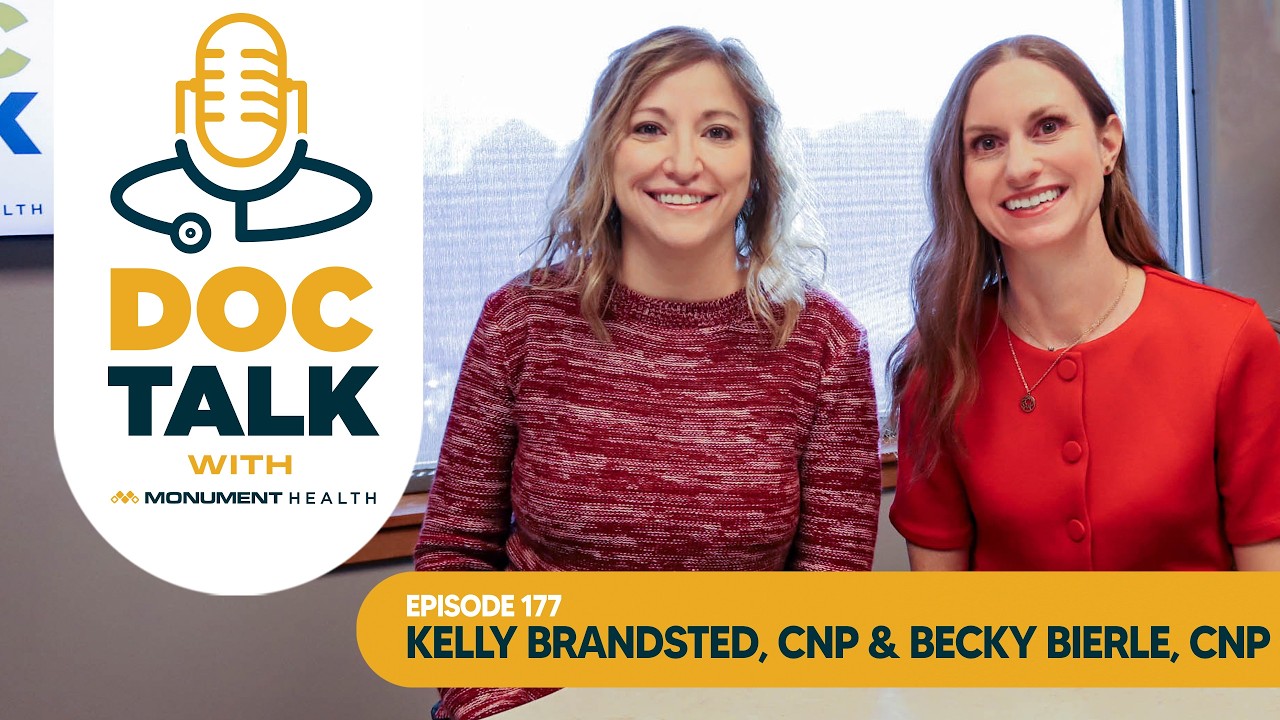
Welcome to Doc Talk, a weekly podcast featuring Monument Health physicians addressing medical topics. Tune in to your health with Monument Health. Welcome to another edition of Doc Talk with Monument Health. My name is Mark Houston, and Monument Health proudly supports the Go Red for Women movement, which focuses on raising awareness around women's heart health and the risks that are still too often overlooked. It's a reminder that heart disease doesn't always look the same in women, and that mental health, stress, and life stages all play a role. Today we are going to be talking with Rebecca Bierle and Kelly Brandsted, two certified nurse practitioners who work closely with women at every stage of life, especially where mental health and heart health intersect. So Rebecca, Kelly, welcome. Thank you guys for coming in.
Thank you.
Thanks for having us.
Absolutely. And Kelly, I know this is not your first time. You've been on before.
I have done this once before, but I can't remember when it was because it was so long ago.
Now, before we started talking, you guys were laying out your official titles and you used a term I don't remember ever hearing before. In front of certified nurse practitioner, what was the word you mentioned? Electrophysiology. What does that mean?
We help manage heart rhythms and devices, so more the electrical part of the heart. We're a subspecialty of cardiology.
Go Red for Women is a movement that I think a lot of people recognize. I think it's become one of those things where when they hear it, they're like, oh, that's in February. Which is National Heart Month. But I don't think a lot of people really understand what the movement is. So from what you see in the clinic, why is this awareness so important? And what do women still misunderstand about heart disease?
Yeah. So the month is important to bring awareness to women. Heart disease is the number one killer of women in the U.S., and many women don't know that or realize it. So it's an opportunity, a month where we can help increase awareness and encourage early detection and overall education for women about symptoms and concerns as they relate to their heart.
Why is it so different for women?
It's different in the sense that symptoms can be different than men's. That typical crushing chest pain and chest pressure that men experience, it's not always like that for women. Sometimes. But many women experience fatigue, dizziness, low back pain, or just an overall sense of feeling unwell. So that can lead to missing symptoms or misdiagnosing from a provider standpoint.
What's so interesting to me is why is the physiology so different? Men and women both have hearts and everything that goes into it. Why does it show itself in different ways in women? Why isn't that crushing sensation the same for women if we have the same parts?
We have different hormones that can affect cardiovascular physiology throughout the lifespan. And sometimes the symptoms we have are attributed to stress or anxiety. We'll talk about the mental health piece. Because those symptoms can be subtle too. I would say hormones is probably the biggest difference, but also environmental stresses.
It seems so much harder for women to determine. Way harder.
Agreed. And I think, kind of like Rebecca was saying, there's a lot of misdiagnosis too. Maybe a man goes into his clinic and says he doesn't feel very good, he's got a nagging upper back pain or chest pain, and the provider will look further into it considering the high risk of cardiovascular disease. For women, it's often attributed to hormonal changes, stress, or anxiety. So the symptoms are allowed to linger longer. That's what we're trying to address in the month of February, just getting women aware of symptoms they should be looking for so they don't just think, well, if I pop some Tylenol or rest for a while, this will be fine. If it's something that lingers, you've got to see somebody.
You've mentioned stress and anxiety and the emotional load that affects women's hearts over time. The connection between stress and heart attacks, or anxiety and heart attacks, is really interesting to me. Those aren't, in my mind, physical manifestations of something. How does that affect the heart? It seems like more of a brain thing, but how does it get into that organ in your chest and cause a heart attack?
It's actually really interesting. Since the last time I was here, I transitioned and worked in mental health for a while. After spending eighteen months in mental health and coming back to cardiology, it's something I'll say I never really thought about before. The American Heart Association has recommended screening for mental health disorders in cardiovascular patients since 2008. The link between mental health disorders and cardiovascular disease has been ongoing for years, but it's just something that is often overlooked and not talked about. It's an uncomfortable subject. I, however, now don't feel that uncomfortable talking about it. It's kind of a twofold issue when it comes to mental health disorders, depression, anxiety, and even more serious disorders such as schizophrenia, bipolar disorder, and post-traumatic stress disorder. And it's a two-way street. People that have mental health disorders are at a significantly higher risk of cardiovascular disease. In people with schizophrenia, they're actually at a one hundred percent increased risk of cardiovascular disease, and it's the number one cause of death in those people. But people with cardiovascular disease are also more likely to have mental health disorders, anxiety, depression, and post-traumatic stress disorder. So it really is a two-way street. If you think about it biologically, we always hear about fight or flight and the sympathetic nervous system. If you're anxious or depressed, your body is constantly in that state of fight or flight. It increases your cortisol, it increases inflammation, it changes the way your body reacts to things. And over time it leads to coronary artery disease, calcium deposits, high blood pressure, diabetes, metabolic syndrome. The list goes on and on. So it's something we don't address very often, but should be.
It's just amazing that your brain can do that to the rest of your body. Does it affect any other organs that way too?
Yeah, it can affect your kidneys, your lungs. It's really one system. The brain connects everything together. But you add in that chronic inflammation and you've got a recipe for disaster anywhere.
So what are some of the most serious symptoms a woman should be looking for when worrying about whether something is affecting her heart?
So kind of what we touched on is ongoing fatigue. And it can be hard to differentiate. We're all tired all the time it seems like. But it's not, you know, I had a rough night of sleep and I'm tired the next day. It's more that ongoing feeling of, I can't put my finger on it, I thought I got enough rest. It's daytime napping. It's just feeling like you can't do your daily activities because you're so tired, where it's affecting your quality of life. That's a common one. We also see shortness of breath, but again, not just one time after you went up seven flights of stairs. It's more that things you used to be able to do are now feeling more challenging. Low back pain, a general feeling of being unwell. Some women do experience chest pain as well. But really, anything that feels out of your norm, we recommend seeking care early and not waiting too long. Those would be the main symptoms, but in general, anything out of the ordinary, talk to a provider.
When I listen to you list off shortness of breath and low back pain, I kind of go back to the fact that those seem like things we all experience, especially as we get older. That's what makes this so difficult to pin down as something that could affect your heart. How specific does it need to be? When do you really start to look at it more seriously?
It is vague. And that's why it's often missed or misdiagnosed. But the message for women would be, if you don't feel like it's right, seek care. There's no set amount of time. It's not, this has been going on for one day versus thirty days. It's just, if this is out of the norm and it's affecting your quality of life or daily activities, seek care. It really is about understanding how your body works and paying attention to it. And I don't think enough of us do that anymore because we have over-the-counter medications that take the issue away for a short period of time, and then we feel good and don't go to the doctor.
This whole podcast could really just be about going to see your doctor once a year and having these conversations. Don't sit with it. Going back to the mental health part of it, depression can be quiet and easy to normalize in some instances. How does it increase heart risk, even when someone feels like they're managing it day to day?
It kind of goes back to exactly what you said. It's easy to tuck it under the covers and feel like you're managing it. Not only does depression cause those biological changes we talked about, it also leads to poor lifestyle habits. Two of the most commonly seen symptoms of depression are lack of interest in things you normally enjoy and just feeling down or low. So you don't have to feel like you're in a deep, dark depression where you can't get out of bed. Sometimes it's just that underlying feeling of not wanting to do anything. So if you used to enjoy walking your dog, exercising, cooking healthy foods, and now you're going through the drive-through and not exercising and not doing things that are enjoyable and good for you, we all know that lack of exercise and poor diet lead to cardiovascular disease. So it's a twofold issue, both the bodily changes and also the choices you make for yourself.
One thing I found interesting in looking through some of this research is pregnancy complications. They can also play a part in this for women who have experienced them. How can they influence a woman's heart down the road? And actually, before we go further, what would a typical pregnancy complication look like that could lead to this?
So most commonly, hypertensive disorders of pregnancy. Things like gestational hypertension, which is elevated blood pressure that occurs during pregnancy, leading to kidney issues down the road, post-birth issues, and things like preeclampsia and eclampsia, which are caused by elevated blood pressures during pregnancy and can cause significant problems down the road. Also gestational diabetes and elevated blood sugar levels during pregnancy. All of these not only increase your risk during pregnancy of preterm birth, low birth weight, problems with the baby and the mother, but also decades down the road you can have problems with hypertension, increased risk of cardiovascular disease, metabolic syndrome, and type two diabetes later in life.
So if you have these complications during pregnancy, what steps can you take to make sure that ten or fifteen years down the road you won't be in as much danger of having heart problems?
It kind of goes along with what Rebecca said, just staying on top of your symptoms. Following up with your primary care provider, cardiologist, or whoever you're seeing. Keeping track of your blood pressure. Making sure you're exercising. Making sure you eat well. Doing all the things we know we need to do and maybe aren't always so good at doing, especially mothers of small children. Rebecca and I are both mothers of small children, and I can tell you I don't exercise as much as I should, and sometimes going through the drive-through is the easiest way to get dinner.
You have kids. Just chasing them around is exercise enough.
Ha, but it is hard. And as someone who has experienced some of those pregnancy complications, it's something I keep in the back of my mind. Not that it should be all-encompassing by any means, but it is something you need to think about moving forward.
And I think you want to assure women too that this isn't meant to scare you. What Rebecca and Kelly are talking about is just being aware. Don't be afraid, because we have the tools now to help you with this, to make sure your heart will be fine until it's used up all its beats. That's the end goal here. So for women listening right now, what are some realistic ways to protect heart health, and what can families, providers, and communities do when they go red for women to make sure this is actually successful?
So as far as clinicians and providers, I would say listen to your patients, validate their symptoms, and do routine screening for mental health. We have plenty of validated tools for that. Just as we routinely screen for blood pressure, doing that at every visit if possible can improve or decrease cardiovascular risk. For families and communities, support women. Encourage women to take care of themselves, prioritize their health, and reduce stress, which I know is not easy. Share responsibilities with your partner and other family members. Just overall reducing that stress and taking care of yourself.
Is there a place people can reach out for more information?
If they search Go Red for Women and Monument Health, there are dedicated pages set up where they can get all those details. The American Heart Association also has a really great website that encompasses everything we talked about today and other questions folks might have about stroke or heart rhythm issues, which is what Rebecca and I work with mainly. It's a really great tool.
Excellent. Well, Rebecca Bierle and Kelly Brandsted, thank you guys for coming in and talking about this. Awareness is the key. Too often we hear all of this because there's a month for everything, really. But you don't want it overlooked. And especially if this affects you, be an advocate for it, speak up about it. In just the smallest ways, check in with your family, check in with your friends, tell them there's no stigma with this. Just go to a doctor and have them look you over, and either they'll tell you you're okay, or if not, take the steps to get you okay. That is the best way to do this. So go red for women. Thank you guys very much for coming in.
Thank you.
Thank you.