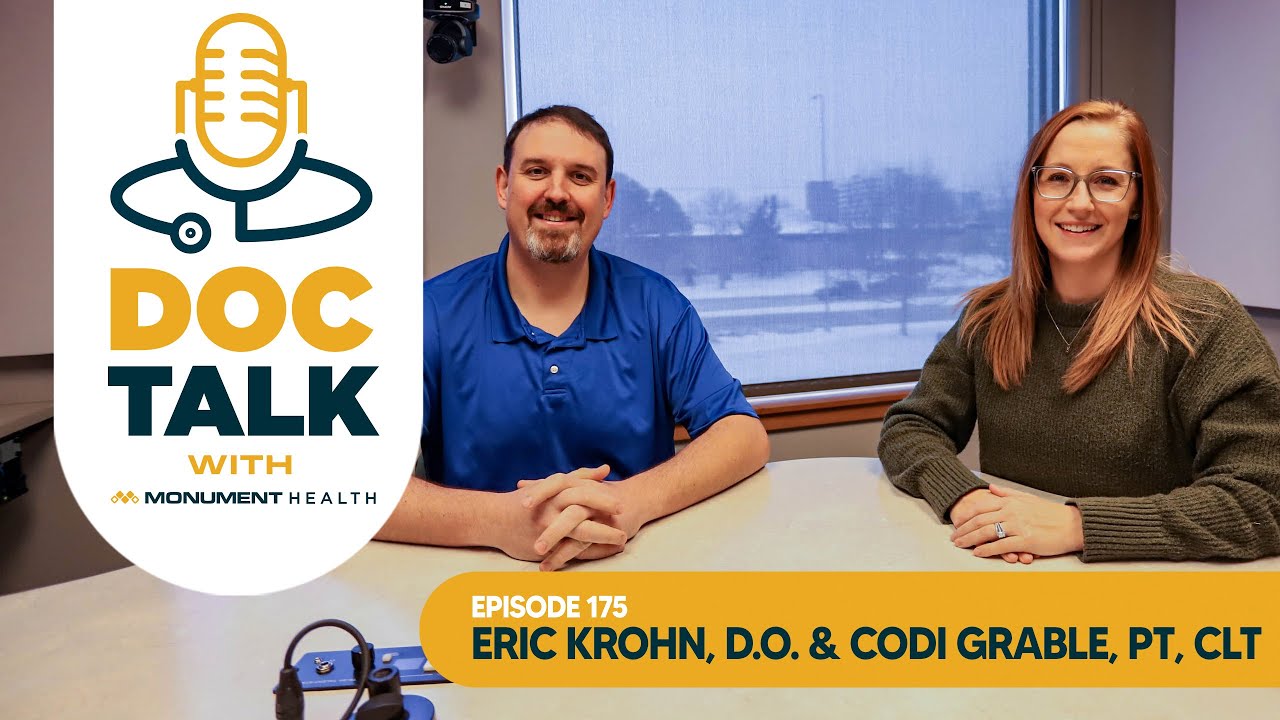

Listen or watch this episode on your preferred platform:


LESLIE LANE: Welcome to Doc Talk, a weekly podcast featuring Monument Health physicians addressing medical topics. Tune in to your health with Monument Health. Welcome to another Doc Talk. Today we have two very special guests, and we're talking about something that, prior to today, I had not heard of. You know how some folks seem like they can twist themselves into a pretzel, and others can barely touch their toes, and there's a lot in between? Well, we're about to talk about ligament laxity, how it differs from flexibility, and what that means over the span of our lives, as well as how you help treat folks with ligament laxity and what that recovery process looks like. So in studio, I have Dr. Eric Krohn and physical therapist Codi Grable. Thank you so much for coming in.
ERIC KROHN: Thanks for having us.
CODI GRABLE: Yeah.
LESLIE LANE: Let's start with the basics. What is ligament laxity, and how is it different from flexibility?
ERIC KROHN: Well, ligament laxity, at least as we think about it in the orthopedic world, involves two stabilizers of all your joints: your static stabilizers, which are your ligaments that act like ropes, and then your dynamic stabilizers, which are muscles attached to tendons. Those ligaments just have an inherent kind of elasticity to them, depending on your own chemistry and biochemistry. There are some people whose connective tissues are just a little bit looser than other people's. No matter how much you really stretch a ligament, you're not supposed to be able to, and you can, but you're really not supposed to be able to stretch it out like you can a muscle. These people just inherently have ligaments, and honestly a lot of their connective tissue in general, that's just a little bit more stretchy than the rest of us. Whereas flexibility, Codi, let me know what your thoughts are on this one, tends to be more that you're inducing a looseness to the muscles and the soft tissue structures, but it's not an inherent looseness. Thoughts on that?
CODI GRABLE: Yeah, I mean, flexibility is something more that you can change, like you said, with stretching, even sometimes different exercises. It's a modifiable factor that we have, whereas ligament laxity comes more from genetics and things you're born with. So really, surgery aside, you can't change your ligament laxity.
ERIC KROHN: Exactly. And even sometimes with surgery, you still really can't change it, just because we can tighten up ligaments while the ligaments are still just inherently stretchy, so they stretch back out.
LESLIE LANE: Gotcha. It's a constant struggle. In layperson's terms, maybe it's the difference between someone who stretches every day and works on their flexibility versus that kid in our class who was double-jointed, for some reason.
ERIC KROHN: One hundred percent, yes. They never tried to do it. They're not a gymnast, or maybe they are, but they can just put themselves in any position, and the rest of us look at it like it almost seems unnatural what they can do sometimes.
CODI GRABLE: For sure.
LESLIE LANE: And that's not something that maybe the everyday person knows a ton about. We all fall on a spectrum there. When you see a patient who's wondering about where they might fall on the scale, or if they have ligament laxity versus just being really flexible, how do you help them figure that out?
ERIC KROHN: Well, we use the Beighton scale. I assume that's probably what you use as well?
CODI GRABLE: Yeah.
ERIC KROHN: And that's a ten-point scale. It's hard to describe over the radio, but essentially it's a bunch of different motions. A couple with your hands, checking for elbow hyperextension, checking for knee hyperextension, and then also with your legs straight, can you put your palms flat on the floor? Way more than just touching your toes. That adds up to nine or ten depending on who you ask. I use the ten-point scale because the last one, the touching the ground, I feel is more a sign of flexibility, so that's two points. Whereas, I don't know about you, but Doctor Milligan is a nine-point person. And so we do a lot of hip stuff together, and we sometimes have to correct each other and make sure we're describing things the right way to associate these patients. You test that and, I am a zero out of ten, so I can show everybody what the textbook normal is supposed to look like. Your pinky isn't supposed to be able to hyperextend past your hand, but a lot of people's can. And you add that up, and most people, like you said, are on a spectrum. They're not really crossing the line to a connective tissue disorder. You may hear of Ehlers-Danlos and Marfan syndrome and those kinds of things, which do involve ligament laxity. But most of us are just kind of on that spectrum.
CODI GRABLE: I usually use the nine-point scale. That's what we were always taught. So for mine, I am a five out of nine. I've got the elbows, the knees, and then I can put my palms flat on the floor.
ERIC KROHN: So for me, you'd be a six out of ten. A little bit higher score. And my sister, I think, is probably way higher than that because she is way more mobile.
CODI GRABLE: Gotcha. But yeah, I mean, it's something that's your normal, and something you have to kind of address. I haven't had much in the way of ligament or joint issues in the past, but I am kind of aware of it. I do try to do my own homework when I can.
ERIC KROHN: I would hope the physical therapist would be. Maybe not the best patient, but you try.
CODI GRABLE: Do as I say, not as I do. Exactly right.
LESLIE LANE: When someone comes to you wondering about where they might fall on the scale, what brings them into the clinic or into your office normally? What are some things they should be aware of that maybe they haven't thought about before? What are those things to look out for?
CODI GRABLE: I'd say a lot of times it's pain, recurrent injuries. I'll have hip patients, specifically, come in and they've had ups and downs with hip pain, maybe recurrent injuries. Patients who even just have recurrent ankle sprains or things like that, where they're not always aware of where they are on the spectrum, which is a component that can go hand in hand with laxity. They're just kind of clumsy and they get these injuries from, you know, maybe something as simple as, oh, I stepped off a stair and rolled my ankle. Things like that. There's kind of a big variety that people come in for.
ERIC KROHN: Yeah. Just because you have, you know, even if you test yourself at home and you're ten out of ten, if you're doing fine, you don't need to come in and see anybody. It's really more of if you're starting to have problems, that's something a provider needs to address. As in, okay, this is something that may become a confounding factor in trying to treat this. Like someone comes in with hip pain, and that hip pain is due to dysplasia, which is where the bone is a little bit deficient. Well, if they aren't ligament lax, that little bit of deficiency in their bone may actually not be a problem. But if they have that little bit of deficiency, or they're just kind of borderline, that laxity can be the thing that kind of pushes them over, and is the reason why we need to do regular PT. If PT is not helping, then possibly injections, to kind of find out where the pain is. And sometimes we actually do bony realignment in some of these people, just because their ligaments just can't make up for that little bit of difference in their anatomy. And unfortunately, like I mentioned earlier, you can't really tighten the ligaments up. They'll just stretch out again. So you have to do other things to try and get that containment.
LESLIE LANE: I'm excited to talk about the different paths you do take with your patients. But before that, when it comes to diagnosis, you did talk about either your ten-point or nine-point scale, and I'm not getting in the middle of that. Is that scale as far as you go with diagnosis, or do you often require further imaging, scanning, testing, etc.?
ERIC KROHN: I would say generally that's all I need for diagnosis. There is, if you're worried about connective tissue disorders, you may be sent to a geneticist to go over those things. But the hypermobile form of Ehlers-Danlos syndrome is actually not one we can test for genetically, so we usually don't send people if that's all they're showing. In terms of other conditions, there are a lot of other findings that you'd have with ligament laxity, but if it's just ligament laxity, usually that's enough of the diagnosis. We generally don't push the line and say, oh, you actually have a connective tissue disorder, just because we can't really differentiate a nine or ten out of ten on the scale from mild hypermobility. I mean, we can sometimes, but there's not like a good test for it.
CODI GRABLE: It kind of depends in physical therapy on what they're coming in for. If someone just wants to see if they're hypermobile, we kind of just draw the line at the Beighton scale. But if we've got other things going on, they've got pain or other issues, we will use things like strength testing, range of motion testing, which can also look at ligament laxity. You know, if a person can again bend into that pretzel, but it also looks at muscle length. And then there are other what we call special tests that we can do to see if the hypermobility or the laxity is causing the pain, or maybe there's something else going on. So we've got a few things in our toolbox, but again, that depends on why the patient is actually coming in.
LESLIE LANE: Both of you touched on a couple of reasons a patient might come in, whether it be hip pain or noticing that they have hypermobility. But we've also heard of other things like scoliosis, rotational issues, bunions, flat feet. How do all of these connect in the grand scheme of things for the patient?
ERIC KROHN: You can definitely have people who score ten out of ten or nine out of ten on the scale, I'm going to have to do that every time now, and have none of these things. And then you can have people come in who have scoliosis, flat foot, adolescent bunions, rotational malalignment issues. It's hard to say. Do people just like to sit in certain positions because of their laxity, and that's what induces the twist? It's definitely not everyone who has ligament laxity who has these issues. But if I start to see these issues, or a constellation of them, like someone comes in specifically for adolescent bunions and scoliosis, I'm going to test their ligaments, because I'm fairly certain they're going to be found to be hypermobile.
CODI GRABLE: Yeah. I don't know that I really have anything to add to that. That's definitely more on the orthopedic side in terms of the deformity and everything. Unfortunately, when they're that bad, there's not a lot of PT options once it induces deformity. But just because you have laxity doesn't mean you'll have true bony deformity. It's just something that can be associated with it.
LESLIE LANE: Both of you have also touched on hip pain. It seems like something you're both focusing in on. Could you elaborate on that?
ERIC KROHN: Yeah, I think a part of it is because we're both part of the Hip Preservation Institute now, which has been really fun. But if you have ligament laxity, you're more prone to some of these things. If the ball and socket joint is not as stable, you've got some play in that joint, or you have some damage caused by some of these deformities, you can have pain. And that's really important to treat. No matter where you are in life, especially if you're younger, come see me, come see Dr. Cohen. We want to make sure we're addressing it. And if it's something you're on the lower end of the spectrum, physical therapy can help by improving joint stability through muscle strength or addressing other deficits, like length imbalances. Even sometimes just how people move can impact their pain.
CODI GRABLE: If you're on the higher end of that spectrum, a lot of times we try physical therapy, patients are really good about their exercises, really good about all the recommendations that we give, and they're like, gosh, I'm just still having pain. I'm still having functional deficits. I'm not able to do what I love. Then we defer to Dr. Milligan and Dr. Cohen.
ERIC KROHN: And I'll also add Dr. Metzler in there, part of the team as well. Just because we really start with therapy for honestly most issues that you come in for. Hip pain has so many different reasons why it could happen. Even if you have some laxity or some bony issues, you'll even find things like the big muscles on the outside of the hip being treated, because there are some issues with the tendons, and it turns out they actually have a little bit of dysplasia and a little bit of laxity, and those tendons are irritated because they're working overtime just to keep that hip stable. Therapy to work on reducing the microinstability that happens with these people is a lot of times all we need. Sometimes that doesn't work, though. So if we don't have a clear line that the pain is coming from the joint or the tissue surrounding the joint, then one of our sports med docs will do an ultrasound evaluation, look for areas of inflammation, do some motions that cause pain, do some injections, and then do the motions again to see how they respond. That's where we can get more information. Okay, this pain is really coming from the hip joint. Maybe their MRI was negative. They have a little bit of dysplasia. They have some issues with ligament laxity. And the tendon on the outside looks a little bit irritated. The injections helped a little bit. Okay. This is starting to quack like a duck. This is probably the cup not being able to contain the ball and socket well enough. Or conversely, your extra mobility could lead to two of the bony pieces kind of pinching each other, and that can pinch soft tissue structures and cause damage that way. And if you don't address this early enough, whether that's with therapy, not everyone needs surgery, if therapy nips it, that's fine, but it might just be a lifelong thing. If it doesn't help and the pain keeps coming back and you keep getting these recurring injuries, it does lead to joint breakdown. You will see people. Dr. Milligan, since he does the adult joint replacements, will see them all the time. Late thirties, forties. Young, healthy people who need joint replacements because they've had hip pain their whole life, and everyone has just kind of been like, well, I guess you have hip pain. These kinds of nuanced details are things that have just started to come about more in the last twenty, twenty-five years.
LESLIE LANE: Our muscles and our joints, it's all a connected system. Going about my everyday life, I'm not always understanding how some muscles are overcompensating for others, or how maybe the pain I'm feeling is a joint or ligament issue. When someone comes into your office with hip pain and they just know they have hip pain, what steps do you take to help them understand the process you're going to go through, and to eliminate any other outlying issues?
ERIC KROHN: Well, if you first meet me, I say go to therapy. So I'll pass that off to Codi to talk about what she does when they first come to see her.
CODI GRABLE: Yeah, a lot of education. I get through my initial evaluation, and then usually I'll sit down with the patient and just say, hey, these are the things I'm finding. These are the things that are fixable. And we want to address this first, because if we can avoid surgery and avoid that higher risk thing by doing low risk, therapy is very low risk and, to be honest, less expensive. If we can do this and get you happy and healthy and doing the things that you love without pain and without limitations, then let's start here. Now, I say if there are red flags or things on my exam, hey, I'm not really sure that this is going to be where we need to go, but we can always give therapy a shot. It's low risk. There's no harm in giving therapy four to six weeks to work. And if it works, amazing. We can keep going, we can get you where we want to be. Or if not, we do send you over to ortho or the other parts of the care team, because we want patients to be back on their feet and doing what they want as soon as possible. We're not going to keep you in therapy and just say, hey, sorry, you have hip pain, kind of deal with it. We want to push those patients through that continuum of care to the best of our abilities. But we also don't want to skip steps and have unnecessary procedures or unnecessary surgeries. Because if we just go off of imaging, sometimes there are X-rays or MRIs or CT scans that might make you think, oh, I'm going to have to do surgery on this person. But they've never tried therapy, and then they go to therapy, and they get better. Well, I don't really care what the images show. We treat people, not images.
ERIC KROHN: But there will be times where our therapists have seen people with these issues get better, and there are plenty of times where they'll reach out and say they're not getting better. So we don't even do the full round of therapy. We're like, okay, let's come back in, let's talk about other options. Of course, if you have a bad labral tear or something like that, we might not start with therapy, depending on your history. But the vast majority of the time, if you're not advancing and they think they're doing the right things for you and getting the right amount of effort out of it, eventually you just stop beating your head against the wall, and they reach out and say, can you bring them in for injections and then possibly talk about surgery? And usually we've met them before. We all meet every month to go over some of these patients and talk about our post-ops and everything. So a lot of these patients we're already talking about before they've even gone through a full round of therapy.
LESLIE LANE: It's good to know that you guys talk about it. It sounds like a highly collaborative process between physical therapy and then maybe that next step to surgery. Can you talk about what a diagnostic injection is?
ERIC KROHN: Yes. So it can be both diagnostic and therapeutic. A lot of the people we're talking about right now tend to be on the younger side. Adolescents, young adults, people who you don't just want to be treating their pain with injections. Steroids have risks. And inside joints, they can really lead to joint breakdown. So we don't just want to do that like we would with a sixty-five-year-old with end-stage arthritis who we're just trying to make feel better until they eventually say they want a joint replacement. In this case, it's really just local anesthetic. There may be some times where Dr. Metzler will recommend some steroid with the local anesthetic. But generally when you're in this pathway, really worried that you're someone who's not just going to do better with therapy alone, a diagnostic injection helps us figure out exactly where your pain is coming from. If we put it inside the hip joint and you get better, that only lasts for, you know, fifteen to thirty minutes. But that's okay. You got better. We know that's your pain generator. If he puts you through motions, a certain motion hurts, he injects the tendon around that area and that motion doesn't hurt anymore, maybe that was the problem. So that's one more way we can confirm. And most of the times when we're sending people for those injections, we're pretty sure we know where the problem is coming from. The PTs have worked on them, we've seen them, we know what their anatomy looks like. But it gives us that one last yes, that's where the pain is coming from. If we don't have an obvious tear, then we know you are the kind of person whose best chance is surgery at this point.
CODI GRABLE: And it helps prevent procedures that maybe aren't going to be beneficial for that patient. I think we've maybe all heard of a story of, oh, my hip hurt, I had this surgery, and it didn't work. And then I ended up having to have a back surgery or something like that, because there are several other structures in the body that can masquerade as hip pain, or masquerade as pain somewhere else when really it's coming from up or down the chain, as we say. And so if we do a diagnostic injection in someone's hip or ligament or tendon and it's not working, okay, do we need to look somewhere else? Do you have some nerve issues or something coming down from the back that is masquerading as hip pain? Usually we catch that before it happens. But sometimes there are the one-offs that happen, where this is characteristic hip labral tear, we do an injection in the joint, and the patient doesn't get better. Okay, now what? We start looking up and down the chain. So we're not doing an unnecessary labral repair on a patient who really needs a back surgery or therapy for their back.
ERIC KROHN: This is an anecdote from when I was back in residency, but I remember a girl coming into the children's hospital saying she'd been having hip pain for so long. Finally the providers were like, all right, we're just going to stick a scope in there and see what's going on. And the mother and patient were both like, I really don't want to do exploratory surgery. So they came and saw my provider and me. And it actually turned out, from their story, that she had a pain-producing tumor up in her spine that was activating the L3 nerve root that comes across there. That's where she was having pain. In that case we figured it out before needing to do injections. But if that patient had come through our pathway and we were at that point where we were saying, yeah, let's stick a scope in there, the diagnostic injection would have been that one more check to say, yes, that's where the pain is coming from. It wouldn't have gotten better. And if we still stuck a scope in there, then we definitely had blinders on. But that should be enough to get us to step back and ask, is the pain coming from somewhere else? I mean, we even have a general surgeon in our hip institute who looks at whether people have hernia issues that are causing their hip pain. There are several different reasons why it could be hurting.
LESLIE LANE: Makes sense. Our bodies are very complicated, and that is an understatement of the century. Once we do get to the surgery part, maybe a patient and both of you have determined through your collaboration and talking to the patient that surgery is necessary, what does that look like? What happens when you have ligament laxity?
ERIC KROHN: It does kind of depend on what other things are going on and what your true mechanical problem is. Like dysplasia and laxity, think of it as there's just not enough containing the hip, and it just wants to kind of come out of socket. So you have to do surgery to contain that a little better. Whereas if it's more from impingement, that could also be an instability issue, but more that there are two bony prominences running into each other. If you're on the dysplasia side, surgery most of the time involves redirecting the cup to better contain the hip, because bone is, even though there are some differences in connective tissue disorders, for most people with ligament laxity, their bone is going to be exactly the same as anyone else's. So being able to use that to contain the hip should be effective, whereas you can't really tighten up the ligaments. In terms of impingement, sometimes it's actually reducing some parts of the bone, usually not the parts that are actually inducing stability, but ones just outside that area that can pinch together. And sometimes it's actually changing the rotation of the bone in the femur so that your arc of motion, your range of motion, is actually different, so you're less likely to get into that position that causes those bony pieces to come together.
LESLIE LANE: And for those unfamiliar, what is impingement?
ERIC KROHN: So impingement is where two bony prominences, really anywhere, are coming together and they're pinching soft tissues in between. You'll hear about FAI, femoroacetabular impingement, in the hip world in orthopedics. That's kind of another common thing that'll happen that could lead to that hip joint breakdown.
LESLIE LANE: And a lot of people, when we're talking about surgery, are really scared when it comes to recovery. That's the part that might freak people out. And I have a feeling, Codi, that this goes back to you. What does this recovery process look like, and what does the communication between surgery, physical therapy, and the patient look like?
CODI GRABLE: Yeah, it's really dependent on what the surgery is. And recovery for me can actually start before surgery. I will oftentimes see patients before surgery for what we call prehab, and that's just to help optimize how a person is moving and doing before surgery. Strength is a big one. If we can get you stronger and moving better before surgery, even if there's a little bit of pain, you're going to do a little bit better after surgery. Now, after surgery, usually depending on the procedure, I'll see someone as soon as two days after. Sometimes if it's more complicated and we really want some of those structures to have some time to settle and heal, it'll be a few weeks after. But I bring patients in on the first visit and do a lot of talking. I really like to try to help calm the fears. I talk them through, hey, this is the protocol. A protocol is something the surgeon will send us and say, here are the things I'm okay with you doing as far as range of motion, different activities, things that are okay and safe to do at this point postoperatively. And then that kind of goes through the continuum. I'll take patients through that and just say, hey, this is what it's going to look like. This is where we're going to be starting. Day one, two, four, six weeks down the road, this is what you can expect. And then we obviously talk about things like pain control. I work really closely with the surgeons on helping patients with pain control. Hey, so and so is in here, they're not taking their medication or not tolerating their medication, is there something else we can do? Because they're just not able to tolerate what we need to do after therapy. So there's a lot of things we can do to make rehab and post-operative care more comfortable and really less scary for patients. And just know that we're always talking with your surgeon. They're always reading our notes and communicating with us, making sure everything is going the way it should be.
ERIC KROHN: And we're all pretty well versed in these. We're not going to do anything with or to a patient that's going to risk a surgery. I think Dr. Krohn knows that we in therapy tend to be on the more conservative side, because we don't want to risk a repair that the surgeon has just spent a ton of time doing. I had one of the other therapists reach out to me yesterday and just ask about a patient, whether we could increase the weight bearing, because we did something a little bit different and actually had to change the rotation of his tibia. That just comes through as something we don't usually do for hip stuff, and so they were like, hey, what do you think about this? It's just nice to see that they're always communicating with us. They see the patients more often in those first few months than we do. So their communication with us really helps us guide any additional changes we need to make through therapy.
CODI GRABLE: But the general recovery, depending on what you end up having, is probably about six to eight weeks of limited weight bearing, if not no weight bearing. And then after that is where you really start to increase your weight bearing and get back to regular activities. That's when we can really start to strengthen things up. The bone is healed. Now we're trying to get you back to where you were before this all started, or hopefully better than before this all started.
LESLIE LANE: Those six to eight weeks being an investment in the rest of your life, in the rest of your time with your ligaments and bones and tendons and all.
CODI GRABLE: That's a really good way to put it, actually.
ERIC KROHN: It is a very good way to put that. And the detriment of getting a joint replacement in your thirties or forties is extraordinary. I mean, we might have different technology in a few years, but I don't think we're going to figure out all of the issues. We can never make something as good as it was before with surgery. You can just kind of make it a little better. And when you get joints done very young, there's a good chance they'll wear out before you are done needing them, and revisions and all that stuff, there are just diminishing returns of benefit every time you have to do more surgery. I wish it weren't the case. I wish we were better at that. But the less surgery we have to do to you, the better it ends up being.
LESLIE LANE: It makes sense. And we are all human. We know that physical therapy is very important. But as someone who has maybe not been an A+ patient in the past, it happens. How do you keep people motivated through what is probably a trying time for them? They're not moving the way they used to, and they know that physical therapy will get them there. But that's six to eight weeks of maybe not putting weight on your leg or your hip. How do you keep people motivated through that process?
CODI GRABLE: That's a tough one. Some patients do it on their own. They're like, I don't want to do this again, this was terrible, I want to feel good. And so they do it themselves. Other patients need a little more encouragement. I do again, a lot of education, just saying, hey, it's a short-term sacrifice for a long-term gain. If you follow these recommendations to the best of your abilities, you're going to feel so much better for so much longer, and the risk of reinjuring or delaying your recovery is a lot less. And I do focus on long-term goals, like, hey, you want to get back to running marathons, or something as simple as hunting, hiking, those sorts of things. You want to get back to this, this is the road to recovery. If I had a magic wand and I could just boop all my patients on the head and say, here, you're fixed, I totally would. But there's just no magic potion to get patients there quickly. It's got to be, like you said, an investment. And some of it does fall back on the patient being understanding of that and having their own intrinsic motivation of, this is terrible now, but it's going to pay off in the end. The patients who can internalize that do tend to do a little bit better than the ones who just say, I don't really want to do this work.
ERIC KROHN: And that's always a tough thing. Sometimes I call in the surgeon and say, hey, I need you to read the riot act. But that's also an assessment we make as a team, kind of before then, of whether this is someone who has been sent to therapy and hasn't really given the push needed to truly say that therapy hasn't worked. Is that someone we really should be advancing to surgery? There are a couple of reasons there. First, they might not even need it, and we've never really done the treatment that's needed. And then second, just because we can realign the bone, if we don't make all of the muscles strong afterwards, you're probably still going to have a pretty tough time with it. So that's someone who you don't want to proceed with surgery. But that's not a common thing. In the age group we're talking about, we have a lot of very driven people who have had to stop sports because of their hip pain. They were quite the athlete before. So now that we're saying, hopefully we can get you back to that point, that's a big carrot at the end of a stick that people sprint toward. There are going to be some who aren't in that boat. But it does seem to be that a lot of the people we've ended up doing this on were very motivated and had been having pain for years and just wanted to get back to some semblance of normalcy.
CODI GRABLE: Yeah, I do think that's a common misconception I deal with in therapy. A lot of patients will come in and be like, well, I don't know why I'm doing therapy anyway. Why can't I just have surgery? And the thing is, surgery is not the be-all and end-all. Surgery is a piece of the puzzle. For most things, especially in the orthopedic world, it's a piece of the puzzle. And if you just want to have the surgery and then go home and sit on the couch for six months, not only are you not going to get better from problem A, you're probably going to result in problems B, C, and D, because surgery affects your whole body and it affects how the entire limb moves. That's a thing I really want patients to understand. We have to put that work in. Because now, to the best of our ability, we've corrected this problem, but now we need to optimize how you're moving globally to not only protect that repair, but protect the rest of your body during the things you want to do.
ERIC KROHN: And that's surgery. If you think the therapy is too hard before surgery, the therapy is certainly going to be too hard after surgery.
CODI GRABLE: That's fair. It does not make the therapy easier in the end. It makes it quite a bit harder.
LESLIE LANE: We are all just complicated puzzles, and I appreciate, and I'm sure your patients appreciate, both of you and your team shedding some light on the mystery that can be our bodies sometimes. Anything else you'd like people to know about ligament laxity or just awareness before we wrap up?
ERIC KROHN: You may have ligament laxity. That doesn't mean you're abnormal. We're all on a spectrum of what is normal. The textbook normal that you read about in school is a very rigid definition. So you might be nine out of ten or ten out of ten, and totally normal. Or you may be ten out of ten, and then start to sprain your ankle, and then you have issues with ankle instability that wouldn't have happened with a person at zero out of ten. And then we have to address that. But just because you have laxity doesn't mean you are broken and your body is going to have a lot of issues. If you do have it and you have pain, there are things we can do about it, because it's a very addressable problem. Unfortunately, most of the time it's therapy, and I do feel bad. People come in to see me in the surgeon's office and they're like, I've done therapy. I have ligament laxity. What do I do? And the answer is probably some more therapy.
CODI GRABLE: More therapy. We're usually pretty fun though.
ERIC KROHN: Yes, exactly. Usually pretty fun. Come hang out with us. We'll have some fun. We'll do some cool stuff to get you feeling better. It is hard. It is hard to do therapy. But it does work. And we're not just sending you there so we can check a box for the insurance company and then do your surgery. If someone came through who needed surgery and we knew therapy was just a waste of time, we'd go and do surgery. We don't try to have you do therapy with a broken femur. But it's just one of those things where I always feel a little bit bad telling patients who have already been through a lot of therapy that they're just going to be doing more.
CODI GRABLE: Yep. Put a period on that, because I like that.
LESLIE LANE: It's good to know that it's addressable. And it's fantastic to hear that there's such a collaborative team over at Monument who are constantly looking for ways to improve the lifestyle and the life of their patients. You both seem to really care a lot. So thank you so much for coming in and shedding some light on something I had never heard of prior to today. Hopefully the same for some of our listeners as well. Dr. Krohn and Codi, thank you so much for coming in. Hope to see you again.
ERIC KROHN: So nice to be here.
CODI GRABLE: Thanks for having us.