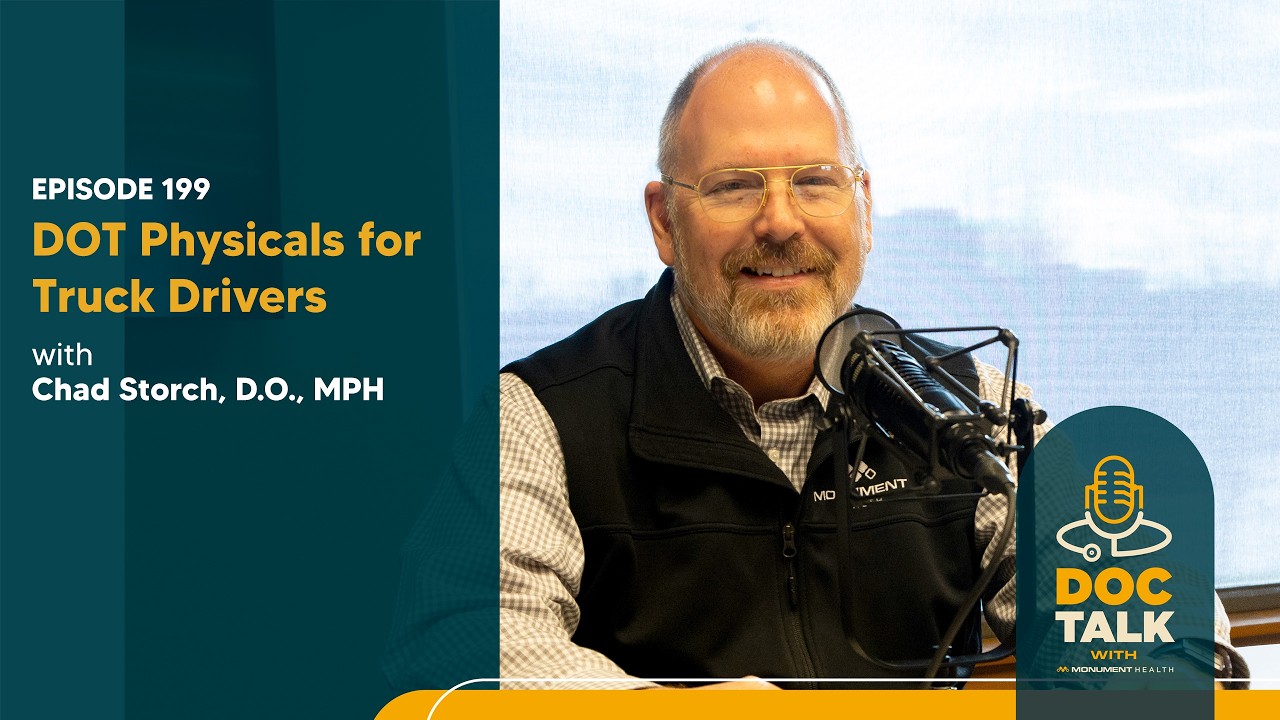

Listen or watch this episode on your preferred platform:


MARK HOUSTON: Welcome to Doc Talk, a weekly podcast featuring Monument Health physicians addressing medical topics. Tune in to your health with Monument Health.
MARK HOUSTON: Hello again, everybody, and welcome to another edition of Doc Talk with Monument Health. My name is Mark Houston. And next time you're stuck behind a big rig on the interstate, here's something you've probably never thought about. That driver had to prove they're medically fit to be there. There's a whole exam behind every commercial license, the DOT physical. It's the checkpoint that keeps the folks hauling our food, our fuel, and pretty much everything else safe on the road. And today, I'm glad I've got Dr. Chad Storch back with us. He spent over two decades in the Navy keeping pilots and sailors fit for some of the toughest jobs out there, and now he brings that same eye to drivers right here in Rapid City on our interstates. So welcome back, Dr. Storch.
DR. CHAD STORCH: Thank you. Thanks for having me.
MARK HOUSTON: Yeah, absolutely. You know, I tell a lot of the doctors that come on the podcast for their third time that pretty soon I'm going to have that Saturday Night Live jacket for you if you get to the fifth time. So you got two more to go. I'm keeping track.
DR. CHAD STORCH: Your little scorecard. We'll be ready.
MARK HOUSTON: But yeah, thanks for coming back in, man. Last time you were here, you mentioned DOT physicals kind of in passing, because I think we were talking about some other stuff.
DR. CHAD STORCH: Sure. As one of the things that I do in my practice.
MARK HOUSTON: Yes, exactly. But we never really dug into it. So that's where I'd like to start. For people that don't know, what is a DOT physical, and why does a truck driver need one when you and I can just go down to the DMV for hours, right, and then get our license?
DR. CHAD STORCH: Right. So, you know, it all comes from a place of safety. If we're having somebody on the road who's driving a very large, very heavy vehicle, or a vehicle that can carry many, many passengers, we want them to be safe, right? And part of that safety comes from, or relates to, their health. We don't want them to have anything, when I say anything, a disease process that may cause a sudden incapacitation, right? We expect the same thing of our pilots. When you take that flight to Denver or Dallas, you want that pilot up there to be as healthy as can be. And so that's really where this comes from. We want those DOT drivers, those CDL folks, just to be healthy and not have a sudden and incapacitating event. And so that's what the physical is aimed at doing, is finding those issues, looking into their medical history and identifying those issues. And if they need to be cleared through a specialist, right, we send them off to see if that specialist is okay with them driving DOT. Now, the medical examiner, the DOT medical examiner, makes that final decision, but oftentimes we enlist the opinions of other experts.
MARK HOUSTON: Now, what's the difference between a DOT medical examiner and what you're doing, then?
DR. CHAD STORCH: Well, a DOT medical examiner is somebody who has gone through a course to do those specific exams for the DOT, FMCSA. And so they take a course and they take a certification exam.
MARK HOUSTON: I see, okay.
DR. CHAD STORCH: And then they're listed in the FMCSA registry. So you can go online and look in the FMCSA registry, the Federal Motor Carrier Safety Administration. You can go in there and find your nearest DOT medical examiner.
MARK HOUSTON: Okay. Now walk me through this. So if I showed up for one of the exams and failed right there, you're done? You just look at me and you're like, ‘You're done, you're done’? Well, what are you actually looking at, and what really tends to surprise most people about what's on that list?
DR. CHAD STORCH: So I think one of the biggest hurdles that I see, and probably most medical examiners see, is medications. First of all, there's a lot of folks taking some medications that maybe you shouldn't be taking that may impact the safety of DOT driving. Blood pressure is a hurdle. You have to be at one hundred and forty over ninety or less, and some folks can't meet that standard. Now, you can take blood pressure medication, right?
MARK HOUSTON: Isn't the normal blood pressure one twenty over eighty, though? You guys go up to one forty over ninety?
DR. CHAD STORCH: They do.
MARK HOUSTON: Oh, okay.
DR. CHAD STORCH: Yep, yep. Obviously you have to have good vision, right? You can't have monocular vision, but you have to do a separate form. They used to have a waiver process for monocular vision, and now it's just a separate MCSA form that you get filled out by an optometrist. But you have to be twenty-forty or better, preferably in both eyes, but if only one eye is twenty-forty or better, then you would qualify for a monocular vision waiver.
MARK HOUSTON: Okay. So I'm assuming there's lots of other things you're looking for. I know one that kind of surprises me on the list. You talked about high blood pressure, I can understand why diabetes would be on here too, especially for type one diabetics, obviously. Is there a big difference between type one and type two when it comes to these kinds of physicals?
DR. CHAD STORCH: There is, in terms of what's required for us to certify them and what's required for the driver to bring to the table, right? So they're going to have to have an MCSA form filled out. MCSA-5870, I believe, is the insulin-dependent diabetic medication form that their treating provider needs to fill out. And they're going to attest to things like, hey, they've had a hemoglobin A1C drawn within the last, you know, three months, and they're going to attest to those things, right? And then they bottom-line it with their signature. And that's the thing that the driver is going to bring to the exam, and that'll ensure success, hopefully, if they have that form. But a lot of folks show up without those forms. They don't bring them, for whatever reason. Maybe they've never had a DOT physical.
MARK HOUSTON: Well, that seems like the most logical explanation, I suppose.
DR. CHAD STORCH: Well, you would be surprised, you know. It's a long year, and folks forget year to year what they, you know, what did I bring at my last DOT physical.
MARK HOUSTON: Right. Another one that came up on this list that I thought was interesting: sleep apnea. Why?
DR. CHAD STORCH: So sleep apnea, it can cause excessive daytime sleepiness. That would be one of the major concerns with DOT driving. We don't want anybody falling asleep at the wheel, right? So they have to prove to us that, if they have obstructive sleep apnea, if they have that diagnosis, and they are being treated with, say, a CPAP machine, then they have to prove compliance with wearing that CPAP machine. And there's printouts, the CPAP machine can print out detailed paperwork, printouts that show the evidence that they've been compliant with wearing their mask. But then, if they get off of it, this is another issue, when they, let's say they lose a bunch of weight and then they don't have their obstructive sleep apnea anymore, which was weight-based, if you will, or from body habitus, they need to redo a sleep study to show us, hey, I no longer have sleep apnea. Many times they come in, they've lost a lot of weight for one reason or another, and they say, well, my doctor says I don't need to use my machine anymore. And that's all well and good, but prove it.
MARK HOUSTON: Right.
DR. CHAD STORCH: Right. And, you know, the FAA says, go get an... not the FAA, the DOT says, go get another sleep study. Show us that you no longer have obstructive sleep apnea.
MARK HOUSTON: Now, here's the part that has to kind of be tough, because for a lot of these drivers, that medical card is their whole paycheck, right? When someone's health puts their ability to work at risk, how do you handle that conversation? That's got to be a tough one to have with these guys.
DR. CHAD STORCH: It is. But I point out right away, I'm not the bad guy, right? I don't write the law. I didn't write 49 CFR. The government plays the music, the drivers and I dance to it. And some folks get that, some folks still look at me as the bad guy. But, you know, I just explain to them, look, I have to make the government happy, and in order to do that, you have to give me warm fuzzies about being out on the road with whatever medical condition you have.
MARK HOUSTON: Yeah, but I get it, it is a very tough discussion to have when folks show up and, for whatever reason, can't get their medical card.
DR. CHAD STORCH: I do try to reassure them, though. Here in the state of South Dakota, if you, for whatever reason, don't get your medical certificate, your DOT medical certificate, in time, in other words, your current one expires before you get a new one, your CDL just becomes a regular driver's license. And then once you get your medical certificate and it gets sent to Pierre, that's what we do with it, we have twenty-four hours to send a copy of the medical certificate to Pierre, it just goes back to being a CDL.
MARK HOUSTON: Well, I bet a lot of drivers are under the impression that they'd need to go retest through the whole process again.
DR. CHAD STORCH: And from what I understand, after talking to folks in Pierre, that's not the case.
MARK HOUSTON: Oh, well, that's going to be helpful then.
DR. CHAD STORCH: Now, this doesn't apply if you let your CDL itself expire, that I don't know what happens there. But from a medical standpoint, I've had to run down this pathway before, and yes, the lady I spoke to in Pierre said, yeah, it just becomes a driver's license, and then a new medical certificate just converts it back to a CDL.
MARK HOUSTON: And you kind of went into my next question there, because I remember last time we talked about the FAA, you said, you know, you're not trying to keep anybody out of the sky, that's not your job.
DR. CHAD STORCH: I'm trying to keep drivers driving.
MARK HOUSTON: Right, you just want to make sure everybody's doing this thing safely. That's your entire job?
DR. CHAD STORCH: Exactly. The driver and myself, we have to prove it to DOT that they're safe to drive.
MARK HOUSTON: Well, now that we've got some background on this, on what you do and requirements, there's been a big change this year, which is kind of what you're here to talk about.
DR. CHAD STORCH: Yeah.
MARK HOUSTON: So explain that.
DR. CHAD STORCH: Okay. So the state of South Dakota has decided that intrastate drivers will now be required to carry a DOT medical certificate, or qualify for one. And so that's put a lot of pressure on a lot of drivers who didn't have to meet any medical qualifications before. If they could drive, they drove, and just stayed within the state lines. But now, if you have a CDL with a K on it, which mean “interstate”, most of them will have to get a DOT medical exam and qualify for a medical certificate, even if they felt they were perfectly healthy, no issues, no nothing.
MARK HOUSTON: Yeah, you've still got to go through this.
DR. CHAD STORCH: The rule change is saying interstate drivers are going to be held to 49 CFR. So the interstate drivers, if that's what you do, over-the-road trucking, you go from here to Seattle and back, nothing's going to change for you.
MARK HOUSTON: Why is that just for in the state?
DR. CHAD STORCH: Well, I'll tell you, when I'm a legislator... I don't know, I don't know why. I didn't make the rules, but those are the rules that existed here when I got here, and now those rules have changed. So if you're going to stay within the state doing CDL driving, you're going to have to get a DOT medical certificate. It's not absolute, there are some carve-outs depending on the vehicle you're driving. If you're driving, get this, if you're a beekeeper transporting bees, then you don't need that DOT medical certificate. And the same goes for certain government vehicles, emergency vehicles, stuff like that.
MARK HOUSTON: Okay.
DR. CHAD STORCH: I think there was also pipeline welding vehicles. Yeah, there's all kinds of carve-outs, and they list them. You can look them up online, all the...
MARK HOUSTON: Yeah, all the exceptions to the rule.
DR. CHAD STORCH: But for the most part, for most drivers, if you had a CDL with a K on it for intrastate driving, the rule change is going to affect you.
MARK HOUSTON: When did it go into effect? Is it in effect right now?
DR. CHAD STORCH: So the original deadline was July 1st.
MARK HOUSTON: Okay.
DR. CHAD STORCH: Right. And then they've since extended it to August 29th of this year. So that's given folks the opportunity to get their medical certificate.
MARK HOUSTON: So does this come into play if these guys are driving and they get pulled over? Are they going to then have to show that they have that? Is that how this works, or do they have to have it just in order to have the license, the ability to drive at all?
DR. CHAD STORCH: So if they say, you know what, I'm not doing that, and they continue to drive a CDL, a commercial vehicle, yeah, I'm sure there's penalties, I'm not a law enforcement officer. But if they choose not to comply, they're just going to stop driving whatever commercial vehicle it is. If they just say, you know what, I'm not going to drive commercial vehicles anymore, then that CDL just becomes a driver's license, right, because you didn't submit the medical certificate.
MARK HOUSTON: Okay. Well, you're being told right now, people, okay, right now, this podcast, you have no excuses anymore. Yeah, you know, Doctor, something stuck with me from the last time we talked. I remember, when you were in the Navy, you said a line to me, you said, you'd walk the spaces.
DR. CHAD STORCH: Uh-huh.
MARK HOUSTON: Just checking on people.
DR. CHAD STORCH: Sure.
MARK HOUSTON: Letting them know you knew them. Does any of that carry over to this? When a driver comes in, are you sitting down to kind of read that person as well? Do you want to really get to know these guys like you did?
DR. CHAD STORCH: Sure, you know, in the time I have, which isn't much, right? But no, I do ask questions that aren't necessarily in the screening forms for the DOT. I ask, sometimes I ask them about their mental health, right? Any thoughts of hurting yourself or others? Do you want to see somebody, talk to somebody, stuff like that? I do an OSA screen, obstructive sleep apnea screen. I ask them if they have excessive daytime sleepiness. Are they taking multiple naps throughout the day? Do they find themselves falling asleep at stoplights, worrisome things like that. So, yes, it is.
MARK HOUSTON: Yeah.
DR. CHAD STORCH: So yeah, I do ask folks that stuff, but some of that can just be in some of their answers, right? They answer some things on the screening exam, and you just oftentimes want to pull the thread on that, right?
MARK HOUSTON: Of course. Yeah. Well, I mean, and as any good doctor, that's what you want to do anyway. You want to get to the bottom of it.
DR. CHAD STORCH: Absolutely. Yeah, there's no magic, right.
MARK HOUSTON: Yeah. Well, what's one thing you wish every driver knew before they walked into their exam? Something that would not just make their day easier, but yours too, and maybe keep them on the road longer. Is there any piece of advice you'd want to tell these guys?
DR. CHAD STORCH: Well, you know, certainly stay as healthy as you can. I don't know, it's tough. You know, I guess I would say, take ownership of your medical conditions, right? Take ownership and take it seriously. Like you said, it's tough to have that discussion with somebody when this is their livelihood, right? So take it that seriously. If that's a serious conversation that I'm going to have with you, that you can't get that medical certificate and may miss a paycheck or two until you do, I mean, that's serious, right? And so take that kind of seriousness to owning your medical condition. You would be surprised how many folks, year to year, don't know what they need. But they show up, they don't have their CPAP compliance report, and now they have to go get that, right? And that's thirty days, you've got to show me thirty days of CPAP compliance. Some folks can print that; some folks, it's time to go home and strap on the CPAP machine, right?
MARK HOUSTON: Right, right. I mean, I'm sure that happens.
DR. CHAD STORCH: Yeah. But take it, take it seriously. If it's your livelihood, then take an active role in setting yourself up for success. Study for the exam, right?
MARK HOUSTON: Right. Study for the exam.
DR. CHAD STORCH: If that's not having that cup of coffee, three energy drinks, and two cigarettes before you come in with your high blood pressure, you know, maybe you don't do that. It's all waiting for you in the car when you get out there, it's there. But...
MARK HOUSTON: Yeah, but let's pass the test, right?
DR. CHAD STORCH: Right. So just take ownership of your health conditions and take an active role in keeping track of what's needed year to year. I do a good job of telling folks what they need. And if you come in, part of that hard conversation, and you can't pass for whatever reason, part of that hard conversation is giving them a path forward. Look, I can't certify you today, but this is what you need, right? This is the path forward. You've got to go see an optometrist, and he or she's got to fill out this MCSA-5871 form for your vision, right? Or you've got to go see your endocrinologist and get this insulin-dependent diabetes form filled out, right? Give them that pathway forward. We print those forms, we give them those forms, go get this filled out. Sometimes it's just a simple letter from their provider saying, hey, he's on this medication, he doesn't have any side effects, he's safe to drive on this medication. They bottom-line the letter, they bring it to us. We have templates of those letters, and MCSA has templates of letters like that, that just give us warm fuzzies if they're on a medication that may be questionable, right? And so take ownership of that. If you're still on that medication, know that, hey, before my next DOT exam, I should make an appointment with my physician, which you should be doing anyhow, right, and get that form filled out.
MARK HOUSTON: Yeah, that's, I mean, that's great advice. Just take ownership of it. Because I can't imagine being just, let's say, an over-the-road truck driver, the hours that you sit.
DR. CHAD STORCH: Right.
MARK HOUSTON: Where you're not getting any activity.
DR. CHAD STORCH: Oh, yeah.
MARK HOUSTON: So once you get up and get out of that thing, boy, you've got to do something.
DR. CHAD STORCH: Yeah, because your body just craves it. You know, you'll just fill your natural space, right? Cabs are pretty big.
MARK HOUSTON: Well, looking down the road, no pun intended, is there anything changing in how we think about driver health or fatigue that folks should maybe have on their radar?
DR. CHAD STORCH: Not that's on my radar. Yeah, yeah, yeah. I don't have anything on my radar that I'm thinking of.
MARK HOUSTON: It seems like it just goes back to, you know, you've got to understand what your job is and what your job needs, just like anything else, because you're not only driving for your safety, you're driving for everybody's safety around you. And it's challenging.
DR. CHAD STORCH: Oh, I mean, I can't imagine, you know, they get cut off all the time.
MARK HOUSTON: Right. I don't know why people think, oh, there's a semi, I'm going to be able to beat that. They can't stop as quick as the car I'm in.
DR. CHAD STORCH: Exactly.
MARK HOUSTON: No. Well, Dr. Chad Storch, thank you for coming in and giving us the update on this.
DR. CHAD STORCH: Of course. You're welcome.
MARK HOUSTON: And, you know, anytime you want to come back, of course, you're always welcome. You've got two more before you get the jacket.
DR. CHAD STORCH: Oh, okay. All right, all right. Sounds good.
MARK HOUSTON: Thanks, doctor.
DR. CHAD STORCH: Yeah.