
Listen or watch this episode on your preferred platform:


Doc Talk with Monument Health
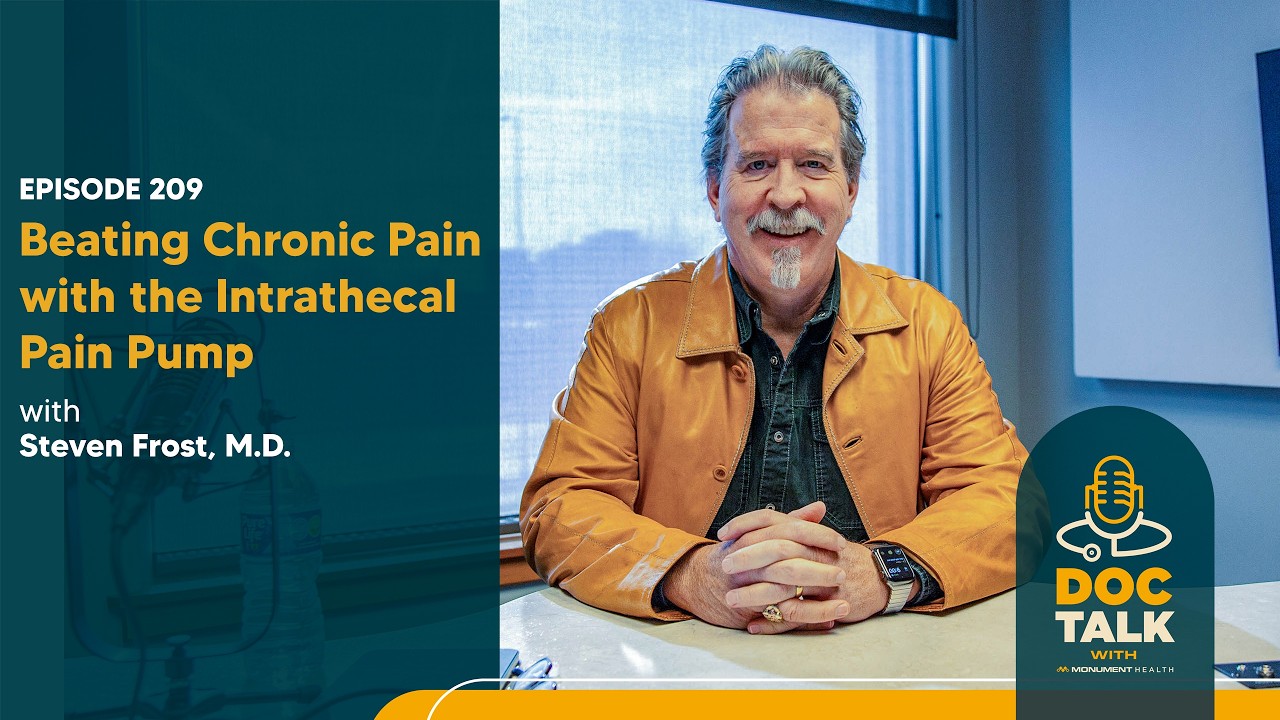
Chronic Pain & the Intrathecal Pain Pump
Host: Mark Houston | Guest: Dr. Steven Frost
**MARK HOUSTON: **Hello again, everybody, and welcome to another edition of Doc Talk with Monument Health. My name is Mark Houston, and joining me today is anesthesiologist and fellowship-trained pain medicine physician Dr. Steven Frost, here from Rapid City. Chronic pain is what we're going to talk about a little bit today, Doctor, whether it stems from cancer or from other conditions people can have. It's got to be incredibly challenging, both physically and emotionally, for the people who experience it. But I think there's been a lot of great advancement in your career that we want to talk about, things that are really helping people through this. Would that be fair to say?
**DR. FROST: **Yes.
**MARK HOUSTON: **One thing we want to focus on is the intrathecal pain pump. Did I say that right?
**DR. FROST: **You did, yes.
**MARK HOUSTON: **I practiced for two weeks on that one. But this is kind of a specialized approach to pain medicine, so let's start with the basics. What exactly is an intrathecal pain pump?
**DR. FROST: **Well, it's a pump with a reservoir, about the size of a hockey puck. We place that underneath the skin in the abdomen, and we tunnel a catheter from the stomach area all the way to the back. It's placed in the intrathecal space, which is the spinal space. The whole concept is to get pain medication, an opiate, directly to where it needs to go.
**MARK HOUSTON: **And what's the advantage?
**DR. FROST: **Well, it's three hundred times stronger. So, for instance, if you're on three hundred milligrams of morphine a day orally, I only need to put one milligram of morphine in the intrathecal space.
**MARK HOUSTON: **Why is that? Why does it work so much better, I guess?
**DR. FROST: **Well, first of all, it's going directly to the pain receptors and blocking the pain right there in the spinal cord. To get that much medication into the spinal cord when you take it by mouth, it's got to go through the liver, the intestines, your whole body. That's why you need three hundred times more to get the same effect. So you get superior pain control and fewer side effects. One milligram in your body versus three hundred milligrams, you can understand you're going to have fewer side effects.
**MARK HOUSTON: **Absolutely.
**DR. FROST: **And whether it's for cancer pain or non-cancer pain, the more you have to increase the dose to help with the pain, the more side effects you're going to get. And the classic side effects are confusion, loss of appetite, nausea, vomiting, constipation, itching. People are just out of it. But if you don't give them enough pain medication, they're in severe pain. So this is where the pain pump comes into play. We follow the World Health Organization guidelines for treatment of pain, whether it's cancer-related or not. The first step is basically "take two aspirin and call me in the morning," anti-inflammatories, Tylenol, non-opiate medications. Then you can move to weaker opiate medications, like Vicodin, people have heard of that, or Percocet or oxycodone. If that doesn't work, you go up one more step to things like the pain patches, fentanyl, methadone. And once you've tried all those steps and you're still having severe pain, that's where the pain pump comes into play.
**MARK HOUSTON: **Now, it seems like, with the opioid epidemic we've all heard about, is that something you think about as a pain doctor? I know it's effective medication, but do you hope that at some point we move away from that as we find new ways to manage pain?
**DR. FROST: **Yes. There's actually a new medication that just came out orally that doesn't block pain at the mu receptor, which is how narcotics work. It's a different mechanism, so it doesn't carry the psychological dependence and the side effects. I'm excited that they're looking at non-opiate ways to treat pain.
**MARK HOUSTON: **Well, you've been involved in this almost your entire career, right? You're local, from Rapid City.
**DR. FROST: **Yes.
**MARK HOUSTON: **Born and raised here.
**DR. FROST: **Yes.
**MARK HOUSTON: **You've spent your entire career here.
**DR. FROST: **Yes.
**MARK HOUSTON: **And you were the first pain management doctor in Rapid City.
**DR. FROST: **Yeah.
**MARK HOUSTON: **A lot of things have had to change since. What were you doing thirty years ago to help people with these types of pain?
**DR. FROST: **Mainly giving them pain medications. And we did certain types of blocks, which we still do today, the same as we did back then. But before I started, well, now we're doing what's called radiofrequency, where we can burn the pain nerves so they can't transmit pain to the brain, and we can do that throughout the entire body. The pain pumps came out literally right when I started practice. We didn't have any of that in my fellowship, so I kind of learned as I went. And there have been a lot of newer medications since, non-opiate ones that can treat nerve pain, which they never had before. So there have been great advances, but we still have room to grow. It would be a great goal if we could treat pain without ever using an opiate.
**MARK HOUSTON: **Why is it so hard to treat pain? I know that seems like a basic question, since all of us have experienced it in different ways, in different forms, and it's all based around your nerves, right, that's where all the pain comes from. Why is it so difficult to combat chronic pain?
**DR. FROST: **Well, by definition, chronic pain is any pain you've had for greater than two or three months. Your brain and spinal cord actually change how they process a pain signal, which makes it more difficult to treat. We've all sprained an ankle, we've all lifted a box we shouldn't have, and usually your body sends its own mediators and you get better. But there are certain pain states where you never get better, and the pain continues. And if you've had pain for quite some time, it affects your entire life. You will clinically get depressed. "I can no longer go out and walk my dog. I can't clean the garage. I can't do the dishes anymore." The most common pain we treat, by far, is back pain, slipped disc, arthritic pain, and that's where we can do injections, mild analgesics, anti-inflammatories and Tylenol, and really help people so they don't have to go to surgery. But once that pain sticks around for four to six months, it definitely becomes more about how we can help people cope with it, knowing there's no magic cure and no hundred percent guarantee in what we do. But things like this pump have clinically shown, through studies, that it reduces pain, it reduces toxicity, the nausea, the constipation, and so on, and for cancer pain specifically, it's actually been shown to help increase survival. It doesn't cure the cancer, but if you have less stress on your body, it makes sense that you're going to be able to help your oncologist fight the cancer better.
**MARK HOUSTON: **Oh, boy. I never even thought of that.
**DR. FROST: **Yeah. And it actually saves money too. Taking oral narcotics is expensive, and when people have severe cancer pain, they end up going to the emergency room, going to the hospital. The spinal pump has actually been shown to decrease the number of admissions, and patients with oncological pain have shorter lengths of stay. Right now we also have shortages of basic morphine orally, it's hard to find in pharmacies. I just got back from a conference in DC, and it's nationwide, drugs that have been around since the dawn of time are in shortage. So the spinal pump, you try everything else first, but when you're there, it really can help the patient.
**MARK HOUSTON: **What specific drug is used in that pump?
**DR. FROST: **It's indicated for morphine. And, like with a lot of medications, you can go off-label and use other things, a local anesthetic, like a dentist would use, bupivacaine. We can put blood pressure medication in there too, called clonidine, which blocks pain in a different way. There's also ziconotide. I'm always amazed at what the "smart docs" come up with. That one actually came from a snail, one with venom, found on a coral reef in Australia, and somehow they figured out it can stop pain. Now we put that in the pump, and it's made only for the pump.
**MARK HOUSTON: **I always wondered about the first guy who tried it. Like, why was he holding the snail?
**DR. FROST: **I don't know.
**MARK HOUSTON: **It's kind of like Botox, right? Botox is used to keep us looking pretty, but sitting in grandma's cupboard it would kill you. And then somebody said, well, wait, let's see what we can do if we inject a tiny bit of it into you. And it helps with headaches. It's amazing what they come up with, and I'm glad there are smart people out there doing that research.
**DR. FROST: **Right.
**MARK HOUSTON: **Now, once the pump is in place, can it stay there permanently?
**DR. FROST: **Yes, it can. I've been in practice about thirty years now, and I still have patients, without cancer pain, who have a pump. It lasts about five years before the battery runs out.
**MARK HOUSTON: **Oh, of course.
**DR. FROST: **And then you just unzip it, put a new one in, zip it back up, and hook it up to the catheter. The catheter itself can stay in for a lifetime. I've had one patient for twenty-seven years, and it's really helped her pain.
**MARK HOUSTON: **Wow.
**DR. FROST: **And that's the concept, you put the medication right where it needs to go. These pumps are so advanced now. If you've ever been in the hospital after surgery and had an IV, there's something called a PCA, where you can push a button to get more pain medication, otherwise it just runs continuously. That same idea has been built into the pumps. They run continuously at a constant level, and if a patient has increased pain, all they have to do is use a little handheld controller, almost like a cell phone, hit the button, and they get more.
**MARK HOUSTON: **Is there a danger of misuse?
**DR. FROST: **Well, there are always going to be a few bad apples out there. The way the pump works, underneath the skin, it's like a fuel tank, the medication lasts about three months before it starts running low. So the patient comes into the office, the nurse preps the skin, puts a needle into the middle of the pump, withdraws the old medication, and refills it with the new. There are bad apples out there who could try to do it themselves, but that's very rare, and honestly, you have to know what you're doing to even attempt it.
**MARK HOUSTON: **Oh, I bet.
**DR. FROST: **Yeah, the risks of the pump itself are very minimal. Patients, especially during a time of cancer pain, have a lot of emotions going on, and pain is probably at the top of their list, because with cancer pain across the board, eighty to ninety percent of patients will have pain, but most of those can be treated with oral medications. For the ones who can't, this is where the pump is the cat's meow, because once it's in, you can get them off their oral medications, a lot of times completely, so they're not walking around like a zombie, they don't have the side effects, and they can enjoy their family, stay alert, while the pump continuously does the work. It is a surgery, but it's a walk-in, walk-out, same-day procedure, almost like getting a port placed for cancer treatment. Usually a neurosurgeon puts it in for us, highly skilled and well trained. So there's always the general risk of any surgery, infection, you can get a spinal headache, but that can be treated. And because the medication is under the physician's control, there are fewer side effects. It's very rare that a patient would overdose or have respiratory depression. You just don't have to worry about that because you're not putting in nearly that much medication.
**MARK HOUSTON: **Got it. So what criteria do you generally use to determine if someone is a candidate for this?
**DR. FROST: **Well, we look first at what type of pain they have. When I first started out, we would just place the catheter in the spine and assume the medication would flow up and down with the spinal fluid, since spinal fluid continuously flows from your head down to your tailbone and back up. In later years, research showed that's not quite right, the medication tends to stay where the catheter is placed. So we've since learned that you have to put the catheter where the pain actually is. If it's in the shoulders, you go all the way up to the neck. If it's in the stomach area, like with pancreatic cancer, you place it right in the middle of the spine. So we look at the type of cancer, where it's located, what medications the patient has already tried, and what has or hasn't worked. We always want to exhaust oral medications first, because that's easier, but we also want the patient to know it's better to get the pump in earlier rather than later, because they'll get a lot more benefit from it. Typically the patient is working with an oncologist, and when the oncologist notices they're having to really escalate the pain medication dose, that's usually when they'll refer them to us. You can also get a pump without cancer pain. Say you've had eight back surgeries, multiple injections, tried multiple medications, what we can do first is a single test shot, kind of like a spinal block, a little morphine, so the patient can actually feel what it's going to be like. It's amazing when you do that. Those patients are just ecstatic.
**MARK HOUSTON: **Oh, I bet, that feeling when the pain isn't there anymore.
**DR. FROST: **It has to be euphoric at that point.
**MARK HOUSTON: **Oh, wow. Well, this has to be a real team effort, with oncologists and nurses and everyone else, to get the most effective use out of this. Do you work closely with them as well?
**DR. FROST: **Yes. We work with the oncologists, we work with palliative care physicians, they're usually the ones handling most of the medications day to day, and then they'll notice, wait, we're only getting side effects, we're not getting pain relief, and that's when they bring us in. We usually work with a neurosurgeon to place the pump, and then our pain management team manages it going forward. One thing that's been really great since we started this is that we now work with a company where a nurse actually goes to the patient's home to change out the medication. At end of life, a lot of patients simply can't get out, so it's difficult for them to come into a clinic or hospital. Now we have a nurse who goes to their home, and even our non-cancer patients are getting home visits too. That's all that nurse does, she doesn't do ports or anything else, she only refills pumps, so she's excellent at her job. In our Rapid City area, we're kind of an island, and we draw patients from about a three-hundred-mile radius. Some of them are rural and live far out, and they can't drive two hours each way just to get a pump refill, but the nurse can go out to them.
**MARK HOUSTON: **Boy, that's quite a service. For people listening right now who might be thinking, "I can't make a four-hour round trip to do this," that's a real game changer.
**DR. FROST: **Yeah, and I get it, it's scary, another surgery. But like I said, it's like getting a port placed, a same-day procedure with very minimal risk. It's not that you're giving up, you're actually getting pain relief so you can live longer and enjoy your life with your friends and loved ones, without being zoned out.
**MARK HOUSTON: **Now, do you think we'll ever get this whole pain thing figured out? The nerves in our body seem almost endless, just in terms of where they go and how they work.
**DR. FROST: **Probably not. That's the problem with the nervous system, and with pain. Some folks will psychologically get a secondary gain from it, and we're never going to fully stop that. But the majority of patients, and this is why I chose this field, come to us after going through primary care not knowing what else to do. They've tried their best and don't know where else to turn. Once a patient comes to the pain clinic, that's our whole focus, so we can spend a fair amount of time with them up front, which is refreshing for the patient to experience. There are no hundred percent guarantees, but there is one guarantee: we can help you cope with your pain. And I think that alone brings a lot of relief to the majority of our patients, both cancer and non-cancer, just knowing there is hope. If A doesn't work, we go to B, and if B doesn't work, we go to C, and we're going to find something.
**MARK HOUSTON: **Are you guys finding any use yet for artificial intelligence? AI is becoming a big deal in medicine. Do you think down the road it might open some doors?
**DR. FROST: **Oh, definitely. I think AI is going to help us make sense of all the data we now have through electronic charting. I go back to the days of paper charting, all the handwriting you had to do. AI is going to be able to say, this many patients had this type of treatment, and it worked better, or this part didn't.
**MARK HOUSTON: **Yeah, it's interesting. I read that Bill Gates said that in ten years we won't need doctors, that AI will basically take over.
**DR. FROST: **I never believe that. We still need people to actually cut and open organs and appendixes.
**MARK HOUSTON: **Exactly, I still want a person in the room when that's happening, for sure, I don't want a robot doing it by itself.
**DR. FROST: **I don't either. But the data will definitely help drive us toward the best approach, because it won't just be based on what's happening in Rapid City, it'll be the entire nation's data. It'll all be linked together, and we'll get to draw on the best information out there.
**MARK HOUSTON: **So if somebody listening is interested, what are the first steps they should take? Is their primary care doctor the place to start?
**DR. FROST: **Yes, usually. We're a referral-based clinic only, because we're so busy. If someone calls the clinic, we tell them to have their primary care doctor refer them, and we'll get them in as soon as possible. With cancer pain, that referral is usually already in motion, working with the oncologist and palliative care physician, so it's already in the pipeline. There are two types of pain I'll see as soon as possible: cancer pain, I'll see that patient that day or the next; and a condition called complex regional pain syndrome, I'll see immediately. Back pain that someone's had for ten years, I'll see them when I can, and that's something we've all experienced in some form, though obviously it's worse for some than for others.
**MARK HOUSTON: **Is there any expansion plan for the clinic? Are you trying to grow it out here at Monument?
**DR. FROST: **Yes. We're at the sports hospital, that's where the clinic is located. Typically we have two physicians there a day and up to four nurse practitioners at a time. They work closely together, the nurse practitioners see the patient initially and recommend injections or medications, and then typically the physician performs the injections.
**MARK HOUSTON: **So I guess, obviously, when you build a new building, the first year you say, why didn't we build it bigger?
**DR. FROST: **Right.
**MARK HOUSTON: **Of course. And Monument's been expanding so much too, which has been wonderful for Rapid City. Like you said, with this two-to-three-hundred-mile radius, it's only going to improve the lives of the people who live here. Having doctors like you who've dedicated themselves to staying here, because you get to know these people, I think that's become so important in helping people get better, knowing they're not just cattle going in and out. Do you feel that too?
**DR. FROST: **Oh, yeah. I trained as an anesthesiologist, and I wanted to come back to Rapid City, but they didn't need another anesthesiologist. They said, well, no one's doing pain here, and I said, that'd be great. As an anesthesiologist, I put the patient to sleep, they wake up, and they forget me, I've done my job, right? But I became a doctor to get to know my patients, and pain management was a great avenue for that, because it's chronic. Sure, I have a lot of patients I help and then never see again, but like I said earlier, I have a patient I've been seeing for twenty-seven years. You get to know them, you become friends, and you're still helping them. So I kind of got the best of both worlds.
**MARK HOUSTON: **That's awesome. Well, this has been really fun to talk to you today, Doctor, and I'd love to come back and drill down into some of the other things you're passionate about when it comes to pain management. Dr. Steven Frost, anesthesiologist and fellowship-trained in pain management here at Monument, thanks for coming in and talking, Doctor. I really appreciate it.
**DR. FROST: **I enjoyed it. Thanks.