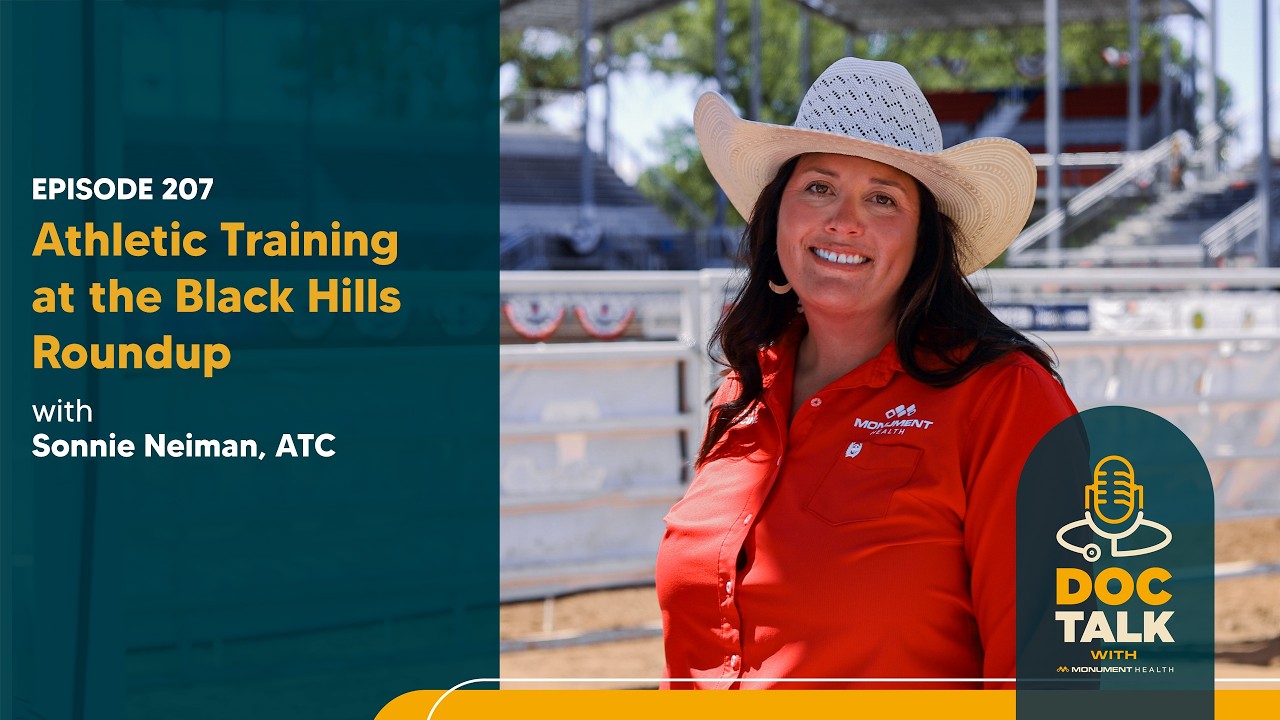

Listen or watch this episode on your preferred platform:


Hello again, everybody, and welcome to another episode of Doc Talk with Monument Health. My name is Mark Houston and we are here at the Black Hills Roundup today, which is one of the oldest roundups in the country, and we're doing something a little bit different. We are going to be talking with Sonnie Neiman, who works with the Hulett school system in Wyoming, but she's paid by Monument Health and she's an athletic trainer here for the roundup. Welcome to the podcast. Thank you for doing this, Sonnie, I appreciate it.
SONNIE NEIMAN: Yes, thank you for having me.
MARK HOUSTON: Is this, is this... just feel like home to you? Is this everything you do, everything you live for?
SONNIE NEIMAN: Yes. You know, and it's a great way to celebrate the Fourth of July.
MARK HOUSTON: Yeah. For sure. If there's any more American thing to do on the Fourth of July than come to a rodeo, and just all the red, white and blue that's here in the arena, it just makes it, makes it pretty cool. Well, let's talk a little bit about how you got started in this, uh, a-and kind of what an athletic trainer does specifically. We'll kind of get into specifically for the rodeo, but just how did your path lead you here, Sonnie? How did you get here?
SONNIE NEIMAN: Well, I grew up in a small town and played a lot of sports and just really enjoyed being in athletics and active, and also grew up on a ranch and with, around agriculture and rodeo, and just kind of tried to meld those two loves together, I guess. So I went into athletic training and, um, always, you know, kind of wanted to do some sports medicine for rodeo. And I guess once I graduated college, this position became available and they did a lot of rodeo coverage and, um, then just some general athletic training coverage at high schools and clinics.
MARK HOUSTON: Well, I suppose it is. I mean, so you get, uh, wake up kind of every day and do something that you love. So it doesn't feel like work in a lot of instances. Um, but what... for people that really don't know what an athletic trainer is, because you, you get the, the stereotypes, right? That it's just somebody standing there handing a water bottle to somebody, uh, you know, in a football game or at a rodeo or anything like that. What does your job entail when you're, when you're out actually in it, like you are right now? What, what does an athletic trainer do?
SONNIE NEIMAN: Well, I would say on a perfect day, that's exactly what we do, is give water to kids. You know, you don't want them to get hurt. You don't want them to be injured. So that would be probably a perfect day, handing out water. But, um, on a day-to-day thing, as far as practices and stuff go, I'm at the high school level. Um, so I deal primarily with high school kids during the school year. And so I'm at their practices in the afternoon after school, and then I do all the event coverage. So basketball, football, volleyball.
MARK HOUSTON: So it's not just rodeo. You are covering anything. That's, that's athletics.
SONNIE NEIMAN: Yep. I cover anything athletic at my school. And then, um, us as Monument Health, we have different contracts with different, um, I guess we do like the Sasquatch and Spearfish and different, you know, community events, some youth soccer events, some wrestling events, um, that we also work at and cover too. So it's just kind of a wide gamut of athletic events that we cover.
MARK HOUSTON: Well, and it's interesting, kind of the reason for this podcast is one thing I, I don't think a lot of people know is you do work in the Hulett school system. That's where you're based out of, but you're under contract with Monument Health. So how does that partnership work, or how does something like this come about?
SONNIE NEIMAN: Um, I guess they just talk to the schools and the schools partnered with them. And yes, I am a Monument Health employee, but I'm contracted out to the schools. I'm considered like a community benefit employee. So I get to kind of go out in the communities that Monument Health services and work there. I don't necessarily do any clinic stuff during the day. I'm strictly at my high school. Um, and then just do other events, you know, through the summer and whatever other events that we have throughout the year.
MARK HOUSTON: Yeah. Is this, is this common? Are there more people like you that work for Monument but are out in the schools where the, where the, where the student athletes are?
SONNIE NEIMAN: Yeah, they're mainly just the athletic trainers. Um, and we also have some strength and conditioning coaches that work with different schools. Spearfish. The Black Hills State University, School of Mines, they all have, um, strength coaches that are employed through Monument Health, but then work at the school as well.
MARK HOUSTON: So what does a typical day look like for you then, while you're at the school on, you know, a typical Tuesday morning? What does it look like for you?
SONNIE NEIMAN: Um, well, I don't go into my school until the afternoon typically, um, just because that's when sports practices happen. Um, and so I'm there a little bit before practice to get things set up, water, ice. And then once school gets out, I get the rush of kids coming into the training room needing taped, or maybe they're coming back from an injury and they need rehab, or maybe they got injured the night before when they were at an away game, that I wasn't there, that I've got to look at and evaluate. Um, and then I go and hang out at practices and talk to coaches and make sure everybody's on the same page and make sure everybody's doing good and healthy. And I guess wait till practice is over to see if, if anything happens that day.
MARK HOUSTON: Much later, you'll be staying.
SONNIE NEIMAN: Yep, yep.
MARK HOUSTON: And then you come to an event like this, which again, we're at the Black Hills Roundup in Belle Fourche, which is easily one of the, the, the largest rodeos that happens around this time of year. So you work with football players, you'll work with basketball players. Now you're coming out here to work with the cowboys and cowgirls that ride and rope. How is that different? Do you have to prepare your day any differently for stuff like that?
SONNIE NEIMAN: I don't know if it's necessarily preparing yourself any differently. Um, as far as, you know, if they need their knee taped for an ACL, I'm going to tape their knee. It might be a little different as now my kids have to get, or my patients have to get, into a cowboy boot, you know, so I've got to use maybe some different tape that, um, that I wouldn't typically use to get that foot to stay in a boot. Um, and then also, I feel like these athletes are here to compete and they want to do whatever they can to get through their eight seconds.
MARK HOUSTON: Yeah.
SONNIE NEIMAN: And we might put gobs of tape on them to get through eight seconds, but we do it. And we're just so thankful that, you know, like their... I guess their passion and drive is just so great to see, you know, when you're working with them and taping them, like, what can we do to get you, get you through?
MARK HOUSTON: So when you're here and you're, and you're watching them get ready, I guess we'd be this way, right? I believe is where the, the, the chutes are. Are you back in this area here then generally for, for most of the event, or are you kind of... do they come to you when they need you? Like from the trailer that we have back here?
SONNIE NEIMAN: Yeah, we're typically here about two hours early and there's a crew of us and we hang out in the trailer and they come in and they get what they need to, taped or looked at or stretched or, you know, whatever they need. And then once the rodeo starts, we kind of divide and conquer. And we're lucky enough that we have a large staff and we can kind of man a couple people on one side and a couple people on the other side. Here at the roundup, we stand behind these gates right here because we'll go in that gate right there if we have to go into the arena. So we're really close and we can see, have front row seats. See what's happening. So when we get out there, we kind of have an idea of what we're looking at and what happened.
MARK HOUSTON: Now, I'm assuming over the years, because it used to be back in the day, you know, you'd watch these rodeos and cowboys being cowboys would be like, I don't, I don't need anything. Just put me on it. You know? I'll ride till I fall off. Hopefully I make the full eight seconds and we go home. You've seen more and more, a lot of these cowboys taking extra precautions to be safe. Um, is that happening more and more with these guys, or do you still get the ones that are like, look. Nope. Just let me get on. Let me go.
SONNIE NEIMAN: We have both, you know, it just kind of depends. Some of our athletes, you know, they're like, yep, I want to get this looked at. I want to know what's going on. Others are just like, nope, I'm fine. I'll come to you if I, you know, if I want something.
MARK HOUSTON: So you kind of look at him like, come on man, just come on. Just walk into the trailer.
SONNIE NEIMAN: Sometimes it takes some convincing, and sometimes you have to be like, let me take a picture so I can show you, because I know you can't see it. And then maybe you'll decide you need stitches or, you know, whatnot.
MARK HOUSTON: Um, out of, out of... what would surprise a lot of people at these events, um, maybe injury-wise, that, that you see? You know, obviously when you're on the back of a bull or the back of a horse, that fall is pretty bad. The animal can be pretty bad. You know, when it comes to like roping or bulldogging or things like that, are there, are there injuries that you see that a lot of people don't, or wouldn't know, is happening to these?
SONNIE NEIMAN: Um, well, I guess if you're not familiar with roping very much, I mean, if you get your rope around your arm, your fingers, it will burn it off pretty quickly. So you kind of have to be careful for that. Um, have I seen that only once or twice, you know, so maybe not something that's typical, but something that you probably wouldn't see at a football game necessarily. Um, but you know, we see a lot of the same injuries. ACLs, broken bones, concussions.
MARK HOUSTON: Well, I have to imagine that they're relatively similar. I mean, any sport that you're putting stress on any part of your body, you know, that can go wrong. And then they're in the trailer hanging out with you. Um, what are you, uh... for people that might want to, to, to, to do this, to, to be an athletic trainer, uh, what are some of your favorite parts about it? Is it just... to me, it feels like it would be, be able to be outside for a lot of the stuff that you do, right? It's not an indoor desk job. You kind of feel that same way?
SONNIE NEIMAN: Yeah, it is not, by any means. And you know, probably what I like most about it is I get to be in the action. On a football game, I'm on the sideline. On a, you know, volleyball, basketball, I'm on the court, you know, like in the chairs on the court with them. Rodeo, we're right here behind the chutes, you know. And, and you go to a sporting event just for fun and you're up in the stands and you're like, I can't see anything.
MARK HOUSTON: Wow. You got to be there, there. There you go. If you want to be an athletic trainer, you get the best seats in the house, you do, for the whole thing. Um, how does, um, uh... how many times do you have to interact with, uh, Monument? Do you have to go to Rapid City every once in a while, and you have staff trainings, do you have things like that that you have to do as well?
SONNIE NEIMAN: Yep. Um, usually our like staff meetings are in Spearfish. We kind of have like a Northern Hills and a Southern Hills team. And then we can combine as one once in a while, every couple of months for meetings and stuff. But you know, we're seeing probably like our team at least once a month.
MARK HOUSTON: Okay.
SONNIE NEIMAN: Uh, you know, a lot of times we cover some events and there's a couple of us at those events. So we get together a little bit more frequently. But yeah, like I said, I'm not in the clinic or anything during the day. I'm just strictly at my high school and other events. So I'm not, um, I guess, at a Monument facility every day.
MARK HOUSTON: Is it... are there slower times of the year for you? Or, I mean, sports pretty much around here can go all year round, I would guess. So I can't imagine there'd be too much that would be slow, would there?
SONNIE NEIMAN: No. In the school year, you know, we're pretty busy, especially like August through, I would say, March, with football, volleyball, basketball, wrestling. Um, it does lighten up, for especially the smaller schools, in the spring with like track and golf. Got some softball. A couple schools have softball, baseball, um, you know, the bigger schools, they have some more sports in each season. Um, typically summer is slower, but then we have, it seems like, just bigger events that we have to cover. Rodeo. Sasquatch.
MARK HOUSTON: I just, I just love the fact that there's a chance you could be working on Sasquatch at some point. Um, is this the biggest rodeo you work, or do you go... do you go to the fair, too? Are you at the Central States Fair at all for their rodeos?
SONNIE NEIMAN: We're not at Central States Fair. We're at, um, Deadwood for the Days of '76, of course.
MARK HOUSTON: Yeah. I suppose because you're Northern Hills, that... yeah. Different. Okay.
SONNIE NEIMAN: Yep. We do Rodeo Rapid City, in Rapid, in, you know, late January, February. Uh, we also usually send a crew to the state high school finals rodeo in Pierre. Um, we worked it when it was here in Belle, and I guess we've just kind of kept going. Um, and then this year we sent a crew to Kadoka for their rodeo too.
MARK HOUSTON: Yeah. So obviously I can tell, Sonnie, that this is something you really enjoy doing. And to be out here on a day like today, as we're getting ready for the roundup to start... I believe, just after... well, as of recording this, we're just before the roundup is starting here at, in Belle Fourche. Um, is there anything, anything that I missed, anything that, uh, that you, you want people to know before we wrap it up and let you get in there to help some cowboys?
SONNIE NEIMAN: I don't think so. I guess just, I appreciate everybody that lets us do our job, and be safe and drink lots of water.
MARK HOUSTON: That's right. It's a whole other thing you gotta do. Lots of water. Well, Sonnie Neiman, an athletic trainer with Monument Health at the Hulett High School. Thank you for doing this this afternoon. I appreciate it, and, uh, hopefully we'll see you again. Uh, I don't know, in some other sport. We can talk about that then, too.
SONNIE NEIMAN: All right. Sounds good. Thanks for having me. Appreciate it.