
Listen or watch this episode on your preferred platform:


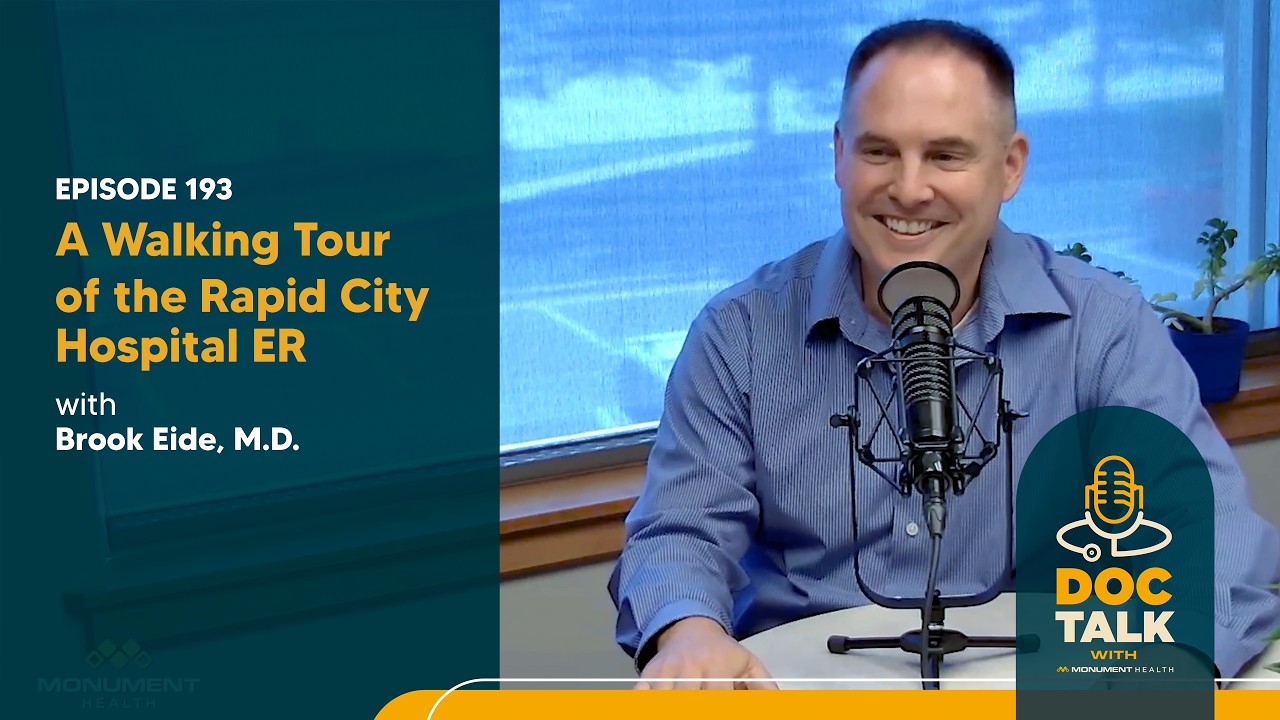
MARK HOUSTON: Hi everyone, I'm Mark Houston and welcome back to Doc Talk with Monument Health. Today we're inside the emergency department at Rapid City Hospital. My guest, Dr. Brook Eide, has been an ER physician here for sixteen years, and he's going to take us on a tour. We'll see the ambulance bay, the helicopter pad, the trauma rooms, and the pediatric setup built specifically for our smallest patients. Brook's going to explain what it means to be a level two trauma center and why that matters for everyone living in this region. Most people will never step foot in here, but if you ever do, it helps to know what's waiting for you. So come along with us. Let's take a look. Hey, Dr. Eide, how are you?
DR. BROOK EIDE: Good to see you.
MARK HOUSTON: Good to see you again, too. I'm happy to come visit you finally at your place of work. Last time you were on was two years ago already. Can you believe it? Time flies. I'm happy to be here where you're doing your thing. I've lived here a long time. This to me has always been the new emergency room, but we're going back six, seven years already for this, aren't we?
DR. BROOK EIDE: Yeah. I'm glad to have you here. It's fun to visit. I'm really glad to show you my place. This is our new ER. We opened in 2019, so it has been a while now. It's more than twice the size of our old ER. We are a trauma center. We're a stroke center. We do all kinds of wonderful things here. We have multiple different helicopter services coming in, so we really function as the medical hub here of western South Dakota and the surrounding area.
MARK HOUSTON: Well, what I would love to do is get a tour of this. That's kind of why I'm here today. So if you can take me inside and show me everything, that would be fantastic.
DR. BROOK EIDE: I'd love to show it. Let's go.
MARK HOUSTON: You know, doctor, when you came up and did the podcast a couple of years ago, one thing I remember talking about was that this was considered a level two trauma center, and I think you had a really good explanation for it back then. But for people that may not have heard that podcast, what does it mean? The difference between a level one and level two?
DR. BROOK EIDE: Yeah. So it's really some subtle differences. We're a level two and that's mostly based off just a few little boxes we don't check for research and some of those things. But we function as the busiest trauma center in the state, and similar to level ones. Other than doing a few of those things, we serve all kinds of trauma. We have trauma that comes in from all across our state, Nebraska, Wyoming, Montana, North Dakota. It all filters in here, where our trauma team meets them, which is our surgeon, our emergency physician, and a whole team of care workers, to rapidly give care and really save lives.
MARK HOUSTON: Well, I remember too, that you said, I believe in the podcast last time as well, that this serves four states. Is that right? Or can it be more? I mean, most people, this is where they're going to end up if they're in Nebraska, if they're in Wyoming, if they're coming from North Dakota, in those smaller communities. This is kind of where we really serve a five-state area.
DR. BROOK EIDE: We serve Nebraska, Wyoming, Montana, North Dakota, and then of course South Dakota.
MARK HOUSTON: Yeah. All right. So they're all coming in here. But I understand this is one of the busier ERs. I remember, I believe we talked about that, that this can get up there and get crazy.
DR. BROOK EIDE: Yeah. We're like quite a bit the busiest ER in our state. And we're the busiest ER in Wyoming, Montana, and North Dakota.
MARK HOUSTON: All right. Well, let's head inside and you can show me the rest.
DR. BROOK EIDE: Come on. Come with me.
MARK HOUSTON: So now that we're inside the doors, doctor, and obviously these doors are doors most people never want to go through, right?
DR. BROOK EIDE: Unfortunately, usually we represent the worst day in someone's life. So it's one of the challenges we have, but it's also the opportunity to really help people when they're having the worst day of their life.
MARK HOUSTON: So as they're coming through, there's obviously going to be lots of different rooms that are back here that you guys use in different ways. One I've specifically noticed is one called vertical care. What exactly does that mean in an ER like this?
DR. BROOK EIDE: Yeah. So when you come in, kind of like you did, we kind of figure out what's going on with you, and then try to get you to the right place for the right care. And so once we triage you or figure out what's going on, one of our options is our vertical care. And the reason it's vertical care is that a lot of people are in chairs, an upright position. And so it can be an ankle sprain. It can be something more minor like that, that we bring you into our vertical care area and really try to rapidly assess and treat you and be able to get you back to your life. So this could be something a little less serious, maybe, that you're coming into a room like this. This is usually our lower acuity or less serious stuff that we come into here. Like I said, if you have an isolated finger laceration or an ankle sprain, we can get you in here quickly. Okay. You want to have a look?
MARK HOUSTON: Yes, please. Let's go. So now that we're inside the vertical care unit, one thing I have noticed is you just have a lot of chairs for people to come in. And I'm assuming when people come in with an ankle sprain or something similar, maybe they'd go here first to have it looked at, because they're all attached. All the monitors are here as well, right? You're not instantly going to a bed?
DR. BROOK EIDE: No. So it's set up so we can. We have a few beds here. And so if we need to do an exam or some place in a room, we have a room for privacy and those kinds of things. But a lot of times we can deliver care right here. And sometimes when things get really busy, we want to be able to put someone, maybe a little sicker, on a monitor. But the idea is to be able to treat minor things, like I said before. Sprained ankles, get you in a chair, hear your sore throat and get a quick look at it, and get you figured out and get you treated and back to your life.
MARK HOUSTON: Have you ever had the room entirely full?
DR. BROOK EIDE: Yes. Yes.
MARK HOUSTON: At times it looked entirely full. So, doctor, I noticed as we were walking down the hall here, one thing I have noticed about the entire renovation that they did for Monument, not just the ER, is this does have a feel of the Mayo Clinic in Rochester. If you've never visited there before, the layout is very familiar. It's very comfortable. It's very bright. Which I think is good when you're having to come into a place like this, like you said earlier, one of the worst days of your life. But all of this is brand new. What used to be here before this all became the new emergency room or the emergency area?
DR. BROOK EIDE: Yes. This area is all new. This used to be the power plant, actually, for the hospital. They built a new one and then built this all new here. And so we've really enjoyed this space. It's double the space of our old ER, which has been great because we continue to grow in Rapid City, continue to have more people live here and more patients with that. And so it lets us serve our community a lot better, just to have this extra room and this really nice area to be able to take care of them. And part of that design is, you can see where we are now, some open spaces, some lights and places for family to sit when they're waiting for tests to be done, or X-rays. So we really try to think about the comfort of our patients and really giving them the best care possible before we go down one of these or into one of these rooms.
MARK HOUSTON: Doctor, one thing I did notice too is that I'm standing out here looking out these big bright windows. There's lots of traffic going on, as always, down these streets around the hospital. But it is so quiet in here. It's one of the things that I think is probably deliberate. Would that be correct?
DR. BROOK EIDE: Absolutely. So we designed this really to have two different flows, where we have this outer area where we keep families and patients. And it's designed to be a calming area with access into our pods for them. The inner circle is where our caregivers are all hustling around, trying to deliver emergency care to all kinds of injuries and accidents happening. And so it may feel calm and quiet here intentionally. On the inside, there's lots of high quality care being delivered, sometimes in a really rapid and timely fashion.
MARK HOUSTON: Well, let's go in and check out one of the pods. Let's have a look.
DR. BROOK EIDE: So we have these hallways here. And so each pod is set up the same with four beds off them. And so we also, at times, unfortunately, will spill over into our hallways. And so we have a place here for that, if we need to, in order to get people back for emergency care. Every room is very similar, well designed and set up to care for any kind of emergency that comes in. And so these four rooms will have a nursing station just outside these doors that is here to watch these rooms. And so there's a nurse for every pod, and then a physician team that's seeing multiple pods and caring for them.
MARK HOUSTON: Now, if we go into these rooms right now, they do feel like a hospital room in a sense. If you've ever had to spend an overnight stay in a hospital, they feel very much the same. What differentiates this type of room from a normal hospital room?
DR. BROOK EIDE: Well, in some ways they're similar, in other ways we have some extra space here. We have a chair for our guests, but we have ways to bring in equipment that we need to in order to take care of people in emergencies, whether their heart's in the wrong rhythm or we need to do different procedures. We can do that here. And that's probably the biggest difference. They're a little smaller. If we have it upstairs, we don't have windows like some hospitals have, but otherwise it's a similar feel. We have oxygen, we have monitors. We have all the things that we need to really evaluate people and stabilize them before we move them to a hospital room or get them on to their life.
MARK HOUSTON: So these really aren't rooms that are meant to be stayed in for a long period. These are to get you stabilized and to get you up where you can rest and hopefully heal at that point.
DR. BROOK EIDE: Absolutely. These are rooms set up for assessment. And so we do that initial emergency assessment to determine what their emergency is, and then determine where they need to be upstairs for more hospital care, or whether we can do some intervention and get them back outside to their life.
MARK HOUSTON: Excellent.
DR. BROOK EIDE: This is our family room. So this is just kind of a nice little room. I think it's locked, unfortunately. This is just kind of a nice little room we have where we can deliver news to families and pull them aside, kind of out of the chaos, and sit them down. And there's a coffee maker, and sometimes bad news, sometimes just news that we want to be able to have some privacy to talk with them. So it's a really nice option that we have right here to get people away from the chaos and talk with them. All right, come on in. I'll show you the main part.
MARK HOUSTON: Now automatically this feels like the emergency room here. This feels like where most of the things happen. Is this kind of...?
DR. BROOK EIDE: So this is kind of where the magic happens. And so this main corridor here, we have five trauma rooms that are set up for major traumas. And so with those rooms, we have our ambulance bay here where ambulances come in. Just up here above us on the roof is a helicopter pad. So helicopters land with patients, come straight down the elevator and into one of these rooms, where we do our resuscitation medicine, whether that be whatever life-threatening things that we have to do here. So this is the main area. This is where the sickest of our sick go.
MARK HOUSTON: But even here it feels calm. It feels controlled, even when you walk through these doors.
DR. BROOK EIDE: Yeah, that's kind of the goal of working in the emergency department, is kind of manage that chaos. And so there's a lot of chaos. And so you get really good at saying, how do we manage this chaos? How do we keep things calm? Because we do our best work then. We think clearest, and we're able to give the best care. And so people that work here work in that environment all the time and kind of learn to manage that chaos, and learn to do that not only for ourselves, but also for our patients, because it's really good to have that calm demeanor and let people know that we've done this before and we're going to do great care for them.
MARK HOUSTON: Awesome. All right. So we just came into one of the other rooms in the main emergency room area here. And this is the room. It feels like you see in the movies. This is the room where it feels like all of the chaos that you talked about earlier is controlled and hopefully contained. And you're here to make sure that this person gets out of here.
DR. BROOK EIDE: Yeah. This is kind of one of our in-between rooms where we see some of the sicker medical patients. And so we have, obviously, a little more room to operate, to do different procedures we may need to do. We have, you can see on our back wall, all the different things we would need to help with someone's breathing or airway. And these tools are all designed on purpose in a way that we can find them quickly in the chaos of a true emergency. So this is just kind of one of those rooms. We also can do some positive pressure ventilation in these rooms.
MARK HOUSTON: That's what... you've said that word a couple of times now. What does that mean in a room like this?
DR. BROOK EIDE: So it's kind of a fancy way to say the air doesn't leak out of them. And so if we have someone with an infectious disease, if they have tuberculosis or something like that, then we can keep these rooms safe for everyone else in the emergency department.
MARK HOUSTON: Excellent. Okay, so the room we were just in, to me, felt like the TV version of an emergency room. But I understand there's bigger ones.
DR. BROOK EIDE: Yeah, that's kind of our in-between room, like I said, for sicker patients. But we have bigger rooms where it is truly the TV, that when the patient leaves, the floor is covered with debris from rapid resuscitation activities. So let's walk you down. I'll show you one.
MARK HOUSTON: Great.
DR. BROOK EIDE: So as you come down the hallway, as I said before, we have five of these rooms, and I think we have one open right now that we can slip into, and I'll give you a peek at what happens here. I think this is also a room that we have here that you can see our little monogram here that we've designated for children's care. And so any pediatric patient that comes in that's very sick, a pediatric trauma, those kinds of things, we take them in this room because we have some different tools in there to help us with that.
MARK HOUSTON: That would, I guess, that would be my question. What makes it different for children versus an adult?
DR. BROOK EIDE: It's going to look the same to you, but I know that it has some different tools in this room that will help me with the smaller anatomy of children and some of the different problems that children can have.
MARK HOUSTON: Okay. Now I know as we're kind of walking by, I don't know if we want to film what's happening over this way, just because of... I mean, this feels like a control center that's right behind you right now.
DR. BROOK EIDE: Yep. That's really our control, which has the rooms. It has the monitors of people. It has their blood pressure, heart rate. You can kind of see our main nursing station. We also have a pharmacist here to help with medications. That's kind of all right here. And then right behind that is kind of what we call our doc box, which is kind of where our physicians and advanced practice providers are mainly located out of, working on their computers, doing some of the things that they're doing, monitoring. There's cardiac monitors you can see, so the nurses can watch them. There's a mirror on the other side. So the physicians can also watch to see if their patient's heart rhythm changes. So we're monitoring all these things all the time. Even if we're not in your room with you and you feel like you're alone, we're watching you out here.
MARK HOUSTON: It does. It feels like you're not alone, which is exactly what you want.
DR. BROOK EIDE: Exactly what you want. We got an eye on you.
MARK HOUSTON: Great.
DR. BROOK EIDE: Come on in. I'll show you one of our big rooms here. So this is one of our, we call our resuscitation rooms, and we use these a lot for trauma. And so the idea is these big doors slide open. We can quickly get an EMS cart in here, get them over onto our bed, and really start that work. We've got lots of expensive lighting here to help us see to do procedures. You can see that big tower in the back has monitors and it has oxygen. It has all the things that we need to quickly get people hooked onto those things so we can start their care.
MARK HOUSTON: And again, one of the things I keep noticing, I'm standing out there where we're kind of the control center, and it's busy, right? There's lots of nurses. You can hear what's happening. I just stepped through here, even with that door open, and again, that calm, quiet is kind of in these rooms too.
DR. BROOK EIDE: Yeah. And that's kind of designed. These rooms are designed for that calm, quiet design. So if we are working as a team on a critical patient, we can hear each other. We can really have those discussions and deliver that care. These rooms are made... so for trauma, we'll turn the heat way up. We want to make sure people stay warm when we're doing those things, so quickly, we can change the temperature in here. And so we can really maximize the technology to deliver the best care in the world right here. So I'll walk you out and kind of show you the other way in. You came in through the front door, and that's where a lot of patients come through when they walk through our doors. The other way to come through is by ambulance. And so when they come by ambulance, they come right through here. Once again, very easily accessible. All right, let's go check it out. Obviously, as you can see right now, there's no ambulances in here, which I'm assuming that means it's a good thing right now.
MARK HOUSTON: Yeah, it's a good thing for the moment.
DR. BROOK EIDE: Right? It's very fluid. Half an hour from now, there might be five ambulances in here. And so, and they just, they can all come in.
MARK HOUSTON: I mean, room for all of it, and then room to move. Has that ever happened? Has it ever been that many in here at a time when something's been going on?
DR. BROOK EIDE: We've done some interesting things here. I actually worked a mass casualty here where we set chairs up and saw people out of here. And so, but most of the time it's ambulances. And so we can bring in, that can be as many as nine ambulances in here. Okay. We haven't had nine. I've seen seven before.
MARK HOUSTON: Okay. So they come in. It's set up very well, or all...
DR. BROOK EIDE: They are. The old one, the one that you talked, the old one from before 2019, we had the old style ambulance bay that you had to back into, with like a two-car garage. This one is set up much better, where we have a one-way flow through here. And so ambulances come in, they come in this way, they go to the front, making ready for the next one. And oftentimes it will be the next one closely behind them, especially something like a multi-vehicle car accident. We'll have several agencies come here. But also, it's kind of a hodgepodge of ambulances here. You'll see ambulances from Custer and from Lawrence County and the LifeFlight ambulances. From Wyoming, you know, from Newcastle, Wyoming. So we'll see all these different ambulance services here. So lots of times it's not just rapid fire. There's multiple ambulances here from all across our five-state region.
MARK HOUSTON: So when the new emergency room, once that gets done and finished, how similar will it be to this? Will it be the same? Will it be smaller? Will there be as many ambulances there? Or will this still kind of be the main emergency room once the new one gets started?
DR. BROOK EIDE: This will remain the main hub of emergency care. This is where we'll have our cardiologists to meet you within minutes with your heart attack. This is where our stroke team will be. We have setup for intervention if you have a stroke, where we can quickly get you to our lab and open things up and make that better. Those main services will be here, and this is where our sickest patients will be. Our new ER will be able to do some of the smaller things that we saw. And if we have to, we'll do some of the large things, but it's not set up for that. We want people to come here for those services because we have those whole teams here. We'll have the same great emergency physicians, emergency nurses there to stabilize things and really get things started. But if you're needing further care, if you need surgery, those kinds of things, then you're going to come to this main hospital. And so it's always better, just if you're truly that injured or ill, we want you just to start here, because, you know, time is tissue, right?
MARK HOUSTON: Exactly. For sure. Okay, great. What's next?
DR. BROOK EIDE: We get to go to the helicopter pad.
MARK HOUSTON: Yeah. Let's go.
DR. BROOK EIDE: It's always fun.
MARK HOUSTON: Yeah, it's always fun.
DR. BROOK EIDE: So we're going to walk through these doors to these elevators here. And so these are the elevators that go to the roof, and to where we will see where the helicopters land, which is always kind of a fun thing.
MARK HOUSTON: Now, is that pad obviously has to be new as well.
DR. BROOK EIDE: Yes.
MARK HOUSTON: Do you still land out here too sometimes?
DR. BROOK EIDE: No. We had the old pad that was out in the corner, and that worked for us, but it wasn't ideal as we had to transfer patients from the helicopter. We had like a little, like a popemobile almost, right? And then we'd bring them into our ambulance bay and then bring them in. And so there were some delays with that, of course.
MARK HOUSTON: So this is obviously closer because... this is much closer.
DR. BROOK EIDE: So when a helicopter lands now, they unload, it's down these elevators, and it's right into one of our treatment areas. So we can very quickly get people that are being flown from a scene accident somewhere. Right there within minutes of landing, we've got them in our room taking care of them.
MARK HOUSTON: Now, the LifeFlight, I'm assuming, is the one... they're the ones who run that, correct?
DR. BROOK EIDE: Correct. Yeah.
MARK HOUSTON: When they land, are you down here generally waiting?
DR. BROOK EIDE: Correct. You're not going up to where they're unloading a patient off the helicopter. No. I have occasionally gone for a really sick patient, gone there to meet them, but it's unusual. For the most part, we're waiting. More in the old system, sometimes we would go out there because there was that delay in getting them in. And sometimes when someone was really sick, I wanted to go out and see what we were dealing with, right? But now they're so quick down here that I can honestly say that we don't come here very often.
MARK HOUSTON: So we just came outside. And this is the... how long was the pad here? In 2019, is that when they moved it from where it is, to where it is now?
DR. BROOK EIDE: No. So the old pad sat right over here, right on the ground, and we'd transport across. So when this new building, this new part of the building got added on, we added a helicopter pad right here in order to quickly access that elevator and be in the air. So it's been a really nice update for us.
MARK HOUSTON: Yeah, I can tell, obviously, it's like you said, it's so much quicker. It lands. You can roll them right down. I mean, obviously, you can see the ramp coming right into the room here. And then they're down and hopefully getting help immediately.
DR. BROOK EIDE: Yeah. So hopefully we don't have them come in while we're here, because we have a very busy helicopter service. We've got three different services that come in quite often, bringing patients from all across our state and the surrounding states.
MARK HOUSTON: Right. Yeah. Well, I don't want it to come in because that means bad news generally, but it kind of would be neat to see it coming over.
DR. BROOK EIDE: We'll hear them coming. They're coming. You want to walk out and see?
MARK HOUSTON: Absolutely. Might as well. I'm up this high.
DR. BROOK EIDE: You're up this high. We'll keep you from the edges.
MARK HOUSTON: Please. Even the pad is high.
DR. BROOK EIDE: Just this part of it is. It's got little shock absorbers.
MARK HOUSTON: Not a fan. Not a fan of heights.
DR. BROOK EIDE: Well, we'll keep you...
MARK HOUSTON: It's so stupid because, you know, we travel a lot.
DR. BROOK EIDE: Yeah.
MARK HOUSTON: And we're always climbing things. It's just the dumbest thing. Well, this is cool. I never thought I would ever... I mean, I don't ever want to stand here. I don't ever want to be here, aside from this moment right now. Because the view, obviously, is amazing. The fact that, again, the access, which I think you want to keep telling people is, that's what it's all about. That's why this is here.
DR. BROOK EIDE: Yeah, that's why we are a major hospital here, serving our community and our surrounding communities. And we've invested in this ability to rapidly treat people and get them here to this helicopter pad and into our room when they're needed.
MARK HOUSTON: The ambulance is coming in. We can hear it. Yeah. Which I'm assuming will be coming into the ambulance...
DR. BROOK EIDE: They will come to that ambulance bay. Yep.
MARK HOUSTON: Yeah.
DR. BROOK EIDE: So, like I said, it's a wonderful view. I mean, you can kind of see off this way, the new freestanding is going to be just over the hill there, from that hill. So it's not too far away, but as the crow flies.
MARK HOUSTON: But having the ability to stand up here, and as you talk about this, because again, we see the helicopters, you hear the ambulances, but unless you're in it, nobody knows where it goes. And I'm sure a lot of people would have questions about it. And hopefully we're answering those now, as people get to kind of get a little behind the scenes here, how this all works.
DR. BROOK EIDE: Absolutely.
MARK HOUSTON: Which is, again, very reassuring.
DR. BROOK EIDE: Yeah, I hope it is, because it's always nice to pull the curtain back and say, this is what happens on the other side of your healthcare journey. People are seeing from their side, from the provider side, the physician side, this is what we're doing. This is how we're seeing things flow. This is how we're always trying to improve the way that we do that, so we can deliver that care.
MARK HOUSTON: All right. I'm ready to get off this.
DR. BROOK EIDE: All right. Let's get off of here. So let's go back down where there's ground level.
MARK HOUSTON: I remember talking in the first podcast, you know, people that are called specifically to... every ER doctor I've ever talked to has a personality type.
DR. BROOK EIDE: Yeah. Absolutely.
MARK HOUSTON: And does that ever in the... how long have you... so you've been here eighteen years?
DR. BROOK EIDE: Yeah.
MARK HOUSTON: But how long have you been an ER doctor?
DR. BROOK EIDE: Just twenty, twenty-one years.
MARK HOUSTON: Twenty-one years. Okay. Has that feeling ever left?
DR. BROOK EIDE: No. I think it's just, you know, the ER personality. It's its own personality. And it's kind of like we talked about before, it's a little bit of that ADHD personality, of you have to really thrive on that chaos. You know, if you like structure, this is not the right place for you, because you never know what's going to come through these doors, right? And so if you're not okay with that, then you're in the wrong business. But if you thrive on that, saying, what's going to come through those doors, and how am I going to have to critically think to stabilize that, and make that person better? Then, as long as you have that mentality, and then you get that feedback of helping people, and you see people... the nice thing is, it's our community, right? And so you see somebody, you know, you see a friend or a family member. And so then it's really rewarding to be able to really touch their lives at that worst point in their life, like I said before, and really help them kind of get through that, figure out what's going on, and get them to the next part of their treatment.
MARK HOUSTON: All right. So one of the reasons why we're doing the podcast here, doctor, is because pretty soon there's going to be a brand new ER that's coming into Rapid City with Monument Health. Now, I'm assuming that that's not going to have a helicopter pad out there, correct?
DR. BROOK EIDE: Yeah.
MARK HOUSTON: So when you come to a place like this, maybe on the helicopter, maybe in an ambulance, what is going to differentiate the new ER from this one? I'm assuming, like you said earlier, that this is the place that you'll preferably want to be, correct? But why is that? Why is this the place you'll want to come? Outside of, like I said, if you're closer to the new ER, go to the new ER, correct? But here, I'm assuming, there's well, things like what I'm looking at right here. The MRI machine here for imaging.
DR. BROOK EIDE: Correct. Yeah. So what we have here is we've really built this for efficiency of lots of sick patients. But with that comes the resources. And so you come down that helicopter pad, you're in one of these rooms like you saw, and then you're quickly around the corner here to the CT scanner, getting those images. And so we built that all right here. And then along with that, we have the resources here. If you have your heart attack, our cardiologist is here and going to see you in a few minutes. If you're having your stroke, we're quickly getting you these images and then to an intervention that's needed. So we have the cardiologist and the neurologist and the trauma surgeons, and then the neurosurgeons, or brain surgeons, the orthopedic surgeons, they're all right here to quickly deliver that care. This new facility will kind of be an adjunct to that, where it's going to be able to see your core team of your emergency physician and your emergency nurse, who are going to kind of assess you, just like we would here. But then if there's something critical there, we're going to get you over here. And so if you start here, you're right here by those teams. Otherwise, lots of things we can do there and stabilize and make your kidney stone feel better and get you set up with that follow-up. But as far as things that need those resources, those other specialists, they're all here at our main center.
MARK HOUSTON: And that's what kind of makes this that level two, is what we talked about earlier as well?
DR. BROOK EIDE: Yeah. So the level two has to do with having the resources here for those trauma patients. And we also have, being a stroke center, we have the resources here to treat strokes rapidly. You know, if you go into stroke someplace further away, you're going to get that helicopter and get flown here. And then once you get here, we're going to rapidly try to get that intervention. But you've kind of lost that time, right? Of that quick treatment. And so the quicker we can get you here to those specialists, the quicker we can start doing the interventions you need to save your life or to make your life better.
MARK HOUSTON: Well, super excited, of course, for the new ER to open as well. I'm sure as you guys all are. But having a little bit of this behind the scenes here, has also, I think, been kind of an eye opener too. Because again, a lot of people only get to see this, and even if they are here, there's a good chance, you know, that they're not paying attention to anything around them because of what has happened. So I'm hoping that once people see this and the explanations that you've given, it just sheds a little bit of that light into what goes on here and how well people are treated when they're here. Because I know for you, that's a number one. All of this is awesome. But you want to make sure that those people are going home.
DR. BROOK EIDE: Yeah. We care about, obviously, their patient care and their experience. And so we've done things for both with that here, where we're able to give that high level of care, and hopefully with this quiet, nice experience. And so we're very proud of what we have here. And we're very lucky in a town like Rapid City to have this major facility here and be able to serve our communities.
MARK HOUSTON: Yeah. Well, Dr. Eide, thank you very much again for doing this. I appreciate it.
DR. BROOK EIDE: Yeah. Thank you for coming. I can't wait to talk about the new one.
MARK HOUSTON: I'm excited for it too. Thank you, man.
DR. BROOK EIDE: Thanks. Thanks.