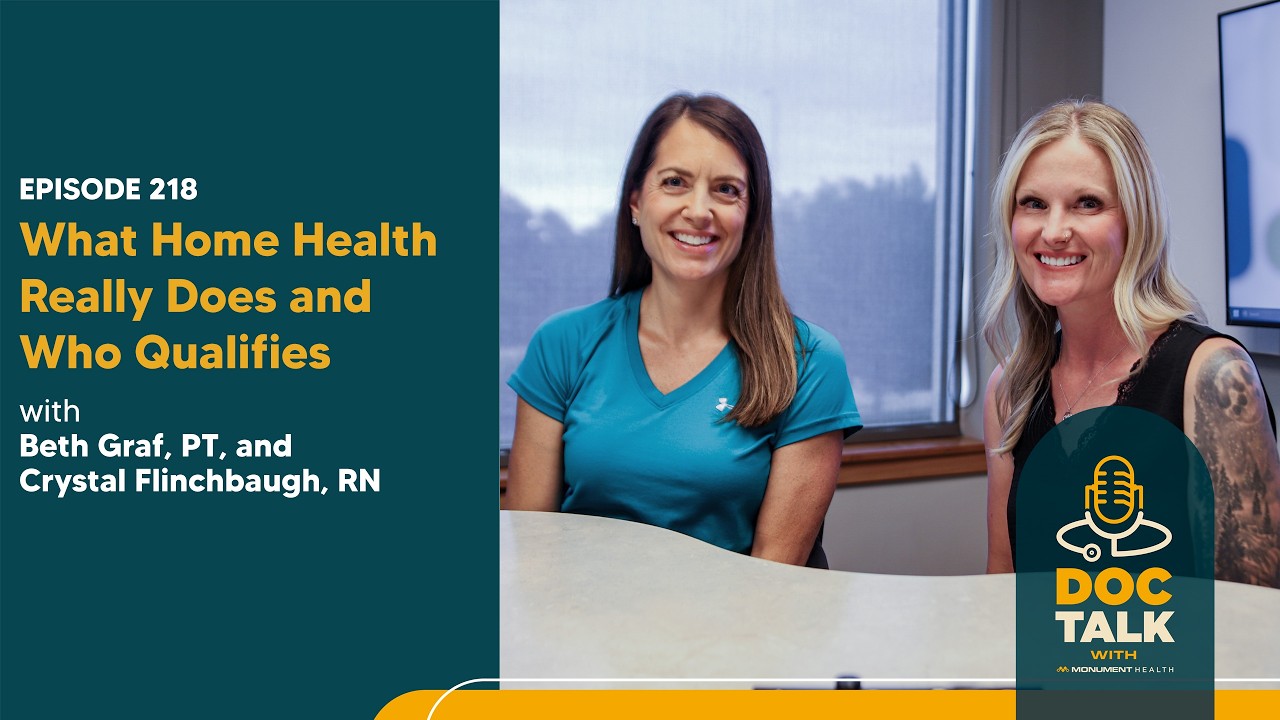

Listen or watch this episode on your preferred platform:


MARK HOUSTON: Hello again, everyone, and welcome to another edition of Doc Talk with Monument Health. My name is Mark Houston. And when most of us picture health care, we picture a building, a hospital, a clinic, a waiting room. But some of the most meaningful care doesn't happen in any of those places. It happens at a kitchen table or on a back porch, in the same living room where someone watched their kids grow up. This month is National Home Health and Hospice Month, and it ties into our This Is What Kindness Looks Like campaign. Because sometimes kindness is just a nurse who shows up on a Tuesday morning, or a physical therapist who helps you trust your own legs again after a fall. And today I'm joined by two of those people who do exactly that. Beth Graf is a physical therapist out of Spearfish, and Crystal Flinchbaugh is a registered nurse and our home health nurse manager. So let's get into this. Welcome to the podcast, you guys.
CRYSTAL FLINCHBAUGH: Thank you.
BETH GRAF: You bet.
MARK HOUSTON: Thanks for coming up and doing this. Um, all right, let's set the stage on this whole thing, because before we started the podcast, you made a good point, is that when people talk about home health, I don't know if a lot of people understand what this is. Um, maybe they picture something they've seen on TV, uh, or they just draw a blank. So in plain terms, what is this? And who is it for?
CRYSTAL FLINCHBAUGH: Well, home health can be for anyone in our community. Um, it is kind of a specialty in regards to skilled care. So if someone is in the hospital for an illness, a surgery, a knee replacement, um, if they're diagnosed with a new disease such as diabetes or heart failure, the doctor can order home health to go in the home after discharge or even from a clinic setting.
MARK HOUSTON: It can be all of those. I mean, like diabetic, I mean anything like that.
CRYSTAL FLINCHBAUGH: Yep. And we, we have pediatric patients sometimes on services up to 102-year-olds. That kind of just depends on who needs the service.
MARK HOUSTON: All right.
CRYSTAL FLINCHBAUGH: And who qualifies. Yeah.
MARK HOUSTON: Well, I suppose, yeah.
BETH GRAF: Go ahead. There's a misconception that, you know, it's somebody that comes to your house and sits and visits with you and maybe does housekeeping. So this is totally different. This is skilled care. So you have to have the need of a skill of a nurse, a therapist in order to qualify.
MARK HOUSTON: So what's that moment then that usually leads to a call? Um, is it, is it, is it has to be like after a hospital stay or, um, like you said, surgeries, falls, things like that? Is that what leads to that call?
CRYSTAL FLINCHBAUGH: Then a lot of our referrals come out of patients who are recently in the hospital. For whatever reason, we can get referrals out of the community. If a patient goes to their physician at their annual visit, and they feel like maybe my legs are a little weak, or I feel like I've had a lot of falls lately, um, that physician might order home health services just to go in and evaluate to see if there's something we can do to help them.
MARK HOUSTON: So just having that conversation with your doctor can, they can make that decision then.
CRYSTAL FLINCHBAUGH: Absolutely.
MARK HOUSTON: Um, and I think there's an assumption out there too that, that needing this kind of thing. And I think, you know, because you guys know where we live, we live in a, we live in a part of the country where everybody is almost ridiculously independent, right? And nobody wants this kind of thing. Is that, is that true? Um, do you guys find that to be true, or is it sometimes the opposite, that people are like, well, I can't have this because I'm, you know, that means I'm weak. That means I've failed.
BETH GRAF: That means... what I hear more is actually that they didn't even know it was an option. Oh, and then when we come into the home, they're like, wow, this is great. I never knew that I could have this service. So I hear that more than I hear that they don't want it.
CRYSTAL FLINCHBAUGH: Yeah. Mhm. Because I think, you know, there are patients who are able to go to physical therapy in the outpatient setting or go to speech therapy or go to outpatient wound care if they have a wound that needs to be addressed. But there are people who really struggle getting outside of the home. And that's one of the qualifiers for home health, um, to where if we can come to them, it allows them to get that therapy or the nursing care that they need, the education they need, wound care supplies, things like that, that really help them. Um, just to enable them to get better and back to their baseline without...
BETH GRAF: Compliance too, because maybe they, you know, they should go in for therapy, but they don't because it's so hard for them to get there. They cancel a lot of appointments, but if we go to them, we see better compliance.
MARK HOUSTON: All right. Well, Crystal, let me, let me go, let me go through the nursing lens here just a little bit. Um, how did you get started in this to begin with? Why? Why are you here, Crystal?
CRYSTAL FLINCHBAUGH: Um, I started with Monument Home Health and Hospice, uh, thirteen years ago. Okay. And I started out as a nurse going into the homes. I had patients that I went and saw, mostly home health.
MARK HOUSTON: You were doing this from the beginning then? I mean, going into the homes and everything.
CRYSTAL FLINCHBAUGH: That's where I started. Okay. Um, and I had all my patients that I would see. Um, and again, I would do disease education. I would teach someone how to check their blood sugars, how to take their insulin, how to count their carbs, things like that, to heart failure education, to wound care, to catheter cares. It's kind of really whatever they're needing in the home that we can do in the home as a nursing setting. Um, and we would just provide that care. And again, the whole goal is to get people better, hopefully, than they were before they needed us and then get them on their way to where they're independent again.
MARK HOUSTON: Okay. So like, walk me through then, um, you knock on someone's door in the morning, and then what happens after they, they answer the door and you're standing there?
CRYSTAL FLINCHBAUGH: Well, so we usually have it set up to, once they come on to services, so they have that first initial visit that takes a little bit longer. We go over paperwork, make sure that, um, they qualify, make sure that they're okay with us, you know, for billing purposes. Um, we get their meds organized, we get kind of a plan set in place of who's going to be coming to see them. If the doctor ordered, um, nursing, physical therapy, occupational therapy, we'll get all that set up for them. Um, then our staff as a team work together to call that patient, get up those visits, or set up those visits for them. Um, and then we set up times, so we don't just knock on the doors unexpectedly most of...
MARK HOUSTON: The...
CRYSTAL FLINCHBAUGH: Time. Um, if we can't find you, we'll track you down. But, um, generally we'll set up a time. Um, and we set that and we go make the visit. Um, nursing is probably a little different than therapy. We do more of a full body assessment. We get vital signs. We listen to heart and lungs, just like the nurses do in the hospital setting. And we go over any meds, we review any, um, teaching things we need to get done. We might have to do wound care or catheter cares. Um, and every visit is kind of set up like that.
MARK HOUSTON: Um, so, so how long are you generally there? Or is this just as long as needed sort of a deal?
CRYSTAL FLINCHBAUGH: Or so, Medicare is our primary, um, clientele, Medicare patients. Um, Medicare authorizes home health, as long as they meet criteria, for 60-day benefit periods. Now, if we find that there is a reason we would stay in longer, we can recertify someone. Um, it really just depends on how they're meeting goals and if they're close to meeting goals, or whatever they need is really how we provide that care.
MARK HOUSTON: Well, are you, are you generally going... You know, because in a, in a, in a hospital, you've, you've got a whole building of backup when you're there, right? As a nurse. So you're there in the home solo. Um, how does that change the way you do this job?
CRYSTAL FLINCHBAUGH: Um, you have to have really good critical thinking.
MARK HOUSTON: Yeah.
CRYSTAL FLINCHBAUGH: You have to be comfortable with being a little autonomous. Um, we do have a whole team on the back end. I mean, we have nurses available by phone if you run into questions or issues or things that you might not know. Um, but we really, um, we pride ourselves on having every nurse be really thoroughly educated on the, the services we provide. Um, and you just, again, phone a friend if you need something. But for the most part, most patients when they're in the home are a little bit more stable. Obviously, if there is a situation, we go in and we're thinking that that patient might not be doing so well, we have the 911 service available. And that's been utilized before. And again, we work really great with the community providers to reach out to doctors if there's concerns or questions.
MARK HOUSTON: Does the ambulance come quicker for nurses calling? I don't know.
CRYSTAL FLINCHBAUGH: I haven't tested that out. I don't think they'd like us to try that out.
MARK HOUSTON: Yeah. Probably not. Yeah. Well, you are a nurse manager, so you see the whole team then, right?
CRYSTAL FLINCHBAUGH: Mhm.
MARK HOUSTON: Um, is there something the public gets wrong about what home health nurses actually handle that you would like to clear up?
CRYSTAL FLINCHBAUGH: Um, you know, I think the biggest thing, and I think it was a misnomer for myself, and I hear it all the time from other nurses and other departments that might think about home health, is they think it's like a, a department you go to when you, when you kind of want to slow down and you want to just maybe have a cup of coffee with a patient. Um, it's not that. Um, it's a very busy setting. Again, you are on your own.
MARK HOUSTON: So it seems.
CRYSTAL FLINCHBAUGH: Like a lot of critical thinking. You have to, you have to know what you're doing. Yeah. Um, and honestly, you get the privilege of being in your patient's turf. Um, they accept you into their life. Um, so you get a privilege of meeting them on a different level than I ever met or worked with patients when I worked in a hospital.
MARK HOUSTON: Oh, I suppose the one-on-one time is, is far greater.
CRYSTAL FLINCHBAUGH: Very valuable.
MARK HOUSTON: Yeah.
CRYSTAL FLINCHBAUGH: Then you see the other side. I always think of when I first started in this department, I worked, um, in a hospital before, where I would see patients that maybe came in repeatedly. And you'd wonder, gosh, what are they doing there in the hospital every other month for the same thing? Um, but when I found that, I got into the home setting, I maybe saw there was some food insecurity, or maybe someone lived in a motel where, if they had CHF and all they had was a microwave to cook meals, um, they probably aren't able to follow a very healthy diet with fresh fruits and vegetables and low sodium. So it made me think differently on how to help and serve those patients who maybe struggle a little bit more with staying healthy.
MARK HOUSTON: Yeah, that's a, that'd be a whole eye-opening way to, to, to go into this too.
CRYSTAL FLINCHBAUGH: Absolutely.
MARK HOUSTON: Yeah. Um, all right, Beth, let's go through the, the physical therapy lens, uh, a bit with this now. So I know most people, when they hear physical therapy, it's gyms and machines and counting reps and that whole thing, right? But you're doing this in someone's home at this point. So how do you turn, I don't know, uh, you know, somebody's living room or hallway or porch into where people can get physical therapy?
BETH GRAF: Yeah. It'd be interesting to see what we can do with, like, a can of soup or something. You know, it is, it's just taking things that they have in their home and turning it into therapy. And what I really love about home health, kind of like Crystal alluded to, in a clinical setting, they're on your turf, you know, everything's flat and there's not a lot of stairs and the doorways are wide. And then you get into a patient's home and it could be a historical old home in Lead. There's fifteen steps to the front door without a railing, and doorways are narrow. And so it just is really, you know, so much more fulfilling for the patient to be seen in their own environment and their own challenges.
MARK HOUSTON: Well, all of that too, like you say, you keep saying you're on their turf. So all of that comfort is there for them right away. The intimidation factor has to leave relatively quickly too, I think.
BETH GRAF: Yeah. I think, you know, they all just enjoy being at home, sleeping in their own bed, you know, being in their own chair. And it just puts them at ease in that respect.
MARK HOUSTON: Well, why did you, how did you get here with your career path too? Why did you pick...
BETH GRAF: A physical therapist for twenty-five years. Okay, I've been with Monument now for fifteen, and just the very first out of school, I kind of contracted and did a little home health on the side. I was working at a hospital and doing some outpatient therapy, and I just instantly fell in love. And I think for me, for a physical therapist, it's just when you're making functional goals, there's nothing like being in the patient's own environment. I mean, it's just so easy to see what they really need for fall prevention, for strengthening, you know, what, what are their real challenges.
MARK HOUSTON: Um, speaking of falls, uh, I mean, that can do something to people beyond just the physical injury part of this. Um, you know, a lot of people will fall down, they brush it off, because it's interesting anymore. You go to the doctor and one of the questions they will ask you, have you recently fallen, you know, which is a very recent thing for me. Every year, go to the doctor, get your checkup. And they ask you that. I'm like, well, why, do I look like I fell? But that's not, you know, I know that's not the reason why they're asking, but it can shake your confidence when that happens too. Um, so how much of your job is, is kind of rebuilding the trust between people and their body? That must be a big part of this.
BETH GRAF: Definitely. Yeah. I mean, and that's, you know, we really focus on falls and fall prevention, because that's our best thing, is to prevent these falls. And so going into someone's home, they might not even realize that that throw rug that's by their door is dangerous, or the shoes that they're wearing, or, you know, the...
MARK HOUSTON: But it was expensive and it's pretty.
BETH GRAF: Yeah. Right. And their dog and their cat. Yeah. That's the other thing you don't have in the clinic is their pets. And that's a huge part. That's some people's family, are their animals, so that plays into it. Do they, you know, they like to walk their dog, and now they had this fall and now they can't. So, um, yeah, all of that comes together for teaching and preventing falls.
MARK HOUSTON: Are there, are there kind of small wins that that might look, you know, tiny to an outsider, but when you're with the people in their homes and it happens, that you're like, yeah, here we go? All right.
BETH GRAF: Definitely. I mean, part of it can just, of what we do, is helping people with just small equipment changes. You know, it might be a grab bar placed somewhere. Uh, railing. Uh, we call it a bed cane, on the side of their bed. Something where now they can get in and out of bed themselves, or, um, you know, shower themselves, because now they have the right grab bar placement and the right shower bench. So some of just those little equipment things that people don't even realize are available. They can order them off Amazon, their family has them there in two days, and now they're independent. So I think those are a couple, you know.
MARK HOUSTON: Yeah. Well, that, that must feel good, though, when somebody is... You show up there, frustrated because of whatever's wrong, and there must be moments when it clicks with them, like, oh my goodness, this feels good. And it works now, and I can do this thing, right? And then you walk out of there like Superman, because you're like, I did this for them. Yes. I mean, that has to feel great.
BETH GRAF: It does. It does. And I think, too, it's interesting with the family dynamics, you know, because also we're seeing the patient, but we're also kind of treating the whole family. So when the family's there and there's those dynamics, and there might be things that they kind of have blind spots. And then we come in and it's like, oh, well, what if you did it this way? Oh, we never thought of that. And then all of a sudden, you know, that fixes the issue, right? And it's just like a new set of eyes, a fresh set of eyes, because sometimes they're just so used to doing things a certain way. Well, we've lived in this house for fifty years, and this is just how we've done it. And then just a new perspective helps.
MARK HOUSTON: Oh, that's perfect. Well, you two both work, um, the same patients from different angles, really, right? Um, Beth, you're thinking strength and movement, and Crystal, you're, you're doing a lot of the medications and the healing and the vitals. So where do those two worlds kind of meet in a person's living room?
CRYSTAL FLINCHBAUGH: Well, I think, you know, nursing and the therapy team works really well together. It is a collaborative, um, task. And we work as an interdisciplinary group to meet the goals of the patient. I think in the aspects, if you think of falls, where therapy might be looking at the safety, the equipment, those things, nursing will kind of piggyback on that. And we might be asking the patient, well, if you've been falling at night, what's, what's occurring, what's happening? And they might be like, I have to go to the bathroom three times a night. And then we're thinking, oh, well, maybe that's the problem. If someone is having to get up and they're having strong urge to go to the bathroom in the middle of the night, that is contributing to your risk of falls, because you're going to be in the dark. You're not turning the light on. You're going to be rushing to get to the bathroom. And so we tend to collaborate on a lot of things like that, um, to, again, make the patient be as safe as possible in their home.
BETH GRAF: And, you know, we have occupational and speech therapy, and they focus a lot on cognition and doing different testing. So they might find out, you know, this patient seems like they have a good memory, but whoa, we tested them, and really, I don't think their memory is good enough to take their medications. And then we can let the nurse know. And then, okay, what are some different ways that we can help the patient, you know, remember to take their meds correctly.
MARK HOUSTON: So this has to be a team thing.
CRYSTAL FLINCHBAUGH: Absolutely.
MARK HOUSTON: I mean, it's, um, just, yeah, the way you guys have described this, it, it can function independently, but boy, when it's together, that's what has to make the whole difference here.
CRYSTAL FLINCHBAUGH: It really is. I do think, again, we all seem to work really well as a team, trying to, again, have every patient meet the goals as best they can. Um, and again, we also collaborate when a patient is getting ready to no longer need services and we're getting ready to discharge. We work to see if there's any ongoing referrals that need to be going on. If they need to be going to outpatient therapy once they're strong and able to get out of the home. Or maybe they need long-term assistance, where they would be fine in the home, they would have no problems if we just had a nurse every week, forever, kind of set up their pill box for them.
MARK HOUSTON: Yeah.
CRYSTAL FLINCHBAUGH: And that's something that we can make those referrals to, um, to help, help them succeed in their home setting, because that is the goal, is to keep people in their homes as long as possible.
MARK HOUSTON: Well, and the kind of the overarching, excuse me, the overarching theme with this whole thing too is the kindness angle that this is coming, that we're coming at it from. Um, and this whole series is kind of built around that idea, um, what kindness looks like, you know, just showing up in some instances. Um, so after doing this work, um, has, has your own definition of kindness kind of changed a little bit?
CRYSTAL FLINCHBAUGH: I think, um, it, it makes me, um, again, because we see patients and they can be at any level, um, I've gone into homes that, maybe not to be derogatory, but just maybe not the nicest of situations. And I don't think it's based on any patient or what, what they mean.
MARK HOUSTON: Yeah, there are a lot of, I mean, there's just a lot of things that can happen.
CRYSTAL FLINCHBAUGH: And it makes me realize that there are people who are so much far off or worse off than we are. And it makes me fortunate to be where I'm at, to where I can maybe help them, if they're okay with me helping them, of course. Um, but it makes me just have a different look at patients when they're really struggling. It's generally not because they're choosing to struggle. It's other factors that are preventing them from succeeding and being healthy.
MARK HOUSTON: Well, how about you, Beth?
BETH GRAF: Yeah, I think just, you know, part of what makes this job so great is just seeing the patients, again, in their own environment and thriving there, and the joy that they have being able to stay in their own home and not have to go somewhere else. I mean, that, that's worth it right there. You know, just helping somebody.
MARK HOUSTON: Exactly. And you, and you guys get to see the wins, though. I mean, think, and I think, you know, there are, there are certain instances where you, there are people in, in your profession too that don't always get to see that. And I think a lot of times, yeah, you guys get to walk out and be like, yeah, you know, I helped this person today, and that's, and that feels great.
CRYSTAL FLINCHBAUGH: Absolutely.
MARK HOUSTON: Um, well, for anyone listening who's, who's, who's got a parent or a spouse or a neighbor or anybody that they may be kind of quietly worried about, um, what's the one thing you wish more people knew before they ever picked up the phone to ask you guys? Is there one thing you could think of that's like, if they knew this before they call, that would help?
CRYSTAL FLINCHBAUGH: I honestly think it's something that, again, people just don't know. And if you are, if you have Medicare, it's a service that's covered 100 percent.
MARK HOUSTON: That's good to know.
CRYSTAL FLINCHBAUGH: So it's something, if you qualify, and like, there are certain rules Medicare has for someone to be on home health. It can't be just because you don't want to drive, and, you know, gas is expensive. But, but it's, it's truly for those if they are homebound and it's hard to get out of the house, and they have a need, a disease education or a mobility concern. It is something that's covered 100 percent. And it doesn't hurt to have your doctor send a referral. We can come out to the home, make that assessment. If you qualify, take the services, because that's what we're here for.
MARK HOUSTON: What's, like, what's the range around Rapid City? How far will you guys go for this?
CRYSTAL FLINCHBAUGH: So we kind of cover all of the Black Hills. Our Spearfish office, where Beth is out of...
MARK HOUSTON: Yeah.
CRYSTAL FLINCHBAUGH: Um, sees, obviously, patients in the Spearfish market, but we see patients in Lead, Deadwood, Newell, Belle Fourche, Sturgis, um, Whitewood.
BETH GRAF: Basically from the Wyoming line to Tilford Road is kind of...
MARK HOUSTON: Oh, really? Okay. Yeah. All right. Oh, perfect.
CRYSTAL FLINCHBAUGH: Yep. And then, and then Rapid City kind of starts in the Piedmont, Summerset area, and we go far east as well. We go as far south as Edgemont or...
MARK HOUSTON: That's a huge... Well, how, how many people then? How many are... Do you, do you have any number of how many, like, of the physical therapists that are doing this?
BETH GRAF: We have two of us in the Northern Hills.
MARK HOUSTON: Okay. That's it? Oh my goodness. You need more people.
BETH GRAF: Yeah.
CRYSTAL FLINCHBAUGH: Yeah. I think between nurses, and again, we have different nurses who have different tasks, and therapists, and we probably have about forty-five, fifty employees that go out throughout the Hills in both areas.
MARK HOUSTON: Right.
CRYSTAL FLINCHBAUGH: Um, seeing patients.
MARK HOUSTON: All right. Well, I think, um, I think we've, you know, we've opened the door to this, and I think you guys really did a very good job of explaining, um, what exactly this is and how people can utilize it. Um, Beth Graf is a physical therapist out of Spearfish, and Crystal Flinchbaugh, registered nurse and the home health nurse manager. Thank you guys for coming in and doing this. I really appreciate it. And I hope, I hope that it helps. And like I said, I think you guys answered a lot of questions. So thank you.
CRYSTAL FLINCHBAUGH: Perfect. Thank you.