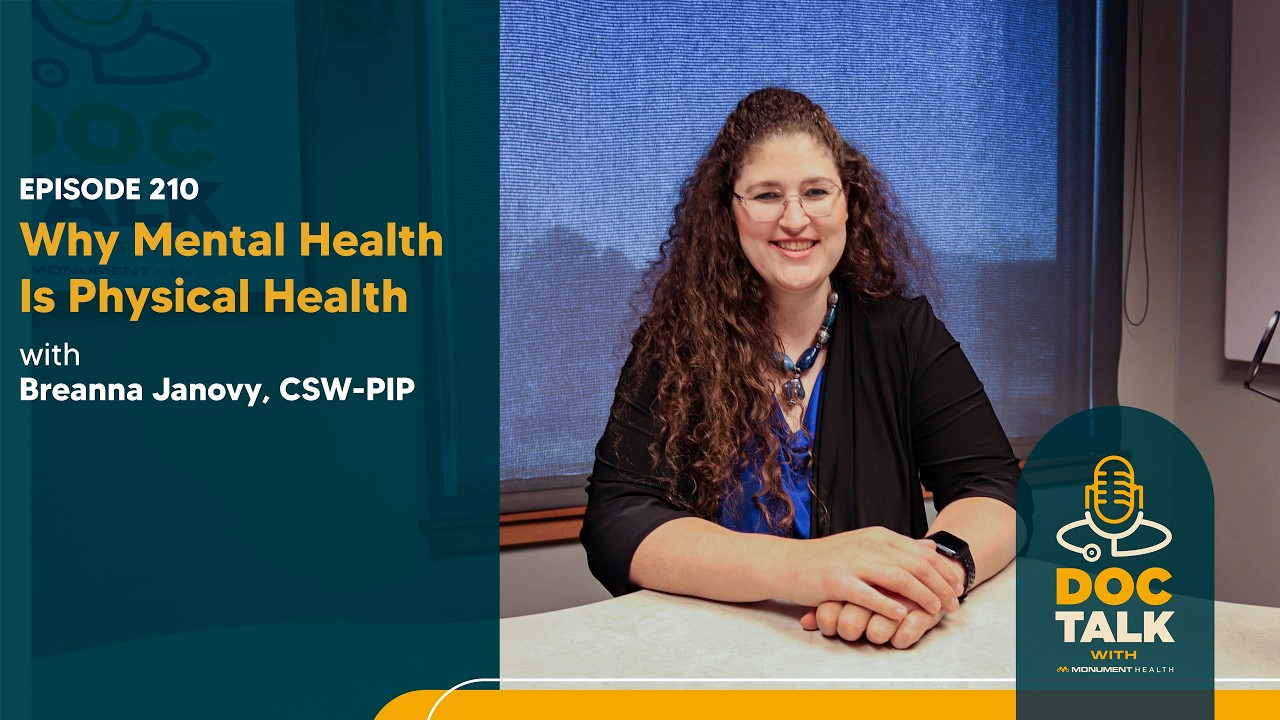

Listen or watch this episode on your preferred platform:


Doc Talk with Monument Health
Mental Health as Physical Health
Host: Mark Houston | Guest: Breanna Janovy, CSW-PIP
MARK HOUSTON: Hello, everybody, and welcome to another edition of Doc Talk with Monument Health. My name is Mark Houston, and joining me today is Breanna Janovy, who is a CSW-PIP. I did look this up because I didn't want to screw it up. Certified social worker in private or independent practice, right?
BREANNA JANOVY: Correct.
MARK HOUSTON: Yes, got it. Well, welcome, Breanna. I'm glad to have you on the show. And I'm really happy to find out just how local you are. Good heavens, you're like Sturgis royalty practically, in a sense.
BREANNA JANOVY: But yeah, I graduated from Sturgis Brown High School and went on to start at Black Hills State University for college, and ended up transferring and graduating from the University of South Dakota. I went and worked for a couple years, and then decided to go get my master's in social work.
MARK HOUSTON: Okay. Why did you choose this, Breanna? This is a topic where, I mean, the profession that you do, you get so intimately involved with people's lives. What is appealing about that for you?
BREANNA JANOVY: It's amazing to be able to walk alongside someone on their journey, as they figure out things about themselves, or work on or work out different problems or things they've been through processing. It is an amazing journey to have someone be so vulnerable that they let you walk alongside them.
MARK HOUSTON: I can imagine the satisfaction, and the feeling of fulfillment you could get from helping people who need it. Does it ever get overwhelming sometimes, though, for you personally?
BREANNA JANOVY: It can, at times, yes. And that's where, you know, it used to be a catchphrase, maybe it still is, that self-care piece. Of course, we have to be aware of our own reactions as well when we're working with someone.
MARK HOUSTON: The reason we wanted to have you on the podcast today, we were talking a little about this before we started recording, is that it seems, just recently, or in my perception recently, that mental and physical health haven't been utilized together to heal people as much as I think they should have been for years and years and years. But it seems like we're getting this kind of new awakening in how this all works. Is that how you see it too?
BREANNA JANOVY: I believe so. It's coming more into the now, about how everything is connected. We have our mental health, our physical health, our nutrition, how we're sleeping. It is all connected, and we're learning more and more about that all the time.
MARK HOUSTON: Well, when I got the email for this podcast, there was a line that mentioned talking about mental health is physical health. That's a simple statement, really, but in your practice that really seems, I mean, it seems super important.
BREANNA JANOVY: How we're doing physically. If we eat a lot of junk food, we might not be getting enough protein or enough things to keep us fueled before we run on empty. So how do we support ourselves physically, whether it's nutrition, or, well, someone's not getting enough steps in or moving enough, then you might be more tired, right?
MARK HOUSTON: As funny as it sounds sometimes, right? Yeah, exactly.
BREANNA JANOVY: The more you move, even a little bit, the more feel-good hormones our brain releases. And that helps us improve our outlook, improve our day, even if it's just something very small.
MARK HOUSTON: Well, and I suppose another big part of this, and I think it's kind of a big crux of this podcast too, is the stigma that goes along with mental health. When you have physical issues, those seem to be okay. My arm hurts, I've got to go to the doctor. I'm not feeling well, I've got to go to the doctor. But you don't hear a lot of people in an office setting say something like, 'God, mentally I just feel off, I'm not there, I want to go see somebody.' And so they don't talk about it, and in a lot of instances they don't go and get help. Is that kind of where you come in as well, to tell these people it's just as important as their physical health?
BREANNA JANOVY: Yes. Mental health is very important. It plays a role in us and how we're doing, and how we work on connecting or bridging that gap. You have a broken arm, you might need a cast. You might need to go see somebody if you're not doing well, if you're angry a lot, or if you're really sad or feeling hopeless, down, depressed, or maybe you're going through a tough situation and you're not handling it well, you're not acting like you typically do. Maybe that's something to come in and talk to somebody about.
MARK HOUSTON: Why is that so hard to get past for a lot of people? Why can't we just go, you know, I've got a stomach ache, I go to urgent care. I'm feeling down, depressed, sad, anxious, why don't I go seek mental health care too? Why is it so hard for us to do that?
BREANNA JANOVY: I think it's very hard for people to be vulnerable.
MARK HOUSTON: I suppose that's the key right there, isn't it? But I'm just sitting down talking to you, right? There's nobody else in the room. Why is that any different?
BREANNA JANOVY: It is something I've thought a lot about. I can go in and sit down and talk to a doctor, and it's fine. Why can't I sit down and talk to you about how anxious I felt today? Where's that line?
MARK HOUSTON: Well, maybe you're more comfortable, and you've seen your doctor more often. Maybe I'm a stranger you've never met before. And there's probably some fear in there too, that coming to visit means you have to share everything, right, the first visit.
BREANNA JANOVY: That's not true. It's okay to take some time to build a connection with the therapist, the counselor. It's okay to figure out whether you think you can trust that person. And then let's figure out some goals and things that you are wanting and willing to work on. So making it more human. It's not as scary as our imagination and emotions tend to make it.
MARK HOUSTON: Well, and I suppose the more we talk about it, like on podcasts like this, maybe more people will realize, well, hey, I should give it a try. It shouldn't be as scary as that. Great point, too, in that you see your doctor at least once a year just for regular checkups, but you don't go see a mental health doctor at all in most people's lives, ever.
BREANNA JANOVY: Correct.
MARK HOUSTON: When it comes to what you do, how do you work with Monument Health? What's your connection there with them?
BREANNA JANOVY: I've been working at Monument Health for over five years now. I started off at our inpatient psychiatric unit, Monument Behavioral Health, and recently transferred over to outpatient. So my role now is mainly outpatient services. People can schedule appointments with me, come in, walk in, just like you're going to a doctor's appointment. If they're someone who's having a rough day, and say they come into the urgent care or the primary care clinic, also in the same building, and they're having a rough day or having a crisis, I'm able to come over and talk with them. I can try to help de-escalate. Just see, is there anything you need that we can help connect you with, or get you, right now? And hey, are you interested in following up on this? Maybe these are some things we could work on. Or do you feel you need more help than just right now?
MARK HOUSTON: So if somebody goes into an urgent care right now that's connected with Monument, that option is available right now?
BREANNA JANOVY: I'm currently in Sturgis.
MARK HOUSTON: Okay, got it.
BREANNA JANOVY: If someone comes into the Sturgis clinic, I can see them outpatient, scheduled appointments, or if they go to the urgent care or primary care and I don't have another patient with me at that moment, they can give me a call, staff will give me a call, and I can go over and talk with them.
MARK HOUSTON: Are you seeing a noticeable pickup in this? Are people utilizing this, aware of it?
BREANNA JANOVY: I'm getting called over by staff, it seems, more and more often. So if someone comes into the urgent care and they're having a crisis, extremely down, extremely sad, tearful, and that's not normal for them, the staff can call me. 'Hey, Breanna, can you come and talk to them, please?' And we can explore that further. So we're trying to get the word out that in the Sturgis clinic, I am able to do that.
MARK HOUSTON: I absolutely love this. Having grown up in an era where you didn't talk about your mental health, you just toughed it out, right? That was the whole reasoning behind it, to go in with a physical hurt, which in some sense can be mental, and have the ability to say, or even for the staff to recognize, which I think is pretty important too, that the staff, the nurses and doctors, also have to understand, hey, this is more than just 'ouch, this hurts,' right?
BREANNA JANOVY: It can be, and it can be tough to identify too. Especially, as humans, we don't always know, maybe we're feeling a little off or irritable.
MARK HOUSTON: Yeah, but how do we know when that becomes a problem? Boy, that's a good question too. I'm so glad you guys are on top of this right now. Have there been some good, noticeable outcomes to this approach? Are you seeing people leaving the hospital, or leaving urgent care, or leaving the clinic with a better understanding? Can you look at them and be like, oh, they do feel a little bit better, that did help?
BREANNA JANOVY: It's amazing. And part of the conversation with the therapy is also checking in. How are they doing? How do you feel about this? What progress do you feel like you've made? Do you feel like maybe you're getting stuck somewhere? Figuring out, working with them, how do they feel about it. And then yes, sometimes if someone starts off as severely depressed and you're working with them, working with them, you can maybe see that they're getting a little bit lighter.
MARK HOUSTON: And how do you handle people where you know there's a problem, but they're not going to open up about it, they're not going to talk about it? What are some tricks you can use to get them to open up a little bit? Because you have to recognize it, you have to see that it's there, this is more than just a physical hurt, but you know they don't want to talk about it.
BREANNA JANOVY: Well, we work with resistance. It's very interesting how intertwined it can be. 'Okay, I'm okay talking about this, but I don't want to talk about that.' So maybe we pull out some motivational interviewing, and that is a way of communication. What is maybe holding you back? What is stopping you from making changes, or wanting to make changes? And then I also hear, yeah, you're wanting to work on this, but yet you also still have this other side, you're ambivalent, right? So we do some motivational interviewing to pick that apart a little bit, and figure out where you want to go, where you want to be, and how we try to help get you there.
MARK HOUSTON: It seems like people want to talk even when they say they don't. I don't want to call these tricks, because they're not, you're just able to tell, yeah, here's how I think I can get this person to open up. And usually it seems like when they do...
BREANNA JANOVY: They've wanted to this entire time, right? Maybe there was something in them that was like, yep, I need to talk about it out loud, outside of my own head.
MARK HOUSTON: Right, exactly. So what advice do you give someone who might be hesitant to seek this kind of help? I'm sure you get that question a ton, because there are probably family members or friends who see that these people need help, but can't break through that wall. What advice would you give to people like that?
BREANNA JANOVY: I think doing some self-reflecting, some mindfulness, can get you started, if you want to work on making a change, or are willing to work on making a change. Come in, let's figure out how to help you make that change. There's also nothing wrong with going to see someone new for therapy, for counseling. It's okay to take a little bit of time to decide if you like that person, in the sense of, okay, do I feel like I can trust them, do I not, do our personalities click, right? We have to build that. We call it the therapeutic relationship, or rapport. And it's okay to not like that person. It's okay to go find someone else. It's not personal. So I feel it's very important to let people know that you're not stuck with just that one person. There are more out there.
MARK HOUSTON: Do you ever feel like there are people who have maybe come to you a few times and then stopped, and you felt like, oh, I was so close, I could have helped them? Does that happen occasionally?
BREANNA JANOVY: It does happen occasionally. And then also, at times, people sometimes think, well, I'm going to be in therapy for a long time to work on this, but maybe it was more of a short-term thing, maybe they just needed help getting through the moment, or a specific time.
MARK HOUSTON: And I think that's another really good point, that people think, oh, if I go see a therapist, I'm locked in once a week for an entire year. And I think you can have these short-term outcomes that help people. Correct?
BREANNA JANOVY: Yes, yes. Short-term therapy, it does not have to be forever. And that's something you talk with the therapist or counselor about. Let's try this. And do you need more support in this time frame? Is it a special anniversary of someone who passed, or anything like that? Let's get you feeling supported or connected. What do you need? So it is fairly flexible.
MARK HOUSTON: Now, do you do stuff outside of the hospital too? Can people make appointments to see you like a regular therapist? Or do you only work within the confines of Monument, with people who come in for other issues?
BREANNA JANOVY: So I'm currently within Monument, but people coming in to see me, that's the outpatient part.
MARK HOUSTON: Okay, got it. Excellent. Well, Breanna, I really want to thank you for coming in and talking about this stuff, because I do think, like we mentioned when we started, that people just don't know that a lot of these services are available. Like they say, you go in to see your doctor, you're hurt, part of it could be mental, and you just go home without fixing that mental part. You fix the physical, and that seems fine, but I think there are people who sit there and think, God, if I could have just talked to somebody really quick about whatever was wrong, then maybe all of me would feel better, right? And so now, just knowing that this service is available in Sturgis specifically, because that's where you're based out of right now.
BREANNA JANOVY: Correct.
MARK HOUSTON: I think it's a wonderful thing. I think this can be a game changer in medicine for sure, if we can have people start talking as well.
BREANNA JANOVY: Yeah, and that's, I think, one of the hardest pieces.
MARK HOUSTON: It is. It totally is. You're right. But it can be very much worth it. Excellent. Breanna Janovy, a certified social worker in private or independent practice, I don't like that last part. I just want to say you're a certified social worker that's changing lives. How about that?
BREANNA JANOVY: Well, that works. And some states make it easier to say licensed clinical social worker.
MARK HOUSTON: Oh, that's better. Okay, come on, South Dakota. Well, Breanna, thank you very much for coming in, I appreciate it.
BREANNA JANOVY: Yeah. Thanks for having me.