
Listen or watch this episode on your preferred platform:


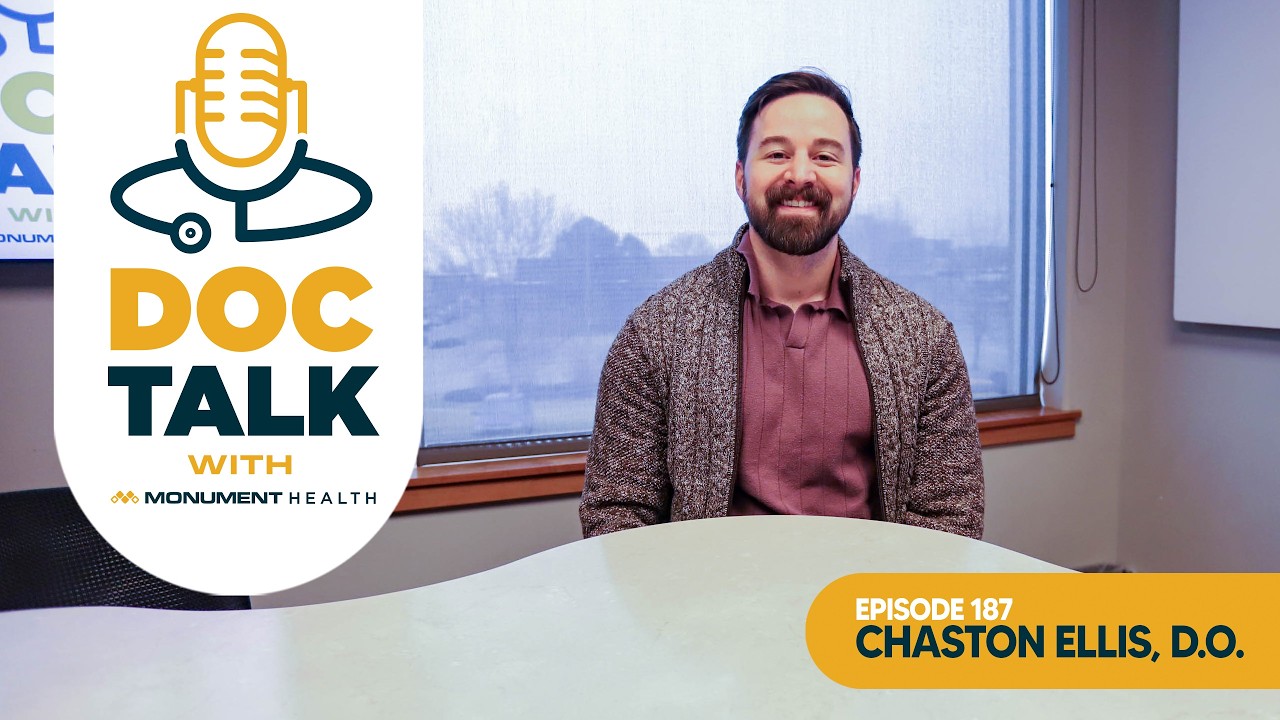
Hello again everybody, and welcome to another edition of Doc Talk with Monument Health. My name is Mark Houston and mental health, it's one of those topics that touches pretty much everyone, whether you're dealing with something yourself or you love someone who is. Today we're going to sit down with Dr. Chaston Ellis, who is a psychiatrist at Behavioral Health here in Rapid City. And we're going to talk, hopefully honestly, about where things are hard and where things are actually getting better when it comes to mental health, because there are bright spots and I think you just have to know how to look. So I want to welcome Dr. Ellis to Doc Talk. Thank you for coming in and doing this. You're relatively new in the area, right? How long have you been here?
Yeah. So we just moved here last summer. I'm originally from Idaho. My wife's from Nevada. It was kind of a random thing that we ended up this way, but we were charmed by the Black Hills and we've loved it.
So what part of Idaho are you from?
East Idaho. My hometown is called Blackfoot. Pocatello, Idaho Falls are nearby cities. It's not a big area.
Well, that sounds like a very Idaho name for a town right there for sure. That's still a relatively pretty part of the country there too, though.
It is. It has its own beauty. The access to like the Tetons nearby, Yellowstone's nearby. It's not as close as the Black Hills are to Rapid City, like it's way more accessible here. But there's some very similar, like people love fly fishing here, hunting and.
Well, are you into that too? Are you outdoorsy in that way?
I like skiing, I like whitewater kayaking. Which I know there's some of that here in Spearfish, but I haven't done any of that here yet. I still have to kind of get my toes wet with that.
Well, you've been busy. You've only been here since the summer, so I suppose you're trying to work into everything. Well, what led you into this field though? I mean, when you were in middle school and high school, do you have family in medicine?
So my dad's a chiropractor. And that kind of led me a little bit to the route of medical school. I don't think I knew very much about it back then though. And as far as just mental health, that came much later. I will say that my sister's given me permission to share this story. When she was younger, she struggled with her mental health. I really appreciated your intro that most of us are touched by mental health and we have loved ones who are affected by it. And she struggled. And I remember thinking that it was hard to find somebody who could see her. And so that was kind of like the first seed that was planted for me to go, you know, it looks like there's a need for this. But it wasn't like the thing that made me go, I'm going to go do this now. But later on, I met my wife in undergraduate and she was getting her degree in social work. We finished undergraduate and she decided to get her master's in social work so she could be a full-time therapist. And we talk about mental health a lot, and some of the struggles that she was seeing. And that seed was kind of growing at that time. Like, okay, there's some interest here. I wonder what that would look like. And at that time, I was applying to medical schools and I had gotten accepted soon after. And so I went to medical school down in Vegas. And it was like, didn't know what I was going to do, you know? But then when psychiatry kind of came around, I'd already been exposed to mental health in some ways. And so I was kind of hoping I'd like it. And I loved the didactics. I found it fascinating. I was already very intrigued. And by the time I was in the hospitals and actually seeing patients on that side of things, it became so obvious. It's what I loved. So it became pretty, pretty easy.
Well, as you're telling me this, I'm thinking, because when a lot of people think of psychiatrists, obviously there have been famous psychiatrists that existed throughout history. Are there any that you really enjoy or follow? Or you think, boy, these guys were on the right track?
I think the one that, I mean, there's many, people know about Freud and Jung. And I mean, I think they kind of get a bad rep because they were sort of off on a lot of stuff, but we sometimes dismiss the things that they were foundational for. But as far as more instrumental and more recently, Carl Rogers was a very big one in terms of how we think about mental health and therapy specifically. And he was a lot more positivity-focused. But as far as figures that actually influence me now, these aren't going to be people that people know about. There's somebody who's around right now. His name is Dr. Michael Cummings and he works in California for the state hospital system there. He's brilliant. And so he was going to be, I think he was saying he was going to be a neurosurgeon, but he went blind. And so he had to go off course. And this guy's like an encyclopedia. Whenever he talks, he's on podcasts and things like that. And this guy's brilliant. And so he's somebody who I really look up to and admire, but not like a well-known figure.
I'd say, well, this is going to be a fun podcast. I don't know if I'm going to bring any brilliance to any of this, but that'll be fine. People will still enjoy it. Anyway, mental health obviously seems to have really come to the forefront recently with social media, right? The internet alone and then social media specifically when we talk about TikTok, I mean, this is a big, big deal. I think when people are trying to get help or it's hurting in ways as well. But are people, in your opinion, getting the help they need or are we just talking about it more?
Yeah, I think there's a lot to unpack with that. I think it's both, you know. In some ways, I think exposure and people being aware of it is helping. People are way more understanding that there are mental health concerns out there. I do think that, I mean, you mentioned social media specifically, I'm kind of deviating from your question a little bit here, but there's been a lot discussed about, I mean, there are so many books right now, like The Anxious Generation, and even these books have been out for a really long time. Every ten years, it seems like there's this monumental anxiety book coming out. And so this has been a concern for a while. But I think it kind of reached a climax during COVID. I remember thinking, this is kind of how I phrase anxiety specifically with my patients. I'll say, a lot of us have struggled with anxiety. It's something that's a normal part of being human. You go through periods of being anxious. It's about self-preservation and protecting yourself. But I'll give this example, I want you to have a little bit of anxiety if you're going to cross the street. I want you to have enough anxiety that you're going to bother looking both ways. But I have some patients who come into my office and say, my anxiety is so bad that in that metaphor, I can't get across the street, or maybe I manage to get across the street but it's impacting my quality of life. And so this is when we say there's an anxiety disorder. When I think about COVID, I think about these kids who some of them were like, okay, let's go home, let's do virtual schooling for a little bit. And the kids who had a lot of anxiety were like, yeah, this is great. I don't want to be at school anyways. And maybe a year later or whatever it was, those kids are invited to come back. And some of them are like, I'm not going back. I've become accustomed to this. And I'm starting to see some of those kids in my office now. They're eighteen and nineteen and they want to go to college or they want to enter the workforce and they feel like, I can't do that now. My world has become much smaller. And so their exposure has reduced. When I'm seeing people for mental health and I think of anxiety with social media, this is a common one where their world has become smaller, they've become more isolated. So this is a very roundabout way to get to your question, but hopefully I addressed it somehow.
No, I think you did. And it's interesting when you said that, like every decade or something, this anxiety topic pops. Is that really the case? Did this even exist before there was social media and the internet and people still had the same kind of thing?
I think that's good for people to hear because I think when people are on social media and they see either what they're missing out on or what they're not living up to, they feel like this never happened thirty years ago. Why would it have? Right.
Yeah. The exposure was different. And I think you're on to something there where obviously this has been discussed with social media. There's comparison and nobody's putting their issues that they're going through on social media. I mean, some people might be, but predominantly people are putting, hey, look how awesome things are going. And so it's easy to go, okay, why are things going so great for them and not for me? And I think there's a bit of a trap. There's this book called The Happiness Trap, and it's by this doctor who's the founder of this therapy called ACT therapy, or Acceptance and Commitment Therapy. And this book kind of talks about how we have this expectation that happiness should be the norm or that should be our default emotion, when in reality, the human experience is so many different emotions. It's being frustrated or lament or dread or whatever it is. Sometimes it's euphoria. But happiness isn't the default state. It's all of these emotions. And so if in any one moment you're not feeling happy, you can start feeling like, what's wrong with me? Especially when you compare it to this image being put out on social media that looks like they're so happy and things are going so great.
Well, if someone is sitting at home right now and they're thinking, something's not right, but I don't know if it's bad enough to see someone. What do you tell them?
Yeah, that's a great question. So from the psychiatric perspective, what we're looking for is not just a spectrum of human emotion. Anxiety is part of our life, even sadness and all those things. But at some point, people's depression will get to the point where we say, this is a disorder. We're going to call it something. We're going to diagnose it. And you'll meet these criteria. And so sometimes I'll be talking to patients about, are you still enjoying things? We call this anhedonia. Do you find joy in your hobbies and activities and socializing, or does that not bring you pleasure or joy anymore? Do you feel like you've lost the ability to concentrate? Is your sleep impaired? Is your energy impaired? And there are several other things. Are you starting to have suicidal thoughts? Things like that. When we've met a few of those criteria, we go, okay, I think you're meeting the criteria for what we would call a depressive disorder. You might benefit from therapy, from medications, and from some lifestyle interventions where we can kind of get you back to improving your quality of life.
Well, a lot of people think, I can fight through this. This is fine. I don't need to go see somebody. Now that I know what he's going to say, let me just try to sit and correct this myself. Does that work?
I think in some cases, yeah. In some cases this will be a time-limited period where they're going through some very significant stressor and they're going through some depressive symptoms, but it's time-limited. In other cases, this is something that's gone on for a while. And by definition, we call a depressive episode where these symptoms have happened more often than not for at least two weeks. So if this is going on for weeks where you've kind of got the bedrock where you're just not getting out of bed, you're not motivated, you're not taking care of the things that you need to in your life. Some people, it's bad enough they're not showing up to work and their relationships are being affected by this, and this is going on for more than two weeks. Yeah. Come in. Let's get some help. And some people, it's a thing where it maybe hasn't been that long, but it's quite severe and they want to get ahead of it. And I obviously invite that. Come in and let's talk about it and address it.
What are some of the biggest things that people get wrong about psychiatry? Because there are a lot of assumptions out there, let's be honest. Are there things specifically that you're like, man, I need people to know this is how it is?
I could do a whole episode on that.
Well, maybe we will.
Yeah. Let me kind of talk about a couple big ones. One is the model of mental health and depression specifically being like a biological neurochemical deficiency. I think for decades, we've kind of known that there's no such thing as like a serotonin deficiency. People come in thinking like, I don't have some chemical or something wrong in my brain. And we've sort of known for a long time that's not the case. And we've known even more recently, more concretely, that that's not what's going on. And the reason it's important people understand that is that when we use a medication, the idea is that we're trying to affect these pathways in your brain that have been affected by stress and by inflammation from stress. I won't get too technical with that, but I could. These medications, it's kind of theoretical that they're stimulating certain pathways that have been affected by stress and inflammation. But we do see that there's evidence that this theory is accurate. And so when we use a medication, that's the role and the reason we go that route. But I don't want people to dismiss that you can do things for yourself. Medications aren't always the thing that needs to be done. There are lifestyle interventions that can be done. Therapy is a great approach. There are things that you are capable of affecting in terms of your neurochemistry. It's not just something that needs to be addressed all the time with medication. There are exceptions with people with very severe mental illness, like thought disorders like schizophrenia or bipolar disorder. I feel very strongly that they should be using a medication. And there are many other times where a medication is important and warranted because of the severity of their mental illness, mood disorders, trauma disorders, and things of that nature. But I want people to feel like they actually have the capacity and power to influence what will happen.
Are there technologies that are existing now though? It seems like the better we get with, like the robotic surgeries and the imaging that we can get, does that help in your field? Is there imaging that's getting better and better that we're starting to see these processes that aren't firing like they should?
I think it's definitely in its infancy. I think we're all dreaming of this age where people will come in and we just kind of go, hey, put a helmet on and then we go, look, here's your concern right here. Like there's this little miswiring, we could just, but we're not there yet. I think there are probably people on the cusp of this right on the frontier who could speak eloquently about where we're at and some new burgeoning things that they're very interested in. I think from a practical psychiatrist standpoint, most of us are kind of a ways away from most of that stuff. That's not to say that there's nothing helpful about imaging at all because there is. It's just not often practical yet.
Well, as you're talking about sitting down in a room with a person, I mean, it's pretty intimate, the conversations you get to have. And I'm sure you work with a lot of people that are going through some pretty dark moments. How do you personally hold on to hope for them when they can't do it for themselves?
Wow, what a question. So first off, when somebody comes into my office, one of the things I acknowledge is this is a very vulnerable and brave moment for a person to show up. I think there are tons of people who are struggling with their mental health who don't ever show up. And that's a step that's difficult to take. And so when somebody makes it there, I say, hey, you've got some momentum going for you. You have hope in your corner already, otherwise you wouldn't be here. And I'm hopeful on your behalf. I've seen people improve. And so that's one of my primary things I'm trying to help people with, to be optimistic and hopeful that something can get better. Because in my experience, it does. And I'm very optimistic about that.
And that's really one of the things you're trying to have people experience. And I mean, that's a great point, the fact that they have taken themselves to sit across from you is such a giant step for these people. If you could get that across to be like, look, it might be scary in your mind, but you know, look at me. I'm a good dude. Let's sit down and talk. You've already taken that giant leap to be here. How do you in your profession get people to even consider that? Is that one of the biggest challenges, to just show up?
Yeah, just to show up. I don't have the answer to that. It's one of the things that I'm on here for is to invite that. In most of the places where I've trained and seen psychiatry, there's a huge waitlist. Psychiatry is a field that's underserved. There's more need than there is supply. We're in a circumstance now where at Monument Health, they've had a few psychiatrists, but most of them have been there a long time and their panels are full. But they just recently hired three new providers. They've doubled the number of psychiatrists they've had. So there's myself and Dr. Stephanie Bennington and Dr. Kyle Siefers, who all started within about a year and a half ago. And we have a lot of availability. And so one of the messages I want to send out is you can come in and oftentimes we're able to get people in almost same day or next day right now.
Oh, wow.
And so this is really cool. I've not been anywhere where psychiatry has been that accessible before. So one part of it is getting the word out, but I think there is something else to be said where it's hard to get people to show up.
Well, I'm wondering, as we talked about the dangers social media can pose, it seems like these newer generations, you know, I'm of the Gen X generation where we did have to just kind of figure it all out. But I think we still understand that we could go talk to somebody. We've held a lot of this stuff in over the years. Millennials too, I think, kind of got the ball rolling with going to see people about their mental health. Are you seeing the younger generation embracing this more?
I've actually been surprised. I've seen the whole gamut, really. I kind of thought maybe it would be young people that I was seeing more often. But it seems like they're not as scared of it though. I think there's probably some truth to that. When I'm seeing somebody who may be in their forties, fifties, sixties, seventies, sometimes they're coming to me and it's been going on for a long time. Their concerns have been there for maybe even decades and this is the first time they're seeing me. I think they're starting to feel like, yeah, this has become normalized and they're showing up more often. But I think you're right to say it's been a while. They're coming around to it. Whereas young people, they're coming in for the first time and they're young.
It's because there's always been the stigma with mental health too. But even in my lifetime, I've seen it at its worst, where the attitude was, well, you're just crazy. Why would you, the way that you can be made to feel when you have those issues. People just said suck it up, you're fine, go get a job, go have kids, go do something. And now I've seen it almost completely turn around to where I have a son as well who will talk openly about it. And I'm like, boy, I never would have done that. And I'm wondering where that shift happened.
That's a good question. I'm not exactly sure. It might be back to your thought of social media. Like what are the pros and cons? I suspect that it's been normalized in part by social media in ways that are very positive, where we go, this is normal to have mental health issues and to seek help for it and to ask for help. I think it's really cool that we've seen that shift.
If people are listening right now and they're trying to support a friend or family member who's struggling, what is the one thing you wish they knew? They're in a position where they're looking and seeing a loved one, a friend who they know is struggling. What would you tell them to help that person?
Yeah, it's kind of complicated. But what I'd say is that the best thing from your perspective is to be present, to be loving, and to be there. I think that there are times where I have people who feel like they've done everything and they feel like, what do I do next? And I think those moments are, yeah, you should probably get a professional to come help.
Because I'm thinking when you see people that struggle, it's hard to have that conversation with them to say, look, I think you need something, you need to talk to somebody. That's a hard conversation to have.
Yeah. I think a lot of instances, it's hard to know what to ask. And I think when people start to express what's going on, people have a hard time knowing how to respond to that. How to validate and how to express, this is okay that you're feeling this, and I love you and I care about you and I want you to get help. I think that people feel paralyzed to know how to respond to these issues. And I think, do those things even if it's hard. But then also encourage them like, hey, let's go together. You know, I'll take you in. I have plenty of patients whose friend comes with them to an appointment or their family member comes with them to an appointment, or to their therapist, whatever it is. And it might not be that way forever. You might go the first time, and then they're going to feel comfortable going and being there themselves the second time.
And that's interesting because I don't know a lot of people that feel that's something you can do. If you're sending somebody to see a psychiatrist, they feel like, well, you've got to go alone.
But it's okay. I've had people who come in and they'll go, I'm more comfortable with this person here. And sometimes we'll say, okay, I'd like to have you step out for a minute and let's talk about some sensitive information that you might not be comfortable sharing with them here. But then they can come back into the room if you feel more comfortable with them being here after that.
All right. That's a great way to kind of wrap this up too. There's a lot of things I want to ask you, doctor. And I want you to come back and specifically drill down on a lot of this stuff. I can tell just from this twenty-five-minute conversation that you are passionate about a lot of these things. And I think the one thing you want to have when seeing somebody in your profession is that passion. It's really good to know, and really good to know from this podcast, that the accessibility is now there through Monument Health to see you and the people you're working with. So as we're getting ready to wrap up, is there anything, mental health, how we treat it, how we fund it, anything that you would change right now looking into the future a little bit?
Yeah, that's such a difficult one. I mean, I think obviously it's easy to say we should fund it more. It's been underfunded and we see the consequences of it. I see it especially on the inpatient side of psychiatry where people get help and then it feels like so often they're kind of lost in the system, you know, they leave. And I've been in places where we have teams of mental health that go to people with severe mental illness, people with things like schizophrenia. And they will, once they leave the hospital, we can enter their home and help them. But that's something that requires a lot of funding. These are oftentimes people who are uninsured or have insurances that are not well funded, Medicare and Medicaid. And it's very difficult to get a team like that. In large cities where these are well funded, sometimes this happens. But you can see where some of these people fall through the cracks. And I hurt for those people.
Well, it feels like Monument Health is doing the right thing right now by getting more of this help available. And that's really good news to hear for this area. Well, Dr. Ellis, thank you very much for coming in and doing this, I appreciate it. I hope you are so far enjoying your time here since last summer. We'll figure out a way to get you into a kayak somehow if you're ready. We know lots of people that can take you up and show you a good time up there for sure. Dr. Chaston Ellis, who is a psychiatrist at Behavioral Health here in Rapid City, thank you for coming in and talking. Let's have you back.
Okay. Thank you.
Yeah. Thanks so much.