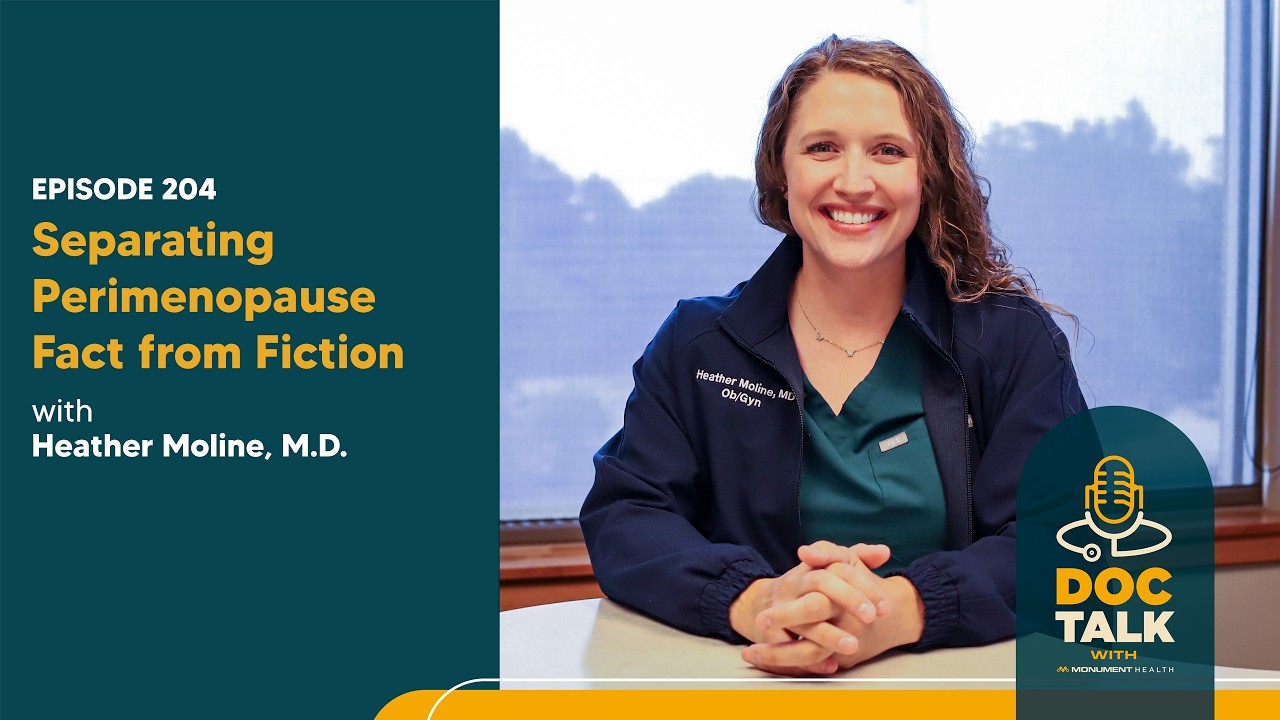

Listen or watch this episode on your preferred platform:


MARK HOUSTON: Welcome to Doc Talk, a weekly podcast featuring Monument Health physicians addressing medical topics. Tune in to your health with Monument Health. Hello again everyone, and welcome to another edition of Doc Talk with Monument Health. My name is Mark Houston, and if you've spent any time on social media lately, you've probably seen it. Hashtag perimenopause. Hashtag menopause. Millions of women swapping symptoms, theories, hormone advice online. It's a conversation that's louder than it's ever been. But how much of what we're seeing is actually accurate? So today I'm very happy to sit down with Dr. Heather Moline, an OB-GYN with Rapid City Medical, to talk about what's really happening to a woman's body during this stage of life, and to separate what's real from what is out in all of these algorithms right now. So thank you for coming in, Dr. Moline.
DR. HEATHER MOLINE: Thanks for having me.
MARK HOUSTON: Yeah, absolutely. Um, how did your journey get here? How did you decide this is what I'm going to do?
DR. HEATHER MOLINE: Well, I didn't originally go into OB-GYN to be a perimenopause expert, that's for sure. Um, but it kind of finds us naturally in our careers, I think, really, um, mostly because as we age, so do a lot of our patients, we often age with our patients, and then we start having the same symptoms that our patients have. And then gradually over time, because the vast majority of OB-GYNs now are female, so now in this new era, we have all these OB-GYN female physicians that are going through very similar things, that there's been a resurgence of interest in hormone replacement therapy. There's been new data, new studies that have been done on women, and all of a sudden all the algorithms are trending perimenopause.
MARK HOUSTON: So you must be seeing all of this too. I mean, anytime you're on, and when you see, as we get into it here, um, when you see this stuff, is there some of it that just makes you grit your teeth like, oh my God, why is this information getting out there?
DR. HEATHER MOLINE: You know, I will say that I think in general, social media that is sort of a crowdsourcing of health care is not always bad. At least some information can be out there and some women can be more compassionate than they might be getting from their, you know, providers who don't know as much about perimenopausal care. I will say about five or six years ago is when I first had patients coming in wanting to be tested, wanting to talk about treatment for perimenopause, that was about the time that I saw it on social media as well. And I was initially frustrated. I will just say, as someone who feels very educated and I feel like I pride myself in knowing the newest data and all the science and everything, that I was initially frustrated when people would come in and want to talk about it when I thought, you don't have perimenopause, you know, that's not... it's a thing, but like, you don't have to worry about it right now. Um, and I think that that's transitioned into much more acceptance on my part, for sure. But also, I've, in the last five years, I've done a lot of education for myself on it. I've found quite a bit of new resources that are available since I was a resident, which was very limited back then. And I think that now it's not just a trend. This is the direction that we're heading in health care for women. And it's a trend that is very necessary. It's been delayed on for a lot of reasons, but also most women have always needed this, and they really could benefit from a lot of hormone replacement therapy. But we haven't had a lot of opportunities to have the conversation until recently. And now it's women that are driving health care.
MARK HOUSTON: Perfect. I mean, it's perfect. Um, but let's get started. I guess, um, backing up just a little bit, what's the actual difference between perimenopause and menopause? Because I think a lot of people in the social media and in those algorithms that are popping up, they're just using them interchangeably, right?
DR. HEATHER MOLINE: Yeah. And I would say, from a clinical perspective, there are some differences in how we manage treatment and how we would talk about diagnostic criteria. But the technical definition of menopause is much easier than perimenopause. The technical definition of menopause is passing twelve months, twelve consecutive months with no menstrual cycle, where perimenopause is sort of this gray zone of indeterminate menstrual cycles, sometimes your cycle can be affected. You can have all of the atypical symptoms of perimenopause that I'm sure we'll talk about at some point, but it's much less defined, but it can be any time in your mid-thirties to into your 50s prior to the onset of menopause. So we talk about menopause, the average age of menopause for women is age fifty-one. But that means that some women are seven years before or after that. And perimenopause can be all of the years preceding menopause to like the mid-thirties. I mean, it can appear even then.
MARK HOUSTON: Yes. Um, well, you mentioned the symptoms and things that people are talking about quite a bit online when they see this, mood swings, brain fog, weight gain, joint pain, um, blaming it on hormones. Now, how much of that is accurate and has that just kind of become a catchall?
DR. HEATHER MOLINE: That is a really hard thing. I think in today's modern society, in the culture that we live, it's easy to try and say, well, my hormones are out of whack, and not really be able to acknowledge or really own that stress plays a huge factor, that a lack of exercise plays a huge factor. Your nutritional status can play a factor in how your hormones do play. So while our hormones guide all of our bodily functions, really, if we're being, you know, down to a molecular level, there are a lot of lifestyle choices that also, you know, can impact our well-being. And so it's hard to say that perimenopause is the factor that is the leading factor of all that, but it definitely can contribute to increased weight gain, mood swings, the irritability that we talk about, and the millions of other perimenopausal symptoms that women complain about.
MARK HOUSTON: Well, what are the signs then that are actually kind of worth paying attention to versus what might be just stress or aging or these things that you're talking about?
DR. HEATHER MOLINE: So it's, it's impossible to tease out truly, you know, we talk about like, well, your cortisol levels could be high and that could be contributing to your perimenopausal symptoms. Well, it's very easy to say you should manage your stress and you should have less stress in your life and you should do all these things. And if everyone did that, we probably wouldn't need as many of the other medications that we have in our, you know, pharmacy. But I think that it's really important to say, if you're having these symptoms, these are the things that hormone replacement therapy can help. And these are the things that it's probably not going to impact. But I think that the biggest thing is, most of the time, women come to me early in perimenopause with changes in their menstrual cycle. If they still have a uterus or they're still cycling, they can have mood symptoms that are pretty bothersome, sleep disruptions that are really bothersome. And those things all play a role in their cortisol level and how they feel in their day-to-day, and weight gain, and all of those things. The joint pains, increased heartburn symptoms, muscle fatigue, those things, those are much more a symptom of like the chronicity of perimenopause. And truly, when we start hormone replacement therapy, we find many women have resolution of all of those symptoms. And so they have the short-term benefit, but then also all of the long-term benefits from hormone replacement therapy as well. So sometimes it's not as much teasing it out, and we can do labs and figure out what could be what. But sometimes it's, let's try some therapy and see if it helps you. If it does, it's probably perimenopause.
MARK HOUSTON: So, because we'll get into a little bit more on the hormone therapy and the supplements and things, but that really can make that big of a difference that you guys are, that you guys are learning about right now.
DR. HEATHER MOLINE: Yeah, absolutely. So that's why it's such a big thing. This is not just like a viral trend that's going to go away in three weeks. This is something that we're going to see more interventions going forward with, women's health and new studies that are going to be coming out for cardiovascular wellness, all of the long-term benefits that we see from hormone replacement therapy. So while it feels like it's trending, it's also trending in the right direction, probably with the knowledge that we're gaining going forward.
MARK HOUSTON: So how long has this therapy been available? Has it been out there a while?
DR. HEATHER MOLINE: Um, yeah. So this is the story of hormone replacement therapy that I wish was more well known in modern culture. But we used to have easy access to hormone replacement therapy. Even as soon as early as, like the two-thousands, most women were offered by their primary care provider or gynecologist hormone replacement therapy somewhere in their forties or 50s to help with the symptoms of menopause or perimenopause. And many of them were on either an oral or a transdermal or some type of estrogen and progesterone supplementation around the age of menopause. They would usually be taken off of those around age sixty-five. The Women's Health Initiative came out, or started, in nineteen ninety-one, which was a study that essentially was trying to determine what the benefits and risks were of hormone replacement therapy for women anywhere in their forties, all the way into their sixties and 70s. And the challenge with that study is that in about the two-thousands, early two-thousands, they paused the study early. They canceled the study early because the initial data had shown that there were increased risk of cardiovascular outcomes that were negative and increased risks of breast cancer. And so they stopped the study completely. And then it ended there. And what happened was that the modern media spilled out to everyone in the early two-thousands that hormone replacement therapy is dangerous. No one should be on it. We shouldn't be putting women on these medications. And then what happened is about twenty years of silence from the women's health department in general, in America. And what we didn't do was any more real studies at that time, because we were fearful of the long-term outcomes, knowing what the Women's Health Initiative had done for HRT in the early two-thousands when they canceled this study. And so, no, very few primary care providers, very few gynecologists, were even offering hormone replacement therapy for basically all of the early two-thousands, even into the twenty-twenties. And so it's only been in the last five to ten years that we've really seen a resurgence of prescriptions for hormone replacement therapy, more efficacy and safety data that's come out regarding hormone replacement therapy and some of the more long-term outcomes and benefits. What's hard is that the WHI trial was debunked. They found that the studies and the statistics were not correct, that there was an overestimation of risk and harm to women and an underestimation of the benefits. And so. But that was never really released.
MARK HOUSTON: How frustrating.
DR. HEATHER MOLINE: Very frustrating. I think if it were, if I were a woman in that twenty-year age range, and you were just completely told to grin and bear it, and like, you know, white-knuckle your menopausal years. Um, I think I'd be very frustrated. The other thing I'd be frustrated with now is knowing all of the benefits that you might have missed out on. So we have a reduction in dementia, reduction in all-cause cardiovascular problems, osteoporosis, all of the things that actually cause morbidity and mortality in women. And so that's really the tragedy of the two-thousands to me, I think, so far, is that we had this whole generation of women who have missed out on that opportunity.
MARK HOUSTON: So there was nothing to replace it. There was nothing that really was. It was like you said, suck it up, this is how it's going to be.
DR. HEATHER MOLINE: They gave us a couple of old, um, like SSRI medications that can help with vasomotor symptoms. And that was what we were taught. And so I went to residency and graduated residency in twenty-eighteen, which was when I finished. And we were just at that time tiptoeing into... and we had a, you know, a whole lecture series in my residency about menopause and menopause management. But we were very careful about offering all of the alternatives before you initiated hormone replacement therapy. So instead of talking about osteoporosis prevention with estrogen management, it would be, let's try all the other drugs before we do that. And the real problem is that there's a narrow window where you can have benefit to the HRT. You can always have some benefit, but the real prevention for osteoporosis and a lot of cardiovascular complications for women, those are a narrow window where we can have real impact. And not having access to those drugs for that time, it's a question of what their eighties and nineties will look like now that we've known what their fifties and 60s are.
MARK HOUSTON: So, I mean, this almost seems, um, you know, you don't ever want to use the term like a miracle drug. Right? But it does seem like this, uh, yeah, like you said, the missing out on two, almost three decades of this, uh, was just too bad. But walk me through, how does this replacement therapy work? They come into you and they're talking about the perimenopause and they know what's coming into their fifties. What is that conversation like with these women then? Um, when you say, hey, HRT is a thing, let's give this a try.
DR. HEATHER MOLINE: Well, what I will say is that this newer generation of perimenopausal women are more educated than any of their counterparts from the last three decades, mostly because of social media, that people are sharing more of their stories and they're hearing more than they've ever heard before. Because in the past, menopause was a very private thing that people wouldn't even talk about what they were experiencing, even amongst families and women. You might ask your grandma, or you might ask your mom, like, what was your menopausal experience? And they'd say like, oh, I, you know, it was fine. I had five years of hot flashes, or I couldn't sleep for fifteen years, but I'm fine now, you know. Um, and I think it's because it was like a very private experience, um, which is part of the change in our culture too, is that we're just probably a more open culture thanks to a lot of things. But, um, but that sharing of experiences has been, you know, significantly impactful for the new generation of women. But oftentimes when perimenopausal or menopausal women come into my office, they're either there for an annual. And then I happen to say, you know, any other symptoms that you're having, or we discuss other symptoms that they might be complaining about. But when they complain of those perimenopausal symptoms, we have the discussion of whether or not there's a benefit to testing hormone levels. There's always a question of whether or not that's a benefit. I will say that in most cases, getting a baseline for people before we initiate therapy is not a bad idea. Many patients just want confirmation that they're not crazy. You know, that they're having these symptoms and that it could be because of a fluctuation in their hormones, that they're not just wanting to divorce their spouse every other day because he didn't take the trash out, and that it's that he didn't take the trash out, but also that your estrogen levels might be quite fluctuant. Um, you know, some of the conversations that I have are incredibly personal with patients, including about their libido or their enjoyment of sex or dryness during intercourse. And a lot of those conversations are very challenging for people to bring up. So I try to encourage patients to try and be as open about all the symptoms they're having, because there are a lot of things that hormone replacement therapy can do, as long as we're offering those things early, and if we know what they are, then we can work towards making them better. Sometimes we can't make everything go away. I can't make you sleep through the night every night, all the time. But maybe I can get you more sleep so that you're less irritable. Maybe you want to exercise more, which then will help with stability of your weight. All of those things kind of can play a role. And we talk about the risks and benefits of all of the different facets of hormone replacement therapy.
MARK HOUSTON: How come this can't be just a normal test every time they come in? Um, you know, so you don't... maybe you don't have to ask as many questions, for the women that are uncomfortable with it. Maybe. I mean, is that ever a likelihood? Could that ever be a thing that happens? Or is testing difficult?
DR. HEATHER MOLINE: So that's the challenge of perimenopausal lab testing, is that if I were to test a hormone-deficient woman, let's say she's forty-five. And let's say she came in and she's still having menstrual cycles. And I were to test her on... She came in for a visit and I test her on cycle day three of her menstrual cycle. I test her on cycle day ten and cycle day twenty-one. I might have wildly fluctuating levels of her hormones. And so if I were to just do a spot test, which sometimes happens, and then they get referred to me for atypical values, or, you know, oh, her estrogen level was really high, so I don't want to put her on estrogen. Sometimes that happens, you know, from different providers that will refer to us. What happens in perimenopause is the instability of your hormones is what can make you feel quite abnormal. Okay. So it's not just a decline in hormones, which does happen, but it's that the hormone levels can be very unstable. So it's the curve that we see in the hormone values that can make you have so much frustration with your hormone levels, or with just how you feel in general, and what can contribute mostly to the symptoms that patients have. It's the instability of the levels. So having a lab where you're like, well, you're coming in for a perimenopausal consult with Moline, let's get your labs drawn before you come: there is value in that, because I can have a general idea of where you're sitting, but it's only at this one point in time, and it's not as standardizable as it would be if you were twenty-five. So that's a hard thing. And there is a certain nuance, and that's why it can be a little bit challenging for providers to provide hormone replacement therapy care, because they don't always know what they're looking for, and they don't always know exactly what they're titrating up to, you know, to get. But I will tell you what, I go more, you know, as a provider myself of this, I usually go based on symptoms and less about a lab. So if someone comes in and says, I have no libido, I have absolutely no interest in sex, I haven't for the last five years, I'm fifty-two, I don't know where I'm at. And let's say I draw a lab that shows that her testosterone is like low to normal. It's probably that she was normal ten years ago. And over the last ten years, we've seen her levels just decline very rapidly in menopause. So then that would be a patient who would be a great testosterone supplementation patient. So it doesn't always matter what the lab is. It matters more how they respond to treatment and also what their symptom profile is.
MARK HOUSTON: So for hormone replacement therapy, there's different types that you can take. What are some of the most common, I guess, that most women would take?
DR. HEATHER MOLINE: The most common, if you still have a uterus, the most common would be progesterone, oral progesterone therapy, like a micronized progesterone. It's a pill that you take every day. Um, for estrogen, the standard of care would be a transdermal patch. The challenge for any of our listeners here today is that there's a national shortage in patches, and so it's very challenging to get certain doses of patches. Um, what we find in our clinic is that I might prescribe a patch to Walgreens or Walmart or Boyd's or CVS, and then we kind of transfer some of them, have them, and then they don't, and they have them and then they don't. And so then they end up having to go to kind of pharmacy chasing for these patches. That's a big thing right now, is this national shortage. Um, and then that's kind of the standard of care, would be a transdermal patch. We really like those. And then the progesterone pill, the other forms of estrogen would be an oral pill. And then we also have transvaginal rings. And then there's topical creams that we can use. Estrogen also comes in a form of vaginal estrogen cream, which helps with vaginal atrophy and dryness, which can be in the perimenopause and the menopausal years. I would tell you that there are almost no contraindications for vaginal estrogen cream, and most patients in their sixties, seventies, eighties, 90s could benefit at least somewhat from vaginal estrogen cream, not only for all of the genitourinary symptoms of menopause with dryness and pain with intercourse, but also prevention of chronic urinary tract infections. So that can be a really big benefit. We also see that testosterone is prescribed quite a bit, and that's a little bit of a controversial topic. I'll tell you, as an ACOG member, a member of the American College of Obstetricians and Gynecologists, I prefer topical microdose testosterone. So, in a cream form. Some patients get a lot of benefit out of pelleting. But the challenge for me as a physician is that I can't dose the testosterone any differently once it's in a pelleted form. And if you have any reaction to it, if you have a really super high level of testosterone, I can't take that away once it's in pellet form. We used to do injections.
MARK HOUSTON: Why is it controversial? The testosterone?
DR. HEATHER MOLINE: Because testosterone actually does have some pretty significant side effects if we're not careful. So if you overdose women on testosterone, they can have really significant facial hair growth. They can have recession of their hair on their hairline. They can have clitoromegaly, which is an enlargement of the clitoris. Most of those are permanent, they don't often recede with time. You can have deepening of your voice, which also can be permanent as well. So even if we were to take away the testosterone, they often have some of these permanent problems. While you might feel great on a really high level of testosterone, we can also see really significant impacts in your liver function, significant cardiovascular problems. So if you're not careful and you overdose testosterone, you actually can slip into the risk-versus-benefit category where the risks are really pretty significant.
MARK HOUSTON: Okay. And you were talking about injection too before?
DR. HEATHER MOLINE: Yeah. We used to do a lot of testosterone injections, but that's the same idea as the pelleting, is that we can end up with really high levels of testosterone that are irreversible.
MARK HOUSTON: What's the pelleting? What does that mean?
DR. HEATHER MOLINE: Pelleting is a little tiny pellet that releases over time slowly. And it usually goes in the buttocks. It's placed by a provider in the clinic.
MARK HOUSTON: Okay. Got it. Um, and that's most of them? What else is out there?
DR. HEATHER MOLINE: That's it. So we have injections, those are, you know, like some people will do like monthly or weekly injections of testosterone. That's much more that we see like on the male side, we don't do as many injections because of all the side effects, the pellets, and then the topical creams. Those are the most common forms of testosterone.
MARK HOUSTON: Do you know why there's the shortage with the patches?
DR. HEATHER MOLINE: Yeah. Everybody wants them all of a sudden because they're trending.
MARK HOUSTON: Because it's trending. Yeah. But you said, but it helps. I mean, you're saying there's a reason why they want these?
DR. HEATHER MOLINE: Absolutely. The other thing that can happen is that we'll have a shortage of a certain type of patch. So we prefer generally the twice-weekly patch. The once-weekly patch doesn't stay on as well. And so people like the twice-weekly patch. Well, so what happens is that we prescribe the twice-weekly patch, they run out of it at the pharmacy, they give you the once-weekly patch, then they run out of it at the pharmacy. And so it's this back-and-forth. It's a lot of manipulation of the pharmacy sometimes.
MARK HOUSTON: So, but kind of going back to what you were talking about, now has the research caught up from this two-decade window that we missed? I mean, has it been like, yeah, we understand it way better now? And, I mean, are we getting closer? How much longer do you think it'll be before you can be like, yes, this is what you need?
DR. HEATHER MOLINE: I think that we're in medicine, we have a significant limitation on studies for women in general. We have a paucity of that just in general in medicine, but in women's health for hormone replacement therapy, we still have a ways to go. I will say that the reevaluation of the Women's Health Initiative was not for nothing. There was some really good data that came out of it. Some of the drugs that we previously were using consistently for hormone replacement therapy, we don't do anymore. So some of the older drugs that were consistently used for HRT, we found that there are some risks to that. And then we switched over from medroxyprogesterone to micronized progesterone. And we found that the safety data on that was markedly better. So there are some benefits to the trial. It wasn't just all bad, but we have done more analysis of that over the years. And there have been a couple of other trials that have come out that have been showing all the benefits of it, especially the long-term benefits for cardiovascular wellness, dementia risk, lowered osteoporosis, all of that. And that has shifted us in with more studies going forward. I think that's just the trend, is that we need more data, you know, but we really are in that era of collecting the data, and new studies come out all the time, even if they're small, that can help support that.
MARK HOUSTON: Well, as we're living longer too, um, is this... um, I mean, does that make it more challenging to do this kind of stuff as we live longer as well? Because like you said, people are living into their seventies and 80s, and they're like, you know, my sex life is great, I mean, this is awesome, you know? I mean, does that... from your end, does it be like, okay, well, we hope it stays that way? I mean, what, you know...
DR. HEATHER MOLINE: Yeah, I think that is a challenge. So one of the things that I sometimes talk with my patients about is that, you know, we live in a monogamous society where a thousand years ago we were dying in our forties and 50s. And so our hormones haven't caught up to that. You know, our hormones didn't expect for us to be in a monogamous relationship with a man in his sixties who still wants to have sex twice a week. And when that's the rub in your relationship, is that you have no interest, and he still wants it. And he's probably on testosterone therapy himself. Um, that's a challenge. And so then these conflicts in relationships happen when a thousand years ago, when you were living in the cave, you would have never even considered, you would have never been a sexual conquest for anyone because you would have been a grandma, you know, raising the family as a, as an elder woman. And that is just... that's where we are. You know, women living into their nineties and having sex in nursing homes is a great thing. The challenge is, are we physically capable of that?
MARK HOUSTON: Right. Exactly.
DR. HEATHER MOLINE: So then I have to... we, in my lane, have to say, okay, let's try and get everything ready for you to be well enough to have sex with your partner. And we can work on your desire. We can work on your vaginal dryness. We have to look at it from a comprehensive standpoint. But I really do see sexual wellness as a huge factor in women's health that we have ignored for many years. And I think that, again, the resurgence of people's interest in it, and also just that we're trying to live as well as we possibly can, instead of saying, I'm going to be a little old lady when I turn sixty-five. I don't have anyone in my office that is sixty-five saying, I just want to be a little old lady in my little pink chair. Nobody wants to do that. They want to be fit and they want to be well. And I think that's a positive trend. And part of it is the modern medicine allows us to live well into our sixties, seventies and eighties. But if we're going to live the best, then we have to... I say this all the time: we get the body we deserve in our sixties that we cultivate in our forties.
MARK HOUSTON: Oh, exactly. And getting people to understand that is so difficult.
DR. HEATHER MOLINE: It's a challenge, right? But also, investing in yourself from a hormone replacement therapy perspective in your forties, 50s, 60s, we reap those benefits in our seventies, eighties, and nineties. So we reduce the chance of a fall and a fracture. We reduce the chance of chronic urinary tract infections that lead to sepsis and lead to hospitalization. We can reduce the chance that a woman is going to end up in a nursing home because she's incontinent all the time. If I can do that and keep people out of a nursing home, out of the hospital, in their own home safely, that's the goal. And it's not just about having sex with your spouse and making sure that your hot flashes are gone. It's the long-term well-being of those patients as well.
MARK HOUSTON: And everything you just said, I mean, that makes it worth a conversation with you to come and have, for sure. You know, we started out kind of this podcast, you know, you can roll your eyes at the social media and how this can blow up. Um, but, you know, after hearing what you've said, it started the conversation. It's really got people talking, like, come on, let's do something about this. I mean, it exists. Let's make it happen. Um, so if someone listening is wondering, you know, is this me, right? Because I have to imagine there have been some women listening in their forties or 50s right now. Um, what is the first step that you want her to take?
DR. HEATHER MOLINE: I would say reaching out to your healthcare provider, whether that's your primary care provider or your gynecologist, and saying, I think I might have perimenopause symptoms. At least starting that conversation to know what treatment options you have available, what kind of testing you might want to have done. Many patients come to me with just the wanting to have the discussion of it and not ready to start any HRT, or that they might have a couple of things they want to dip their toe in. I think that's the best foundation, is to at least express what your symptoms are. We also find that many patients have been out of the health care system for a while, because maybe they were done having their babies in their twenties and thirties. They haven't established with primary care, they don't have a gynecologist anymore. It's important to get established with care in your forties and 50s, so that we can prevent all those bad things later down the road. So screening stuff can happen in your forties and 50s, with an annual exam and other things. But bringing it up and talking to your provider would be the first step, and saying, do you think I'm... I think I'm in perimenopause, what do you think? That's not always welcome. I will say, as a provider, when people come and they're thirty-one saying, I think I'm in perimenopause, I sometimes will mentally roll my eyes. I hope they don't notice that I'm doing that. Um, but I kind of think that it can be a catchall sometimes, and that can be the detriment, you know, because we get a little bit overwhelmed with it. But from a physician's perspective, or a provider's perspective, but also it's important to at least say what symptoms you're having. And if the person that you're seeing gaslights you and says, no, no, I think you just have anxiety, well, you probably do have anxiety, but you might have a hormone deficiency. And so those things are a discussion that should happen, you know, between you and your provider.
MARK HOUSTON: Perfect. Well, Dr. Heather Moline, thank you very much for coming in and doing this. I really appreciate it. It's been a lot of fun. Um, and I know that I can tell that you're passionate about this and, uh, that this is information that you want people to know and to get that conversation started. So, um, you know, I'd love to have you back anytime to talk about any of the rest of this too, because this was great. I appreciate it.
DR. HEATHER MOLINE: Yeah. Thanks, I have fun.