 Caregiver Feature
History, Healing and Helping Hands
Published August 2026 in Summer 2026
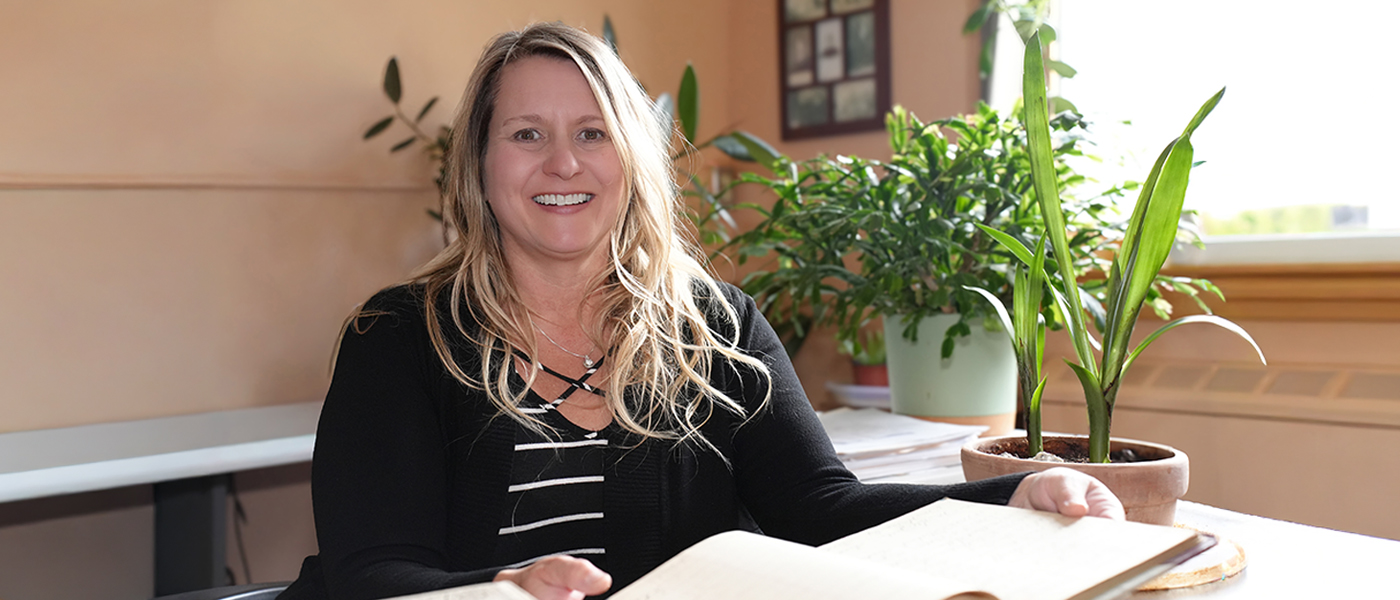
History is part and parcel of life in the Black Hills, and nowhere is that more apparent than in Deadwood. Here, history isn’t confined to museums or memorial plaques. It walks around on the streets, lingers in the buildings and is part of the community’s fabric. The past isn’t something remembered; it takes hard work, dedication and passion to keep history alive and well. While Nicole Shiffrar is a Monument Health caregiver, she cares for Deadwood’s history as well.
The work of wearing many hats
Nicole’s official role is Assistant to the President at Lead-Deadwood Hospital. Unofficially, however, she’s something of a jack-of-all-trades. That sounds straightforward. In practice, though, she’s a central figure in a small but complex system.
“I help the leaders here at the hospital, I help the physicians schedule meetings and I’m the work comp coordinator. I also do a lot of stuff with employee health,” she explained, before pausing and laughing at the understatement. “In a smaller facility we have a tendency to wear a lot of hats!”
Her role is defined less by job descriptions and more by responsiveness. When problems arise, needs change or work piles up, Nicole steps in to keep things moving. She’s been doing it for 16 years and still finds satisfaction every day.
“I always kind of wanted to be in a job where I could help people,” she explained. “I love doing it, because I get to help all the people who can handle the stuff I can’t and make their jobs easier.”
Bridging gaps and building legacy
When Nicole started she discovered that the hospital’s rich history was largely inaccessible. For almost 130 years, patients have received care there, and while most people had accepted that artifacts and records of that long continuity of care were scattered, and maybe even lost, Nicole knew she could do something about that.
So, she began organizing.
“I wanted to look into the history, see what we had, get it organized and figure out what we could do with it,” she said.
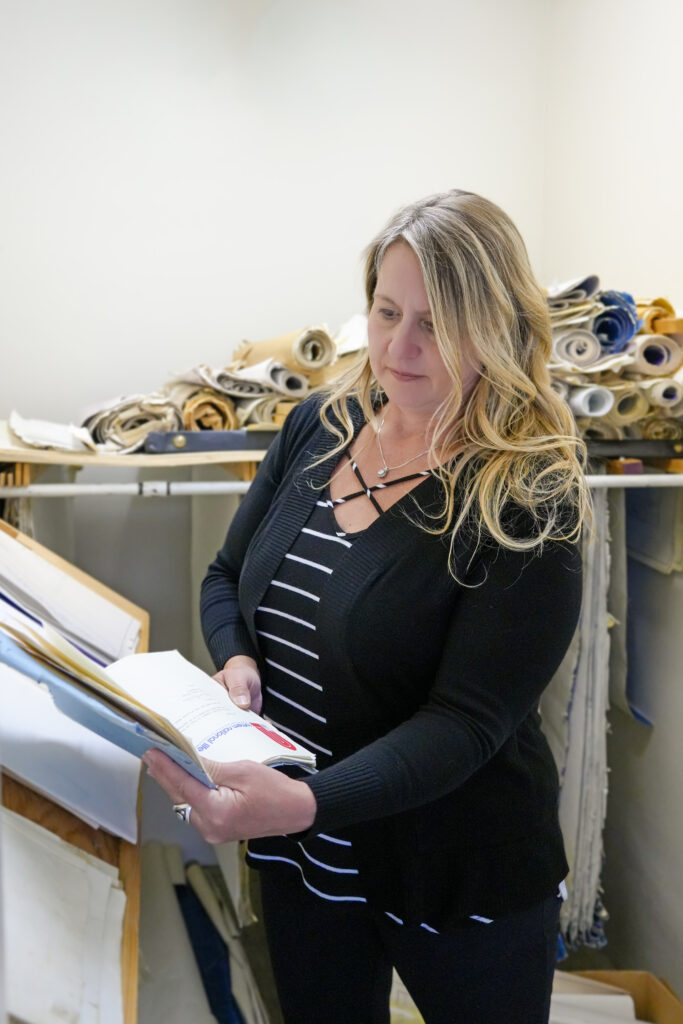
She began collecting and archiving medical records dating back to 1900, and worked with the City of Deadwood to document deaths prior to 1906, filling in
gaps that official records had missed. She collaborated with the Benedictine Sisters, who founded the earliest incarnation of Lead-Deadwood Hospital — St. Joseph’s Hospital — in 1897, reconnecting the hospital’s earliest history to its present and future.
What started as organization became preservation. Preservation led to storytelling, and storytelling eventually solidified into something material; a book.
Encouraged by colleagues, Nicole started documenting the hospital’s history in earnest. “I remember people telling me, ‘Get it all down, once you’re gone, nobody is going to know this history.’ And that’s what I did.”
Nicole’s project started as a simple idea, but it expanded into a comprehensive work. The culmination of her efforts, the History of Health Care in Lead and Deadwood, was completed just in time for the 125th anniversary of the hospital opening on Jan. 15, 1897. Copies of the book were available during the anniversary celebration, and Nicole happily signed them for everyone.
She’s proud of her work, and is amazed at how far it has reached. “It opened a lot more doors than originally anticipated,” Nicole said. “I felt like people here in the Black Hills would be interested, but now there are copies in the NIH (National Institute of Health) Library, and it’s being used in medical school classrooms.”
Although Nicole worked on the History of Health Care in Lead and Deadwood for years, once her goal was achieved, she realized it was only the beginning. She continues to strengthen ties between the hospital and the historical community. “I just love seeing us be part of the Deadwood community, and I want to be as involved as I can.”
History beyond the hospital
Nicole’s passion for history doesn’t stop when she leaves work. She serves on multiple boards, including the West River History Conference, the Lawrence County Historical Society and the Society of Black Hills Pioneers. Through these roles, she contributes time and expertise by organizing and digitizing historical records.
One impactful project involved scanning decades of historical papers from the West River History Conference, making them accessible through the Case Library at Black Hills State University. “It took me a long time but I was able to get all of those books scanned,” she said. “Now they’re available to students and researchers.”
Because of her work on the digitization project she received the conference’s Helping Hand Award, recognizing the time and effort she put into making those documents accessible.
Nicole has also worked on projects with more personal connections. In 2025, she helped lead a decades-long effort to identify and preserve the long-abandoned Carbonate Camp Cemetery in Lawrence County where her great grandfather was laid to rest. What began as a genealogical curiosity became a full-scale preservation initiative, culminating in a formally recorded cemetery map and renewed protection for the site.
Where care and history meet
For Nicole, her passion for history and desire to help people are connected. “There’s a lot I’m proud of,” she said. “But more than anything, I just love being able to see involvement with the community.”
Whether she’s volunteering her time to help local history organizations or working with locals to update the historical displays in Lead-Deadwood Hospital, she also keeps a close eye on connecting with people. Because for Nicole, people are the most important part of history and health care — and those two things come together more often than you might think.
“There was one gentleman who really stood out to me. He was here for months while he was recovering and he just loved the history of this place, so I gave him a copy of the book,” she said. “He read the whole thing while he was recovering, and told me that if he was going to be stuck in a hospital for months, he was glad it was ours.”
In a town like Deadwood, history is part of everything, even patient care. “Nobody wants to be in the hospital,” she said. “But any little comfort that we can provide can make things better, whether it’s talking about the history here or sharing a book. I love being able to do that.”
A Labor of Love
As Volunteer Project Coordinator, Nicole helped lead a years-long effort to identify, map and preserve the long-abandoned Carbonate Camp Cemetery, where her own fourth-great-grandfather was buried in 1893. Working alongside local historian and surveyor Mike Madler, Dakota Gold’s survey team, representatives from South Dakota Mines and a network of dedicated volunteers, Nicole helped assemble what she called a “dream team” to bring the project to life. The work culminated in the official filing of a cemetery plot map with the Register of Deeds, ensuring long-term protection of the site. It was a ton of work.
Reflecting on the effort, Nicole described it simply as “a labor of love.”
Photos by Erika Bratten-Cianca