 Caregiver Feature
A Very Modern, Ancient Dance
Published August 2026 in Summer 2026
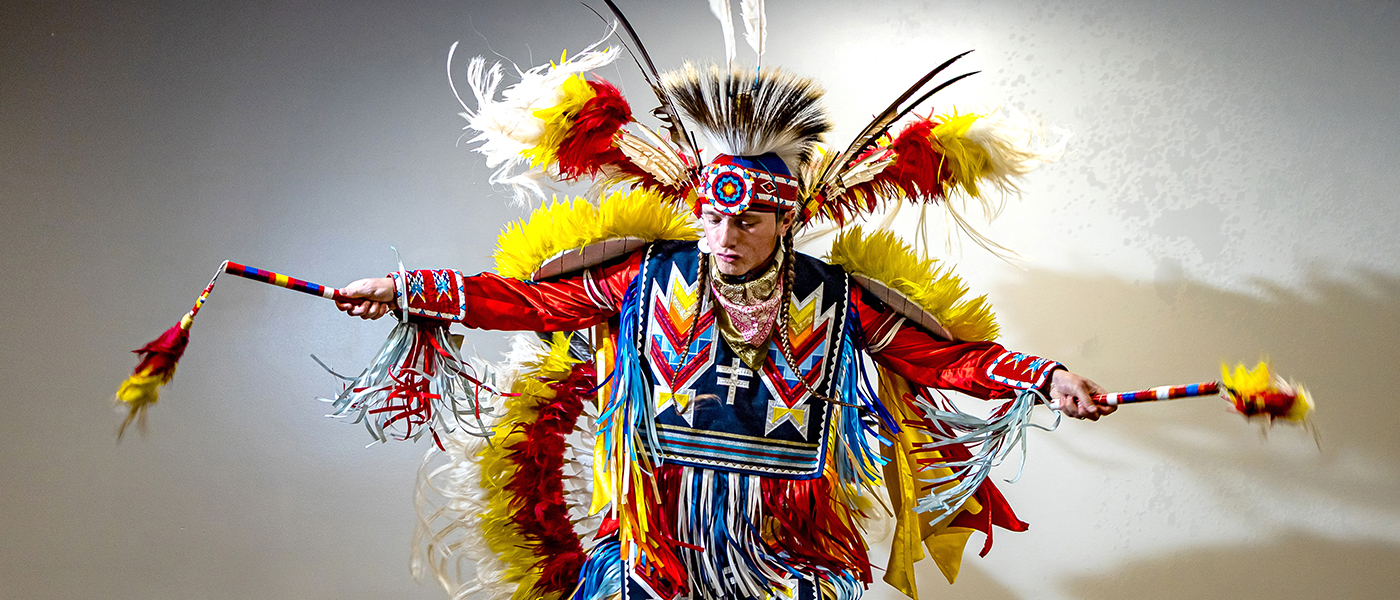
Clad in full regalia, Keegan Her Many Horses dips into a squat, springs upward and kicks his right foot into the air, then does a quick half-splits before springing up again. His regalia flashes white, gold, crimson. In his hands are two feathered implements that resemble torches, which is fitting because Keegan dances as if on fire. Drums and chanting drive his spinning, dipping, head-nodding and whipping as he channels and honors his ancestors and their tradition.
It is called Fancy Dance. And amongst his peers during Black Hills Powwow 2025, or He Sapa Wacipi Na Oskate, held annually inside The Monument in Rapid City, Keegan, 28, is in his element in more ways than one. The Monument is the site of many annual athletic events in addition to Powwow, such as Lakota
Nation Invitational and Rodeo Rapid City. As an Athletic Trainer with Orthopedic & Specialty Hospital at Maȟpíya Lúta Owáyawa (formerly Red Cloud School)
in the Pine Ridge Reservation, Keegan spends a lot of time around athletes, in gyms and on fields.
He lives and works where sports and native life intersect on a daily basis.
An Athletic Background
During the day at Maȟpíya, Keegan acts as Lakota immersion instructional support staff for students ranging from kindergarten through the fourth grade. After school, he works with the high school athletes. As the only Athletic Trainer in Pine Ridge, Keegan estimates that he works with about 120 kids across football, cross country, volleyball, golf, basketball, wrestling, cheerleading and track.
“I cover practices throughout the week. I make sure the athletes are hydrated. I deal with any current injuries. I give them rehabilitation exercises and treatment. I do injury prevention such as taping or correcting form, managing workload. I also cover emergency and acute injury care,” he said. “I’m kind of like a safe space for these athletes to come and talk about what they’re dealing with, physically and emotionally. I try to take care of them the best that I can.”
Keegan recalls that when he was in high school, he would see professional athletes get injured on the field. He sensed that someone must be helping them recover from injuries. By contrast, when his teammates were injured it was up to the local hospitals to provide care, or for the students to simply “tough it out.” There was no one to advise students dealing with injuries. It sparked a curiosity in Keegan: who helps athletes when they are hurt?
With some research, Keegan discovered that such a role did exist. In fact, it was a medical career — athletic trainer. As it turned out, Keegan would eventually have regular access to one when he signed on as an undergrad to run cross country at Black Hills State University (BHSU) in Spearfish. “From there, I was super interested in it and I wanted to become that so I could help bring a native awareness to it and show them that it can be done,” he said.
Though he grew up in Ethete, Wyoming in the Wind River Reservation, Keegan has deep family ties to Pine Ridge. His father’s family lived there during Keegan’s childhood, and he visited often. Those trips to Pine Ridge and his time at BHSU strengthened Keegan’s connection to the Black Hills.
It was also at BHSU where Keegan met his future wife, Sierra, who grew up in Pine Ridge. Now, they each work at the very same school she attended in her youth. As Lakota immersion instructional support staff for grades six, seven and eight, she teaches entirely in the Lakota language.
“A lot of us here at Maȟpíya Lúta are passionate about speaking and teaching the Lakota language, and I’m glad to incorporate that into my athletic training
as well,” Keegan said. “I speak Lakota with the students who know it and who can speak it. I think that’s just cool that it helps our language project and it’s relevant to things that they’re interested in. It helps me use Lakota thinking and spirituality in my training practices, as well.”
Fancy Dance Legacy
Ever since he could stand on two feet, Keegan has been dancing.
“There’s pictures of me in my regalia dancing at Powwow that I don’t even remember. My whole family dances, my dad, my uncles and aunties, my brothers,
my sisters, my cousins, they all dance.”
In a way, Keegan never learned to dance, not in the usual sense. It’s intuitive; you grasp it by watching older relatives and others in the community. Each dancer adapts what they see and brings that particular interpretation to their unique style. Some dancers do not begin until their late teens or even early 20s.
“I’m Oglala Lakota. Every tribe, every nation has their own stories of what dances are for, how they came about. They differ with every nation that they’re from,” he said. “With Fancy Dance, I’ve heard stories that it represents a horse’s movements or that it’s a war dance. But in my opinion, it’s just a fun dance. I say a prayer every time I dance so that other people feel good and I feel good; that nobody gets hurt.”
Powwows in the Black Hills are held primarily in the summer. However, some take place in early spring, too. People come from all over the U.S. and Canada.
Keegan attends as many local powwows as he can. He occasionally travels to others, though he tends to stay within the Great Plains area. “I go to North Dakota, Montana, Utah, Wyoming. I have gone to Wisconsin before to dance. New Mexico,” he said. “The category that I dance in is the most contemporary of the categories. It’s very acrobatic and uses quick twitch muscles. I try to entertain the crowd and make people smile. I try to make people happy when they see me dance.”
Bringing It All Together
This is Keegan’s first year working for Monument Health, although his relationship with the Sports Medicine team began while he was in graduate school at University of Colorado, Colorado Springs. “My last clinical rotation as a student was with Monument Health. I spent three or four months as a student athletic trainer learning with everybody.”
During this time, he also became acquainted with Jim Rix, Manager Rehabilitation and Sports Medicine Services, Shawn Mechling, Supervisor Sports Medicine and many other Monument Health athletic trainers that would go on to become his eventual superiors and colleagues.
There is now an additional layer to dancing for Keegan, one that is rooted in a different tradition: that of medical knowledge. Keegan merges his athletic training with Fancy Dance techniques to create a better — and safer — dancing experience.
“I think about, ‘what muscles am I using the most when I’m dancing?’ And I try to warm up and do extra workouts that help complement those. If I’m super sore or something’s hurting after dancing, I have this whole new perspective as an athletic trainer. I can figure out what I can do to help prevent that next time — what muscles, what structures do I need to strengthen?” said Keegan. “It’s definitely got me thinking about my dancing in a different, more health focused way, and being more respectful of my body.”
This perspective, in turn, further connects Keegan to the student-athletes.
“A lot of them will go to the powwows or community events, and they’ll see me dancing. And that’s something that we can talk about the next time I see them. That’s another thing that they can relate to me — I’m not just ‘Keegan from the gym.’ I’m the athletic trainer who’s also out here dancing and praying with them. It helps build a deeper trust.”
Despite this hope, Keegan is reluctant to call himself a role model. At the core, it’s the sense of community that is his motivating principle. “I love the school.
I love the teachers, the students,” said Keegan. “I’m just happy to work here, and I love what I’m doing.”
Story by Kory Lanphear“Just in the short time that I’ve been here, I’ve seen lots of kids who are interested in what I do, and they’re passionate about it. So hopefully in the near future, there will be a lot more opportunities for athletic trainers, physical therapists, sports medicine careers here on the reservation.”
Photos by Bob Slocum