
Mason Thorson dialed in his settings, started his treadmill workout at a Rapid City gym, then collapsed. The fact that he was in medical distress and in need of assistance was immediately apparent. Nathan Svendsen and Matthew Dey, two fellow gym members and Monument Health Physical Therapists, answered the call.
As outpatient PTs at Sturgis Hospital, Nathan and Matthew have CPR training. So, while Nathan began administering chest compressions, Matthew rushed out to a nearby supermarket to see if he could track down an Automated External Defibrillator (AED). Chest compressions are exhausting to perform, so luckily for Nathan and Mason, another Caregiver jumped in to help save Mason’s life. Robert Baune, PMHNP-BC, a Psychiatric Mental Health Nurse Practitioner at MWI – Rapid City relieved Nathan. By virtue of his career, Robert also has CPR training. With Robert and Nathan working together, Mason’s chances of surviving until Emergency Services arrived vastly improved.
First responders fitted Mason with a Lund University Cardiopulmonary Assist System (LUCAS) device, which provides automatic chest compressions, then whisked him away to the Emergency Department where he was eventually diagnosed with Pulseless ventricular tachycardia (V-Tach without a pulse) or, in layman’s terms, cardiac arrest.
Fourteen minutes.
That’s how long it took the first responders to arrive. Not a very long time, all things considered. For Mason, though, it was the literal difference between life and an outcome that is awful to contemplate.
Because of Nathan, Matthew and Robert, Mason was able to celebrate his 47 years of marriage to his wife, Karen, just two weeks after his heart episode. “We were at the doctor on our anniversary, but I couldn’t be happier, because it was a lot better than alternative,” Mason says with a laugh.
Miraculously, Mason suffered no brain damage because he was not without oxygen for a significant amount of time.
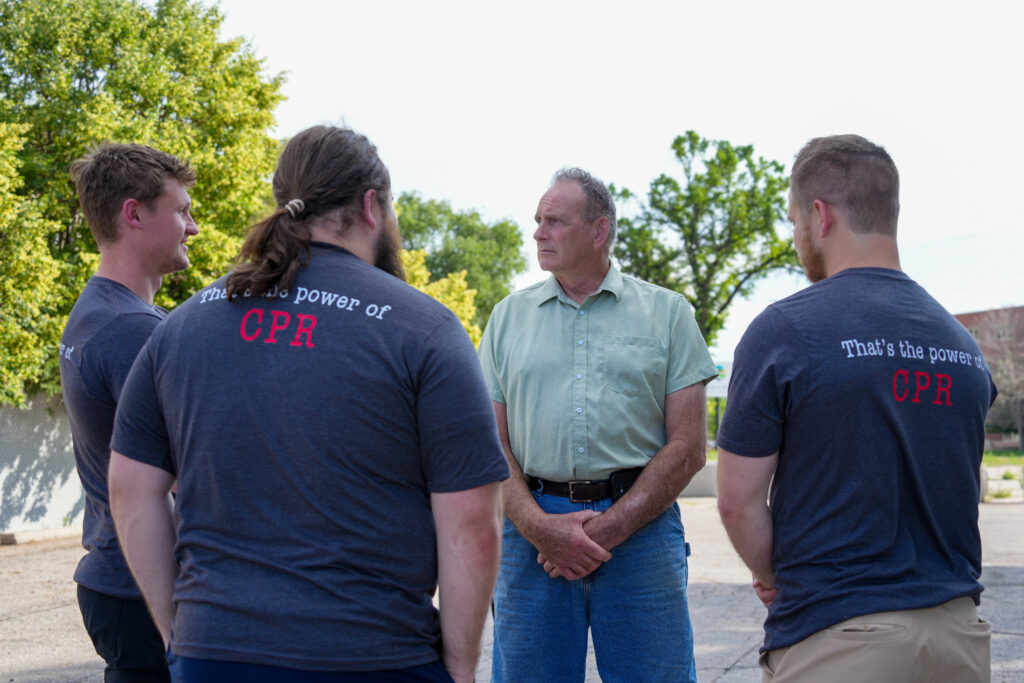
On June 30, almost six weeks to the day after Mason’s cardiac emergency, he reunited with Robert, Nathan and Matthew near the gym where they all first met, albeit in far less jovial circumstances. Mason introduced the Caregivers to his wife, their daughter and their daughter’s family. Gratitude was abundant. Hugs were shared. The three lifesavers were presented with custom T-shirts, which read: “I saved a life” on the front and “That’s the power of CPR” on the back.
Mason’s family praised “the boys” as (Karen has come to call them) for their decisiveness and bravery. They shared that they have had moments of clarity since the events of that day that reminded them of what they’d be missing without Mason around — little things, like receiving his check-in texts or asking him for help move office furniture — the things about people you love that you take for granted.
The thoughts of life without Mason really drove home the significance of CPR training.
“I’ve done CPR training, and I have to admit I didn’t take it as serious as I should have, knowing what I know now,” says Mason. “So, I think it’s good for people to do the training, because you just never know when you could use it. Certainly, if none of these guys were there, I don’t think I would have made it.”
Learn about CPR training on the American Heart Association website.
Story by Kory Lanphear
Photos by Erika Bratten-Cianca