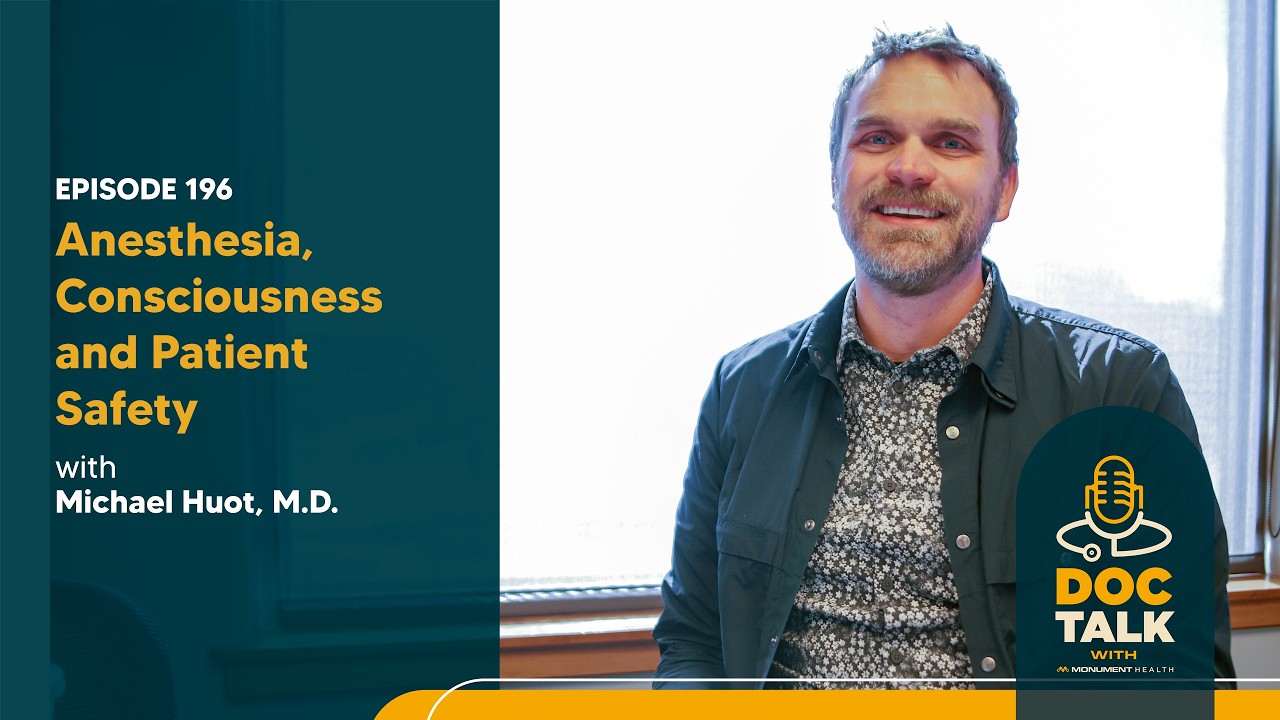

Listen or watch this episode on your preferred platform:


MARK HOUSTON: Hello again, everybody, and welcome to another edition of Doc Talk with Monument Health. My name is Mark Houston. And most of us, well, hopefully not most, but a large number of us have been there. You're on a cold operating table. The lights are bright. Someone's asking you to count backwards. And then there's nothing. You wake up later, and you're not even sure what the person's name was. The anesthesiologist is honestly one of the most important people in the room, and we almost never get to talk to them. Today I get to, again, because Dr. Huot is back with me on the show. This is your third time now. Two more and you get the coat, like for Saturday Night Live.
DR. MICHAEL HUOT: Okay. I want that coat.
MARK HOUSTON: Back in February, I had colorectal surgery to remove part of my colon because of diverticulitis. And Dr. Michael Huot was the anesthesiologist who kept me safe through the whole thing. I was super relieved that morning, Doctor, when I saw you walk through to say, hey, man, I'm going to be taking care of you. I've got your back. Not that any of the other anesthesiologists in Monument Health wouldn't have been just as good, but kind of having a relationship with you and these podcasts and your TikTok fame does help knowing these sort of things, right? So I'm glad you came in here to do this again. Because having had a procedure done that was a major procedure, I would assume, you know, having somebody in the room that you feel super confident with is very important. So thank you for coming back and doing this with me.
DR. MICHAEL HUOT: Yeah, absolutely.
MARK HOUSTON: I don't usually get to talk to any of the doctors that have actually been in a room when I've had something done.
DR. MICHAEL HUOT: Yeah. That's right.
MARK HOUSTON: So you are kind of a known quantity around here, I would think. People recognize you. Like I said, you've got a TikTok following that I think a lot of doctors would either love to have or would want nothing to do with, right? So you're clearly not the guy who disappears after surgery. What made you kind of want to be visible and accessible in that way that I don't think a lot of doctors do?
DR. MICHAEL HUOT: I think it's partly from what you just kind of mentioned. You know, a lot of people don't have exposure to anesthesia. We come in, we keep you safe. We're actually with you for a long time, but patients don't know all the work that goes into what we're doing because most of it, you're asleep for. And our goal is to comfort you in the preoperative area and then safely see you home after the procedure. And if we've accomplished that goal, then we've been successful. So it's kind of nice to have a little bit more exposure, so people get a little bit more access to what we do as anesthesiologists and what our job entails. You know, that morning walking in and seeing you, I probably felt the same way that you felt. It's so fun as an anesthesiologist to see someone you know.
MARK HOUSTON: Oh, sure.
DR. MICHAEL HUOT: Because most of your patients, you don't know. So it feels fun to have that kind of continuity or relationship with somebody and then to be able to take care of them.
MARK HOUSTON: Right.
DR. MICHAEL HUOT: And it's wild how life works because, you know, I never really think things are a chance, but it's weird how many times I walk in a room and I know somebody. You have a one in twelve chance of having me, or maybe it's the third time I've done an epidural for somebody. It's like the odds of me doing an epidural for every one of your children is horrible. It'd be one in twelve times. But somehow it's me the third time, you know? So I think the world has a way of kind of putting us on a certain path. And I think that's so cool. And it's cool living in a small town, because you get to take care of people you know as an anesthesiologist. So it's a blessing.
MARK HOUSTON: And it seems like that really comes through with you as well. I do remember that morning getting ready to go, having you come in, and then eventually being rolled into the room, right? And the room is intimidating for a lot of people right away because stuff is happening. I mean, nobody's just standing there waiting for you, right? You're wheeled in, the nurses are there. You know, you're one of the first faces that people see when they come in. And that moment of trepidation, you want to take that away from the patients as soon as you can. Is that something important that you feel needs to be done right when you see the face of that patient on the table?
DR. MICHAEL HUOT: Yeah. We try to keep you calm, we try to be pleasant. I understand it's intimidating. I mean, the first time I saw an OR was extremely intimidating. And then what's even weirder about it is everybody in the OR, that's their job. That's what they do day in and day out. And so there's no way to eliminate the normal banter that goes on between, you know, whether it's people at Starbucks or McDonald's, or here in the OR people are just chatting like they do on a normal day. Which I think can be a little bit weird for a patient, because you go in, there's this intimidating room, and then everyone's just kind of acting like it's a normal day, because it is a normal day for them. And so I think to be cognizant of, hey, we have this patient awake here, and let's try to make this as smooth as possible until they're off to sleep.
MARK HOUSTON: And I think it's important for people to know that. That's a great way to put it, that it's just a normal day for you. This is your job. This is like getting an order at Starbucks or going to get your oil changed somewhere. These guys, this is what they do day in and day out. Hundreds of procedures, right?
DR. MICHAEL HUOT: Exactly.
MARK HOUSTON: Well, if you can kind of remember my case at all, or just in general for what you do. Once I got wheeled into the room and got situated, you know, I realized, oh, this is pretty impressive. Seeing the robot in the corner was really cool for me. That's one of the first things I love to see, was that thing pretty soon is going to be in me.
DR. MICHAEL HUOT: Yeah. In various different ways.
MARK HOUSTON: Right. But when the patient's there, I don't remember if it was just an injected anesthesia. I would assume for a procedure like that.
DR. MICHAEL HUOT: Yeah. So most of what we do, ninety percent plus of the time, what we did for you, we move you over to the table. We hook you up to all the monitors. You know, we want to make sure the electrical activity in your heart's good, your blood pressure is normal, your oxygen saturation is all normal. We just want to make sure that your baseline is perfect before we start. So that takes a little bit of time, you know, three to four to five minutes. And that's what most people remember, is that initial part. But we're starting to log data on you as an individual, so we understand what we can give you and what we can't. And then we inject medication through your IV to get you off to sleep. Once we inject that, within ten, fifteen seconds, you will be completely asleep. So we inject that, we get you completely asleep. When we do that, you actually stop breathing. And so there's a lot of nuance to what we do to make sure that we can breathe for you, because that can be complicating in some patients. So that's part of what we do in that initial evaluation, where we're just trying to be friendly and nice. We're actually evaluating, well, what are some of the pitfalls in this anesthetic? What could go wrong? What do I, as an anesthesiologist, need to be aware of and be prepared for to make sure that this is a safe anesthetic? So we'll breathe for you for a little bit. And then once we have you really nice and deep under anesthesia, we actually put a breathing tube down into your trachea. And then we hook you up to our ventilator, and we completely take over your breathing. So in that moment from you going into the room, we get the baseline. Within five or ten minutes, we have fully taken over all functions. We can control your heart rate. We can control your blood pressure. We are breathing for you. We can tell exactly what your depth of anesthetic is. And so it's a fascinating field, because it's like a little physiology lab. We give you a little bit of this medicine, we raise your heart rate a little bit. We give you a little bit of this medicine, we can drop your heart rate. We can speed up your breathing, we can decrease your breathing. And we want to keep you in this plane of kind of not conscious, but we don't want to keep you too deep either. So we kind of keep you in this plane throughout the anesthetic, just to make sure you're nice and safe and everything's perfect. So it's a fascinating job from that perspective, but from the patient's perspective, they don't know all that's happening.
MARK HOUSTON: No, you obviously don't. As you're explaining that to me, and this might be the dumbest question I could ask you, but, you know, when people hear the words you're going under, or you're going to have anesthesia, they think, oh, I'm going to sleep. And in a sense that's true. But you said you have to take over for their breathing. So you're not really, I mean, you're asleep. But why do you guys have to control the breathing? What happens there?
DR. MICHAEL HUOT: Well, so there's, again, there's a lot of nuance to this. But when you're going to sleep, you're not actually sleeping. We are giving you anesthetic agents to put you under anesthesia. So it's not like a sleep state. It's different than that. And what's interesting about that is we know what receptors these anesthetic agents work on, but the science behind consciousness is not fully understood. So a lot of this is just, well, we know that we give you this and this is what happens, but we don't fully understand the science behind why that happens. The reason we take over breathing, and sometimes we don't, sometimes we don't for certain procedures, but when you have the robot, it's going to be put in there and they're going to be doing surgery, they have to blow up your stomach, to really inflate it like a balloon, so they have room to work in there. When they do that, it pushes up on your diaphragm, and they need all your muscles to relax. So part of our anesthetic is paralyzing you. So we completely paralyze you so that all your muscles are paralyzed. So you couldn't breathe on your own even if you wanted to. So it depends on what the procedure is. But for what we call like a laparoscopic procedure, where they need that muscle to relax and it's going to be pushed up on your diaphragm, so you really couldn't breathe very well yourself, then we put a breathing tube in and we use positive pressure ventilation to take over your breathing. And how that works is fascinating, because we monitor your end-tidal CO2. You know, when you breathe out, you're breathing out CO2. And how high that level is will trigger your brain when to breathe. So even if we have you paralyzed and we have that CO2 level too high, your body might start to try to breathe. So we typically breathe you fast enough where we get that CO2 level down low enough where your body's not trying to breathe on its own anymore. So there's a lot of science that goes into it. It's absolutely fascinating how we do it. And so at the end of the case, when we reverse the paralytic and we're waking you up, we breathe really slow and we let that CO2 level rise, rise, rise. And at some point, all of a sudden, your body's like, oh, this is too high, I need to breathe. And then you start breathing. And that's how you come out of it. Then we turn off the vent, and you start to breathe on your own. So it's fascinating how that works. It still amazes me to this day, twenty years of doing anesthesia. It still amazes me now that that's what we do.
MARK HOUSTON: So during the time that I'm in there being operated on, then what are you doing? Are you just monitoring? Is that basically what your function is as an anesthesiologist in that room?
DR. MICHAEL HUOT: Yeah. So the highest risk of anesthesia is going off to sleep, because you've got to take over breathing. You've got to figure out how to do that. And if you have trouble doing that, you have to figure that out extremely fast. That's where anesthesia is, you know, people say it's five percent terror, ninety-five percent boredom. You know, if you're a family medicine doctor and you go into the clinic and you say, hey, I got a problem, doc, he can ask his friends or look it up on, you know, ChatGPT or Google. If you have a problem in the OR, you literally have minutes to be able to fix it. You don't have time to look on your phone. You have to know what to do immediately. So going to sleep and waking up are the two most dangerous things. There's other procedures we do, like if you're having a heart surgery, when we go on the bypass machine, that's dangerous. So there's other nuances to other procedures. But those are the two most dangerous. And then the plane of anesthesia in between is just where we're adjusting your anesthetic level. You know, your blood pressure goes up, your heart rate's starting to go up, and we think, oh, you're a little bit light. We might turn the gas up a little bit, and turn it back down, and adjust your breathing up or adjust it down. And who's actually in the room with you can vary depending on where you're at. At our hospital, we do a team model. So I work with four CRNAs, four nurse anesthetists. So the nurse anesthetist is in the room monitoring the anesthesia the whole time. I'm not actually in the room the whole time. I'm there when you go to sleep. I check in multiple times during the case. I'm there if there's a problem or a complication, and I'm there at the end. But the nurse anesthetist is in the room, kind of adjusting that anesthetic level while you're going through your procedure.
MARK HOUSTON: Are you going to other cases or other procedures then in that kind of in-between, you kind of bounce back and forth?
DR. MICHAEL HUOT: Yeah, we're bouncing back and forth. So we'll be supervising more than just one OR at a time.
MARK HOUSTON: Okay. You know, you talk about waking up, right? And I know that's a big fear that I think a lot of people have when they go under anesthesia. So how do you kind of have that conversation with patients, or what would you like them to know if that's a fear? I mean, because none of the fears they have are really irrational. I mean, everybody's going to be scared of something like that, because, you know, it's a surgery. How do you have that conversation with them, like, look, you're going to be okay. The odds of you waking up in the middle of this are, I would assume, pretty low.
DR. MICHAEL HUOT: Yeah. Very low. You know, with our modern medications and our ability to see how asleep somebody is, waking up in the middle of a case is something that's extremely rare. And I'd say that is kind of a fear of people. And then people also are like, well, make sure you wake me up at the end of the case. And we always joke, well, that's what we get paid to do. We actually get paid to wake you back up. That's where the money comes. I don't get the check until you're awake, you know. And we do hundreds of anesthetics. I mean, literally, we're supervising literally thousands of anesthetics a year. So our depth of knowledge and our experience, our main job as anesthesiologists is to know when someone starts looking like they're not doing good, to be able to bring them back up and make sure they're doing good. So we are extremely good at taking care of patients. And if there's complications, we're extremely good at modifying those complications. You know, one cool thing about anesthesia is, prior to like the nineteen eighties, anesthesia wasn't considered very safe. So anesthesiologists as a specialty, they decided to do a lot of quality improvement. They looked at case reports, and they just made drastic changes year over year. And there has been no specialty that has outperformed anesthesia in what they've done in safety in the last forty years. So anesthesia has become incredibly safe, and it's through the work of people working in anesthesia, constantly looking at what we're doing, constantly modifying it, constantly making it better, to the point where now we would consider anesthesia for most people as safer than just driving in the car.
MARK HOUSTON: So I've seen the drivers around here. Yes, that's one hundred percent accurate.
DR. MICHAEL HUOT: You know, and we risk-stratify too. I mean, there's no doubt we do high-risk, very high-risk things. You know, in western South Dakota, there's anesthesia done all over the place. But if you're a complex case, or if there's high risk to it, they come to Monument Health main hospital, because there's nowhere else, you know, other than the Sioux Falls area that has that kind of level of anesthesia expertise. And we're honest with patients. I mean, if somebody is very high risk, or it's a very touch-and-go procedure, we would say that to the patient before. So I think part of being a good anesthesiologist is being comforting, knowing that you are getting world-class care right here in South Dakota, but at the same time, being honest about what that looks like. I mean, if somebody comes in for a big trauma case and it's going to be extremely difficult, I think the patients deserve to kind of know what we're thinking too, even though, at the same time, we are going to really take good care of you.
MARK HOUSTON: What is, in your opinion, what is one of the most difficult cases or difficult procedures that's done? Do you have any that kind of come to mind that you're really, I mean, not that you're not dialed in for every single one, but one you're like, all right, gotta be perfect.
DR. MICHAEL HUOT: So probably the hardest ones that we do are trauma cases. I'd say, because we have planning. Like when you came in, we knew you were coming in. I was able to look through all of your medical history. I was able to talk with you, understand every single pitfall, and really examine with the team, okay, what do we need to watch out for here? How do we make this anesthetic perfect? When we have a trauma come in, it's somebody, you know, got in a car wreck on Eighth Street. We know nothing about that patient. They might not even be conscious. They might have lost half their blood volume. They roll into the emergency room, and we get a trauma page alerting, hey, there's a trauma in the ER. We go visit, see the patient, and the surgeon might say, this person is going to die unless we go to the operating room right now. And so all of a sudden, you call the team, hey, get the OR ready, we're coming right now. We don't know anything. We don't even know the patient's blood type, you know. And we're rolling back to the room, and we save people's lives every single week. Like, you'd be surprised how many times. We probably have more than one trauma alert every single day. And our team saves people's lives every single day, really, because we're covering all of western South Dakota. That's parts of Nebraska, Colorado, Wyoming, North Dakota. If a major thing happens, people are flying in on the helicopter. And so even though, you know, you go out in town, you're looking around, things look normal, at the hospital there's often a trauma going on, where doctors are practicing, everyone, the whole team, is practicing at the top of their game to save someone's life. And I think those are the hardest cases, because you don't really have time to plan. You've got to be quick on your feet. And it really is, moments can be the difference between life or death for people. And so that's kind of the hardest part, I'd say, about being an anesthesiologist.
MARK HOUSTON: Well, there has to be conditions that people have that come in. I know we talked about this once before, and I'm just so interested in this condition of malignant hyperthermia, which some people have, which can be extremely, well, my wife and son have malignant hyperthermia. So if they come into an OR or have to have a procedure done, anesthesia can be dangerous for them, correct?
DR. MICHAEL HUOT: Yeah, it could be if the team doesn't know. There's a couple different agents that you have to avoid if somebody has malignant hyperthermia. There's really just two. And as long as we know, then there's essentially no risk of them having hyperthermia.
MARK HOUSTON: So it used to be a bigger deal, I'm assuming.
DR. MICHAEL HUOT: Well, it used to be a bigger deal, I suppose, when people didn't know. It's still a big deal. But if we know that somebody is susceptible to it, we absolutely can make them have one hundred percent safe anesthetic. Now, in a trauma situation, that's where it gets a little hairy, because we don't know. And I have had that happen to me in my career one time, where, you know, the family rushed in and was like, hey, that person is susceptible to malignant hyperthermia. It's like, oh, man, I'm glad you came in and told us that, because, you know, when you have a trauma patient, they can't talk to you. That's probably the one time when you really need to know that information.
MARK HOUSTON: What is malignant hyperthermia, I mean, as a condition?
DR. MICHAEL HUOT: Yeah. So malignant hyperthermia is essentially you react to anesthetic vapors or non-depolarizing muscle relaxants. And it can just kind of uncouple this process in your body that makes your temperature become extremely high. And so we can treat that with something called dantrolene. So we can treat malignant hyperthermia. But if somebody gets it, it's extremely dangerous. I mean, it is probably one of the bigger medical emergencies that happens with anesthesia. We normally, most people, we keep you asleep with anesthetic vapor. Things like sevoflurane, desflurane. If somebody has that, we keep them asleep with propofol instead. So we ramp up the propofol through the IV, to a level where we have them under a general anesthetic, and we avoid the vapors. So if you avoid those two agents, the vapors or the depolarizing muscle relaxants, then that process won't happen for the patient.
MARK HOUSTON: So is it true that the rooms have to be taken care of, I mean, because the vapors can stick around for a while, and they even have to be? Or is that a thing that...
DR. MICHAEL HUOT: So that's kind of a thing of the past. You know, in the past, when we have you on the ventilator and we have anesthetic vapors. So this is cool, because I'm a chemistry major. So there's a lot of chemistry in anesthesia. But you basically have a flow going over a volatile vapor. It picks up this and you deliver it through a percentage into the lungs. It goes to the brain, puts the person to sleep, goes throughout their body, then they blow it out. Well, before, our scavenging systems used to push some of that vapor into the room. Now that's not the case. Now we have that hooked up to scavenging systems that push that vapor out the roof of the hospital.
MARK HOUSTON: So you're not kidding with how far technology has come with anesthesia.
DR. MICHAEL HUOT: Yeah, it's come a long ways. I mean, the technology that we have now and the medications we have, and what we're doing, is very fine-tuned. So back in the day, when it used to scavenge in the room, you did have to be a little bit careful. You know, somebody potentially with malignant hyperthermia could be breathing in some of the vapor. But now our systems are pretty well dialed in, that I'd say you don't have to worry about that.
MARK HOUSTON: How is AI showing up for you guys in anesthesiology?
DR. MICHAEL HUOT: It is showing up in some of the decision support. There's an AI tool that just came out about twelve months ago, where you essentially can tell it the history of a patient, and it will then give you all of the anesthetic considerations for that patient. And so we've kind of played with that, which is interesting. You know, one of them, I asked about a patient, just me and my partner were playing around with it, and it didn't bring up one very important consideration with this disease process. I missed it, and I was like, hey, wait. It was Dr. Feehan, I don't know if you know him, but I was like, hey, this AI didn't say that this was an issue. That's an issue, isn't it? He's like, oh, absolutely it is. So it's not perfect. It still misses things, right? I think AI is going to play a major role in health care in the future. There's no doubt about it. I mean, I've actually been saying this for a couple of years. And, you know, if I said this two or three years ago, people would be like, no, that's not going to be the case. AI has no empathy, you know? Well, not true. There's a study that showed patients actually felt like AI was more empathetic to their problems than humans, you know?
MARK HOUSTON: Right.
DR. MICHAEL HUOT: And I can see how that is, because, yeah, our dog unfortunately passed away about six months ago. And I was asking AI, you know, all these things, the symptoms, because I was just playing around with it. The first thing it said was like, oh, I'm sorry that your dog passed away. I was like, oh, that kind of made me feel better, even though I was...
MARK HOUSTON: Exactly.
DR. MICHAEL HUOT: So yeah, AI's coming in strong. I think AI's limitation for anesthesia is, you kind of still have to have a human, because computers will always be faulty. You know, they'll freeze or whatnot. That might be fine in like a family medicine visit where you're getting treated for hypertension, because it's like, oh, it froze, reboot the computer. If that happens in the OR, a person could die. So you have to have human interface. It cannot, it has to be so reliable. It can't even freeze for thirty seconds, or there's going to be a problem. So, you know, maybe if it ever got to that point, it would kind of impact anesthesia. But there's no doubt about it, AI is impacting pretty much every profession. It's everywhere. You know, we're part of the Mayo Clinic Care Network. Their goal is to implement a thousand AI processes within their hospital in the next year at the Mayo Clinic. So pretty much every specialty is implementing some kind of AI quality decision support system. So I think it'll really make things better for health care, for sure.
MARK HOUSTON: And when you're going to your family doctor now, you see the signs on the wall that say, you know, this may be recorded to help. And I'm assuming that AI is taking what you're talking about, and just paperwork alone, oh yeah, could be a huge help for what you guys do.
DR. MICHAEL HUOT: Yeah. And we track that. You know, this isn't part of my anesthesia job, but this is part of, you know, I'm the executive medical director for quality and safety, for not just this hospital, but the whole system. And we track how we can tell when physicians and providers are doing chart work. And so we can tell when they're doing chart work in the evening. So a lot of physicians, providers, see patients all day. They'd go home, put their jammies on, and then they'd finish their charts. Well, since we've implemented this AI program that essentially listens to the conversation and dictates a note, they haven't had to do that. And the notes have been much more accurate, because things are caught in there. And it's just incredible that AI can do that. The next step is AI is going to start to listen, but then it's going to start to suggest. It's going to start to be like, well, doctor, maybe you need to think about this diagnosis too. Or maybe you need to run this test. And if you think about what AI does, how it processes thousands or millions of interactions, and it can hone in, and be more accurate than physicians in a lot of ways, I think it'll really make care safer. And it'll really boost quality for everybody.
MARK HOUSTON: Absolutely. Yeah. So I'm excited about that. Well, you also are the medical director at the pain management clinic here at Monument Health too.
DR. MICHAEL HUOT: Yes.
MARK HOUSTON: How does that roll into what you do as an anesthesiologist?
DR. MICHAEL HUOT: Yeah. It's weird that pain and anesthesia are linked, because they are completely opposite. You know, anesthesia is like high acuity, and pain is not. Pain's, you know, managing chronic problems. And so it's weird that the two are linked. I think the two are linked because of the interventional side of anesthesia. We do a lot of procedures, nerve blocks. We're doing epidurals. And so kind of part of the core of pain medicine was a lot of interventions, or intervention-heavy. And so anesthesiologists, way back when pain medicine kind of started, were just positioned well to be able to do those same things. But, you know, they are two extremely gratifying specialties, totally opposite, but to help, you know, I had a lady the other day tell me in the pain clinic, you know, I went home, I came out of the bedroom, older lady, stood up, twirled around, and my husband said, oh yeah, your outfit looks great, honey, you know, just like what a husband should say.
MARK HOUSTON: Yes.
DR. MICHAEL HUOT: And she's like, I'm not showing you my outfit. I'm showing you I can stand up straight for the first time in ten years. And I'm not having back pain. So that kind of story, it's just like, man, those have to feel great.
MARK HOUSTON: Yeah. Oh, yeah. Pain just can pull the rug out from under people's lives.
DR. MICHAEL HUOT: It can be so... but then it's beautiful to take care of people like you too, because, I mean, you know, life is just human interactions. It is, you know, somebody faced with something they have to go through, and nobody wants to have surgery. Nobody. I mean, it's scary. So it's fun to also be there to hear people afterwards.
MARK HOUSTON: I mean, I'm assuming you don't get a lot of that, you know, because most people are like, oh, thank God the doctor was there. And obviously, thank God the doctor was there. They're the ones. But, you know, the crew in the room at that point all should get a thank you, because everybody kept you alive and made sure the surgery worked.
DR. MICHAEL HUOT: Oh, absolutely. And that crew is so crucial. From, like, if you talk about surgeons, surgeons, we can tell how long it takes them to operate based on who their scrub tech is and what their experience level is, just the person handing instruments. So it really is like a well-oiled machine. Everyone in there plays a crucial role to having it be successful. And I'd say, even from a bigger, you know, step back twenty thousand foot view, quality at our hospital, and the reason we've been able to make such progress in quality, really comes from an all-out dedication from the valet to the CEO saying, this is important, and everybody working as teams. But certainly the OR is one spot where you definitely see that teamwork firsthand. It's happening in real time, to make sure that every patient coming through has a safe and successful experience.
MARK HOUSTON: Well, and just thinking back to that day, again, like we mentioned earlier, going in, and after you had said, you know, that it's just like their normal workday, what I'm thinking about, I'm like, that's exactly how it felt. Because at no point did you feel, or me specifically laying there, at no point after I got in there, did I feel like, well, I don't know if this is going to work. I don't know, you know what I mean? It was like, huh, this is, I'm going to wake up here in a little bit, and, you know, I'm going to be in a little bit of pain. Obviously, I've been cut into. But I'm not going to have any of these worries or fears about what just happened in that room. Well, I wanted to get to one question, because I was reading something before you came in, and you mentioned it just briefly earlier, that researchers now are using anesthesia to study consciousness itself. They're trying to figure out what makes us aware as human beings. Have you read anything about this, or have you looked into this at all?
DR. MICHAEL HUOT: I mean, to be fair, I haven't looked at the most recent research into it. But part of anesthesia training does kind of delve into that quite a bit. You know, what is consciousness, which is kind of a fascinating thing. When is someone conscious or unconscious, or aware or not aware? You know, under anesthesia, it's absolutely fascinating, because there's lots of things we can do. You know, if we just put you under anesthesia, like a general anesthetic, we're just using gas, and you're completely unaware, unconscious. And I pinch you really hard, your heart rate's going to go up, and your blood pressure is going to go up. So somewhere your body's still processing, like what we call nociceptive insults. So you're still processing pain, but you're not aware of it. And so in anesthesia, we use lots of different medications. We use pain medications then to kind of blunt that response, because your body still is sensing pain on some level, even though you're not conscious. And that's always fascinated me. And the other thing, I mean, there's just, it's just wild. And then we're using paralytics. If we only use paralytics, we could give someone, we could completely paralyze someone and have them be wide awake.
MARK HOUSTON: Oh, that's, you know, and I think that's what terrifies people.
DR. MICHAEL HUOT: And I think that is what terrifies people. And that's why we have so many different checks and balances to make sure that that never happens. But it's fascinating, because we're using different medications that have very targeted processes, and we're looking for specific responses. It's kind of a cocktail, really, what we're using. But the consciousness component is kind of interesting. And it's the anesthetic gas that's really all that's doing for us, is taking away the consciousness. And again, they're not totally sure. And, you know, they kind of found that out by people would just test it on themselves. I mean, people in the eighteen hundreds were wild. You know, it's like, well, what's this? Let's give it a try, you know, try it out. And then now cut me, all right, what happened? And it was found out, like I think in the eighteen forties, which is wild, like one hundred and fifty years ago. They were messing with ether and found out, oh, man, you know, I just took this, and I passed out, and I woke back up. And so the first demonstration of that was actually, I think, eighteen forty-six in Boston, I think, for a dental procedure, in the Ether Dome, where somebody had dentistry and they were asleep for it, which is fascinating.
MARK HOUSTON: Can you imagine that guy was like, I get to be out, I don't have to experience this awake. This is the best day ever.
DR. MICHAEL HUOT: Yeah, exactly.
MARK HOUSTON: I've also, one thing I've seen or read, and this could be true or not, but apparently you can't dream when you're under anesthesia. I don't know if that's true or not, but to me that was super interesting.
DR. MICHAEL HUOT: I'd say it depends. It depends on what level of anesthesia you're at, and what we're doing. I mean, it's pretty common, like if we're doing a propofol sedation, it's pretty common that people will kind of wake up and have dreams.
MARK HOUSTON: Really?
DR. MICHAEL HUOT: Yeah. If people are under a full-blown general anesthetic, I'd say most of those people don't wake up with dreams. And in fact, it's kind of wild, because a lot of times someone might be saying something when they fall asleep, and then they have this four-hour procedure, and they wake up and finish their sentence, which blows my mind. That's wild. And again, we don't totally understand the basic science behind it. But, like, we literally paused the person's brain, right? And then four hours later, unpaused it, and they finish their sentence like that. When that happens, I just, I'm blown away every time.
MARK HOUSTON: Well, we have to at some point, because, again, you understand the mechanics of anesthesia, but not exactly how it works, and not exactly how it makes you go out and do the things that it does. I just have to assume we'll catch up to that at some point. We'll figure this out as to why it does what it does.
DR. MICHAEL HUOT: Yeah, I'm just kidding. Maybe we'll get to it, I don't know. So far it's working. Don't worry about it. Don't ask any questions at this point.
MARK HOUSTON: Well, is there anything that you wish patients would ask you before surgery that nobody ever does?
DR. MICHAEL HUOT: You know, not necessarily. I think the one thing is, whatever is on your mind, just ask it. Sometimes you can tell someone's a little bit hesitant, and it's like, no, what's your question? You know, several nights ago, I had a patient, a younger patient, and I wasn't busy, but I could tell something was lingering. So I just sat down and we were chatting for a little bit. And then sure enough, fifteen questions came out. You know, all the fears came out, and it's like, oh yeah, yeah, you know, talk about it. And I think that person felt a lot better just to have a conversation about it. I'd say us as anesthesiologists are all incredibly chill people. Like, there's absolutely no, maybe it feels intimidating to talk to the doctor, or to an anesthesiologist you've never met before, but our main goal is to make sure you're comfortable. Like, that's why we see you in pre-op. I mean, we're trying to make sure we have a safe anesthetic plan, but it's vitally important to us also that you're comfortable. So if there's questions, just ask them. We don't think any question is a dumb question. We're happy to answer any questions.
MARK HOUSTON: Do you feel you get enough time with the people? Do you feel like you get to, or are there just too many cases sometimes?
DR. MICHAEL HUOT: Oh, no, we definitely get enough time. I think our model is one where it's pretty nice, actually, because we're never really under the pressure of, oh, we got to see this person and we got to go in five minutes. We're always planning. We know when cases are booked, we know how much time we have. And so we really can slow down and spend more time when we need to. And some people actually don't want that. Some people are like, don't tell me anymore, let's just go. So, make me asleep. Yeah. So we can speed up too. So we can take our foot on and off the gas pedal. But it's very rewarding, I think, to be involved in people's lives in that way.
MARK HOUSTON: Well, you can tell. And, you know, I've made reference earlier to your TikTok account that you have, which is very popular. I mean, lots of people watch your TikToks. I follow you as well, because, you know, you're not just talking about this, and it gives you insight into who you are as a person a little bit, which I think goes so far to people that need to have procedures done, and to need to know that if they're going into the hospital here at Monument, oh, I've watched this guy on TikTok, and he does what I do, and this is funny. And, you know, he's told some touching stories, and he does this with his family, and he's got a new puppy. And you just feel much more confident going in to any job, honestly, if you know that person a little bit more. Do you ever encourage other doctors or people you work with to be like, you guys need to do this?
DR. MICHAEL HUOT: No, I'm not ever encouraging other doctors to do it. But I will say, multiple times a week, I'll walk into a room, and someone will be like, oh my gosh, I'm so glad it's you. I follow you on TikTok. You know, it's kind of funny. Or they specifically request me for epidurals or cases or whatever. I feel bad I can't always fulfill those, of course, because our schedule is the way that they are. But I do think it is kind of cool, that part of it is very cool, because it's like, I don't get to know patients, and they don't know me before I see them. So if someone happens to follow me, and I happen to be their anesthesiologist, it is nice, because it's like, okay, well, you know me, let me try to get to know you then really quick before we go back. So I think, I mean, I've gotten a lot of positive feedback about patients really liking that. It's kind of funny.
MARK HOUSTON: Well, I like them, because yours aren't super long either.
DR. MICHAEL HUOT: I like to keep the short ones in there. Yeah, that's an anesthesiologist attention span.
MARK HOUSTON: Yeah, there it goes. Squirrel.
DR. MICHAEL HUOT: Well, I don't know, I'm afraid to do this, but you said coming in that you had questions for me.
MARK HOUSTON: Oh, yeah, I do, actually.
DR. MICHAEL HUOT: I don't know, I'm gonna open my book here. I don't know how this is going. This is, you know, my third time on here.
MARK HOUSTON: Yes, it is.
DR. MICHAEL HUOT: And I thought, you know, it's cool what you do. You know, you get to talk with doctors, and I do, it's a blast. It's a cool thing that you're doing. But I've kind of observed and watched, and I thought, you know what, Mark never gets to, he's never in the hot seat. So now I'm going to put you in the hot seat. So I was just curious, you know, coming in, what initially inspired you to start doing this, to start to interview, to start doing this podcast?
MARK HOUSTON: Okay. What's really funny about this is, I remember, because this will be episode one hundred and ninety-one or ninety-two. So we're almost at two hundred episodes with this podcast, which in the podcast world is insane. Most people don't get past ten and then they're done. But we, of course, teamed up with Monument Health. I mean, we are a marketing agency here, right? And so we said, well, hey, how can we make your product more accessible? That's the goal. That's what we're hoping to do, to make people understand that Monument Health is a great facility here in our region, because of kind of the island that we're in. And one of the first, I don't even remember who first proposed it, but one of the questions was, well, we should do a podcast with the doctors. And I was in the room when the meeting happened. And as soon as it came out, all eyes turned to me, and I thought, well, this is going to be something I'm going to be asked to. I'm the man for the job, I will be. Because I think it just came down to, I love, I'm curious. I'm ridiculously curious about things. And I love to know what you guys do, because of the specialty, and because of the sheer amount of school and dedication that it takes to do this. There's very, very few jobs that are like that.
DR. MICHAEL HUOT: Oh, yeah.
MARK HOUSTON: And so to me, getting to know that inner working in your brain, that is what I love more than anything. So that's why I decided to do this. I'm like, hell yeah, I absolutely want to talk to...
DR. MICHAEL HUOT: Well, you're fantastic at it. So you kind of mentioned that you're curious. And so in that curiosity, what have you learned that's kind of changed your perspective on health care? You know, after talking to two hundred different doctors, there must be kind of things that have changed the way that just you yourself view health care.
MARK HOUSTON: It's a one hundred. That's a super easy question to answer. It's because, almost to a doctor, that I have spoken with, is the passion that every single one of them has. Usually you'll talk to most people in any given field, and yes, they enjoy what they do, they like it, but there's just a spark. There's something in their eye that clicks when you start talking about what they do. And there's a lot of instances I could turn off my microphone, and thirty minutes later, they'd still be talking about that one thing. And after they're done, you realize, it is, there's something inside of you that makes you, that draws you to this field. I think I've asked so many people, well, how did it start for you? Did you have family members, did you have people that kind of pushed you to it, because you felt like you had to? And most of them were like, no, sometimes I didn't even know, and all of a sudden this thing happens, and I'm in the greatest job I've ever had.
DR. MICHAEL HUOT: Oh, that's cool that you noticed that, because I think medicine, you know, being a physician should be a calling, you know?
MARK HOUSTON: Yes.
DR. MICHAEL HUOT: I mean, you get to be in a sacred space with patients. So it's cool to hear you say that, that you noticed that amongst physicians.
MARK HOUSTON: It was, almost, yeah.
DR. MICHAEL HUOT: I think, and that's who we're trying to find at Monument Health. You know, we tell physicians, hey, this place is not for everybody. We're really looking for people that are passionate about it, and that kind of want to be part of our culture of caring for patients, and really doing a good job. So what's the most unexpected or surprising thing that you've had during an interview? There must be multiple ones during the two hundred. But what's the funniest, or the...
MARK HOUSTON: I don't know if I can talk about it, honestly, because it happened with one of the doctors that is, oh, why can't I think of his name right now? There's been a whole bunch of doctors. But it was a plastic surgeon, one of the plastic surgeons that we've had. Yeah. And, yeah, unfortunately, I'll have to tell you when the mic's off.
DR. MICHAEL HUOT: All right.
MARK HOUSTON: But there have been moments. Yes, you're over there wide-eyed. And again, I mean, none of it, of course, breaks any rules of the things that they're telling me. It's just procedures or things that have stood out to them specifically. But again, it does go back to, every time they're telling a story of something that is kind of surprising, it's always, it always comes from someone coming up to you, like you said, with the woman you helped with pain, of, like, you know, I can't believe you fixed this. I can't believe now I can do this thing again. Right? And every time I hear that, I'm like, God, that's just got to make you guys feel like superheroes. Because, you know, you're just doing your job, you're passionate about it. And it's unfortunate that maybe you don't get to hear that final product as often as you should.
DR. MICHAEL HUOT: Oh, that's true. I never thought of that. So, yeah, that could be... I just got two more questions for you. So, so, you are incredibly comfortable to talk to. You know, I remember the first time coming on here, I was like, asking my wife, what do you think he's going to ask me here? Quiz me some questions. And then I came, and you didn't ask any quiz questions, but somehow we got through the half hour, and it seemed like it passed in no time. So, do you have some tricks to this, or is it just who you've always been?
MARK HOUSTON: It's not who I've always been. Honestly, it took me a long time to get comfortable with asking these kind of questions, or just doing interviews in general. Because doing an interview is not easy, because you want to make it interesting. I want people to listen to this podcast to be like, oh, that was, you know, the questions were cool, the responses were great, the doctor sounded like they were super intelligent, which of course they are, super knowledgeable. But there's a guy that I have, I have a mentor in this business, who has no idea who I am. But in the business of radio and broadcasting and podcasting, you listen to a lot of other people. And there's one guy in particular that I've listened to since the nineties. He was a late-night radio guy for a long time in Minneapolis, and now he's grown into podcasting, which he does quite a bit of. And he is just the best interviewer I have ever heard. Somebody will come in with a book that, hey, we want you to interview this guy. He sits down, reads the book twice, and then goes through the questions. And then when he's talking to these people, you can tell he's paid attention. And so then the responses that he gets are responses you wouldn't normally hear from. So, what do you do for a living? So, where do you, you know, those boring questions that some interviewers will do. So that's where it comes from. It's just, this guy has changed my interviewing life, honestly, because I try to emulate everything he does. So, you know, I've looked into your background, and watched your TikToks a ton, so at least I kind of, so I don't feel stupid coming in and asking a question that you're like, well, you should have known that, that's dumb, right? That sort of deal. So that's where that comes from.
DR. MICHAEL HUOT: Yeah. Oh, well, you're very good at it.
MARK HOUSTON: And this is very difficult, by the way, me trying to read my questions, listen to what you're saying, but think about what my next question is. I'm like, oh, dang.
DR. MICHAEL HUOT: It's easier, I'd rather do anesthesia than this. I'd rather keep someone alive. All right, so last question. And this one, I mean, there's a lot riding on this. Okay. You better choose correctly. All right. But after, you know, two hundred podcasts, you must have thought, what specialty would you be if you were going to go into medicine? So what would that be? And it better be anesthesia. I'm not ever coming on here again.
MARK HOUSTON: The thing is, after this conversation, you know, because we generally talked about anesthesia the first time, and then we talked more about, you were of course the pain and pain management quality. And I think anesthesiology might be the one I would pick, because of the known unknowns in it, like you talked about. And they're the coolest doctors out there. So far, every single one that I've talked to, and like you said earlier, you guys are just chill, right? You're easy to have, not that a lot of the people I've talked to haven't been easy to have a conversation with, but you guys, all the rest of the doctors, please don't take this wrong, you guys have a ton of personality, right? And that's so vitally important. When you're the last face somebody sees generally before they go under, you know, that has to be there, that trust. So I would say either anesthesiologist, or, um, I don't know, maybe dermatology, for some odd reason that seems appealing. I don't know why that seems appealing to everybody.
DR. MICHAEL HUOT: You know, my little sister's a dermatologist.
MARK HOUSTON: Oh, is she really? Does she love it?
DR. MICHAEL HUOT: And she lives across the street from me, too.
MARK HOUSTON: Okay.
DR. MICHAEL HUOT: Yeah, she loves it.
MARK HOUSTON: Yeah, that's cool.
DR. MICHAEL HUOT: She's home at night, home on the weekends, right? Home at lunch. She's home when I leave for work in the morning. But no, she's actually extremely smart. You know, a lot of dermatologists, the ones I've talked to, kind of tend to lean towards cosmetics. She's, like, just incredibly smart, and loves the medical side, which is really cool.
MARK HOUSTON: Yeah.
DR. MICHAEL HUOT: Yeah. Maybe I'll send her your way.
MARK HOUSTON: Well, yeah, absolutely. I would love to. If she wants to talk, we should definitely have her on.
DR. MICHAEL HUOT: She would?
MARK HOUSTON: Yeah. Okay, because we gotta. Yeah. Well, thanks for letting me spin the table.
DR. MICHAEL HUOT: I know that was, last night, I was like, guess what, I think I'm going to put him in the hot seat, and come up with some questions. And it is hard to do. It's what you do, because you're trying to think about, well, I know nothing about podcasting. What am I supposed to ask him?
MARK HOUSTON: Right. Well, that was, and again, that was harder than I thought it was going to be, to really sitting here being asked the questions. So now I kind of have a feel for what you guys are going through, and helped each other out. Dr. Michael Huot, who is an anesthesiologist, board certified, medical director at the Pain Management Clinic at Monument Health, and you're also the executive medical director for quality and safety for the whole system. So go take a nap. What do you do?
DR. MICHAEL HUOT: I know, jeepers creepers. That's why you always bring coffee when you do these interviews, right?
MARK HOUSTON: Thank you so much for coming in. I appreciate it.
DR. MICHAEL HUOT: Oh, thank you. It was very good.