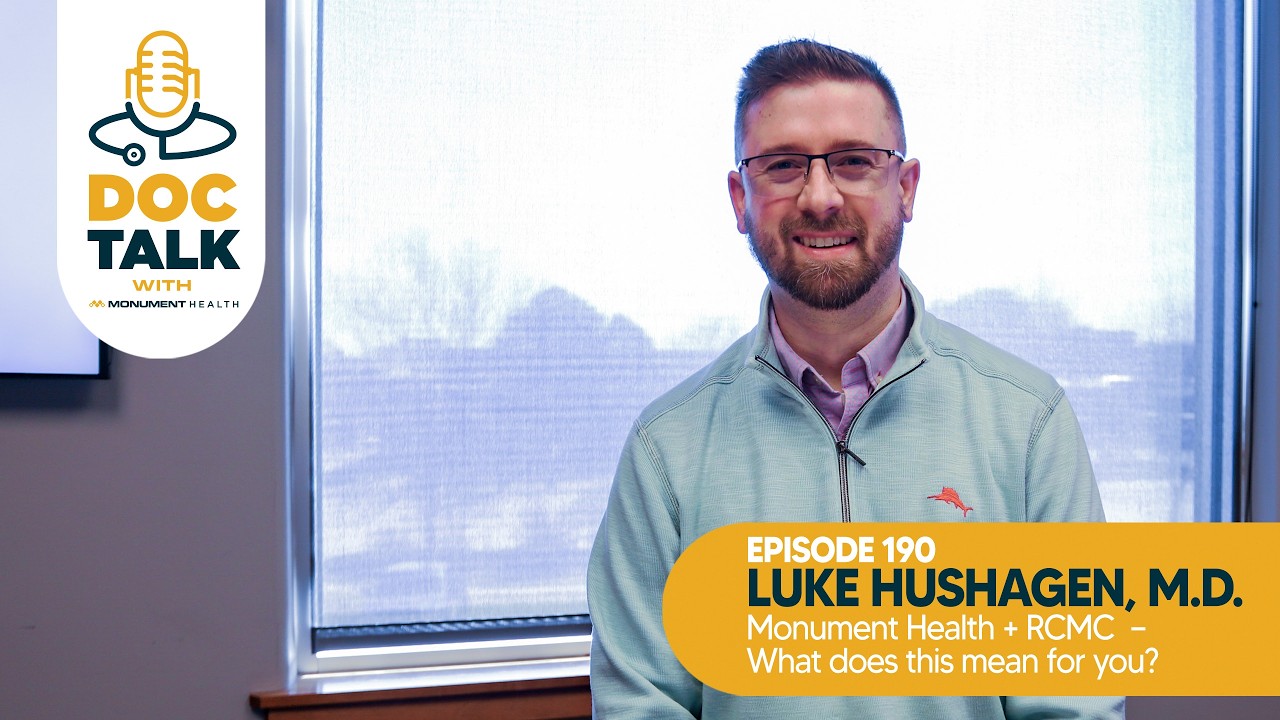

Listen or watch this episode on your preferred platform:


Hello again everybody, and welcome to another edition of Doc Talk with Monument Health. My name is Mark Houston. And we all know that change can feel unsettling, especially when it involves your doctor. The medical field. But sometimes change is actually very good news. And today on Doc Talk, we're sitting down with Doctor Luke Hushagen, to talk about something that's been on a lot of people's minds lately. And that's Monument Health's acquisition of Rapid City Medical Center. What does it mean for you, your family and the care you have come to count on? That's what we're going to talk about today. So, Doctor Hushagen, thank you very much for coming in and doing this.
Absolutely. Thanks for having me.
You bet. Now before we get to the logistics of all of this, I want to start with something maybe a little more personal. You've been building relationships with patients here in this community for years. So what is that? What does that actually feel like from where you sit? And why does that matter in medicine?
Sure. I think it's a huge aspect of patient care is how you connect with your patients. And for me, it's paramount to that. Having good health is making sure that you have someone who listens to you and makes sure that they understand where you're coming from, can meet you where you're at, and they can kind of put themselves into your place and they can make sure that treatment is tailored to the individual as it should be. That's something that I've modeled my practice since day one. I make sure that patients are involved in every step of the way. They understand what decisions are being made and why they have to make these decisions, and what are the ramifications of going one route versus another route versus doing nothing. And so that is really important to me that patients understand the kind of behind the scenes of what's going on. Why something may be this way is, well, maybe this option is the best option, but we have to go through these hurdles to get there. And maybe it's also the best option, but financially not feasible. And you need to do something else first. And so making sure that patients are involved and understand those kind of nuances is important because if you just tell someone, hey, you have this disease, like you have diabetes, we're going to treat it this way. There's no say in it. I find that you don't get the buy in and it's, it's if you go to some place and you're going to go buy a car and you're like, no, I don't think this is the right car for you. You're going to buy this car. Like you're going to walk out of that place and you're never going to come back. And so you kind of have to view it that way and have people involved in their decision. And I think once you do that, it's also a lot easier for them to kind of understand, well, I did this and now maybe the medication I pick didn't quite have the side effects that I, or has side effects that I wasn't expecting to have. And, but I was aware of that. Now I know what to do. And we can kind of circle back and make a new decision on that. So.
Well, where did, how did this all start for you, doctor? Like where's your background in this? Where are you from and how did you end up here?
I mean, my background specifically, I'm from Bismarck, North Dakota.
North Dakota, boy.
Yeah. So eventually I wised up and realized that it's warmer some other places and came to the tropics of South Dakota. So, but this is kind of the general community that I grew up with. And for me, Bismarck and Rapid City are very, very similar. And so that was one of the things that drew me here. My wife has a little more deeper connections to the Black Hills area. And so when we came in, got done with our years and years of training and wanted to kind of set down roots and come to a place that we could be helpful and be part of a community. Rapid City was high on our list, and it just happened to work out the way that we both were able to find jobs. With me with Rapid City Medical Center right away and with her Black Hills Pediatrics and then later Rapid City Medical Center. But it was in terms of what drove me into medicine. I honestly don't remember ever wanting to do anything different. I grew up in a household of parents being teachers and professors, and so they always kind of pushed academics and wanted you to kind of see your full potential in that way. And for some reason, medicine was just something that always kind of drew me.
So did you have anybody in the family outside of that that was in medicine, I mean, the teachers and professors, but did you have anybody in the medical field at all?
Not not like direct relatives. I think my mom would tell me that one of her uncles was an anesthesiologist and I. But no one that I had a direct model to look at and say, well, this person to kind of say, well, they're a doctor. They do well, they like it. I want to do that. It was just kind of, I think, unique to me.
Well, a lot of people going back to this transition that's happened, they've made pretty big news here a couple of months ago when it was first announced. A lot of people are probably hearing Monument Health attached to their clinic's name for the first time, Rapid City Medical Center now. And wondering what that means. So let's just say it plainly, I guess. What should your patients know about what this change is actually going to affect? And maybe even more importantly, what it's not going to affect?
Sure. I think that anytime change happens, I think those are the two important aspects to look at. It's like, what is going to be different and what is not going to be different. I think in this situation, it's almost more important to say what is not going to change. And I think that what is not going to change, and I can speak to myself specifically, is that the how you interact with your physician or your provider, whether it be a midwife, a nurse practitioner, an audiologist, whoever it may be, that interaction is not going to change. We're not going to be putting anything, any new barriers between you and your provider. The care that you receive, the respect that you get in that office is not going to change. The same goal of patient centered care is not going to change. I think that is something that we want to hit over and over again, is that while the provider may be in a different location, the signage might be a little bit different on the door. There may be a different logo attached to their brand. There might be a different logo on the bill that you receive. But when you're in the walls of the clinic, the care you're going to receive is going to be the same.
Did you have, you've had a lot of people kind of a little apprehensive talking with you about it since the news was announced?
I mean, I wouldn't say it was unexpected. I think just with the change in general, I think everyone gets a little apprehensive because I think anytime you hear someone who is really important in your life is going to be changing, whether that be your pastor or minister, your banker, your dentist, or your doctor, if you feel like, well, is it going to impact me? Am I going to have to go find a new person? Like, I've put a lot of trust in this individual and I don't want to have to start over from scratch. And I get that a lot. And I just want to emphasize that is not going to, that should not change. The apprehension that I get of saying, well, why would you want to go with Monument? Why would you not want to go with some other entity? And I think the message I bring is that we're looking for kind of continuing to foster this relationship with the community of Rapid City and the surrounding areas as a whole. And for me, it was important to see what organizations have been here, what have they done? And that was what kind of drew me towards Monument was like, we have kind of a similar mindset and vision for the community. If we want to be here, we want to be not only for our patients but for ourselves. We want to have options of excellent medical care. I mean, I'm a patient as well. So I think that was a thing that they understand. We felt, I felt that Monument understands the community. And also there's a lot of infrastructure already there. A lot of my patients are already part of that system, seeing specialists. And to kind of have that immediate continuity and easier access, I think was a major selling point to me.
Well, and you kind of answered this here. But probably the most practical question that come May first when it officially happens. I believe in this podcast comes out, though, it'll already have happened.
That's my understanding, right?
So patients can still see you and people that they already know. So that first appointment, is it going to look any different for anybody coming into the clinic?
I mean, again, just the surroundings might be different. Like, so for myself, I have, I'm going to be relocating, thirty seconds down a hill into a different practice, but that will just be different. So the walls that you'll see when you walk in are going to be slightly different, but the same people that you've come to know and come to know that care for you, like my nurses are going to be the same. And so other than the fact that the four walls around you will be slightly different, the nothing else I would expect to have material changes.
Well, what are you most excited about then? I mean, because this is a big deal when something like that happens, when something else comes in and, you know, I don't like to use the word takes over, but, but purchases and wants to expand. So you have to look at it like, well, there's going to be some opportunities here. Maybe. I mean, are there things like that that get you excited for this?
Oh, absolutely. I think the things that I'm most, I have different ways to look at this. So from a physician, I'm very much excited for this change because it will just make continuity of care so much easier. I'm primarily a primary care specialist, so I'm kind of like the family doctor role. So for me, it's crucial that if I have a patient who I have sent somewhere to get another opinion, or if they've been in the hospital for some reason, I want to make sure that things aren't falling through the cracks when they come home. To have all of those documents and testing and all of that be lined up so that I can make sure that I'm not dropping the ball, things aren't getting missed. To have that continuity is huge to me. So this will just make that easier and easier and easier. I mean, not that it's been a major difficulty in the past, but any time you can remove barriers to continuity, it's a win for me. The thing I'm looking forward to is kind of the more of the administrative part of my job is the kind of the collaboration that we've had. And I think that's already been evident with the discussions that we've had with Monument leadership, is that I think we share a common vision for wanting to better health care in this community and make sure that people have better access and make sure that people feel that they don't need to run away from Rapid City to get the best care they can get it here and be happy with it.
That's an interesting idea or thought. Before this happened, before Monument stepped in, was there collaboration between the two entities? I mean, does that generally happen in a community of this size there?
You're going to have to. Okay. When there's, when you have service lines in medicine that are unique to one group versus another group that you're, there's no other option but to be collaborative. And so I think it's historically, there's always a, there's tendency to have it be somewhat adversarial because you're, money, unfortunately rules a lot of things.
Right.
And if you're having people come in to Monument for a service line, but then they go to Rapid City Medical Center for a service line versus other places for service lines. There's always the thought of, well, what if this patient doesn't come back? What if they get plugged into a system and then they get, they realize that it's just easier if I stay within that system. Then that is a fear that has happened in the past. And I think, I wouldn't say it happens often, but it was something that was always on people's minds, at least from our side of things. And to have that go away is also a major win where you don't have to worry about, well, if this person sees this specialist, am I going to lose it for other specialties?
And well, and I wonder if a lot of people, I mean, that might put some people at ease because I'm sure people think that way. They're like, well, if I don't want to go to Monument, I'm going to go here. And if I don't want to go to Rapid City Medical, I'll go to Monument, and I don't want there to be any, you know, like you said, that adversarial position is there, but I think it helps to understand that. Well, you guys, you did kind of communicate. I mean, you kind of had to do that already. So there's a little thread, right, that kind of already connected the two. So hopefully, you know, people shouldn't worry about that as much.
No, I think right now the conversations that we've had have been very fruitful. And I think the collaboration is there. And I think the again, the common vision and goals are there. I think this is going to be a positive change for the community. I think the other thing I'm very excited about is just kind of the resources that we, as Rapid City Medical Center will now have access to that we maybe previously didn't.
That was my next question. Like, because of the, the connection to the Mayo Clinic, that Monument has, is that, is that important to you?
I mean, it certainly is for me because I think I have a lot of patients who, again, from, I look at this from a multiple kind of lenses as a physician, as a patient, and then as like an administrator from the physician side. To me, I'm, anytime you have more access to resources where you can bounce ideas off people who are going to come at it from a different viewpoint than you are, especially when you have access to like the Mayo Clinic. I think that is a huge difference because you can say, well, I think this, I wasn't entirely sure of exactly how to approach this, but I'm able to reach out to X, Y, or Z person at the Mayo Clinic or even just across the street at Monument and say, well, we're all kind of on the same page about how we want to approach this. And I think that one makes me feel more comfortable about making sure that I'm providing the best care to my patients, but it definitely gives them confidence. Like, well, everyone's on the same page. People have looked at this and we have a goal that should work for you.
Yeah. Well, some people that are going to be listening to this podcast at home right now are going to be, they're still a little nervous, I'm sure, about what is going to be happening. But I think the statements that you've made so far have been very reassuring. And I think everybody should kind of feel that way. But if they're wondering if they should find a different provider or just kind of wait and see, what do you want to say directly to them at this point?
Yeah. I mean, I think my biggest thing for that is if you feel you have a good relationship with the providers that you currently see, I can't imagine any single thing in this change that would have a negative impact there. I know historically, I mean, there's no way around having a medical entity and not have some negative connotation with that. I mean, that's just the way it goes. You're going to have good experiences. You're going to have bad experiences. And I don't think that's unique to any one entity. I think for the people who are nervous, the people who are detractors, I'd say this is our time to show you what we can do and show you what we're about. And I wouldn't by any means cut us off early. I'd say this is where we know that this the merger is a big deal, and we don't take that lightly. And I think my, my certain focus is to kind of hit this hard and make sure that you continue to provide the top level care, the premier care that you've come to expect while having it remain patient centered and patient focused. So I would say that nothing about this in my mind should have a negative impact there.
Well, in people that are listening and people that, you know, the doctors and the nurses and the caregivers that are in both, you know, at Monument and Rapid City Medical Center. I mean, you guys aren't all of a sudden going to become, you know, these monsters all of a sudden? I mean, you still care about the people that you've always seen, no matter what the name is above the building.
Yeah. And again, I don't think that was unique to us. I think we just, I think the physicians as a whole, I mean, I like to think I'm obviously biased about this, but I think you get into medicine because you care about people and you want to make sure that people are taken care of no matter what walk of life they come from. And that is still going to be the single number one goal is to make sure that every time a patient walks into our building, they're going to get the best possible care they can.
Well, and I think that's the best way to leave this right here. And as you guys work together and after the shift happens here, as we move into it through May, you know, I can't imagine much will, a lot of the people that come there on a regular basis will see much difference. And I think that's really the end goal here is what you're hoping for is that that seamlessness that's there. You'll just notice a different, you know, the yellow and blue on the doors or the halls or like you said, the bills you get and that'll be it.
Yeah. That that's our goal is to have it be the visual, the perception change, be as little as possible.
That's great. Doctor Luke Hushagen, thank you very much for coming in and talking about this. I appreciate it. And anytime you want to come back and be on the podcast and talk specifically about what you do, your family practice, I'd love to have you back, man.
Absolutely. It's been a pleasure.
Yeah. Thank you very much.