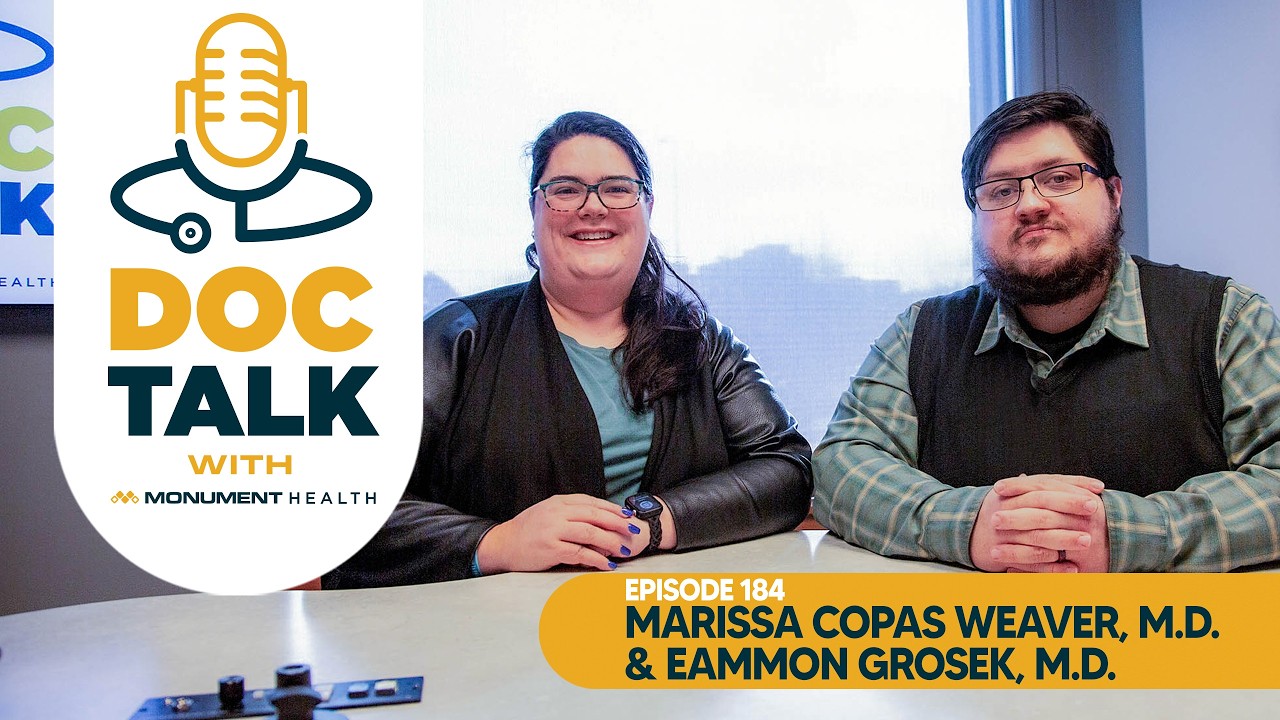

Listen or watch this episode on your preferred platform:


Welcome to Doc Talk, a weekly podcast featuring Monument Health physicians addressing medical topics. Tune in to your health with Monument Health. Hello again, and welcome to another edition of Doc Talk with Monument Health. My name is Mark Houston, and if you've ever looked at your family and thought, okay, who's the doctor for everyone here, then this episode is going to be for you. Today we're going to talk about Med-Peds at the clinic with Monument Health. That's internal medicine and pediatrics under one roof with doctors who can see kids, teens, adults, and not someday, but right now. We're going to talk with Dr. Marissa Copas Weaver and Dr. Eammon Grosek about why this model makes so much sense, especially if you're starting fresh with primary care or trying to simply care for your family. So this is about relationships, continuity, and finally not having to explain your health history from scratch every few years. So doctors, thank you very much for coming in and doing this, I appreciate it. To start the whole conversation today, we just need to know what Med-Peds is. I don't know a lot of people that have heard that term before. So if you could explain in the simplest real world sense, what is it?
Yeah. The easiest way to think about it is to think of it as we are both internal medicine physicians and pediatric physicians. So typically when you get done with medical school, you go onto residency. That's where you really start to specialize. You kind of learn what you're going to be doing as a physician. Internal medicine physicians go to residency for three years. Pediatric physicians go for three years. In Med-Peds, we basically spend two years as an internal medicine physician and two years as a pediatric physician. And so what that means is about every four months or so, you switch. For four months, you are an internal medicine physician. You basically do what the other residents do. You're held to the same standards. You see the same patients. But in addition, you have an outpatient clinic where you're seeing both adults and kids. And then after four months, you switch over to peds. And once again, you do what the pediatric residents do. You see the same patients, you're held to the same standard. And you continue to follow with your longitudinal patients, both adult and pediatric. So the easiest way is just to think of it as both.
Oh, that's a great way to explain that. Well, Marissa, what brought you into this? Why did this appeal to you over just being an internal medicine doctor or a pediatric doctor? Because it just seems like more work, right?
Well, some days. I actually thought I wanted to be a family medicine physician for a really long time. That's why I went to med school. And then I was on the pediatric floor in the hospital and I really enjoyed it. And then I went to labor and delivery and I loved delivering babies, but not enough that I wanted to be on call for that. I also really loved my time in the internal medicine group as well. And so I just couldn't pick between either specialty once I kind of ruled family medicine out. And then I realized that with a Med-Peds residency, I'd be specialized in both internal medicine and pediatrics. And that really kind of sold it for me.
It's, is this not a, I was talking a little bit with Eammon before we started the podcast, like I said to me, I've never heard of this specialty. But apparently it's been around for a while. Is it new though to Monument Health in Rapid City?
Yeah. So I actually applied to family medicine physician jobs when I applied to Monument, and then just said, I'm actually a Med-Peds physician. And so they hired me into the internal medicine department because they didn't have a Med-Peds spot yet. But we've been blessed that Dr. Grosek and I have been able to kind of move into our own Med-Peds pod inside of the clinic where we can do both of our specialties.
Do you see this as kind of the future of internal medicine when it comes to family practice? Or will there always be the need for pediatrics and the need for just, you know, family internal medicine? Do you think this blending will be something that might be the future?
So one of the things I do every year is take a look at the match and see where the USD med students are matching to. And for the five years I've done that, I think I've only seen two match in Med-Peds. It's not a very popular thing. The vast majority of physicians are still going to be internal medicine or pediatrics or family practice. We're kind of the exception, not the rule, I guess I would say.
Well, what we were talking about a little earlier too, and what I think is most interesting about this, is a family brings their baby into you for you to see and they're like, look, we want you to be our doctor. Through this child's toddler years and teenage years and into adulthood. And as long as you're going to be here, you're going to be their doctor. And if conditions arise or situations come up where something happens to that baby or that child or that teenager, you are seeing it from the very beginning. You are seeing that condition develop. And to me, that seems like you have an advantage then to help this person throughout. Hopefully it's not a permanent thing, but it might be. It could be a condition that's not life-threatening, but they're going to have to manage it, like maybe a diabetic, right? Does that give you guys kind of a leg up on these patients as well?
I feel like it does. With the specialization of our internal medicine residency and our pediatric residency combined, we have that maybe more defined experience in like type one diabetes. And so then as we have more experience in the pediatric part of it, when they cross over into adulthood, we have that pediatric background, we're used to this type one diabetes, they're on the regimen. It's a much easier crossover to adulthood. And then we kind of have a leg up on what screenings we need to do now that they're adults, versus someone who would go to a pediatric clinic and then have to go to an internal medicine clinic and start over.
Well, what is a day to day like for you guys then? When you get up and get into your office, it has to be very unique compared to what other doctors do, because of the difference in patients that you're seeing. What does that look like?
I don't think it's terribly different. I mean, I'm still seeing mostly adults. Hopefully I'll get more pediatric patients here soon. But yeah, there are definitely some times where you kind of have to do a one-eighty. The way that you speak to a fifty-seven-year-old and the way that you speak to a five-year-old is very different. So I would say the biggest thing is kind of changing communication styles. And then also the focus of the visit can change a lot. Like for example, well-child visits, it's all about preventive care, trying to anticipate things that'll come up. Adult care is all about trying to deal with the consequences of bad decisions that we all make. So yeah, there is a little bit of change in ethos and you kind of have to switch gears a little bit, but it's still just one patient after another.
What's your patient mix like? Is it mostly kids? Mostly adults? Do you have a mix right now?
I have a little bit of a mix. I'm seeing a lot of actually younger adults. And I'm slowly getting pediatric patients. I've been getting a lot of, um, their parent comes and sees me and I say, hey, by the way, I also do pediatrics, and then the kids will kind of trickle in from the parents. I've had a couple of newborns, which I love. Those are some of my absolute favorites. Just to get them when they're fresh and then watch them grow. But mostly more adults as the word gets out.
I love the fact that adults will come and see you, you tell them that if they have kids you also do pediatric medicine, and then the adult gets to have even more of that conversation with you. When my son was growing up, we'd take him to Black Hills Peds. That's generally where they went. And I never felt, though, like, I mean, I could be there, I could be there and ask the questions, I could sit in the room, but there still felt just a tiny little disconnect there. Like, well, if you were my doctor too, then that whole family history, that whole conversation we could have. And that must be a big benefit for you guys as you get further down the road with this. Would that make sense?
Yeah, yeah. So much of the troubles that we run into in pediatrics can be based on kind of like the environment, you know, how are things going at home? So knowing both the adults and the children gives you a more complete picture. And it's not uncommon that if you're seeing the adult and they have a question about their kid, they could just add it on to the visit super easy. Or vice versa.
Does it make it, I mean, when somebody comes in to see you and both parents come in and the kid is there and all of a sudden you're doing the appointment for all three of them, that's not recommended, I assume. But they're obviously going to have questions while they're sitting there. How do you handle something like that?
If it's a fairly benign question, if they are nervous to start a medication or nervous about taking their own Tylenol or ibuprofen for something, then I'm more than happy to answer questions. If we do kind of start straying away into more complex questions, then I do recommend that they make an appointment so we can focus solely on them and not take away from the child. I love well-child checks. It's where you can sit down and focus completely on that child. And then you get the parents in and you see the social interactions. And it's even better when the parents are also your patients because then you also kind of understand where they're coming from. And what I've noticed is when parents have concerns and you know their medical history because they're also your patient, that kind of helps with the way that you counsel them. I can say, well, your child is healthy and doesn't have signs of that, this is what to look for. And it kind of helps ease the parent's anxiety about it.
Well, I've noticed in doing these Doc Talks over the years that a very important thing is sitting down and actually being able to listen to what your patient is saying, not like, oh, I've got ten minutes with you, I've got to get you in, get you out. And it seems like that is a big benefit to patients. And you're just adding on to that with, look, if I know your family history because you're also my patient, then the outcomes we're going to have with your kids and what we can look for and maybe stop in the future, that's invaluable, right?
Yeah. There have been a lot of studies looking at patients who have primary care versus those who do not. And most of them show that even when we factor out things like socioeconomic status, just having someone who's longitudinally following with you long term, someone who's on your side, who kind of knows you and knows your values, is generally associated with better outcomes. And I suppose we're in a unique position where we can do it for the whole family.
Well, what's something unique about what you guys do that patients might not get anywhere else? Is there that uniqueness that you're like, here's what I offer you that you might not be able to get with one or the other?
Yeah. I think that we're in a very good position for handling what I like to put it as, either kids with adult illnesses or adults with kids' illnesses. We're basically seeing a lot more survival as medicine is advancing. So like cystic fibrosis, a lot of those patients are living into adulthood that never did before. We're really good for patients who have cystic fibrosis because my experience is that we followed them from the hospital when they're younger, and then that just gives us more information when they're older. Congenital heart disease is another one. Those patients are living longer. Cancer survivors, survivors of childhood cancer, that's another group where they're living a lot longer than they used to. There are a lot more of these patients out there. And just our unique perspective allows us to know what they went through, what happened, and it gives us a better ability to know what to do next.
If there are adults listening right now to the podcast, why might something like Med-Peds still be the right choice for them if they haven't made a decision yet?
I feel like it just kind of goes back to our training. We are combined physicians. We have the specific training in internal medicine and pediatrics. I don't know about you, doctor, but my clinics were actually split. I had an internal medicine clinic where we did quality over quantity for patient visits and we really sat down and went through each patient with my attendings, my faculty, and were very diligent about going through every single thing. And there was a lot of good teaching involved. And then we went to our pediatric clinic and had that same experience. And so I think one of the benefits from that is there wasn't a lot of overlap in the clinic. So when I was there, I wasn't juggling a four-month well-child check and then a Medicare wellness visit. We were able to focus more deep down in the details individually. And then I can take that into my clinic now and with the experience of residency, it's way easier to just juggle between the two because I had that deep experience in residency.
How do you feel too, Eammon?
My training, our clinic was both adults and peds at the same time. But like I said earlier, you kind of put on a different hat when you switch between adults and peds. Getting back to the question, why would an adult choose Med-Peds? Going back to my earlier answer, we are internal medicine trained. We took the internal medicine boards. We're held up to the same standards. I do feel that a focus on the social determinants of health is something that's more emphasized in pediatrics. So even in adults, I think we talk more about those things in your life that might need fixing, but we're not going to just throw a drug at it. More of a whole-picture kind of approach to health. I think that's one advantage when it comes to seeing adult patients as a Med-Peds physician.
I suppose talking about all the benefits and all the reasons why, it's also helpful to know what you don't do too. Let's talk about some things that are outside the scope of Med-Peds, and why it's actually a good thing that some of these are outside that scope.
Obstetrics.
Yeah. Okay, that's a big one. Why is that?
It just doesn't fall under the umbrella. A lot of obstetrics is very procedure-based. Ultimately, it's going to be a procedure, the birth. Family practice has a lot more experience with procedures. At least when I was in med school in Sioux Falls, I knew of a couple family practice residents that were spending time with general surgeons. There was even one learning how to do colonoscopies, which I thought was kind of cool. But yeah, family practice just spends a lot more time on procedures. They spend a lot more time on obstetrics. They can do things like ingrown toenails. We don't do things like that. But I guess the biggest advantage of not doing obstetrics is that it gives us more time to learn about everything else. Is that kind of how you feel, too?
Yeah, I mostly just didn't want to be on call for this.
Well, that's grueling, right? That totally can be. You've got to be super, I mean, not that you guys aren't super dedicated, but that's a whole other ball game. Now, if someone doesn't currently have a primary care provider or wants one clinic for most of their family, what is the one thing you would want them to know more than anything?
Well, like I was saying earlier, just having a primary care physician, a lot of patients may feel like they don't need it. They're like, I don't have any health problems right now. But there's a lot of anticipatory things we can be doing. There's a lot of monitoring we can be doing. And like I said, sometimes it's just very reassuring to know that you have someone who knows you. So if something weird does come up, you can go to the physician and we can tell you, no, that's nothing to be worried about, or that is something to be worried about. And like I said, outcomes for people who have primary care physicians are just better, even when we factor out things like income or position or anything like that. There's a lot of anticipatory guidance that we can offer.
How do they take the first step then? How do you encourage somebody to get into the clinic to get a doctor that they can trust? Because there are still people that worry about the economics of it. There are people that worry about, well, what if the condition that I have, they're not going to understand this. Most importantly, I think it's just listening, isn't it? You just want to get people to give you that call, to be like, hey, just let's talk, and then let's see first.
Yeah, you mentioned the trust thing and that gave me a little flashback. One of the reasons I became a physician was because I wanted to be a provider that patients trusted. That was literally my entire basis for my personal essay. And so really, I think with primary care, the most important thing is to find a physician that you feel like you can trust, that you feel like sits and answers your questions. And if you come in and you see someone and you don't like it, it's okay to switch to someone else. I think some people are afraid that the person they see they're going to be stuck with. And I just want to remind people that at Monument they have all of our pictures and a little bio. And if you come in and you feel like it's not the right fit, that's okay. That doesn't mean don't try again. It just means keep going until both you and the provider feel like it's the right fit and you just feel comfortable talking to them.
Yeah. It's funny, sometimes patients are like, oh, I'm so sorry, I'm going to switch providers. And I'm like, no, you go with whoever you feel you're best treated by. I want you to feel comfortable. I don't take it personally when a patient switches physicians. So if you just don't feel comfortable, and a lot of that is things that we can't put into words, you just don't feel that connection, that's understandable. And if the physician just doesn't hold the same values that you hold and you want someone different, that's fine. At the end of the day, I want you to get what you need from whoever's going to provide you the best care. So I don't take it personally.
That's about the best way to wrap this up, honestly. That was about perfect. Was there something else you wanted to add, though?
Just, I've had several patients come in who were like, I feel like maybe I'm too much for you, or I feel like you're not going to understand what's happening to me. And internists specifically love to read journal articles and love to learn. So I always say if I don't know the answer right in this very moment, that doesn't mean I won't figure it out or I won't talk to a colleague about what's going on or reach out to a specialist. So if they have concerns and they're like, I never felt like someone understood it before, that shouldn't be a deterrent, because someone will listen.
Excellent. Dr. Marissa Copas Weaver and Dr. Eammon Grosek, thank you guys for coming in and talking. And I encourage people to look up Med-Peds for your entire family. It's refreshing and reassuring to know that this exists. And for a lot of people too, it's a time thing. Look, I can go to one doctor, I can take my entire family there. I don't have to split it amongst, you know, pediatricians and internal medicine, which they're still great, don't get me wrong, but one stop and you guys get taken care of. So thank you very much for coming in and talking with me. I appreciate it.
Yeah. Thank you.
Thank you very much.