
Listen or watch this episode on your preferred platform:


Welcome to Doc Talk. I’m your host, Mark Houston. As we celebrate the best of 2025 this month, we’re revisiting some of our most informative and popular episodes from the past year.
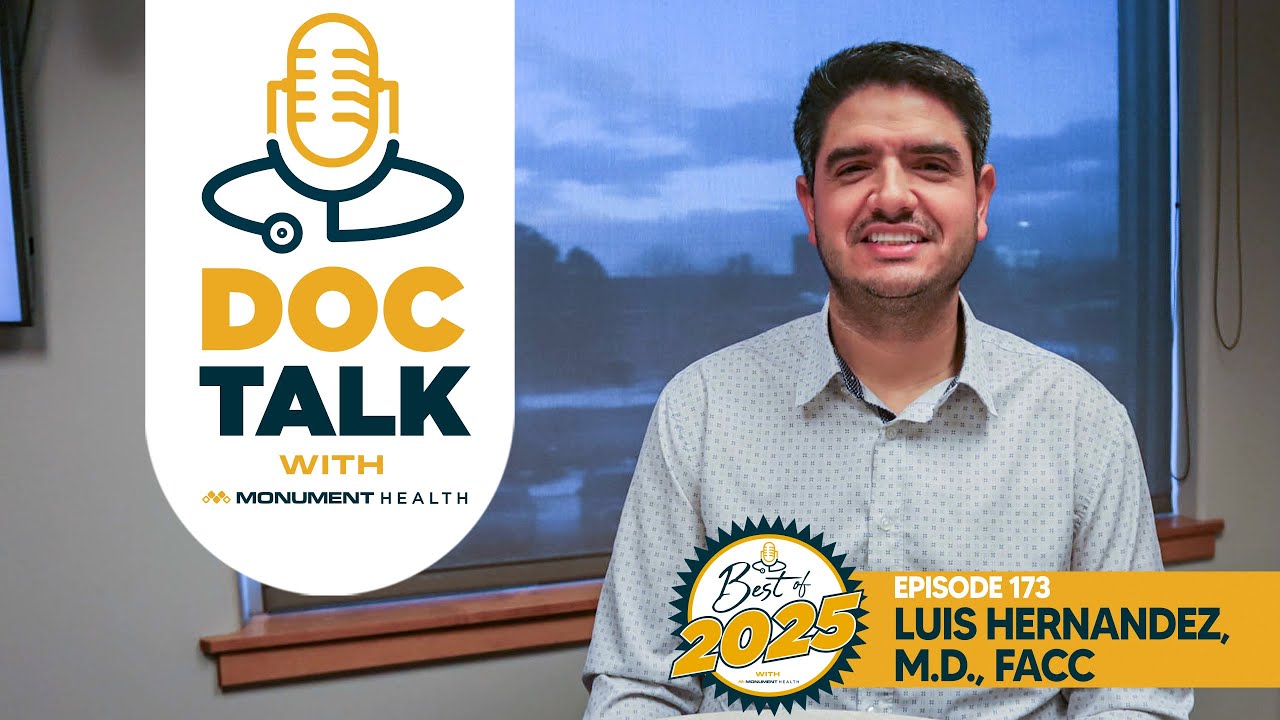
This week, we’re revisiting Episode 137, “Advancements in Heart Failure Devices and Treatment,” with Dr. Luis Hernandez.
Dr. Hernandez, a fellowship-trained cardiologist and medical director of the Advanced Heart Failure Program at Monument Health’s Heart and Vascular Institute, gives insight into how devices like defibrillators, pacemakers, and pulmonary pressure sensors manage heart health and help prevent hospital readmissions. He also outlines the importance of medication and patient monitoring in improving heart failure outcomes.
Dr. Hernandez brings plenty of visual aids in this episode, so be sure to check out the video version on YouTube.
Hello again, everyone, and welcome to another edition of Doc Talk with Monument Health. My name is Mark Houston, and heart failure doesn’t mean your heart has stopped. It means it needs help to keep up.
And thanks to some incredible advances in medicine, that help now comes in the form of a lot of small devices that we’re going to talk about on this show.
On this episode, I’m sitting down again with Dr. Luis Hernandez, a cardiologist at the Monument Health Heart and Vascular Institute and the medical director of the Advanced Heart Failure Program, to talk about heart failure devices.
It’s interesting. When I was telling people what the podcast was going to be about, I’d say, “We’re going to talk about heart failure devices,” and the joke was always, “Why would I want a device that makes my heart fail?”
I’m sure you hear that too. When people hear those words together, it sounds scary. Can you help us understand what that really means?
And first, doctor, we’ve got some great visuals too. If you’re listening on the podcast, I encourage you to check out the video version because we’ve got some really helpful things to look at as we go.
But let’s start with understanding what heart failure actually means.
Perfect. So I think we talked about this before. Basically, what I tell people is there are two types of heart failure.
One is where the heart is weaker and isn’t pumping enough oxygenated blood to meet your body’s demands.
The other is where the heart is normal but stiff. It doesn’t relax properly, which raises pressure inside the heart and causes shortness of breath.
In reality, they’re different, but they end up feeling similar.
So today I decided to bring examples of what we have now and what’s coming in the future, because heart failure has grown so much.
And like I told you before, when I first came here two years ago, things were already advancing. Now, as a heart failure and transplant physician, there are even more options.
Not all of these are things I personally do, and I’ll explain who does what, but I want to show what’s available and how we use it.
That said, the most important thing is still to follow up with your doctor and take your medications consistently.
Now, even since the first time you were on a couple of years ago, has this changed dramatically?
Actually, not really. At least when it comes to pacemakers and defibrillators, the technology has improved, but those devices were already available.
Some of the devices I’ll talk about today were already around. We just understand them better now, so we use them more effectively.
What is newer, especially in the last three to five years, is monitoring. We now have pressure sensors that help us keep patients out of the hospital.
And it’s important to talk about who qualifies for those and when they should be used.
Okay, so let’s talk about the technology. Can you give a general overview of what exists right now for heart failure?
Sure. First, heart failure has many causes.
When it’s caused by a valve or structural issue, that’s where structural cardiology comes in. One of our specialists here is Dr. Tuma.
If your aortic valve isn’t working properly, we can replace it using what’s called a transcatheter aortic valve replacement. There are two main types on the market, and these are examples.
You can see how the original valve is replaced by this one. It looks like metal netting, but there’s tissue inside.
So when the valve is the problem, we fix the valve.
Now, something that’s newer but still not brand new is treatment for the mitral valve.
If the mitral valve is leaking significantly, we can sometimes fix it without open-heart surgery by going through the groin.
That’s where the MitraClip comes in. It’s a small clip that reduces leakage by bringing the valve leaflets closer together.
Now we can even do similar procedures on the right side of the heart.
So medicine has grown a lot.
What condition would require something like a clip?
That would be severe mitral regurgitation.
But before we ever go there, we focus on medication. At Monument Health, we prioritize quality. Patients are first optimized on medications.
If they’re still having symptoms after being on the right medications, then we consider procedures like this.
If the heart is already too enlarged, then we may need to consider more advanced options like a heart pump or transplant.
So medications can actually reverse some of the problem?
Yes. In some cases, medications can reduce heart size and allow the valve to function more normally again.
That’s pretty incredible.
It really is.
So are medications advancing faster than devices?
I’d say they go hand in hand. But if the problem is mechanical, like a valve issue, sometimes it has to be fixed mechanically.
Got it.
Now moving into devices specifically for heart failure, when the heart function drops below 35 percent, guidelines recommend a defibrillator.
A defibrillator is used to prevent sudden cardiac arrest. If a dangerous rhythm occurs, the device delivers a shock to restore normal rhythm.
These are implanted in the upper chest, usually on the left side.
There are also pacemakers and cardiac resynchronization devices, which help coordinate how the heart beats.
Some hearts beat out of sync, and these devices help bring everything back into rhythm.
And these are surprisingly small.
Yes. Some are very small, while defibrillators are larger because they require a bigger battery.
There are even devices placed differently for cosmetic reasons, depending on the patient.
So bigger doesn’t necessarily mean worse condition?
Not exactly. It usually just means a different function or a larger battery.
Now, let’s talk about one of the most interesting devices, the pulmonary pressure sensor.
This is a tiny device implanted in the lung through a catheter.
It measures pressure changes that can indicate worsening heart failure up to 30 days before symptoms appear.
That’s incredible.
It is. But again, it only works if patients are compliant. They have to take medications and use the monitoring system daily.
It’s not just about placing the device. It requires follow-up and teamwork.
So it’s almost like having a daily check-in with your heart.
Exactly.
And the goal is always to keep patients out of the hospital. Hospital stays can lead to muscle loss, decreased mobility, and more complications.
Being at home, staying active, and managing the condition is always the goal.
Can people still live normal, active lives with these devices?
Absolutely. I tell patients the limit is you.
If you get short of breath, stop, recover, and keep going. Even if you have to stop multiple times, that’s okay.
Movement is important. Exercise helps the heart, especially in heart failure.
Before we wrap up, what symptoms should people watch for?
If you have chest pain, that’s always concerning.
For heart failure specifically, watch for shortness of breath, swelling in your legs, rapid weight gain from fluid, or difficulty lying flat.
If you wake up gasping for air, that’s a major sign.
Those are things you shouldn’t ignore.
Dr. Luis Hernandez, cardiologist at Monument Health Heart and Vascular Institute and medical director of the Advanced Heart Failure Program, I always enjoy having you on.
Your passion really comes through, and it says a lot about the care available here.
Thank you.
I always tell people, you’re fortunate to have this level of care here. I trained at Cleveland Clinic, and I’m here because I believe in what we’re doing.
Well, I hope you’re the last guest we ever have, because you were the first.
Deal.